
Buying a 60V electric scooter battery charger sounds simple. If your scooter has a 60V battery, you may expect to buy a charger marked 60V and connect it.
In reality, it is not that simple.
A battery sold as a 60V electric scooter battery may need a charger with an output of:
- 67.2V
- 71.4V
- 73V
- or, in some less common designs, another voltage altogether.
The correct charger voltage depends mainly on the battery chemistry and the number of cell groups connected in series.
For example:
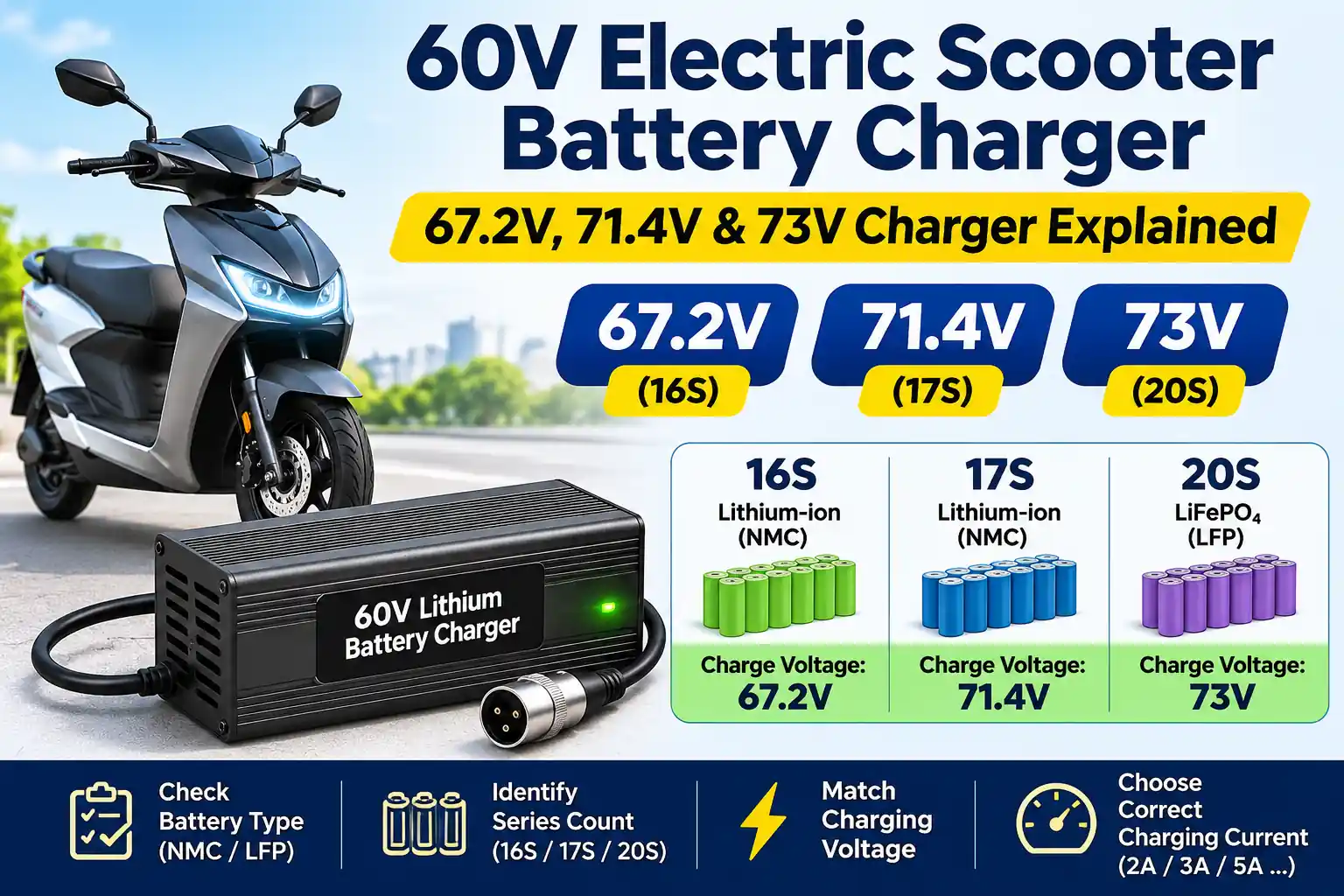
- A 16S lithium-ion/NMC battery normally charges to 67.2V
- A 17S lithium-ion/NMC battery normally charges to 71.4V
- A 20S LiFePO₄ battery normally charges to around 73V
So two electric scooters may both be advertised as having a 60V lithium battery, yet their chargers may not be interchangeable.
This guide explains how a 60V scooter charger works, why different charging voltages exist, how to identify the correct replacement charger, what charger current means, and which specifications must be checked before connecting a new charger.
Quick Answer: Which Charger Does a 60V Electric Scooter Battery Need?
For a complete overview of electric scooter charging, including charger voltage, current, battery chemistry, connectors and compatibility, read Electric Scooter Battery Charger Guide. It explains how to choose the correct charger for 48V, 60V and 72V lithium batteries and helps avoid common charger-selection mistakes.
The table below covers the most common 60V-class battery configurations.
| Battery Type | Series Configuration | Approx. Nominal Voltage | Full-Charge Voltage | Typical Charger |
|---|---|---|---|---|
| Lithium-ion / NMC | 16S | 57.6–59.2V | 67.2V | 67.2V lithium charger |
| Lithium-ion / NMC | 17S | 61.2–62.9V | 71.4V | 71.4V lithium charger |
| LiFePO₄ / LFP | 20S | 64V | 73V | 73V LiFePO₄ charger |
| Lead-acid | 5 × 12V | Approx. 60V | Approx. 72–73.5V | Dedicated lead-acid charger |
These voltages come from the maximum charging voltage of each cell chemistry multiplied by the number of cell groups connected in series. Charger manufacturers also list 67.2V and 71.4V for 60V-class lithium-ion batteries and approximately 73V for 60V-class LiFePO₄ systems.
Important: Never select a replacement charger only because both the battery and charger have the words “60V” printed on them.
Why Does a 60V Battery Need More Than 60V to Charge?
One of the most common questions is:
Why does my 60V scooter use a 67.2V charger?
The reason is the difference between:
- Nominal battery voltage
- Fully charged battery voltage
The voltage written on an electric scooter battery is usually its nominal or system voltage, not its maximum charging voltage.
A lithium-ion cell commonly has a nominal voltage of approximately 3.6V to 3.7V, but it may reach approximately 4.2V when fully charged.
So if 16 cell groups are connected in series:
16 × 3.7V = 59.2V nominal
This is commonly marketed as a:
60V battery
But at full charge:
16 × 4.2V = 67.2V
Therefore, that battery requires a charger designed to terminate at approximately 67.2V.
This is why a charger labelled 67.2V is commonly the correct charger for a conventional 16S 60V lithium-ion scooter battery.
What Does “S” Mean in a Lithium Battery?
When discussing lithium batteries, you will often see terms such as:
- 16S
- 17S
- 20S
The letter S means Series.
For example:
16S battery
There are 16 cell groups connected in series.
17S battery
There are 17 cell groups connected in series.
20S battery
There are 20 cell groups connected in series.
Connecting cells in series increases the battery voltage.
Cells may also be connected in parallel to increase capacity.
For example:
16S10P
means:
- 16 groups in series
- 10 cells connected in parallel in each group
The S number determines the battery voltage, while the parallel configuration mainly affects capacity and current capability.
67.2V Charger for 60V Electric Scooter Battery
A 67.2V electric scooter charger is one of the most common charger types used with 60V lithium-ion electric scooters.
It is normally intended for a:
16S lithium-ion battery
The calculation is:
16 × 4.2V = 67.2V
The approximate nominal battery voltage is:
16 × 3.7V = 59.2V
which manufacturers commonly market as:
60V
Therefore:
60V 16S lithium-ion battery = 67.2V full-charge voltage
A 67.2V charger should only be used where the battery specification confirms this charging voltage.
Common Search Names for a 67.2V Charger
The same charger may be advertised online using several different names:
- 60V electric scooter charger
- 67.2V lithium battery charger
- 60V lithium-ion charger
- 16S battery charger
- 60V e-scooter charger
- 60V electric scooty charger
- 67.2V EV battery charger
- 60V 2A lithium charger
- 60V 3A charger
- 67.2V 3A charger
- 67.2V 5A charger
- 67.2V 6A charger
These names may describe similar products, but the charger should still be matched to the actual battery specification.
A connector that physically fits the scooter does not prove electrical compatibility.
71.4V Charger for a 60V Electric Scooter
Another common configuration is a 17S lithium-ion battery.
In this configuration:
17 × 4.2V = 71.4V
Its nominal voltage is approximately:
17 × 3.7V = 62.9V
or approximately 61.2V if 3.6V nominal cells are used for the calculation.
Despite this, many manufacturers and sellers still place these batteries in the general 60V battery category.
That is why some electric scooters described as “60V” require a:
71.4V charger
rather than a 67.2V charger.
Published electric-mobility voltage references also show 67.2V and 71.4V as common full-charge voltages for 60V-class lithium systems.
Can I Use a 67.2V Charger Instead of a 71.4V Charger?
Normally, no.
A battery designed to charge to 71.4V will not normally reach its intended full-charge voltage when charged using a 67.2V charger.
The charger may stop charging before the battery reaches full capacity.
For a 17S lithium-ion battery:
Required maximum:
17 × 4.2V = 71.4V
Using only 67.2V means the average cell-group voltage could reach only around:
67.2 ÷ 17 = 3.95V per cell group
The battery may therefore remain partially charged.
It may appear to work, but that does not make it the correct charger.
Can I Use a 71.4V Charger on a 67.2V Battery?
This is much more serious.
A normal 16S lithium-ion battery is designed around a maximum of approximately:
67.2V
Connecting a charger designed to regulate at:
71.4V
can attempt to push the battery above its intended full-charge voltage.
A properly functioning BMS may disconnect charging before dangerous cell voltages are reached, but the BMS must never be treated as permission to use the wrong charger.
The charger itself must be correctly matched to the battery.
What Is a 73V Charger Used For?
A 73V charger is commonly associated with a 20S LiFePO₄ battery.
LiFePO₄ is also called:
- LFP
- Lithium iron phosphate
- LiFePO4 battery
A typical LiFePO₄ cell has:
- Nominal voltage: approximately 3.2V
- Maximum charging voltage: approximately 3.65V
For a 20S battery:
Nominal voltage:
20 × 3.2V = 64V
Maximum charge voltage:
20 × 3.65V = 73V
Therefore:
20S LiFePO₄ battery = approximately 64V nominal and 73V fully charged
Such batteries may sometimes be grouped commercially with 60V-class electric scooter batteries, which is one reason buyers encounter 73V chargers while searching for a 60V scooter battery charger. Charger reference tables likewise specify approximately 73V for 20S LiFePO₄.
Is a 73V Charger the Same as a 71.4V Charger?
No.
Although the difference looks small:
73V – 71.4V = only 1.6V
the chargers are intended for different battery configurations.
A typical:
71.4V charger
is associated with:
17S lithium-ion / NMC
while a:
73V charger
may be associated with:
20S LiFePO₄
The two batteries use different:
- Cell chemistry
- Series count
- Charging limits
- BMS settings
- Charging behaviour
Therefore, charger selection cannot be based simply on whichever voltage appears closest.
67.2V vs 71.4V vs 73V Charger
Here is the most important comparison.
| Charger | Typical Battery | Series Count | Typical Cell Maximum | Full Battery Voltage |
|---|---|---|---|---|
| 67.2V | Lithium-ion / NMC | 16S | 4.2V | 67.2V |
| 71.4V | Lithium-ion / NMC | 17S | 4.2V | 71.4V |
| 73V | LiFePO₄ | 20S | 3.65V | 73V |
This table explains why simply saying:
“I need a 60V charger”
is not enough information.
A better request is:
“I have a 16S NMC battery requiring a 67.2V charger, and I need a 3A charger with this connector and pin polarity.”
That gives the seller enough information to identify the correct product.
NMC vs LiFePO₄ Charger – What Is the Difference?
Battery chemistry is one of the most important charger specifications.
Two packs with similar overall voltage may use completely different cell chemistry.
NMC / Lithium-Ion
A conventional NMC lithium-ion cell may charge to approximately:
4.2V per cell
Common examples include:
- 16S → 67.2V
- 17S → 71.4V
- 20S → 84V
LiFePO₄
A conventional LiFePO₄ cell may charge to approximately:
3.65V per cell
Examples include:
- 16S → 58.4V
- 20S → 73V
- 24S → 87.6V
Therefore:
Never choose a charger from nominal voltage alone.
First identify:
- Battery chemistry
- Series count
- Maximum charging voltage
What Is CC/CV Charging?
Most lithium battery chargers use a charging method known as:
CC/CV
which means:
Constant Current / Constant Voltage
During the first part of charging, the charger provides approximately constant current.
For example:
3A
As battery voltage increases and approaches the charger’s maximum output voltage, the charger changes into the constant-voltage stage.
The voltage is held close to the target while charging current gradually decreases.
For example, a 67.2V charger may operate approximately like this:
Constant-current stage → battery approaches 67.2V → constant-voltage stage → current reduces → charging terminates
Commercial 67.2V chargers for 16S lithium packs are commonly specified as CC/CV chargers.
What Does Charger Current Mean?
After voltage and chemistry are confirmed, the next important specification is:
Charging current
Common scooter chargers include:
- 2A
- 3A
- 4A
- 5A
- 6A
- 8A
- 10A
A higher charger current can reduce charging time, but only if the battery is designed to accept it.
60V 2A vs 3A vs 5A Charger
Suppose you have a 30Ah battery.
Ignoring the final CV stage and charging losses for a moment:
Using a 2A charger
30Ah ÷ 2A = 15 hours
Using a 3A charger
30Ah ÷ 3A = 10 hours
Using a 5A charger
30Ah ÷ 5A = 6 hours
Actual charging usually takes longer because charging current reduces near full charge, and other losses and control limits are involved.
A charger manufacturer similarly notes that capacity divided by current is useful only as an approximate comparison because the charging process slows near full charge.
Can I Replace a 3A Charger with a 5A Charger?
Not automatically.
Before increasing charging current, check the maximum charging current supported by:
- Battery cells
- BMS
- Charging connector
- Charge wiring
- Fuse
- Battery temperature limits
- Manufacturer specification
For example, if the original battery is designed for only 3A charging, replacing it with a 6A charger may create unnecessary heating or overload part of the charging path.
Voltage matching alone is not enough.
Does Battery Capacity Change Charger Voltage?
No.
A common misunderstanding is that a larger Ah battery requires a higher voltage charger.
For example:
- 60V 20Ah battery
- 60V 30Ah battery
- 60V 40Ah battery
may all use exactly the same 67.2V charger if they are all 16S lithium-ion batteries.
Capacity mainly changes:
- Stored energy
- Charging time
- Suitable charging current
It does not automatically change the required maximum charging voltage.
Example: 60V 32Ah Battery Charger
Suppose a scooter uses:
60V 32Ah 16S NMC battery
Its charger voltage would typically be:
67.2V
If the recommended charging current is 4A:
Ideal bulk-charge estimate:
32Ah ÷ 4A = 8 hours
Actual complete charging time may be longer due to the CV stage and losses.
Example: 60V 40Ah Battery Charger
If the battery is:
16S NMC 60V 40Ah
the charging voltage remains:
67.2V
If a 5A charger is permitted:
40Ah ÷ 5A ≈ 8 hours
Again, current selection must be approved for the battery.
How to Identify the Correct Electric Scooter Charger
Before buying a replacement 60V electric scooter battery charger, check the following specifications.
1. Check the Old Charger Label
Look for:
OUTPUT
Example:
OUTPUT: 67.2V DC 3A
This is much more useful than the AC input specification.
The input may say something like:
INPUT: 100–240V AC, 50/60Hz
That describes the mains supply.
The OUTPUT specification tells you what is being sent to the battery.
2. Check the Battery Label
Look for information such as:
- 60V 32Ah
- Li-ion
- NMC
- LiFePO₄
- 16S
- 17S
- 20S
- Charging voltage
- Maximum charging current
If the label specifies:
Charging voltage: 67.2V
then use that specification rather than guessing from the nominal voltage.
3. Confirm Battery Chemistry
Determine whether the battery is:
- NMC
- Generic Li-ion
- LiFePO₄ / LFP
- Lead-acid
Do not assume every lithium battery has the same charging voltage.
4. Confirm Series Count
If known, determine whether the battery is:
- 16S
- 17S
- 20S
The series count is one of the best ways to confirm the required charging voltage.
5. Check Charging Current
Confirm whether the battery supports:
- 2A
- 3A
- 5A
- 6A
- or another charging current
Do not automatically select the highest available current.
Electric Scooter Charger Connector Types
Even after electrical specifications match, the connector must also be correct.
Common electric scooter charger connectors include:
- GX16 aviation connector
- GX16-3 connector
- XLR connector
- Anderson connector
- DC barrel connector
- XT60
- XT90
- Proprietary scooter connectors
- 2-pin charging connectors
- 3-pin charging connectors
Some scooters may also use communication or enable pins.
Same Connector Does Not Mean Same Charger
This is extremely important.
Two chargers may both have a:
GX16-3 connector
but still have different:
- Voltage
- Current
- Pin assignment
- Positive pin
- Negative pin
- Communication pin
Therefore, never connect a charger simply because the plug physically fits.
The CPSC has specifically warned that so-called universal micromobility chargers can physically connect yet still be incompatible with the battery, creating a fire risk.
Check Charger Polarity Before Connecting
For a replacement charger, verify:
- Positive terminal
- Negative terminal
- Connector pin number
- Connector orientation
For example, a three-pin connector might use:
- Pin 1: Positive
- Pin 2: Negative
- Pin 3: unused
while another manufacturer may wire the same connector differently.
Connecting reverse polarity can damage:
- Charger
- Battery BMS
- Charge-port circuitry
- Fuse
- Battery wiring
Always confirm with the original wiring diagram or a qualified technician.
What Does the BMS Do During Charging?
The Battery Management System, or BMS, monitors the battery pack.
Depending on its design, it may provide protection against conditions such as:
- Cell overvoltage
- Cell undervoltage
- Excess charging current
- Excess discharge current
- Short circuit
- High temperature
- Low temperature
- Cell imbalance
However:
The BMS should never be treated as a substitute for the correct charger.
The charger should already be designed for the correct:
- Battery chemistry
- Series count
- Charging voltage
- Charging current
The BMS provides another layer of protection.
It is not intended to continuously correct a badly mismatched charger.
Why Does My Scooter Stop Charging Before the Charger Turns Green?
Several reasons are possible:
1. BMS protection
One cell group may reach its overvoltage limit before the rest of the pack.
2. Cell imbalance
If one series group is higher than the others, the BMS may stop charging.
3. Charger problem
The charger may not be reaching the correct output voltage.
4. Battery deterioration
An old or damaged cell group may rise in voltage faster than healthy groups.
5. Connector resistance
A damaged or loose charging connector can cause voltage drop or intermittent charging.
Why Does My Charger Turn Green Immediately?
A charger that becomes green immediately after connection may indicate:
- Battery already fully charged
- Charger not detecting battery
- Charge-port wiring fault
- BMS charge MOSFET turned off
- Broken connector
- Internal charger fault
- Blown battery fuse
- Battery protection state
The charger should not automatically be replaced until the battery voltage and charging path are checked.
Why Does a 60V Charger Become Hot?
Some warmth during charging may be normal because the charger converts AC mains power into regulated DC power.
Heat increases with:
- Higher charging current
- Poor ventilation
- High ambient temperature
- Low charger efficiency
- Continuous operation
The charger should not be:
- Covered with cloth
- Placed on a bed
- Kept beside flammable material
- Used where ventilation is blocked
If the charger becomes abnormally hot, smells burnt, makes unusual noises or shows signs of damage, stop using it.
Charger Power: What Do Watts Mean?
Charger output power can be estimated using:
Power = Voltage × Current
For example:
67.2V 3A charger
67.2 × 3 = 201.6W
67.2V 5A charger
67.2 × 5 = 336W
71.4V 3A charger
71.4 × 3 = 214.2W
73V 5A charger
73 × 5 = 365W
Higher wattage usually means the charger can provide more charging current at the required voltage.
It does not mean that a more powerful charger is automatically suitable for every battery.
Can I Use a Universal Electric Scooter Charger?
Be very careful with products marketed as:
- Universal scooter charger
- Universal e-bike charger
- Universal lithium charger
- Multi-voltage scooter charger
A connector adaptor does not make a charger electrically compatible.
The U.S. Consumer Product Safety Commission has warned consumers against using universal micromobility chargers unless compatibility with the specific device has been established. The agency reported numerous fire and thermal incidents involving incompatible universal chargers.
For a replacement charger, confirm the exact electrical specification of your battery.
Can I Charge a 60V Lithium Battery with a 60V Lead-Acid Charger?
Do not assume you can.
Although both systems may be described as “60V,” their charging characteristics can be different.
A lead-acid charger may use:
- Different charging stages
- Different termination behaviour
- Float charging
- Different maximum voltage
Lithium batteries normally require charging appropriate to their chemistry and BMS design.
A charger specification table, for example, lists different full-charge targets for 60V lithium, LiFePO₄ and lead-acid systems, even though all fall into the same nominal 60V category.
Is 73V LiFePO₄ Charger the Same as 73.5V Lead-Acid Charger?
No.
A small voltage difference does not make two chargers interchangeable.
A 20S LiFePO₄ battery may require around:
73V
while some 60V lead-acid chargers may reach around:
73.5V
But the charging algorithm and battery behaviour are different.
Always select the charger for the correct battery chemistry.
What Happens If Charger Voltage Is Too Low?
If charger voltage is lower than required:
- Battery may not fully charge
- Available range may decrease
- Battery indicator may never show full
- Cell balancing may not occur correctly on some BMS designs
- Charger may terminate early
For example, a 67.2V charger on a battery designed for 71.4V will generally leave the battery undercharged.
What Happens If Charger Voltage Is Too High?
This is more dangerous.
A charger voltage above the battery’s specified charging limit may cause:
- Cell overvoltage
- BMS shutdown
- Excessive heat
- Battery damage
- Reduced battery life
- In extreme cases, thermal failure or fire
Never intentionally use a higher-voltage charger to make a battery charge faster.
Voltage does not control charging speed in that way.
Charging current is the main specification related to charging rate.
Should I Charge the Battery to 100% Every Time?
For normal users, follow the scooter or battery manufacturer’s charging instructions.
Some advanced battery systems intentionally use a charging voltage slightly below the theoretical maximum cell voltage to improve cycle life.
For example, a manufacturer may configure a pack so that cells are not charged all the way to their absolute chemistry limit.
Therefore, calculations such as:
16 × 4.2V = 67.2V
are useful for understanding the battery architecture, but the manufacturer’s specified charger voltage always takes priority.
How to Buy the Correct 60V Replacement Scooter Charger
Before ordering a replacement charger, provide the seller with:
- Photo of the battery label
- Photo of the original charger label
- Battery chemistry
- Battery voltage
- Battery capacity in Ah
- Required charging voltage
- Original charging current
- Photo of charger connector
- Number of connector pins
- Connector dimensions
- Pin polarity
- Scooter make and model if known
This is much safer than asking only for:
“60V electric scooter charger.”
60V Electric Scooter Charger Selection Checklist
Before connecting a charger, confirm all these points:
| Specification | Must Be Checked? |
|---|---|
| Battery nominal voltage | ✅ |
| Battery chemistry | ✅ |
| Number of series groups | ✅ |
| Maximum charging voltage | ✅ |
| Charger output voltage | ✅ |
| Charger current | ✅ |
| Connector type | ✅ |
| Number of connector pins | ✅ |
| Pin polarity | ✅ |
| BMS charging limit | ✅ |
| Manufacturer recommendation | ✅ |
If even one critical specification is unknown, verify it before charging.
67.2V, 71.4V and 73V Charger – Easy Way to Remember
A simple reference is:
16S NMC
4.2V × 16 = 67.2V
➡ 67.2V charger
17S NMC
4.2V × 17 = 71.4V
➡ 71.4V charger
20S LiFePO₄
3.65V × 20 = 73V
➡ 73V charger
This is one of the easiest ways to understand why several different chargers are sold for scooters described as 60V.
Common Mistakes While Buying a 60V Scooter Charger
Avoid these common mistakes:
Buying only by nominal voltage
“60V” alone is not enough.
Assuming all lithium batteries are NMC
Some scooters use LiFePO₄.
Ignoring the series count
16S and 17S NMC batteries require different charging voltages.
Looking only at the connector
A matching plug does not guarantee compatible voltage or polarity.
Buying the highest-current charger available
The battery and BMS must support that charging current.
Depending entirely on the BMS
The BMS is protection, not a replacement for a correctly specified charger.
Assuming 71.4V and 73V are close enough
They may belong to completely different battery chemistries.
Electric Scooter Charging Safety
Lithium batteries store a significant amount of energy, so charging should be treated carefully.
Good charging practice includes:
- Use a charger approved for the battery
- Charge in a ventilated area
- Keep the charger on a firm, non-flammable surface
- Do not cover the charger
- Avoid charging beside flammable material
- Do not use damaged cables or connectors
- Do not charge a visibly swollen or damaged battery
- Stop using a charger that smells burnt or behaves abnormally
- Follow the manufacturer’s charging instructions
- Disconnect once charging is complete when instructed by the manufacturer
- Avoid unattended overnight charging
CPSC advises users to remain present during charging, follow the manufacturer’s instructions and use the supplied or specifically approved replacement charger.
Frequently Asked Questions About 60V Electric Scooter Chargers
1. What voltage charger is required for a 60V lithium battery?
It depends on the battery configuration. A 16S NMC battery normally uses 67.2V, while a 17S NMC battery normally uses 71.4V. A 20S LiFePO₄ battery may use approximately 73V.
2. Why is my 60V scooter charger 67.2V?
Because a conventional 60V-class lithium-ion battery may contain 16 cell groups in series. Each group charges to approximately 4.2V:
16 × 4.2V = 67.2V
3. What battery uses a 71.4V charger?
A 17S lithium-ion or NMC battery commonly uses a maximum charging voltage of:
17 × 4.2V = 71.4V
4. What battery uses a 73V charger?
A 20S LiFePO₄ battery commonly charges to approximately:
20 × 3.65V = 73V
5. Can I use a 67.2V charger for a 71.4V battery?
It is not the correct charger. The battery would normally remain undercharged because the charger cannot reach the battery’s intended full-charge voltage.
6. Can I use a 71.4V charger instead of a 67.2V charger?
No. A 71.4V charger can exceed the normal charging voltage of a conventional 16S lithium-ion battery. Use the charger specified for the battery.
7. Is a 73V charger suitable for a 60V lithium-ion battery?
Only when the battery is specifically designed for that charging voltage, such as certain 20S LiFePO₄ systems. Do not use a 73V charger on a conventional 16S 67.2V NMC pack.
8. Can I use a 5A charger instead of a 3A charger?
Only if the battery cells, BMS, connector, wiring and manufacturer specification permit 5A charging.
9. Does a higher-amp charger damage an electric scooter battery?
It can if the current exceeds the battery’s permitted charging rate. Higher current also increases thermal stress on the charger, connector and battery charging path.
10. How do I know whether my scooter battery is 16S or 17S?
Check:
- Battery label
- BMS specification
- Original charger output voltage
- Battery documentation
- Manufacturer information
A 67.2V original charger strongly suggests a conventional 16S 4.2V-per-cell lithium system, while 71.4V commonly indicates 17S.
11. Can the same charger be used for NMC and LiFePO₄ batteries?
Not unless the charger has specifically been designed and approved for both configurations. NMC and LiFePO₄ cells use different maximum cell voltages and charging requirements.
12. Does battery Ah decide charger voltage?
No. Ah represents battery capacity. The charger voltage is determined mainly by battery chemistry and series count.
13. Is a 60V 3A charger faster than a 60V 2A charger?
Yes, if both are otherwise compatible and the battery supports 3A charging. A higher charging current normally reduces charging time.
14. Can I use a charger with the same connector but different voltage?
No. A matching connector does not prove electrical compatibility. Voltage, current, polarity, chemistry and pin configuration must also match.
15. Which is the safest replacement charger for an electric scooter?
The safest choice is the charger specified by the battery or scooter manufacturer, with the correct output voltage, charging current, chemistry, connector and polarity.
Final Summary
The term 60V electric scooter battery charger does not describe one universal charger.
A 60V-class scooter battery could require:
67.2V → 16S NMC / lithium-ion
71.4V → 17S NMC / lithium-ion
73V → 20S LiFePO₄
The correct charger depends on the actual battery design.
Before purchasing a electric scooter charger, always confirm:
Battery chemistry + series count + charging voltage + charging current + connector + pin polarity.
Do not assume two chargers are interchangeable just because both are advertised for a 60V electric scooter.
Understanding these specifications helps you choose the correct 60V lithium battery charger, avoid incomplete charging, protect the BMS and battery cells, and reduce the risk created by using an incompatible charger.