

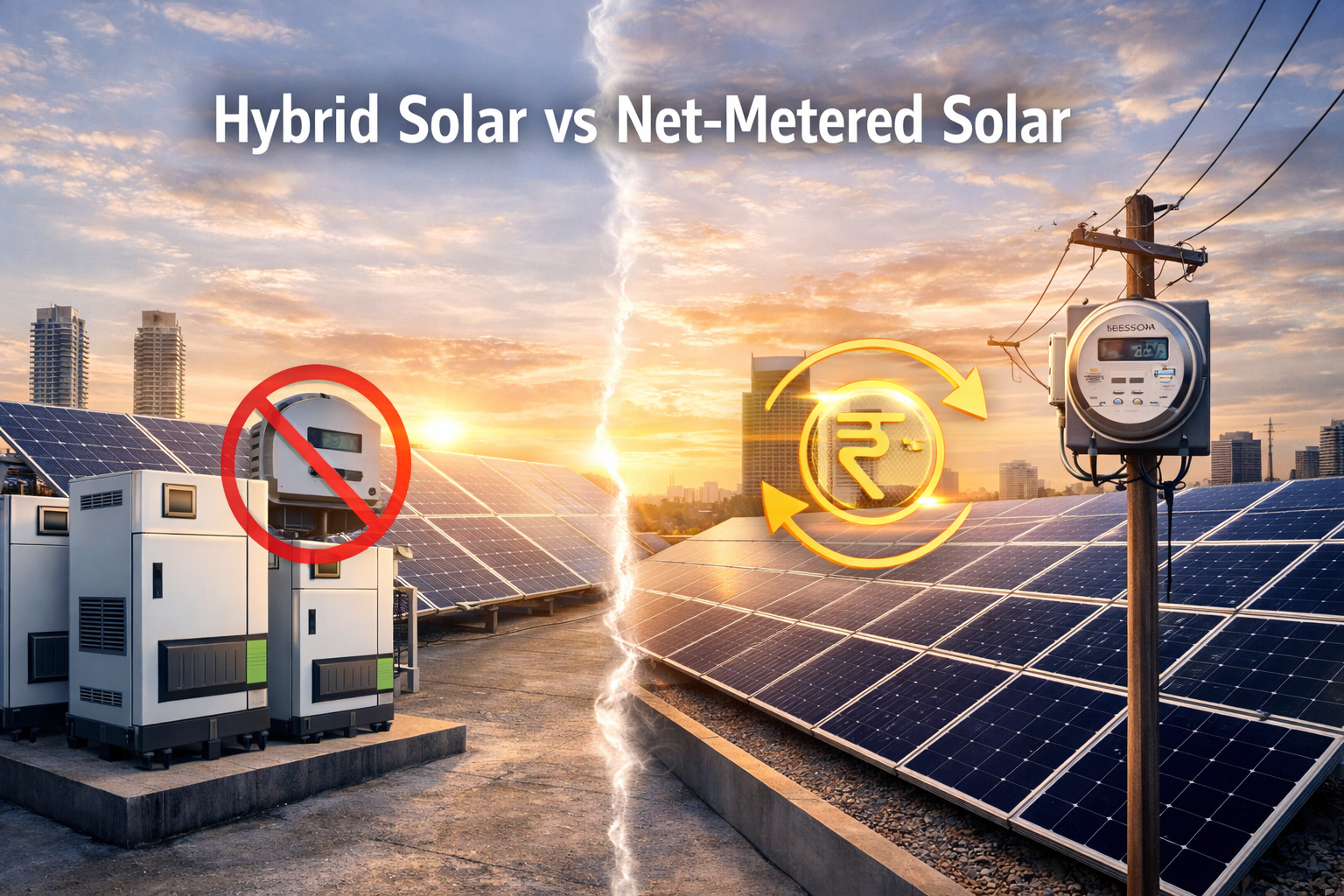
Zero-Export Hybrid Solar vs Net-Metered Solar in Bangalore: The Practical Business Guide (Pros, Cons & ROI)
For many Bangalore businesses, the “best” solar choice is not only about payback. It’s also about approval delays, billing uncertainty, and power continuity. Two common options stand out: (1) grid-tied solar with net metering, and (2) hybrid solar configured for zero export (captive consumption, no grid feed-in).
For most Bangalore businesses, net-metered solar usually delivers the highest financial return because excess electricity exported to the grid becomes energy credits. However, hybrid zero-export solar can be a better choice when approval delays, power reliability, or operational continuity are bigger priorities than maximum ROI.
If you want a deeper understanding of how these systems are actually installed, how pricing works, and what factors affect performance, you can also explore our complete guide on solar panel installation in Bangalore. This will help you make a more informed decision before choosing the right solar model for your business.
This blog breaks down how each system works, what you gain, what you trade off, and how to pick the right model for your business in Bengaluru.
1) What “Zero-Export Hybrid Solar” Actually Means
A hybrid solar inverter can manage power from solar panels, batteries, and the grid. In a zero-export setup, a limiter (often called a Zero Export Device or sensor-based limiter) continuously measures your building load. If solar production is higher than your internal consumption, the system reduces inverter output so that no power flows back into the grid.
You stay connected to the grid for backup (nighttime and peak loads), but because export is blocked, your existing meter typically remains unidirectional and you avoid export-credit billing dependence.
2) Why Many Bangalore Businesses Consider Bypassing Net Metering
In Bangalore, businesses often complain about long approval cycles, bi-directional meter delays, and confusing billing outcomes after net-meter adoption. A zero-export hybrid approach is used by some establishments to start consuming solar immediately—without waiting months for meter changes and approvals.
That said, a grid-interactive system still has safety responsibilities (especially anti-islanding compliance), and in practice it can fall into a “grey zone” if installation is hidden or not properly documented.
3) Quick Comparison Table: What You Get vs What You Give Up
| Area | Net-Metered Grid-Tied Solar | Zero-Export Hybrid Solar |
|---|---|---|
| Primary benefit | Best financial return due to export credits | Immediate self-consumption; avoids export-billing dependence |
| Approvals & meter | Usually needs net-meter process + bi-directional meter | Can operate without export; limiter prevents feed-in |
| Excess solar | Exported to grid as credits (subject to billing) | Curtailed/wasted when load is low and batteries are full |
| Backup during outages | No (typically shuts down during grid outage) | Yes, if battery-based hybrid is used |
| Long-term care | Lower maintenance complexity | Battery replacement cycle can affect ROI |
4) Cost & ROI: What Bangalore Businesses Commonly See
If you are comparing options strictly on investment return, net-metered grid-tied solar usually ranks highest. Hybrid systems become more attractive when reliability, independence, and “approval pain avoidance” matter more than the fastest payback.
| System Type (Commercial Example) | Approx Cost (100 kW) | Typical Payback | Net Metering Needed | Backup |
|---|---|---|---|---|
| Grid-tied (net-metered) | ₹60–80 lakh | 6–8 years | Yes | No |
| Hybrid (no battery) | ₹65–85 lakh | 7–9 years | No | No |
| Hybrid + battery (zero-export capable) | ₹80 lakh+ | 8–10 years | No | Yes |
In addition, some analyses note that moving to a hybrid + battery setup can raise initial investment significantly (often described as an increase of 40% to 60% in upfront cost compared to simpler setups), so it’s best treated as a resilience decision, not only an electricity-saving decision.
5) When Zero-Export Hybrid Solar Makes the Most Sense
Hybrid becomes strategically valuable when your business cannot tolerate downtime or when you want to reduce dependency on grid processes. It is especially relevant for operations that treat power stability as a business requirement.
- IT parks, offices, and campuses that want continuity and predictable energy behavior
- Hospitals, clinics, labs, and facilities where outages damage services or equipment
- Sites facing long net-meter approval timelines or metering delays
- Businesses positioning themselves as energy-independent (brand + operations)
- Locations where grid export is limited or discouraged in practice
6) When Net-Metered Solar Is Usually the Better Choice
If your goal is the highest return on investment and your business can manage the approval process, net-metered grid-tied solar typically remains the most financially efficient option for Bangalore commercial buildings.
| Decision Lens | Best Fit |
|---|---|
| Max savings + fastest payback | Net-metered grid-tied |
| Avoid export billing dependency and start using solar quickly | Zero-export hybrid |
| Backup power is a must-have | Hybrid + battery |
| Lowest maintenance complexity | Grid-tied (net-metered) |
7) The Important Compliance Reality (Read This Before Installing)
Even when you do not export, a grid-connected solar system should still meet essential grid safety requirements (especially anti-islanding behavior). This is not just paperwork—anti-islanding protects utility workers and prevents dangerous backfeed during outages.
In practice, some small commercial setups run zero-export as “behind-the-meter” solar usage. However, if officials notice solar panels or detect unusual meter behavior, you may be asked for inspection or certification. This is why professional design and correct limiter configuration matter.
8) Final Takeaway: A Simple Decision Statement
For most Bangalore businesses, net-metered solar is still the strongest financial option. But zero-export hybrid solar becomes the better answer when you prioritize resilience, fast deployment, and reduced dependency on export-credit billing. Think of hybrid as an operations decision—ROI matters, but reliability can matter more.
FAQ (Short)
1) Will a zero-export hybrid system completely eliminate BESCOM interaction?
It can reduce dependency on export-related metering and billing, but grid safety requirements still matter. A grid-connected system should be designed to meet anti-islanding and safety expectations, and in some situations you may still be asked for inspection or compliance documentation.
2) If hybrid costs more, why do businesses still choose it?
Because hybrid (especially with batteries) is often chosen for continuity and predictability, not purely for electricity-unit savings. For sites where downtime is expensive, resilience can justify a longer payback.
3) Which solar system is better for Bangalore businesses?
Net-metered grid-tied solar is usually best for maximum savings, while hybrid solar systems are preferred when businesses need backup power, faster installation, or want to avoid delays related to net-meter approvals.
If your organization in Bangalore is weighing the choice between net-metered solar and hybrid zero-export systems, it helps to evaluate the decision based on your actual electricity usage, reliability needs, and long-term cost outlook. PowerKart a Bangalore based solar company works with commercial facilities to study these factors and recommend solar configurations that align with both operational requirements and financial goals, helping businesses adopt solar with greater clarity and confidence.
Explore more about commercial rooftop solar solutions in Bangalore with PowerKart.