

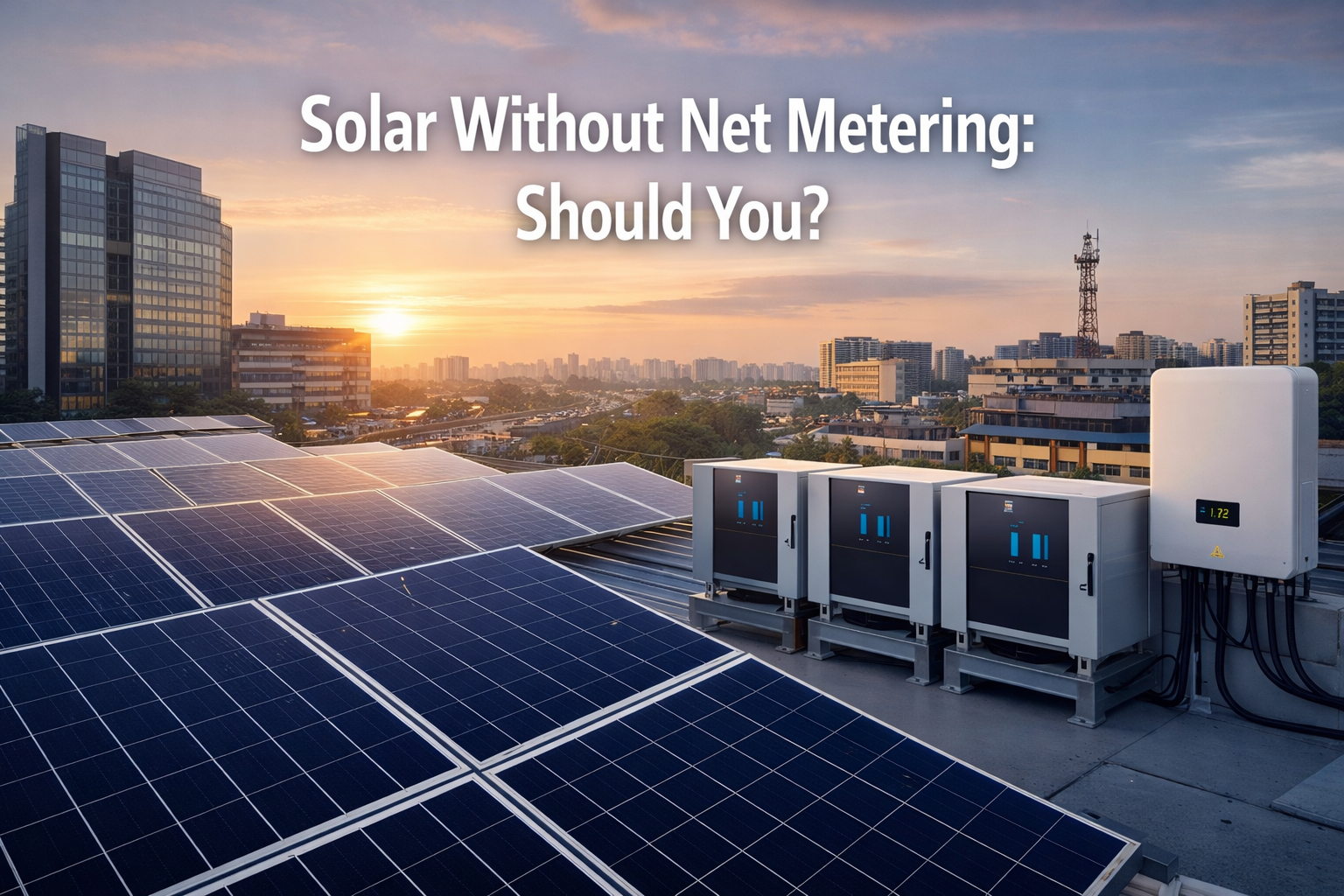
Rooftop Solar Without Net Metering in Bangalore: Hybrid, Zero-Export & Financing Guide
Short form for hero image (max 8 words): Solar Without Net Metering Bangalore
Solar Without Net Metering in Bangalore: Can Your Business Install Without BESCOM Headaches?
Many businesses in Bangalore are now exploring solar without net metering as a faster alternative to traditional grid-tied systems.
If you run a business in Bangalore, you’ve probably heard the same line: “Solar is good, but net metering takes forever.” Between approval delays, waiting for a bi-directional meter, billing mismatches, and paperwork follow-ups, many commercial rooftops remain unused—even when the solar opportunity is excellent.
A practical alternative more businesses are choosing is to install solar for self-consumption without exporting power to the grid. That means no export, less dependency on net metering, and often faster commissioning.
Before choosing the right model, it’s important to understand how solar panel installation is actually planned and executed for commercial buildings.
This guide explains what “solar without net metering” really means, which model fits your building and ROI goals, the real trade-offs (convenience vs returns), and how financing and new solar models reduce CAPEX fear.
What “Solar Without Net Metering” Actually Means
Solar without net metering means your solar plant is configured to power your building, but it does not export excess power into the BESCOM grid. This approach is commonly called:
- Zero Export Solar
- Captive Solar
- Hybrid Solar in Self-Consumption Mode
Instead of sending extra solar energy outward, the system will do one of the following: use the solar power internally to run your loads, store surplus in batteries (if installed), or automatically limit production (curtail) to avoid export.
Why Bangalore Businesses Look for This Option
For many businesses, the friction is not about Solar panels—it’s about process uncertainty. Common reasons include net-metering approvals and follow-ups taking time, bi-directional meter replacement delays, billing confusion or disputes, policy uncertainty, and pure paperwork fatigue.
The Bigger Barrier: CAPEX and Cashflow Reality
Many Bangalore businesses don’t reject solar savings—they reject capital lock-in. Typical commercial solar CAPEX benchmarks often discussed locally are ₹30,000–₹45,000 per kW, and a 100 kW system can be roughly ₹30–₹45 lakhs upfront. Even when payback is often cited around 5–6 years, it can still feel long when cashflow is tight.
Financing can also be difficult: banks may ask for collateral, strong credit history, audited financials, and clean GST returns. Interest costs can also reduce effective returns. That’s why some businesses choose no-export models for speed and certainty, and others explore subscription/PPA-style models to avoid the upfront burden.
The 3 Practical System Choices for Bangalore Businesses
1) Zero-Export Hybrid (No Battery)
Solar runs your daytime load. Any surplus is curtailed to ensure no export. During power cuts, it typically won’t behave like a backup system unless designed with storage.
2) Hybrid Solar + Battery (No Export)
Solar runs loads; surplus charges batteries; battery supports critical loads during outages (design dependent). This option gives maximum control and resilience.
3) Grid-Tied Solar + Net Metering
Solar runs loads; surplus exports to the grid; you earn credits. Often highest ROI—but requires approvals and the meter process.
Quick Comparison Table (Honest Trade-Offs)
| Factor | Solar Without Net Metering (Zero Export / Captive) | Grid-Tied Solar (Net Metering) |
|---|---|---|
| BESCOM approval dependency | Minimal (if true no export) | Mandatory |
| Installation speed | Faster commissioning | Depends on approvals + meter |
| ROI potential | Moderate (no export credit) | Often highest (export credits) |
| Battery requirement | Optional | Not required |
| Export benefit | No | Yes |
| Backup during power cut | Only with battery | No (grid-tied typically shuts down) |
Is It Legal to Run Solar Without Net Metering?
Yes. Captive self-consumption solar is allowed—as long as your system does not export power to the grid and includes proper protection and export-prevention mechanisms.
If your goal is “no BESCOM paperwork,” design for true zero-export from day one using correct inverter settings, export-limiting logic / limiter device (where applicable), and protection that prevents reverse power flow. If export occurs accidentally, it can create operational issues and disputes.
Who Should Consider Zero-Export / Captive Solar?
This model fits businesses that want control and fewer dependencies on approvals.
| Business Type | Why It Fits Self-Consumption Solar |
|---|---|
| IT parks & offices | Strong daytime load; quicker start |
| Manufacturing units | Continuous load absorbs solar well |
| Hospitals & critical facilities | Battery option adds backup resilience |
| Cold storage / labs | Uptime focus; prefers control |
| Sites facing approval complexity | Avoid export approvals + meter wait |
What You Gain vs What You Trade Off
What you gain
- Faster commissioning
- Reduced approval friction
- More predictable savings from self-consumption
- Optional backup with battery
- Less dependence on export credits and policy swings
What you trade off
- No export credit (surplus cannot earn)
- Often lower ROI versus net-metered model (in many cases)
- If batteries are included: higher upfront cost + long-term replacement planning
- Requires careful load matching and correct limiter design
Decision Guide: Which Model Fits Your Business?
| Your Situation | Recommended Direction | Why |
|---|---|---|
| You can wait and want best returns | Grid-tied solar with net metering | Full solar utilization + export credit |
| You want fast deployment for daytime savings | Zero-export hybrid (no battery) | Faster start, simpler self-consumption |
| Grid is unstable and you need backup continuity | Hybrid + battery | Better uptime + resilience |
| You want savings but can’t lock big CAPEX | Subscription / Solar-as-a-Service / PPA | Reduces capital risk and balance-sheet stress |
How to Reduce CAPEX Fear: Financing & New Solar Models
A growing trend in Bangalore’s C&I market is shifting from “buy solar” to “pay for solar outcomes.” Common approaches include green loan schemes (structured repayment), NBFC + fintech partnerships (more flexible underwriting), subscription / Solar-as-a-Service (avoid CAPEX lock-in), and group financing in industrial clusters (pooled demand, better terms).
How PowerKart / CleanPhase Evaluates the Right Model
The best system is not the most popular one—it’s the one that matches your load and goals. A proper feasibility typically reviews contract demand and tariff structure, daytime load pattern (hourly consumption), roof area and usable shadow-free space, grid reliability and outage impact, ROI priorities vs uptime priorities, and CAPEX appetite vs financing preference.
Then it recommends the best-fit path: grid-tied net metering, hybrid zero-export (no battery), or hybrid with battery.
If you’re planning solar installation for your business and want expert guidance without confusion, PowerKart – A Solar Company in Bangalore—can help you assess your site, compare system options, and recommend the most suitable solution based on your energy usage and budget.
FAQs
FAQ 1: Will I waste solar power if I do not export to the grid?
Not necessarily. A good zero-export design matches solar generation to daytime load. If load dips, you can either store in batteries (if installed) or the system can curtail production to avoid export.
FAQ 2: Is hybrid solar always expensive?
Hybrid without battery can be much closer to a normal solar budget. Hybrid + battery is the premium resilience option. The right choice depends on how much you value backup power and control versus maximum export-driven ROI.
FAQ 3: Can I install solar for my Bangalore business without net metering?
Yes—by using a captive self-consumption approach with true zero-export configuration and proper protections to prevent reverse power flow.
Final Takeaway
If your building has reliable grid supply, can wait through approvals, and wants the best ROI, net-metered grid-tied solar is often the strongest financial choice.
If your site cannot wait, wants faster commissioning, faces approval complexity, or needs resilience, zero-export or hybrid solar can be a smart move—but treat it honestly as a trade-off: you’re buying convenience or backup at the cost of peak ROI potential.
If your business in Bangalore is evaluating rooftop solar and wants to understand whether net-metered, hybrid, or zero-export solar is right, PowerKart can help you analyze your load, estimate ROI under multiple scenarios, and design a system that fits your operational reality.