
Planning to go solar installation? Discover the right system, pricing, and installation approach for reliable and cost-effective energy
Bangalore is witnessing a quiet but powerful transformation in how people think about electricity.
A few years ago, most homeowners never considered installing a solar panel system. Electricity came from the grid, bills were paid every month, and that was the end of the story. Today, that mindset is changing rapidly.
Rising electricity costs, increasing awareness about solar energy, and the need for reliable power have pushed many homeowners and businesses to explore solar panel installation in Bangalore. But even with this growing interest, there is still a lot of confusion.
People often ask:
- How does a solar panel system actually work in a home?
- What are the real solar panel prices in Bangalore?
- Is my house suitable for solar panel installation?
- Should I choose a hybrid solar inverter or a basic solar inverter?
- Do I really need a solar battery or lithium ion battery?
Many people have the same doubts when they start exploring this.
This guide is written to answer all of these in a clear, practical, and easy-to-understand way — without unnecessary jargon. By the end of this article, you will have a complete understanding of solar panel installation, whether for your home or for a larger solar panel project.
⚡ Why Solar Energy is Becoming the Preferred Choice in Bangalore
The increasing demand for solar power in Bangalore is not just because it sounds modern or environmentally friendly. It is because it solves real, everyday problems.
Electricity bills have been steadily increasing. A household that used to pay ₹2,000 per month may now be paying ₹5,000 or more, especially if they are using appliances like air conditioners, washing machines, and geysers.
This monthly expense does not create any long-term value. You pay every month, and the cycle continues.
Solar energy changes that completely.
When you install a solar panel system, you are essentially creating your own electricity source. Instead of depending entirely on the grid, your home starts generating power during the day. This directly reduces your electricity bill.
Another reason solar works well in Bangalore is the availability of sunlight. The city receives consistent sunlight for most of the year, which makes solar panel systems highly effective. Even during the monsoon, the reduction in output is not significant enough to make solar unviable.
There is also a growing awareness about sustainability. Many people now want to reduce their carbon footprint, and installing solar panels is one of the simplest ways to do that.
🏠 How Solar Panel Systems Work in a Home
At its core, a solar panel system is quite simple, even though it may seem technical at first.
When sunlight falls on solar panels installed on your rooftop, the panels convert that sunlight into electrical energy. This electricity is initially generated in DC form.
Since most household appliances use AC power, a solar inverter is used to convert DC electricity into AC electricity. Once converted, this electricity is used to run your home.
During the day, when solar panels are actively generating electricity, your home consumes this power directly. This reduces the amount of electricity you draw from the grid, which is why your electricity bill decreases.
If your system generates more electricity than you use, the excess energy can either be exported to the grid (in on-grid systems) or stored in a solar battery (in hybrid or off-grid systems).
At night, when solar panels are not generating electricity, your home either uses grid power or draws energy from the battery, depending on your system setup.
This is why a solar panel for home is not just about generating power — it is about managing energy intelligently.
🔋 The Role of Solar Battery and Lithium Ion Battery
One of the most important components in modern solar systems is the solar battery.
A solar battery allows you to store excess electricity generated during the day and use it later when needed. This becomes especially useful during power cuts or at night.
Traditional battery systems were bulky and required maintenance. Today, most advanced systems use lithium ion battery technology. These batteries are more efficient, last longer, and require almost no maintenance.
A lithium ion battery also performs better under heavy load, which is important if you want to run appliances like refrigerators, air conditioners, or multiple devices simultaneously.
When combined with a solar power inverter with battery, the system becomes much more flexible. It can intelligently decide when to use solar power, when to store energy, and when to draw from the grid.
If you want to understand how solar batteries improve power reliability in real-world scenarios, you can explore our detailed guide.
⚙️ Types of Solar Panel Installation Systems
Choosing the right type of system is one of the most important decisions you will make.
An on-grid system is the simplest and most cost-effective option.It connects your solar system to the main grid, allowing your home to use solar power during the day while sending any extra energy back to the grid. Through net metering, you receive credits for this exported energy.
However, on-grid systems do not provide backup during power cuts. This is because they are designed to shut down when the grid is off, for safety reasons.
A hybrid solar inverter system, on the other hand, combines solar panels, battery storage, and grid connectivity. This allows you to use solar power during the day, store excess energy, and use that stored energy during outages.
Hybrid systems are becoming increasingly popular in Bangalore because they offer both savings and reliability.
An off-grid system operates completely independently. It relies entirely on solar panels and batteries and does not connect to the grid at all. While this provides complete independence, it is usually more expensive and is not commonly used in urban areas.
💰 Solar Panel Prices and Rates in Bangalore
One of the most common questions people ask is about solar panel prices.
The truth is, there is no single fixed price. Solar panel rates depend on multiple factors, including system size, panel quality, inverter type, and installation complexity.
For a basic understanding, a 1 kW solar panel system in Bangalore may cost between ₹60,000 and ₹80,000. A 3 kW system may cost around ₹2 lakh, while a 5 kW system may range from ₹3 lakh to ₹4 lakh.
If you include a solar battery or choose a hybrid solar inverter, the cost increases, but so does the functionality of the system.
It is important to understand that solar is a long-term investment. Choosing the cheapest option may save money initially but can lead to lower efficiency and higher maintenance costs over time.
Solar Panel Price & Subsidy in Karnataka (2026)
| System Size | Approx Price (Before Subsidy) | Central Subsidy | State Subsidy (Karnataka) | Final Cost (Approx) |
|---|---|---|---|---|
| 1 kW | ₹60,000 – ₹80,000 | ₹30,000 | No major state subsidy | ₹30,000 – ₹50,000 |
| 2 kW | ₹1.2L – ₹1.6L | ₹60,000 | No major state subsidy | ₹60,000 – ₹1L |
| 3 kW | ₹2L – ₹2.4L | ₹78,000 | No major state subsidy | ₹1.3L – ₹1.6L |
| 5 kW | ₹3L – ₹4L | ₹78,000 (max) | No major state subsidy | ₹2.2L – ₹3.2L |
| 10 kW | ₹6L – ₹7L | ₹78,000 (max) | No major state subsidy | ₹5.2L – ₹6.2L |
Karnataka mainly follows central subsidy (PM Surya Ghar scheme)
Unlike states like Delhi/UP, no extra major state subsidy
You get up to ₹78,000 government subsidy in Bangalore under central scheme. Karnataka doesn’t add extra subsidy, but solar still gives excellent ROI.
In Karnataka:
- Customers get ₹30K–₹78K subsidy
- No extra state benefit
- But:
- Net metering available
- Good sunlight
- Fast ROI
🏠 Installing Solar Panels on Houses – What You Need to Check
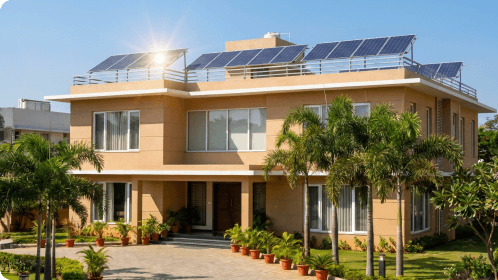
Before installing solar panels on houses, it is important to evaluate whether your property is suitable.
The direction of your roof plays a significant role. South-facing roofs receive maximum sunlight and are ideal for solar panel installation. East and west-facing roofs can also work, although they may produce slightly less energy.
Shadows are another important factor. Even small shadows from trees, buildings, or water tanks can reduce the efficiency of solar panels.
The amount of available space also matters. Typically, a 1 kW system requires around 100 square feet of shadow-free area.
Structural strength is equally important. Your roof must be strong enough to support the weight of the solar panel system and withstand wind loads.
⚙️ Step-by-Step Solar Panel Installation Process
How to Install Solar Panel on Houses
The process starts with a site inspection to understand the setup and requirements. During this stage, a technician evaluates your roof, checks for shading, and analyzes your electricity usage.
Based on these details, a suitable system is designed. This includes selecting the right number of solar panels, choosing the appropriate solar inverter, and determining whether a battery is required.
Once the design is finalized, installation begins. Mounting structures are installed on the roof, solar panels are fixed, and electrical wiring is completed.
Once the installation is complete, the system is checked to ensure everything is working properly. If the system is connected to the grid, the net metering process is initiated.
The entire installation process usually takes a few days, although approvals may take longer.
📊 Solar Panel Projects for Homes and Businesses
Solar panel projects are not limited to residential installations.
In commercial settings, solar panels are used in offices, factories, and warehouses to reduce electricity costs and improve efficiency.
For businesses, solar is not just about saving money — it is also about improving sustainability and brand image.
Large solar panel projects require careful planning, but they also offer higher returns due to greater energy consumption.
📉 Savings and Return on Investment
One of the biggest advantages of solar panel installation is the potential for savings.
For example, if your monthly electricity bill is ₹8,000 and your solar system reduces it to ₹2,000, you save ₹6,000 per month. That’s about ₹72,000 in yearly savings. Most systems recover their cost within 4–5 years, after which the electricity generated is nearly free for the rest of its lifespan.
⚠️ Common Mistakes to Avoid
Many people make mistakes when installing solar systems.
Choosing a system based only on price can lead to poor performance. Cheap components often fail earlier and reduce efficiency.
Incorrect system sizing can also affect savings. A system that is too small will not meet your needs, while an oversized system may not provide proportional benefits.
Ignoring after-sales service is another common mistake. Solar systems require occasional maintenance, and reliable support is essential.
🔋 Solar Battery and Backup Considerations
Adding a solar battery can significantly improve system reliability.
It allows you to store energy and use it during outages, ensuring uninterrupted power supply.
Modern systems often combine solar panels, hybrid solar inverter, and lithium ion battery to create a complete energy
solution.
If you’re unsure whether to choose a lithium ion battery or a traditional lead-acid battery, you can explore our detailed comparison
🧠 Final Thoughts
Solar panel installation in Bangalore is no longer just an option — it is becoming a necessity.
With the right system, you can reduce electricity costs, improve reliability, and take control of your energy usage.
🔚
A well-designed solar panel system is one of the smartest investments you can make for your home or business.
By understanding your requirements and choosing the right system, you can create a reliable and efficient energy solution that delivers long-term value.
FAQS
Is solar panel installation a good long-term investment?
Yes, solar panel installation is a long-term investment that reduces electricity costs, increases energy independence, and provides reliable power for 20–25 years.
How much can I save with a solar panel system?
Savings depend on your electricity usage. A typical home can save ₹4,000–₹6,000 per month. Most systems recover their cost within 4–5 years, after which the electricity generated is nearly free.
Are solar panels suitable for all houses?
Most houses are suitable for solar panel installation if they have sufficient rooftop space, minimal shading, and proper structural strength. South-facing roofs are ideal, but east and west-facing roofs can also work effectively.
Is solar energy reliable during power cuts?
Solar panels alone do not work during power cuts in on-grid systems. However, if you use a hybrid solar inverter with a solar battery, you can get backup power during outages.
Is it expensive to add a solar battery to an existing solar system?
Adding a solar battery is an additional investment, but it is worth it if you need backup during power cuts or want more energy independence. Yes, it can be expensive.
Adding a solar battery usually costs between ₹30,000 to ₹1,20,000+, depending on the battery type (lead-acid or lithium ion) and capacity. You may also need a hybrid inverter upgrade, which adds to the cost.
What is the cost of solar panel installation in Bangalore?
In Bangalore, solar panel installation costs roughly ₹60K–₹75K per kW, and after subsidy, it can drop to around ₹30K–₹45K per kW.
A typical home system (3–5 kW) will cost around ₹2 lakh to ₹4 lakh depending on setup.
How does a solar panel system work in a home?
A solar panel system converts sunlight into electricity using solar panels. This electricity is then converted into usable power through a solar inverter. During the day, your home uses solar energy, reducing your electricity bill, and any extra power can be stored in a solar battery or sent to the grid.
Why is solar energy becoming popular in Bangalore?
Solar energy is becoming popular in Bangalore mainly due to rising electricity bills, good sunlight availability, and the need for reliable power. A solar panel system helps reduce dependency on the grid and lowers monthly electricity costs over time.
What is the actual payback period for a 5kW rooftop solar system in India in 2026?
4–6 years is the realistic payback for a 5kW solar system in India (2026)
👉 After that, electricity is almost free for 15–20+ years