
Can I charge an electric car with solar panels at home?
If you own an electric car, one question always comes up:
👉 “Can I charge my EV car using solar panels at home?”
The answer is straightforward — yes, you can.
But instead of giving you a boring technical explanation, let me share a real story from Bangalore, where we actually charged a Tata Nexon EV using just 4 rooftop solar panels.
This is not theory. This is practical, real-world experience.
🚗 The Day We Decided to Try Solar EV Charging
Like many EV owners, we started noticing something interesting.
We bought an electric car to save money on petrol…
But slowly, the electricity bill started increasing 📈
That’s when we thought:
👉 “What is the cheapest way to charge an electric car?”
Since Bangalore gets good sunlight throughout the year, using solar power energy which is absolutely free of cost, made perfect sense.
So we planned a small setup:
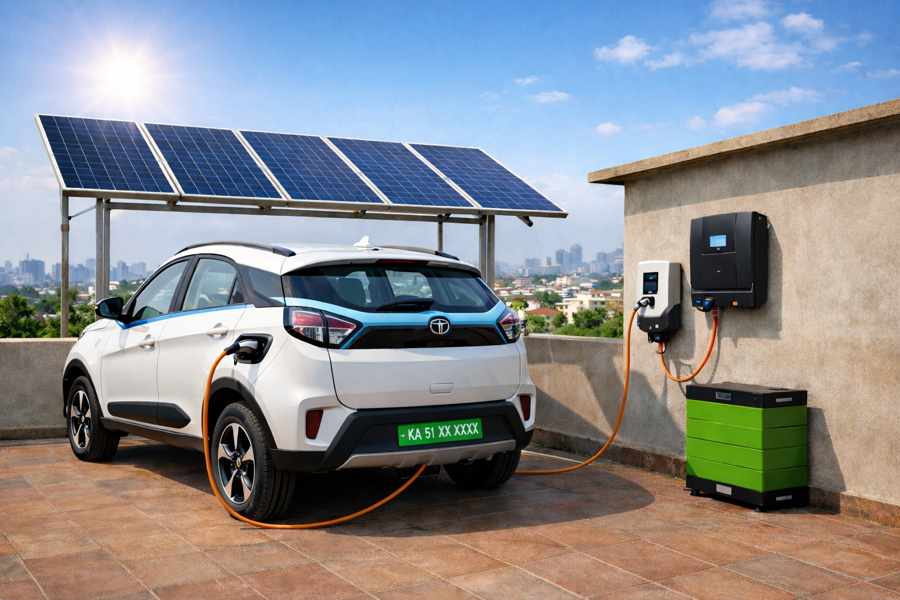
- 4 rooftop solar panels
- A hybrid solar inverter in Bangalore
- Existing home wiring
And then… we tested it with our Nexon EV.
☀️ How Solar Panels Actually Charge Your Electric Car
Before going deeper, let’s understand the process in very simple words:
- Solar panels capture sunlight
- They generate DC electricity
- An inverter converts it into AC power
- This power is used by your EV charger
- Your car battery gets charged
This is exactly how solar EV charging works in homes across India
👉 In short:
Sunlight → Electricity → Charger → Car battery
🎥 Want to see how this works in real life?
Check out our YouTube video where we practically show how we charged a Nexon EV using rooftop solar panels in Bangalore — it will give you a clear, real-world understanding of the entire setup.
🔌 Our Real Setup in Bangalore
Let me break down our setup so you can understand easily:
- 4 solar panels installed on rooftop
- Hybrid solar inverter in Bangalore
- Grid connection (backup)
- Standard EV home charger
We didn’t go for a very large system initially.
This was more like a pilot experiment.
And the result?
👉 We were able to charge our Nexon EV using solar energy during the day.
⚡ How Much Solar Power Do You Actually Need?
This is the most common question people ask.
Let’s simplify it:
- 1 kW solar system → generates ~4–5 units/day
- EV consumes → ~1 unit per 8–9 km
So if you drive:
- 40–50 km/day → you need around 2–3 kW solar system
👉 That means:
- Small setup → partial charging
- Bigger setup → full charging
In our case, with just 4 panels, we were able to:
- Offset part of the charging cost
- Reduce electricity bill
🏠 Why Home Solar EV Charging is Becoming Popular
More people in Bangalore are now choosing solar panel installations for EV charging.
Here’s why:
1. Huge Cost Savings 💰
- Grid charging: ₹1–₹1.5 per km
- Solar charging: almost ₹0 per km
2. Energy Independence
You are not dependent on:
- Electricity price hikes
- Power cuts
3. Eco-Friendly 🌱
- Zero emissions charging
- Clean and renewable energy
4. Long-Term Investment
- Payback: ~3–5 years
- Life: 20–25 years
🔋 Role of Lithium Ion Battery for Electric Vehicle in Bangalore
Now comes an important part.
Most EVs, including Nexon EV, use lithium ion batteries.
These batteries:
- Charge faster
- Last longer
- Work efficiently with solar
But here’s the interesting part 👇
You can also install a home lithium battery system to store solar energy.
That means:
- Daytime → solar generates power
- Night → stored energy charges your car
This makes your system even more powerful.
🔄 Why Hybrid Solar Inverter is Important
If you are planning solar EV charging, don’t ignore this.
A hybrid solar inverter in Bangalore is a game changer Why?
Because it can:
- Use solar power first
- Switch to grid automatically
- Store energy in batteries
This ensures:
- No charging interruption
- Maximum solar usage
In fact, hybrid systems are ideal for Indian homes where:
- Power cuts happen
- Charging happens at night
🌙 What Happens at Night?
This is where most people get confused.
👉 “If solar works only in daytime, how do we charge at night?”
There are 3 options:
Option 1: Net Metering
- Day: export solar power
- Night: use grid power
Option 2: Battery Storage
- Store solar energy
- Use anytime
Option 3: Hybrid System (Best)
- Mix of solar + grid + battery
Most homes in Bangalore prefer hybrid systems.
🔧 Choosing the Right Solar Panel Installer in Bangalore
This is very important.
Even the best system will fail if installation is poor.
When selecting a solar panel installer in Bangalore, check:
- Experience in EV + solar integration
- Proper load calculation
- Shadow analysis
- After-sales support
👉 A good installer will:
- Design system based on your EV usage
- Not just sell panels
📊 Real Cost of Solar EV Charging Setup
Let’s talk numbers (approximate):
- Solar system: ₹1.5–3 lakh
- EV charger: ₹40k–₹1 lakh
- Optional battery: ₹2–4 lakh
👉 Total investment depends on:
- System size
- Battery requirement
- Installation quality
⏳ Return on Investment (ROI)
Here’s the interesting part:
If you drive daily:
- You can save ₹50,000–₹80,000/year
- Payback in ~3–5 years
After that?
👉 Almost free driving for 20+ years
🚀 Our Experience Charging Nexon EV with Solar
Let me share the real takeaway from our experiment:
- Solar charging works smoothly
- No major modification needed
- Charging speed depends on sunlight
- Hybrid inverter improves performance
Most importantly:
👉 It gives a different level of satisfaction
Driving your car using sunlight energy feels amazing 🌞
⚠️ Challenges You Should Know
Let’s be practical.
Solar EV charging is great, but not perfect.
1. Weather Dependency
- Cloudy days → less generation
2. Initial Investment
- Higher upfront cost
3. Space Requirement
- Rooftop area needed
4. Charging Speed Limit
- Depends on solar output
But still…
👉 Benefits are much higher than limitations
📈 Future of Solar EV Charging in India
The future is very clear.
- EV adoption is increasing
- Solar costs are decreasing
- Government support is strong
India has 300+ sunny days per year, making it ideal for solar EV charging
👉 In the next 5–10 years:
- More homes will adopt solar EV charging
- Smart energy systems will become common
- Electricity bills will reduce significantly
🔥 Pro Tips Before You Install Solar Panel
Here are some expert tips:
- Don’t install only for EV → cover full home load
- Use hybrid inverter
- Choose high-quality panels
- Plan for future expansion
- Work with experienced installer
- If you’re planning a solar setup for your EV in Bangalore, working with the right team makes all the difference. PowerKart -A Solar Company in Bangalore helps you choose the correct system size, installs it properly, and provides ongoing support so your system performs efficiently in the long run.
🏁 Final Conclusion
Charging your electric car with solar panels is not just possible…
👉 It is practical, cost-effective, and future-ready
Our small setup in Bangalore proved that:
- Even 4 panels can make a difference
- You can start small and scale later
- Solar + EV is the perfect combination
❓ FAQs
Can I charge my EV fully using solar?
Yes, if your system is large enough.
How many panels do I need?
Depends on your driving — usually 3–10 panels.
Do I need a special charger?
Yes, a compatible EV charger is required.
Is it worth using solar panels to charge EV Car in Bangalore?
Absolutely, due to good sunlight and rising electricity costs.
How much time is needed to charge an electric car with solar power?
It depends on your solar system size. A 2–3 kW solar system is usually enough for daily driving of 40–50 km.
Can I charge my EV at night using solar?
Yes, but you’ll need a battery storage system or grid support.
Can you charge an electric car directly from solar panels?
Not directly. Solar panels produce DC power, while your EV charger needs stable AC power.
You’ll need an inverter (and usually a proper EV charger) to convert and manage the electricity before charging your car.
✔ In short: Solar panels → Inverter → EV charger → Car
What is the most affordable way to charge an electric car?
The cheapest way is to charge your EV at home using solar power. Once installed, solar charging can cost close to ₹0 per km over time.
Is it a good idea to charge my EV car to 100% every night?
No, it’s not recommended to charge your EV to 100% every day.
For daily use, keeping the battery between 20% and 80–90% helps improve battery life.
Charging to 100% is fine occasionally—like before a long trip—but doing it daily can slowly reduce battery health over time.
🎯 Final Thought
If you already own an EV…
👉 The next smart step is solar panel installation
Because the future is simple:
Drive your car using sunlight 🌞