
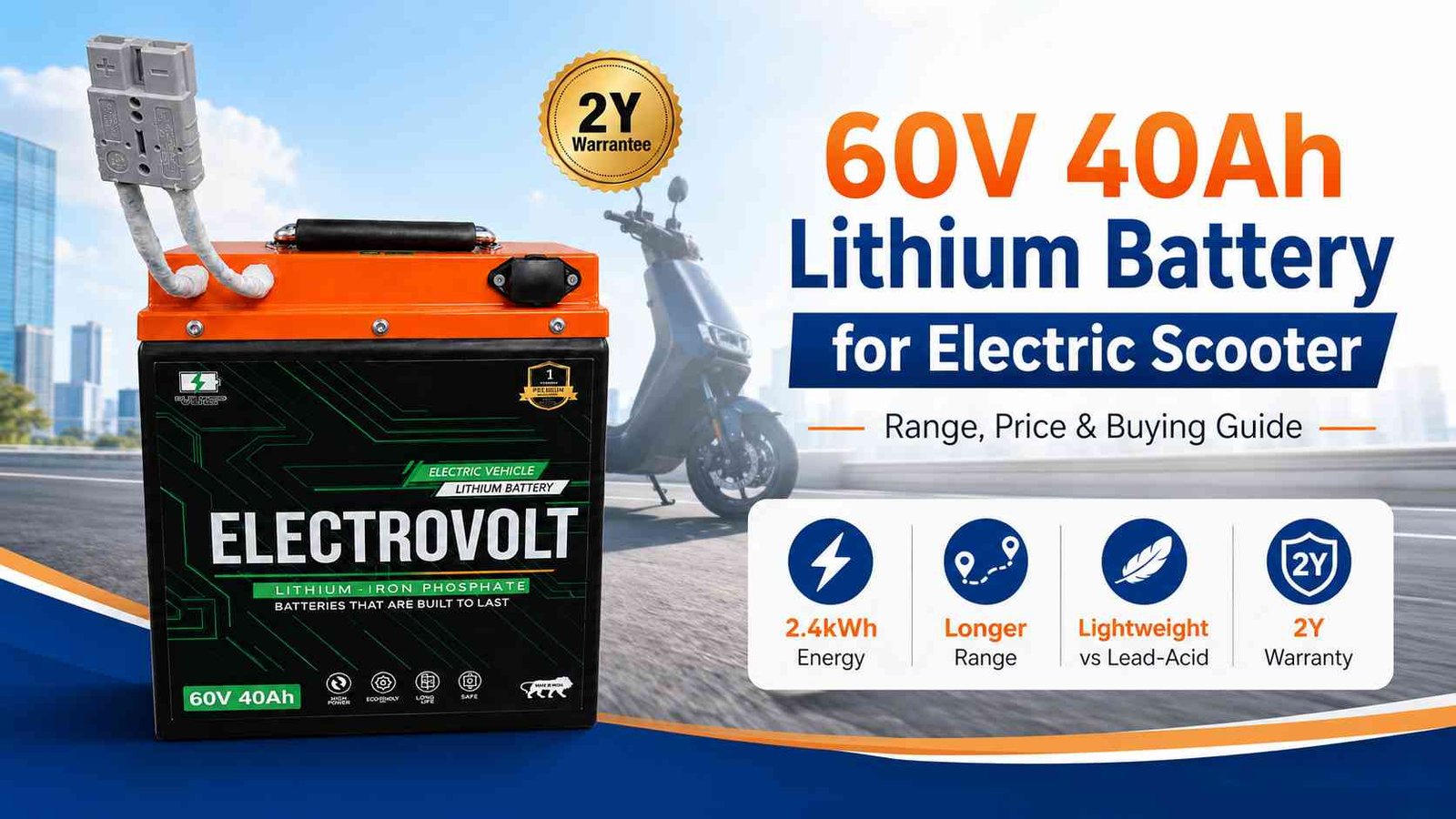
A 60V 40Ah lithium battery for electric scooter is a popular choice for riders who need more range than a smaller 30Ah or 32Ah battery while still keeping the battery reasonably compact and manageable.
But buying a 60V 40Ah battery is not as simple as checking whether your old battery also says “60V”.
You need to consider the battery chemistry, full-charge voltage, BMS current rating, motor power, controller, charger, connectors, physical dimensions and communication requirements of the scooter.
A correctly matched 60V 40Ah lithium ion battery for electric scooter can provide good riding range, strong performance and significantly lower weight than an equivalent lead-acid battery bank. A poorly matched battery, however, may cause BMS tripping, poor acceleration, charging problems or even damage to the battery or vehicle electronics.
This guide explains the range, price, charging time, compatibility, BMS requirement, lifespan and important specifications of a 60V 40Ah electric scooter battery in simple terms.
Quick Answer | Is a 60V 40Ah Lithium Battery Good for an Electric Scooter?
Yes, a 60V 40Ah electric scooter battery can be an excellent choice if your scooter is designed for a compatible 60V battery system.
A 60V 40Ah battery stores approximately:
60V × 40Ah = 2,400Wh
or:
2.4kWh of nominal energy
That is a useful amount of energy for an electric two-wheeler.
Depending on scooter efficiency and riding conditions, a well-designed 60V 40Ah battery may provide roughly 55–90km of practical riding range, while highly efficient low-speed scooters may achieve more.
However, the battery should only be installed after confirming compatibility with the scooter’s:
- Motor
- Controller
- Charger
- BMS requirement
- Connectors
- Battery compartment
- Communication system
What Does 60V 40Ah Mean?
The two most important numbers are:
60V
This represents the battery’s voltage class.
Voltage affects the electrical system the battery is designed to work with, including the motor controller and charger.
40Ah
Ah means amp-hour.
It represents electrical charge capacity.
A 40Ah battery can theoretically supply:
- 40A for 1 hour
- 20A for 2 hours
- 10A for 4 hours
under simplified conditions.
But Ah alone does not tell you how much total energy the battery stores.
For that, we need voltage as well.
Energy calculation
Battery Energy = Voltage × Ah
Therefore:
60 × 40 = 2,400Wh
which equals:
2.4kWh
This makes kWh a better measurement when comparing batteries of different voltages.
How Much Range Does a 60V 40Ah Lithium Battery Give?
This is usually the first question buyers ask:
“How many kilometres will a 60V 40Ah lithium battery run?”
There is no single correct range.
The theoretical battery capacity is approximately 2.4kWh, but not all of this energy will necessarily be available for riding. The BMS normally keeps some protection margin, while the controller, motor and wiring also have losses.
A practical way of estimating range is:
Range = Usable Battery Energy ÷ Scooter Energy Consumption per km
Suppose approximately 90% of the 2.4kWh battery energy is usable:
2.4kWh × 90% = 2.16kWh
or:
2,160Wh
Now look at different scooter efficiencies:
| Scooter Consumption | Approximate Range |
| 20Wh/km | 108km |
| 25Wh/km | 86km |
| 30Wh/km | 72km |
| 35Wh/km | 62km |
| 40Wh/km | 54km |
This explains why two electric scooters using batteries with the same 60V 40Ah rating can provide very different range.
Current 60V 40Ah scooter and replacement-battery listings also show wide range claims, reinforcing the importance of vehicle efficiency and operating conditions rather than battery Ah alone.
What Affects 60V 40Ah Battery Range?
Your actual electric scooter battery range can change considerably depending on how you ride.
Important factors include:
Rider weight
A heavier rider requires more energy during acceleration and climbing.
Pillion rider
Carrying a second person increases total vehicle weight and power demand.
Riding speed
Higher speeds generally increase energy consumption, particularly because aerodynamic resistance increases rapidly with speed.
Acceleration
Frequent hard acceleration draws higher current from the battery.
Road gradient
Climbing hills requires considerably more energy than riding on flat roads.
Tyre pressure
Under-inflated tyres increase rolling resistance.
Traffic
Repeated acceleration and braking can change overall efficiency.
Motor efficiency
Different motors convert electrical energy into mechanical energy with different efficiencies.
Controller settings
A high-current controller can improve acceleration but may consume battery energy faster.
Battery condition
An older battery may no longer provide its original usable capacity.
So when a seller promises an exact range such as “100km guaranteed”, treat that claim carefully unless it specifies the scooter, rider weight, speed and test conditions.
60V 40Ah Lithium Battery Price in India
Another important buyer query is:
What is the 60V 40Ah lithium battery price in India?
As of August 2026, current Indian listings show a wide range of approximately ₹25,000 to ₹44,000 for 60V 40Ah lithium battery packs, depending on cells, BMS, warranty, construction and seller.
For example, current listings include products around ₹25,499, ₹28,320, ₹37,270 and ₹43,999.
The cheapest battery is not automatically the best value.
Price can vary because of:
- Cell manufacturer
- Cell grade
- NMC or LiFePO₄ chemistry
- Number and type of cells
- BMS quality
- Continuous discharge current
- Peak current
- Enclosure
- Connector quality
- Charger supplied
- Warranty
- Service support
When comparing the 60V 40Ah lithium ion battery price, ask for the complete specification rather than comparing only ₹/Ah.
NMC vs LiFePO₄ for a 60V 40Ah Scooter Battery
A 60V 40Ah battery can be built using different lithium-ion chemistries.
Two important options are:
NMC
Nickel Manganese Cobalt
LiFePO₄
Lithium Iron Phosphate, also called LFP.
Both belong to the lithium-ion battery family, but they have different characteristics.
Why NMC is commonly used in scooters
NMC offers relatively high energy density.
That is useful in an electric scooter because the battery must provide good capacity while fitting inside a limited battery compartment.
A smaller and lighter battery can improve:
- Vehicle packaging
- Handling
- Battery portability
- Range-to-weight ratio
This makes a 60V 40Ah NMC battery attractive for many electric two-wheelers.
Why LiFePO₄ may also be considered
LiFePO₄ offers advantages such as strong cycle characteristics and thermal stability.
However, an LFP battery of similar stored energy may require more physical space and weight.
The choice between NMC vs LFP battery should therefore be based on the scooter’s original design and available battery space rather than simply choosing one chemistry because it sounds better.
What Is the Full-Charge Voltage of a 60V Lithium Battery?
This is extremely important.
“60V” does not always tell you the full-charge voltage.
A common NMC configuration uses 16 cells in series, often written as:
16S NMC
If each cell reaches approximately 4.2V when fully charged:
16 × 4.2V = 67.2V
Therefore, many 60V-class 16S NMC batteries use a 67.2V maximum charging voltage.
Current 60V 40Ah NMC battery specifications also show 67.2V as the maximum voltage for certain 16S packs.
But you should not assume every battery sold as 60V uses 16S NMC.
Other pack configurations exist.
Before buying a charger or replacement battery, always check:
- Battery chemistry
- Number of cells in series
- Nominal voltage
- Maximum charging voltage
- BMS specifications
Which Charger Is Needed for a 60V 40Ah Battery?
The charger must match the battery.
For a common 16S NMC 60V battery, this may mean a charger with approximately:
67.2V maximum charging voltage
But charging current also affects charging time.
With a 5A charger
Simplified charging time:
40Ah ÷ 5A = 8 hours
With an 8A charger
40Ah ÷ 8A = 5 hours
With a 10A charger
40Ah ÷ 10A = 4 hours
Actual charging time can be longer because lithium charging is not perfectly constant from empty to full.
Charging current normally reduces near the upper voltage limit during the constant-voltage stage.
The BMS and cells must also support the charger’s current.
Never replace a 5A charger with a much larger charger without checking the battery manufacturer’s maximum charging-current specification.
What BMS Rating Does a 60V 40Ah Scooter Battery Need?
The Battery Management System or BMS is one of the most important parts of an EV battery.
It monitors and protects the battery.
Typical BMS protections include:
- Over-charge protection
- Over-discharge protection
- Over-current protection
- Short-circuit protection
- Temperature protection
- Individual cell-voltage monitoring
- Cell balancing
But a BMS must also supply enough current for the scooter.
Suppose a battery has a:
40A continuous-discharge BMS
At approximately 60V:
60V × 40A = 2,400W
So, in simplified terms, the battery can supply approximately 2.4kW at 40A.
A 60A peak capability would correspond to approximately:
60V × 60A = 3,600W
for the permitted peak period.
However, actual safe power depends on:
- Cell capability
- BMS design
- Wiring
- Connectors
- Temperature
- Controller behaviour
This is why a 60V 40Ah battery does not automatically support every 60V scooter.
The Ah rating tells you capacity.
It does not tell you the maximum safe motor power.
Will a 60V 40Ah Lithium Battery Fit My Electric Scooter?
Before ordering, check compatibility carefully.
The fact that your old battery says 60V does not guarantee that another 60V battery will work.
Check these nine things.
1. Existing battery voltage
Confirm the nominal voltage printed on the original battery.
2. Battery chemistry
Check whether the original battery uses:
- NMC
- LiFePO₄
- Lead-acid
- Another chemistry
3. Full-charge voltage
This must match the controller and charger requirements.
4. Motor rating
Check the motor label.
It may say, for example:
- 1000W
- 1200W
- 1500W
- 2000W
5. Controller current
This is especially important.
The battery BMS must safely support the current demanded by the controller.
6. Charger output
Photograph the charger label.
Check its:
output voltage + charging current
7. Connectors
Check both:
- Charge connector
- Discharge connector
8. Battery dimensions
Measure:
Length × Width × Height
Don’t assume a higher-Ah battery will fit simply because the voltage matches.
9. Communication
Some modern electric scooters may require communication between the battery and vehicle electronics.
A generic replacement battery may not work correctly in these scooters even if the electrical voltage appears compatible.
60V 32Ah vs 60V 40Ah Lithium Battery
Many buyers upgrading an electric scooter compare these two capacities.
60V 32Ah lithium battery
Approximate nominal energy:
60 × 32 = 1,920Wh
or:
1.92kWh
60V 40Ah
Approximate nominal energy:
60 × 40 = 2,400Wh
or:
2.4kWh
At the same nominal voltage, the 40Ah battery has:
25% more Ah capacity
than the 32Ah battery.
That can translate into longer riding range if:
- Both batteries use similar-quality cells
- Both have similar usable depth of discharge
- Scooter efficiency remains the same
- Additional battery weight does not significantly change consumption
But before upgrading from 32Ah to 40Ah, check whether the larger battery physically fits.
60V 40Ah Lithium Battery vs Lead-Acid Battery
A rider replacing an older electric scooter battery may also be deciding between lithium and lead-acid.
| Factor | Lithium-Ion | Lead-Acid |
| Weight | Generally much lower | Higher |
| Energy density | Higher | Lower |
| Usable capacity | Generally higher | More limited |
| Charging | Typically faster | Usually slower |
| Maintenance | Very low | Depends on battery type |
| Voltage sag | Generally lower | More noticeable |
| BMS | Required | Normally not electronic BMS |
| Initial cost | Higher | Lower |
| Cycle life | Generally higher | Generally lower |
A lead-acid bank may look cheaper initially.
But for an electric scooter, battery weight is particularly important.
Reducing battery weight can make the vehicle easier to handle and prevents the scooter from carrying an unnecessarily heavy battery bank on every trip.
How Long Does a 60V 40Ah Lithium Battery Last?
There is no reliable single answer such as:
“It will last exactly five years.”
Battery lifespan depends on several factors:
- Cell quality
- Depth of discharge
- Charging voltage
- Charging current
- Discharge current
- Battery temperature
- BMS settings
- Cell balancing
- Storage conditions
- Riding frequency
One current 60V 40Ah NMC product specification, for example, lists around 1,000 cycles at 80% depth of discharge, while another listing quotes approximately 1,200 full-capacity cycles. These numbers apply to those specific products and should not be assumed for every 60V 40Ah battery.
The quality of the cells and the way the battery is used often matter more than the Ah figure printed on the case.
How Can You Increase Electric Scooter Battery Life?
A few practical habits can help reduce unnecessary battery stress:
- Use the correct charger
- Avoid exposing the battery to excessive heat
- Do not use an incompatible high-current charger
- Repair loose or heating connectors quickly
- Avoid repeatedly running the battery far below its recommended discharge limit
- Keep the battery dry
- Follow the manufacturer’s storage instructions
- Investigate unusual heating or sudden range loss
- Don’t bypass the BMS
If a removable battery becomes unusually hot during charging or riding, stop using it until the cause has been checked.
If you notice a gradual reduction in riding range, you can use a battery health check calculator to estimate how much usable capacity the battery may have lost compared with when it was new.
Tracking battery condition along with good charging and riding habits can help identify degradation early and avoid unnecessary battery replacement.
Signs Your Electric Scooter Battery May Need Replacement
Battery degradation is usually gradual.
Common symptoms include:
- Riding range has dropped significantly
- Battery percentage falls unusually quickly
- Scooter cuts off during acceleration
- Battery shuts down on hills
- Charging finishes unusually early
- Battery voltage drops quickly under load
- Battery becomes unusually hot
- Cells become badly imbalanced
- BMS trips repeatedly
However, these symptoms do not always mean the cells are permanently damaged.
Problems can also come from:
- BMS
- Connector
- Charger
- Loose wiring
- Cell imbalance
- Controller
If several of these symptoms appear together, they may match the 5 signs your electric scooter battery needs replacement and indicate that the battery should be tested before continued use.
However, these symptoms do not always mean the complete battery needs replacement. Problems with the charger, BMS, connectors, wiring or cell imbalance can sometimes produce similar behaviour.
A proper EV battery health test can help identify the actual problem before replacing the complete battery.
What Should You Ask Before Buying a 60V 40Ah Battery?
Before paying a lithium battery supplier, ask for:
- Battery chemistry
- Nominal voltage
- Maximum charging voltage
- Actual Ah capacity
- Nominal kWh
- Cell manufacturer
- Cell grade
- BMS brand
- Continuous BMS current
- Peak BMS current
- Maximum charging current
- Battery dimensions
- Battery weight
- Charge connector
- Discharge connector
- Charger specification
- Warranty
- Repair support
If the supplier cannot explain the BMS current or charging voltage, comparing only the advertised 60V and 40Ah rating is not enough.
Frequently Asked Questions
How many kWh is a 60V 40Ah lithium battery?
Approximately:
60V × 40Ah = 2.4kWh nominal energy.
Actual usable energy depends on the battery design and BMS limits.
How much range does a 60V 40Ah battery give?
A practical range may be around 55–90km for many scooters, but efficient low-speed vehicles may achieve more. Range depends heavily on Wh/km consumption, speed, rider weight, terrain and controller settings.
What is the price of a 60V 40Ah lithium battery in India?
Current Indian listings in August 2026 indicate roughly ₹25,000–₹44,000, depending on cells, BMS, warranty and battery construction.
What charger is used for a 60V 40Ah NMC battery?
Many 16S NMC 60V-class batteries use a 67.2V charger, but you must confirm the actual battery series configuration and manufacturer specification before connecting a charger.
Can I install a 40Ah battery instead of 30Ah?
Possibly.
If voltage, chemistry, controller, charging voltage, BMS current, connectors and dimensions are compatible, increasing Ah can provide additional range.
Do not make the replacement based on Ah alone.
Can a 60V 40Ah battery run a 2000W motor?
Potentially, but motor wattage alone is not enough to answer this.
You need to know the controller’s maximum battery current and compare it with the BMS and cell current ratings.
Is NMC good for electric scooters?
Yes. NMC’s high energy density makes it useful where substantial energy needs to fit into a relatively small and lightweight battery pack.
Final Verdict | Is a 60V 40Ah Lithium Battery Worth Buying?
A 60V 40Ah lithium battery for electric scooter can provide an excellent balance between capacity, riding range, battery size and weight.
With approximately 2.4kWh of nominal energy, it can be suitable for riders who travel moderate to long daily distances and want more usable range than a smaller 30Ah or 32Ah battery can provide.
But the words 60V 40Ah alone are not enough to choose the correct battery.
Before buying, confirm:
battery chemistry + charging voltage + BMS current + controller + motor + dimensions + connectors + communication.
The right lithium ion battery for electric scooter is not necessarily the battery with the highest Ah rating.
It is the one that safely matches the scooter while providing sufficient energy for your actual daily travel requirement.
When discussing a replacement with a lithium battery supplier, share photographs of the existing battery, charger and controller labels along with battery-compartment dimensions. This allows the battery to be selected based on the complete electrical system instead of voltage and capacity alone.
A properly matched 60V 40Ah battery can deliver strong daily performance, useful riding range and reliable service without unnecessarily increasing battery size or cost.