

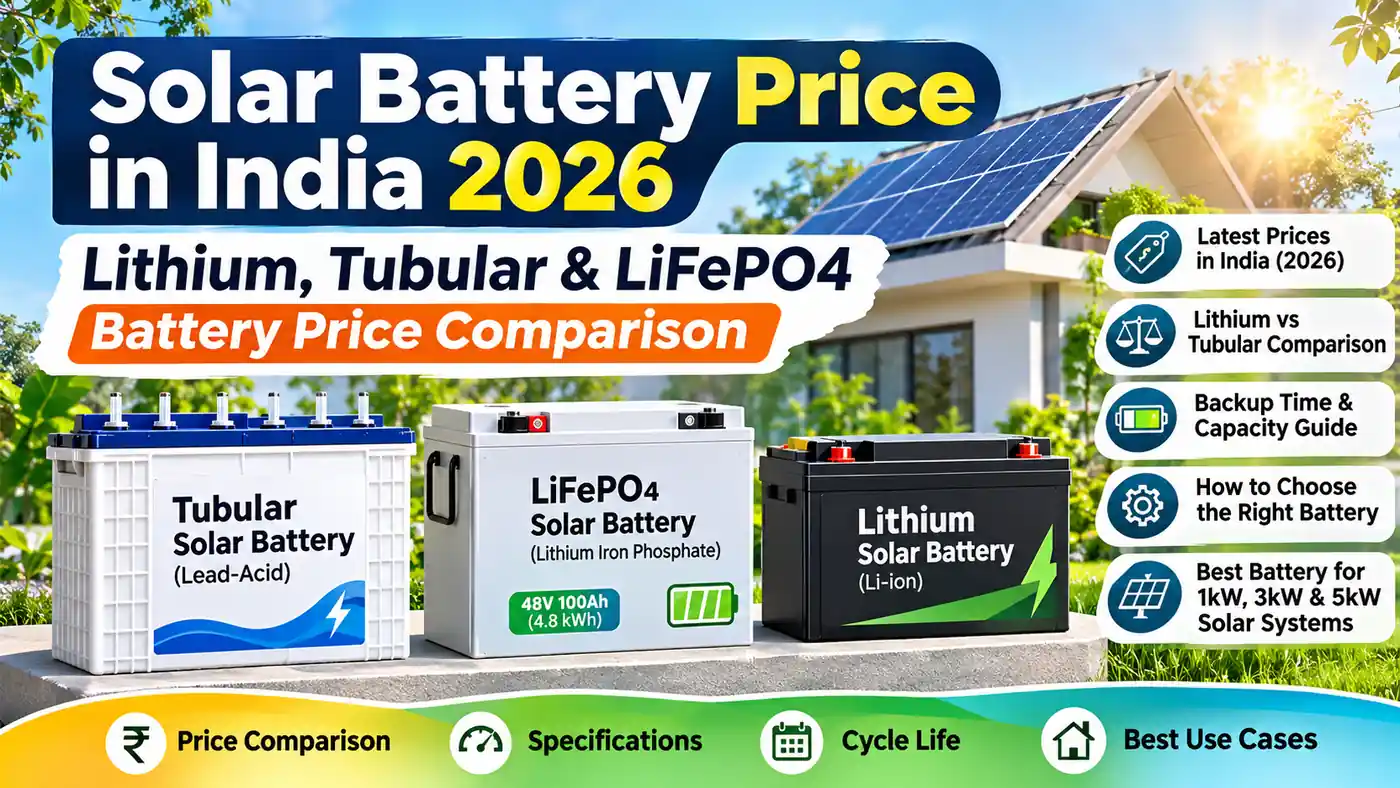
Planning to buy a solar battery for your home, shop or business? Before comparing prices, there is one important thing to understand: the cheapest battery is not always the most economical battery to own.
A tubular battery may cost less initially, while a lithium iron phosphate (LiFePO4) battery can offer more usable energy, higher efficiency and a longer rated cycle life. Your ideal choice depends on how frequently you use the battery, how much backup you need and which inverter you have.
In this 2026 solar battery price guide for India, we compare lithium, tubular and LiFePO4 batteries using actual advertised prices, technical specifications and practical backup calculations.
You will also learn how to select the right battery for a 1kW, 3kW or 5kW solar system, estimate its backup time and avoid common mistakes when replacing an old inverter battery.
Solar Battery Price in India 2026 – Quick Comparison
The price of a solar battery depends on its chemistry, voltage, capacity, BMS, warranty and manufacturer.
Here are examples of publicly advertised prices for solar and inverter batteries in India.
| Solar Battery Type | Nominal Energy | Listed Price |
|---|---|---|
| Luminous 12V 100Ah tubular | 1.2kWh | ₹13,499 |
| Luminous 12V 150Ah tubular | 1.8kWh | ₹17,999 |
| Luminous 12V 200Ah tubular | 2.4kWh | ₹23,399 |
| Luminous 12.8V 100Ah LiFePO4 | 1.28kWh | ₹29,000 |
| Nexus 25.6V 100Ah LiFePO4 | 2.56kWh | ₹54,374 |
| PowerKart 48V 100Ah LiFePO4 ESS | 4.8kWh | ₹88,618 |
| Nexus 51.2V 100Ah LiFePO4 | 5.12kWh | ₹1,08,749 |
Price references: Luminous and Nexus manufacturer websites and PowerKart’s product listing, checked in November 2026. Prices are advertised retail figures and can change. The Nexus prices above are rounded to the nearest rupee. These products are examples, not market-wide minimum or average prices. Inverter, installation, protection equipment and delivery charges may be additional.
Key takeaway: Tubular batteries generally have a lower initial purchase price for smaller backup systems. LiFePO4 batteries are worth evaluating when the battery will be charged and discharged frequently or when low maintenance and longer cycle life are priorities.
What Are the Different Types of Solar Batteries?
Although people commonly search for lithium battery vs tubular battery, these terms do not describe three completely separate battery technologies.
There are two major battery families used in these comparisons:
1. Tubular Lead-Acid Solar Batteries
A tubular battery is a type of lead-acid battery that uses a tubular positive-plate construction.
It is commonly used in residential inverters, solar backup systems, offices and small commercial installations.
Advantages:
- Lower initial purchase cost
- Widely available in India
- Established service and recycling infrastructure
- Suitable for compatible conventional inverter systems
Limitations:
- Heavy and bulky
- Flooded types require electrolyte maintenance
- Lower usable energy when limiting discharge depth for longer life
- Generally shorter cycle life than LiFePO4 under comparable demanding cycling conditions
Tall tubular batteries are popular choices for customers searching for a 150Ah solar battery price, 200Ah tubular battery price or home inverter battery price in India.
2. Lithium-Ion Solar Batteries
Lithium-ion is a broad family of rechargeable battery chemistries.
Lithium batteries are used in electric vehicles, consumer electronics, industrial equipment and solar energy storage systems.
However, not all lithium-ion batteries have the same chemistry or operating characteristics.
Two well-known examples are NMC (nickel manganese cobalt) and LiFePO4 (lithium iron phosphate).
3. LiFePO4 Solar Batteries
LiFePO4 is a type of lithium-ion battery, not a completely separate battery family.
Also called LFP, this chemistry is widely used in stationary energy storage because of its long cycle life, thermal stability and suitability for repeated charging and discharging.
A typical solar LiFePO4 battery pack includes:
- Lithium iron phosphate cells
- Battery Management System (BMS)
- Electrical protection and power connections
- Appropriate enclosure and insulation
- Communication features on supported models
For home solar storage, hybrid solar inverters and many commercial ESS applications, LiFePO4 is an attractive option.
Lithium vs Tubular Battery – Which Offers Better Value?
A useful comparison goes beyond the purchase price.
| Feature | Tubular Lead-Acid Battery | LiFePO4 Lithium Battery |
|---|---|---|
| Initial price | Generally lower | Generally higher |
| Battery chemistry | Lead-acid | Lithium iron phosphate |
| Cycle life | Usually lower at comparable deep cycling | Generally higher |
| Usable capacity | Often designed around shallower cycling for better life | Usually supports deeper cycling |
| Charging efficiency | Generally lower | Generally higher |
| Weight | Heavy | Lighter for comparable energy |
| Maintenance | Flooded models need maintenance | No routine electrolyte maintenance |
| BMS | Not normally used | Essential |
| Charging profile | Lead-acid charging | Lithium-compatible charging required |
| Best suited for | Budget-focused, intermittent backup | Frequent cycling and modern ESS |
There is no universal winner for every home.
If you need occasional backup and want to minimize the initial investment, a tubular battery can be a sensible choice.
If your battery will store rooftop solar energy every day and supply electricity each night, a LiFePO4 system may offer better long-term economics, depending on its purchase price, efficiency and actual cycle life.
How Much Does a 150Ah or 200Ah Solar Battery Cost?
Customers frequently search for Luminous solar battery price, Exide solar battery price, 150Ah inverter battery price and 200Ah solar battery price.
The price can vary significantly between short tubular, tall tubular, flooded and sealed models.
For example, Luminous lists its 12V 150Ah LPTT 12150H tubular battery at ₹17,999 and its 12V 200Ah LPTT 12200H tubular model at ₹23,399.
The important difference is not just the price.
A 12V 150Ah battery has approximately:
12V × 150Ah = 1,800Wh or 1.8kWh nominal energy
A 12V 200Ah battery has approximately:
12V × 200Ah = 2,400Wh or 2.4kWh nominal energy
The 200Ah battery provides 33.3% more nominal capacity, assuming the same system voltage.
However, lead-acid battery capacity is affected by the discharge rate, temperature and battery condition. The entire rated capacity may not be practically available at high loads.
Buying tip: Compare battery capacity, discharge rating, warranty, inverter compatibility and price before deciding.
48V 100Ah Lithium Battery Price in India – Is It Worth Buying?
One of the important battery sizes for modern energy storage applications is the 48V 100Ah LiFePO4 battery.
It offers a practical combination of voltage and energy capacity for compatible solar hybrid inverters, energy storage systems, UPS and commercial backup applications.
PowerKart 48V 100Ah LiFePO4 ESS Battery
| Specification | Details |
|---|---|
| Battery chemistry | LiFePO4 |
| Nominal voltage | 48V |
| Capacity | 100Ah |
| Nominal energy | 4.8kWh |
| BMS | Smart Battery Management System |
| Rated cycle life | 3000+ cycles at 80% DoD |
| Applications | Solar ESS, hybrid inverter, UPS and telecom |
| Listed selling price | ₹88,618 |
This battery offers approximately 4,800Wh of stored nominal energy, with a Smart BMS designed to provide overcharge, over-discharge, overcurrent, short-circuit and temperature protection.
Its rated 3000+ cycles at 80% depth of discharge can make it attractive for applications involving regular battery cycling.
Explore the PowerKart 48V 100Ah LiFePO4 ESS Battery
Before purchasing, confirm that the inverter supports the battery voltage, charging profile and BMS discharge-current rating.
48V vs 51.2V Lithium Battery – What Is the Difference?
This is an important detail that buyers often miss.
Although 48V and 51.2V lithium batteries are commonly grouped under the 48V inverter category, they are not electrically identical.
| Specification | 48V 100Ah LiFePO4 | 51.2V 100Ah LiFePO4 |
|---|---|---|
| Typical series configuration | 15S | 16S |
| Nominal voltage | 48V | 51.2V |
| Capacity | 100Ah | 100Ah |
| Nominal energy | 4.8kWh | 5.12kWh |
| Typical full-charge cell voltage | 3.65V max | 3.65V max |
| Corresponding pack voltage at 3.65V/cell | 54.75V | 58.4V |
A 51.2V 100Ah battery stores approximately 6.7% more nominal energy than a 48V 100Ah battery.
But that does not automatically make it a suitable replacement.
The inverter must support the battery’s voltage window, charging voltage, current limits and communication requirements.
For example, an inverter whose maximum permitted battery voltage is below 58.4V may not be compatible with a 16S battery’s full charging voltage.
Always check the inverter manual and battery datasheet rather than purchasing based on the nominal voltage label alone.
Solar Battery Backup Time – How Many Hours Will It Last?
Backup time is one of the most practical questions when buying a solar battery for home use.
A larger battery stores more energy, but actual backup also depends on the connected load and system losses.
Solar Battery Backup Calculation
A useful approximation is:
Backup time (hours) = Battery energy (Wh) × Usable DoD × Inverter efficiency ÷ Connected load (W)
Here:
- Battery energy: Voltage × Ah
- DoD: Depth of discharge, the fraction of stored capacity used
- Inverter efficiency: Accounts for energy lost when converting DC into AC
- Connected load: Total appliance consumption in watts
48V 100Ah Lithium Battery Backup Time
Consider a 4.8kWh lithium battery operating at 80% usable depth of discharge with an assumed 90% inverter efficiency.
The estimated AC energy available is:
4,800 × 0.80 × 0.90 = 3,456Wh
| Household Load | Estimated Backup Time |
|---|---|
| 200W | 17.3 hours |
| 300W | 11.5 hours |
| 500W | 6.9 hours |
| 750W | 4.6 hours |
| 1000W | 3.5 hours |
| 1500W | 2.3 hours |
| 2000W | 1.7 hours |
These are calculated examples, not guaranteed product runtimes. They assume a full starting charge, constant load, 80% usable battery energy and 90% inverter efficiency, without extra allowance for idle consumption or temperature effects. The BMS and cells must also support the required discharge current.
For example, if your home consumes an average of 500W during an outage, a suitable 4.8kWh lithium battery could provide approximately 6.9 hours under these assumptions.
Actual performance should be verified against the inverter and battery specifications.
How Much Battery Capacity Is Required for a 1kW, 3kW or 5kW Solar System?
A common mistake is selecting a battery only according to solar panel capacity.
A 3kW rooftop solar system does not automatically require a 3kWh battery.
Solar panels are rated in kW, while battery storage is measured in kWh.
The correct battery capacity depends primarily on:
- How much electricity you want to use after sunset
- Your essential backup load
- The number of hours of backup required
- Battery depth-of-discharge limits
- Inverter and battery efficiency
- The charging energy available from solar panels
For example, suppose a home requires 1,000W of backup for four hours.
Required AC energy:
1,000W × 4 hours = 4,000Wh
With 80% usable DoD and 90% inverter efficiency:
Required nominal battery energy = 4,000 ÷ (0.8 × 0.9)
= 5.56kWh approximately
This means a single 4.8kWh battery would be insufficient to guarantee four hours at a continuous 1kW load under these assumptions.
A compatible larger battery or an approved multi-battery configuration would be needed.
Example Battery Sizing for Four Hours of Backup
| Continuous Load | AC Energy Needed | Approx. Nominal LFP Storage Required |
|---|---|---|
| 500W | 2kWh | 2.8kWh |
| 1000W | 4kWh | 5.6kWh |
| 1500W | 6kWh | 8.3kWh |
| 2000W | 8kWh | 11.1kWh |
| 3000W | 12kWh | 16.7kWh |
Calculated at 80% DoD and 90% inverter efficiency. Storage requirements are approximate and must be rounded up to actual available battery sizes.
The same principle applies whether you have a 1kW, 3kW, 5kW or 10kW solar panel installation.
Can a Lithium Battery Replace a Lead-Acid Solar Inverter Battery?
Yes, but only when the inverter, battery and charging system are electrically compatible.
Lithium and tubular lead-acid batteries have different charging characteristics.
For example, a conventional lead-acid inverter may use charging stages and voltage settings that are unsuitable for LiFePO4 batteries.
Before replacing a tubular battery with lithium, verify:
- The inverter’s supported battery voltage range
- The required charging voltage
- Maximum charging current
- Maximum discharge current
- Whether lead-acid equalization charging can be disabled
- Compatibility with the battery’s BMS
- Battery communication requirements, if applicable
A LiFePO4 BMS provides essential protection, but it should not be treated as a substitute for a properly configured charger.
Important: Never assume a lithium battery is compatible simply because its nominal voltage matches the old lead-acid battery bank.
Solar Battery Lifespan – How Many Years Does a LiFePO4 Battery Last?
Battery lifetime is influenced by both calendar ageing and charge-discharge cycles.
A battery cycle refers to an amount of charging and discharging equivalent to its rated capacity. Partial cycles can accumulate into full equivalent cycles.
The PowerKart 48V 100Ah ESS battery is rated for more than 3000 cycles at 80% DoD.
At one full equivalent cycle per day:
3,000 ÷ 365 = approximately 8.2 years of cycling
This is a mathematical illustration, not a promised battery lifespan. The pack may experience calendar ageing, heat-related degradation or other deterioration before reaching its rated cycle count.
LiFePO4 batteries commonly offer more deep-discharge cycles than conventional lead-acid batteries, but lifespan claims should always be compared using the same testing conditions and end-of-life criteria.
Is Lithium or Tubular Battery Cheaper in the Long Run?
To make a fair comparison, consider not only the battery price but also how much usable energy it can deliver during its life.
A simple way to evaluate this is:
Lifetime energy cost = Battery purchase price ÷ Estimated lifetime energy delivered
For illustration, consider the PowerKart 48V 100Ah LiFePO4 battery priced at ₹88,618.
Assume:
- Nominal capacity: 4.8kWh
- Usable depth of discharge: 80%
- Rated cycling: 3000 cycles
- Illustrative average capacity over life: 90% of initial capacity
Estimated lifetime battery discharge energy:
4.8 × 0.8 × 3000 × 0.9 = 10,368kWh
Illustrative purchase cost per kWh discharged:
₹88,618 ÷ 10,368 = ₹8.55 per kWh
This calculation excludes electricity charging costs, conversion losses, installation, financing and possible repairs. It also assumes the battery achieves the stated cycle count under the chosen operating conditions.
A tubular battery can be evaluated using the same method, but its cycle life must be taken from the relevant manufacturer’s performance data at the same depth of discharge.
This is why a low purchase price alone cannot establish which battery is cheaper over many years.
How to Choose the Best Solar Battery for Home Use in India
Instead of selecting a battery based only on brand or price, use the following practical checklist.
1. Decide how the battery will be used. Is it for occasional power cuts, daily solar energy storage, off-grid use or UPS backup?
2. Calculate the required energy. Add the expected appliance load and determine how many hours of backup you need.
3. Confirm inverter compatibility. Check the battery voltage, charging requirements and maximum permitted current.
4. Compare usable capacity, not Ah alone. A 12V 200Ah battery and a 48V 100Ah battery have very different energy capacities.
5. Check cycle-life conditions. A rating of 3000 cycles is more meaningful when the corresponding DoD and testing conditions are stated.
6. Examine the BMS and warranty. For lithium batteries, protection features and clear warranty terms are important buying considerations.
7. Consider the total system cost. Batteries may require suitable cables, breakers, communication accessories, installation and compatible charging equipment.
Frequently Asked Questions About Solar Battery Prices in India
1. What is the price of a solar battery in India in 2026?
Prices vary widely by chemistry, voltage and capacity. For example, Luminous lists a 12V 150Ah tubular solar battery at ₹17,999, while the PowerKart 48V 100Ah 4.8kWh LiFePO4 ESS battery is priced at ₹88,618. These batteries are not directly interchangeable because they have different voltage and energy ratings.
2. What is the price of a 200Ah solar battery in India?
A Luminous 12V 200Ah tall tubular solar battery is listed at ₹23,399. A 200Ah lithium battery can cost substantially more depending on its voltage, energy capacity, BMS and specifications. Always compare voltage along with Ah.
3. Which is better for solar: a lithium battery or a tubular battery?
Tubular batteries are attractive for lower initial budgets and occasional backup. LiFePO4 batteries are generally better suited to regular deep cycling, lower maintenance and high-efficiency storage. The best choice depends on system compatibility and total ownership cost.
4. What is the price of a 48V 100Ah lithium battery?
PowerKart lists its 48V 100Ah LiFePO4 ESS battery, with 4.8kWh nominal capacity and Smart BMS, at ₹88,618. Other brands and configurations may have different prices.
5. How many hours does a 5kWh lithium solar battery last?
A battery of approximately 5kWh can provide several hours of home backup. For example, a 4.8kWh battery operating at 80% DoD and 90% inverter efficiency delivers approximately 3.46kWh of AC energy, sufficient for about 6.9 hours at a constant 500W load under those assumptions.
6. Is a 150Ah or 200Ah battery better for a home inverter?
At the same voltage and chemistry, a 200Ah battery stores more nominal energy than a 150Ah battery and can generally provide longer backup under comparable conditions. However, it usually costs more and requires suitable charging capacity.
7. Can I use a lithium battery with my existing solar inverter?
Possibly. You must verify the inverter’s supported battery voltage, charging profile, charge/discharge current limits and any required BMS communication. A nominal voltage match alone is not sufficient.
8. How long does a LiFePO4 solar battery last?
Cycle life depends on the battery design and operating conditions. For example, the PowerKart 48V 100Ah ESS battery is rated for 3000+ cycles at 80% DoD. Actual service life varies with usage, operating temperature and ageing.
9. Is a 48V lithium battery suitable for a 5kW solar inverter?
It can be, provided the inverter accepts the battery’s voltage and the BMS supports the required charge/discharge current. A 5kW inverter does not necessarily draw 5kW continuously, but the battery system must be designed to support the intended peak and sustained loads.
10. Does a solar battery work at night?
Yes. A solar battery stores electrical energy generated earlier, allowing a compatible inverter to power appliances at night or during outages. Available backup depends on its state of charge, usable capacity and load.
Final Verdict: Which Solar Battery Should You Buy in 2026?
If your priority is the lowest upfront cost for occasional backup, a suitable tubular lead-acid battery may be sufficient.
If you want a battery for regular solar charging, daily energy storage, lower routine maintenance and repeated deep discharge, LiFePO4 is worth serious consideration.
When comparing solar battery prices in India, focus on four things:
- The actual energy capacity in kWh
- The usable energy and expected backup time
- The lifetime energy cost
- Compatibility with your inverter and charging system
For customers considering a 48V-class solar energy storage system, PowerKart offers a 48V 100Ah LiFePO4 ESS battery with 4.8kWh capacity, Smart BMS and 3000+ rated cycles.
Explore Lithium Solar Batteries at PowerKart
Choosing the right battery starts with understanding your load, backup requirement and inverter specifications.
View 48V 100Ah LiFePO4 ESS Battery – ₹88,618
Whether you are planning a home solar installation, replacing an old tubular battery or selecting lithium storage for a hybrid inverter, compare the technical requirements carefully before investing.
PowerKart – Lithium Solar Batteries and Energy Storage Solutions in India.
Price and Technical References
Prices referenced in this article were checked in November 2026. They are subject to revision.