The 17S lithium battery active balancer board is designed to help maintain closer voltage levels between individual series-connected cell groups inside a lithium battery pack.
During repeated charging and discharging, some cell groups can gradually move higher or lower in voltage than others.
This imbalance can reduce usable battery capacity and may cause the BMS to reach over-voltage or under-voltage protection earlier than expected.
An active balancer helps reduce this difference by redistributing energy between cell groups, depending on the balancing circuit design.
17S Battery Configuration
The PCB is clearly marked:
17S
This means the board is intended for a battery containing up to 17 series-connected cell groups.
The actual battery voltage depends on the chemistry being used.
17S NMC / Li-ion Example
Approximate nominal voltage:
17 × 3.7V = 62.9V
Maximum voltage at 4.2V per cell:
17 × 4.2V = 71.4V
A 17S NMC configuration is therefore commonly used in 60V-class lithium battery systems.
17S LiFePO4 Example
Approximate nominal voltage:
17 × 3.2V = 54.4V
Maximum voltage at 3.65V per cell:
17 × 3.65V = 62.05V
The balancer should only be used after confirming that its supported cell-voltage range matches the battery chemistry.
Active Cell Balancing
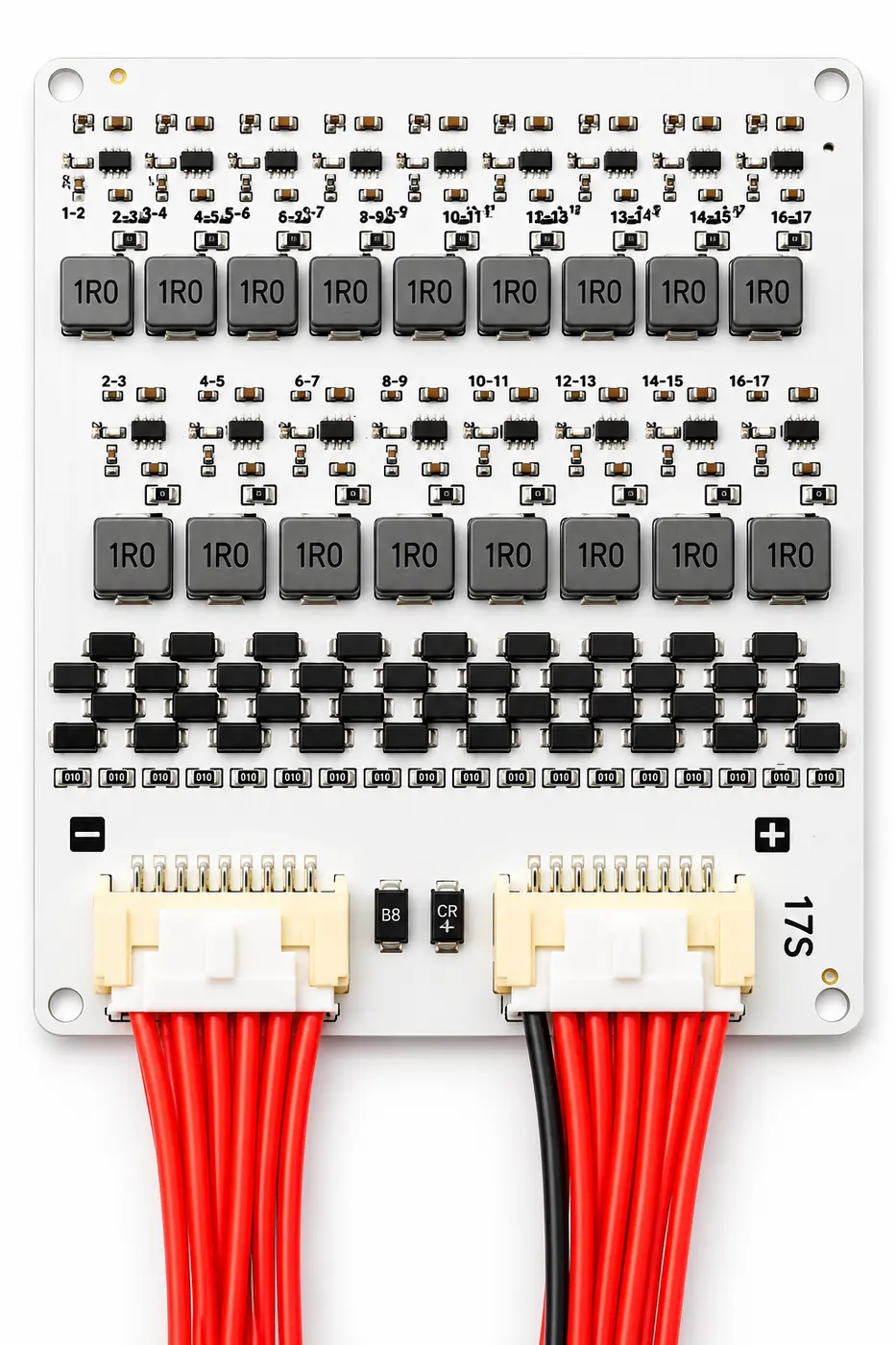
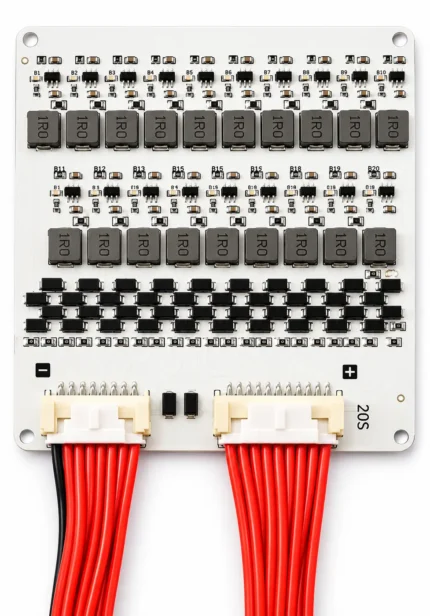
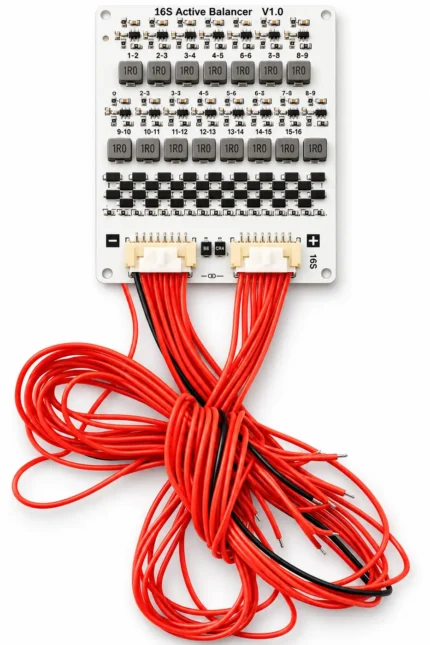
The board contains multiple visible inductive components marked 1R0, indicating an active energy-transfer style balancing circuit.
Active balancing is generally designed to move energy between higher-voltage and lower-voltage cell groups instead of simply dissipating excess energy as heat.
Potential Benefits
- Helps reduce voltage difference between cells
- Improves pack consistency
- Can improve usable battery capacity
- Helps reduce premature BMS cutoff caused by imbalance
- Useful for older or frequently cycled battery packs
- Suitable for larger-capacity lithium batteries
The exact balancing current is not printed on the visible PCB, so it should be confirmed before purchase or installation.
Cell Voltage Balancing
The board connects to each battery series group through dedicated sensing wires.
This allows each cell group to be balanced individually.
Balancing is particularly useful when:
- One or more groups charge faster than the others
- One cell group reaches cutoff earlier
- Cell voltage difference increases under charge
- Battery capacity appears reduced due to imbalance
- The pack is being serviced or rebuilt
- An older battery pack has uneven cell groups
Balance Wiring Harness
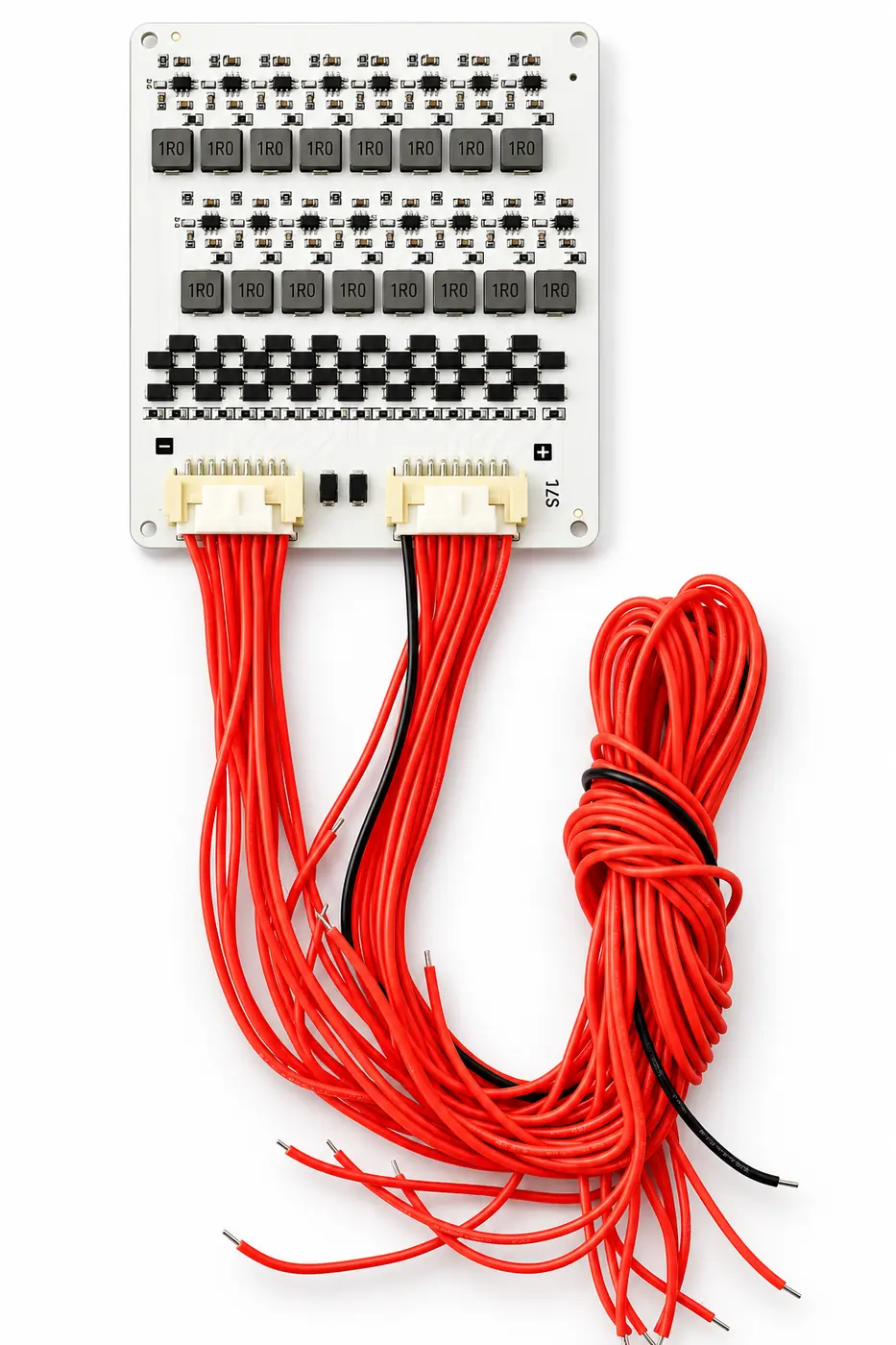
The board is supplied with two multi-pin connectors and individual balance wires.
These wires connect to the battery’s series junction points.
Important
Balance wires must be connected in the correct sequence.
Incorrect connection can cause:
- Balancer damage
- Short circuit
- Incorrect cell-voltage detection
- Battery wiring damage
- Excessive current through balance leads
Always verify the voltage of each balance connection using a multimeter before plugging the harness into the board.
Active Balancer vs BMS
An active balancer and a Battery Management System perform different functions.
Active Balancer
Primarily helps reduce voltage differences between individual cell groups.
BMS
Typically provides safety protection such as:
- Cell over-voltage protection
- Cell under-voltage protection
- Charge over-current protection
- Discharge over-current protection
- Short-circuit protection
- Temperature protection
Important
This 17S active balancer is not a replacement for a BMS.
A suitable BMS should normally remain installed for battery protection.
Board Construction
The balancer uses a rigid PCB with multiple balancing channels.
Visible board features include:
- Multiple 1R0 inductors
- SMD control circuitry
- Multiple power components
- Positive and negative markings
- 17S marking
- Two multi-pin balance connectors
- Four corner mounting holes
The board should be mounted inside the battery enclosure so it is protected from moisture, conductive debris and mechanical damage.
Suitable Applications
This 17S active balancer may be suitable for compatible:
- Electric scooter batteries
- Electric motorcycle batteries
- 60V-class EV battery packs
- NMC lithium battery packs
- Li-ion battery packs
- Solar energy-storage batteries
- Home inverter batteries
- UPS lithium batteries
- Custom battery projects
- Battery repair and rebuilding
- Industrial battery packs
- OEM battery manufacturing
Compatibility must be checked before installation.
Technical Specifications
| Specification |
Details |
| Product Type |
Active Battery Balancer Board |
| Series Configuration |
17S |
| Number of Cell Groups |
Up to 17 |
| Balancing Type |
Active balancing design |
| Circuit Type |
Inductor-based multi-channel PCB |
| Balance Connections |
Multi-pin wiring harness |
| Number of Main Harness Connectors |
2 |
| Inductive Components |
Yes |
| Cell Monitoring Connections |
Individual series groups |
| Chemistry |
Depends on supported cell-voltage range |
| Balancing Current |
Not visible on product; confirm before ordering |
| Main Application |
Lithium Battery Cell Balancing |
| BMS Replacement |
No |
| Typical Use |
EV / Solar / Inverter / Energy Storage |
Compatibility Check Before Ordering
Before purchasing, verify:
- Battery chemistry
- Battery series count – 17S
- Individual cell-voltage range
- Maximum pack voltage
- Balancer operating-voltage range
- Balancing current
- Balance-wire sequence
- Connector configuration
- Battery capacity
- Compatibility with the existing BMS
Do not select a balancer only based on the advertised battery voltage.
The series count and battery chemistry must also match.
Safety Instructions
- Verify every balance-wire voltage before connecting the board.
- Connect balance wires strictly in the correct sequence.
- Never reverse the positive and negative connections.
- Do not short any balance wires.
- Insulate exposed wire ends during installation.
- Do not mount the PCB directly on a conductive surface.
- Keep the board away from water and metal debris.
- Do not exceed the specified operating-voltage range.
- Use an appropriate BMS for battery protection.
- Disconnect the battery before modifying balance wiring.
- Stop using the balancer if abnormal heating or damage is observed.
- Installation should be carried out by someone experienced with lithium battery packs.
Warranty
Warranty is subject to applicable seller or supplier terms.
Damage caused by incorrect wiring, reverse polarity, incorrect cell sequence, short circuit, wrong battery chemistry, water damage or unauthorized modification may not be covered.
Package Includes
1 × 17S Active Battery Balancer Board
2 × Balance Wiring Harnesses with individual cell connection wires
Battery, BMS and other battery-pack components are not included unless specifically mentioned.