
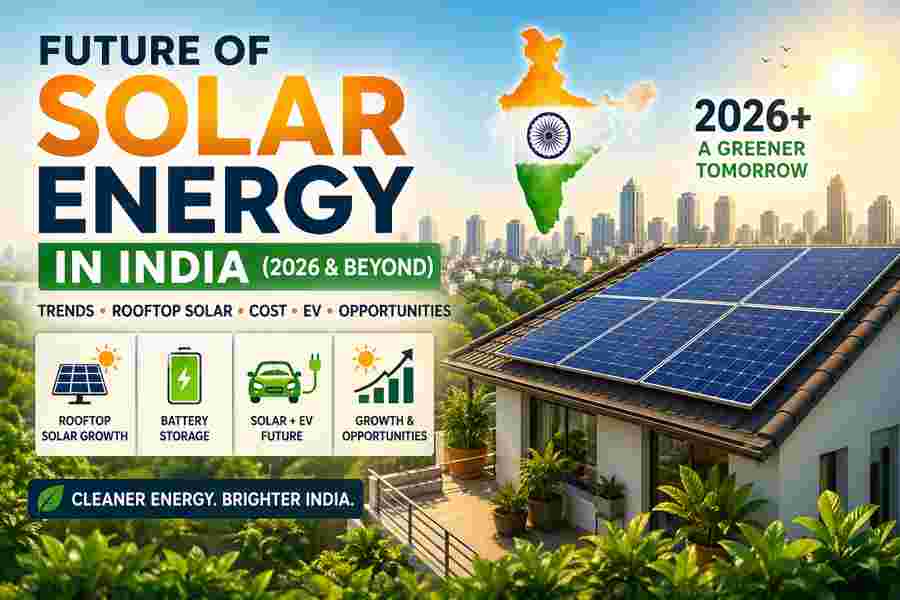
What is the Future of Solar Energy in India?
India is standing at a major energy transformation point. Rising electricity costs, increasing demand, and growing environmental concerns are pushing both homeowners and businesses to look for smarter energy solutions.
👉 And solar energy is leading this change.
But the big question is:
What does the future of solar energy in India look like after 2026?
Is it just about saving electricity bills? Or is something much bigger coming?
In this detailed guide, we’ll explore the future of solar power in India — including technology trends, government policies, EV integration, battery storage, business adoption, and real opportunities.
📈 Why Solar Energy is Growing Rapidly in India
Before we explore the future of solar energy in India, it’s important to understand why solar is already growing so fast today. This growth is not accidental — it is driven by strong economic, technological, and policy factors that are reshaping how electricity is produced and consumed across the country.
🔥 Key Drivers Behind Solar Growth in India
⚡ 1. Rising Electricity Tariffs Across India
One of the biggest reasons behind the surge in solar adoption is the continuous increase in electricity prices.
In India, electricity tariffs have been rising steadily due to:
- Increasing fuel costs (coal, gas, imports)
- High transmission and distribution losses
- Infrastructure upgrades and maintenance costs
- Growing demand from residential and industrial sectors
👉 For homeowners, this means higher monthly electricity bills.
👉 For businesses, this directly impacts operating costs and profit margins.
📊 Real Impact:
- Residential tariffs: ₹6–₹10 per unit
- Commercial tariffs: ₹8–₹12+ per unit
👉 And the most important point:
Electricity prices are unpredictable and likely to increase further.
⚠️ 2. Frequent Power Cuts and Grid Reliability Issues
While major cities have improved infrastructure, many areas in India still face:
- Unexpected power outages
- Voltage fluctuations
- Load shedding during peak demand
👉 For homes, this causes inconvenience.
👉 For businesses, this can lead to downtime and financial losses.
This is where solar — especially with battery storage — becomes highly valuable.
👉 Solar provides reliable and uninterrupted power, reducing dependency on the grid.
🏛️ 3. Strong Government Support and Subsidies
The Indian government is actively promoting solar energy adoption as part of its renewable energy mission.
Key initiatives include:
- Rooftop solar subsidy schemes for residential users
- Net metering policies (export excess power to grid)
- State-level incentives and benefits
- Simplified approval processes in many regions
👉 These policies reduce the initial cost of solar installation and make it more accessible.
Future Outlook:
- Faster approvals
- Better financing options
- Stronger push for solar adoption
👉 Government backing is one of the strongest pillars of solar growth in India.
🌱 4. Increasing Awareness About Clean Energy
People are becoming more aware of environmental issues such as:
- Air pollution
- Climate change
- Carbon emissions
👉 Solar energy is seen as a clean, renewable, and sustainable solution.
Why this matters:
- No fuel required
- No emissions during operation
- Long lifespan (25+ years)
👉 Homeowners and businesses are now choosing solar not just for savings, but also for sustainability.
🚗 5. Rapid Growth of Electric Vehicles (EVs)
The rise of electric vehicles is another major driver for solar adoption.
What’s happening:
- More EVs on the road
- Increased demand for electricity
- Need for affordable charging solutions
👉 Charging an EV using grid electricity can still be expensive.
Solution:
👉 Use solar energy to charge EVs
This creates a powerful combination:
⚡ Solar + EV = Lower running cost + energy independence
💡 Bigger Insight: Why This Growth Matters
👉 Electricity is no longer cheap
👉 Electricity is no longer predictable
This is the biggest shift happening in India.
People are moving from:
👉 Paying monthly electricity bills
👉 To generating their own power
📊 Current Solar Growth in India
India has already crossed:
👉 70+ GW of installed solar capacity
And this is just the beginning.
Future Targets:
- Massive increase in solar capacity by 2030
- Strong focus on rooftop solar systems
- Integration with battery storage and smart grids
👉 The scale of growth expected in the next 5–10 years is enormous.
Solar energy is growing in India because it solves multiple problems at once:
- Reduces electricity bills
- Provides energy security
- Supports environmental goals
- Powers future technologies like EVs
👉 This is not just a temporary trend —
👉 It is a long-term shift in how India will generate and consume energy.
🎯India’s Solar Energy Targets (2026 and Beyond)
India’s Solar Energy Targets 2030 | Government Plans and Future Roadmap
India’s solar journey is no longer just about increasing capacity — it is about restructuring the entire energy ecosystem. The government’s future targets are not only focused on generating more power, but also on how energy is produced, distributed, stored, and consumed across the country.
⚡ 1. Shift from Centralized Power to Distributed Energy
Traditionally, electricity in India has been generated in large power plants and then distributed across cities and villages.
👉 But this model is slowly changing.
Future Direction:
- Power generation will move closer to the point of consumption
- Rooftops, factories, and commercial buildings will act as energy producers
- Dependence on large thermal power plants will reduce
👉 This concept is called decentralized or distributed energy generation.
Why it matters:
- Reduces transmission losses
- Improves energy efficiency
- Enhances grid stability
👉 Solar energy is the backbone of this transition.
🏙️ 2. Solar Integration into Urban Infrastructure
Future solar targets are not limited to installations — they include integration into city planning and infrastructure.
What will change in cities:
- New residential buildings will be designed with solar-ready rooftops
- Commercial complexes will integrate solar as a default energy source
- Parking spaces may include solar canopies
👉 Solar will become part of urban architecture, not just an add-on.
🌾 3. Expansion into Rural and Agricultural Sectors
A major part of India’s solar vision is focused on rural electrification and agriculture.
Key developments expected:
- Solar-powered irrigation systems
- Solar pumps for farmers
- Off-grid solar solutions for remote areas
👉 This reduces dependence on diesel and unstable grid supply.
Impact:
- Lower farming costs
- Increased productivity
- Sustainable rural development
🔋 4. Energy Storage Will Become Policy-Driven
One of the biggest future shifts is the inclusion of energy storage (solar batteries) in national planning.
Earlier focus:
👉 Only generation
Future focus:
👉 Generation + Storage + Smart usage
What this means:
- Policies may encourage battery adoption
- Hybrid solar systems will become more common
- Grid stability will improve
👉 Energy storage will become a critical part of solar infrastructure.
🌐 5. Development of Smart Grids
India is gradually moving towards smart grid systems, which will play a major role in solar expansion.
What is a smart grid?
A system that can:
- Monitor electricity usage in real time
- Balance supply and demand automatically
- Integrate renewable energy efficiently
Future benefits:
- Better handling of solar power fluctuations
- Improved power distribution
- Reduced outages
👉 Smart grids will make large-scale solar adoption more efficient.
🏢 6. Corporate and Industrial Solar Adoption Targets
Government policies are also pushing industries toward renewable energy usage.
What’s happening:
- Large companies are committing to renewable energy targets
- Industrial units are installing captive solar plants
- Green energy compliance is becoming important
👉 Businesses are not just adopting solar for savings, but also for:
- ESG (Environmental, Social, Governance) goals
- Brand positioning
- Regulatory compliance
💰 7. Financial Ecosystem Around Solar Will Expand
Future solar targets are supported by financial innovation.
Expected developments:
- Easier solar loans and financing
- Pay-as-you-save models
- Solar leasing options
- Third-party ownership models
👉 This will make solar accessible even for users who cannot afford upfront investment.
🌍 8. India’s Global Position in Solar Energy
India is aiming to become a global leader in solar energy adoption and manufacturing.
Focus areas:
- Domestic solar panel manufacturing
- Reduced dependence on imports
- Export opportunities
👉 This strengthens India’s position in the global renewable energy market.
🔮 Bigger Insight: Energy Transition, Not Just Solar Growth
India’s solar targets are part of a larger transformation:
👉 From fossil fuels → to renewable energy
👉 From centralized systems → to distributed systems
👉 From passive consumption → to active energy generation
India’s solar roadmap clearly shows that:
👉 The future is not just about installing more solar panels
👉 It is about creating a smarter, cleaner, and more independent energy system
🧠 What This Means for You
- Solar adoption will become more common and standardized
- Early adopters will benefit the most
- Future systems will be more advanced and integrated
👉 In simple words:
Solar energy is not just growing — it is becoming the foundation of India’s future power system.
🏠 Future of Rooftop Solar in India
Why Every Home Will Generate Its Own Power
Rooftop solar is set to become the most visible and widely adopted form of solar energy in India after 2026. Unlike large solar parks that operate in the background, rooftop systems directly empower individuals, businesses, and communities to generate their own electricity.
👉 The future is not just about generating power —
👉 It’s about bringing power generation to every building.
If you’re planning to install a system, understanding the process is important.
You can read our complete guide on solar panel installation at home to learn how it works, cost, and key factors to consider.
🔍 Why Rooftop Solar Will Dominate the Next Phase
💸 1. Urban Electricity Consumption is Exploding
Cities like Bangalore, Mumbai, Delhi, and Hyderabad are witnessing a sharp rise in electricity usage due to:
- Increased use of air conditioners
- Work-from-home setups
- High-rise apartments and gated communities
- Growing number of electrical appliances
👉 This creates a strong need for localized power generation.
Instead of relying entirely on the grid, buildings will start producing a significant portion of their own electricity through rooftop solar.
🏗️ 2. Space Constraints are Forcing Smarter Solutions
India faces a major limitation:
👉 Land is scarce and expensive, especially in urban areas.
Large solar farms require vast land, which is not always feasible near cities.
Rooftop solar solves this problem:
- Uses existing building space
- Requires no additional land
- Converts idle rooftops into productive assets
👉 This makes rooftop solar the most scalable solution for dense urban regions.
🏢 3. Commercial Buildings Will Lead Adoption
While residential homes are important, commercial and industrial buildings will drive large-scale rooftop adoption.
Why?
- Huge rooftop areas
- Daytime electricity usage (matches solar generation)
- Higher electricity tariffs
👉 Offices, malls, warehouses, and factories will increasingly install rooftop solar systems to reduce operational costs.
🔮 What Will Change in Rooftop Solar After 2026
The next phase of rooftop solar growth will be driven by improvements in process, technology, and accessibility.
⚡ 1. Faster and Digitized Approval Systems
Currently, approvals can take time due to paperwork and coordination with electricity boards.
👉 In the future:
- Online approval systems will become standard
- Installation timelines will reduce significantly
- Fewer manual interventions
👉 This will make solar adoption smoother and faster.
🔄 2. Smarter Net Metering and Energy Accounting
Instead of basic net metering, future systems may include:
- Real-time energy tracking
- Dynamic billing models
- Better credit utilization
👉 Users will have greater visibility and control over their energy usage and savings.
💰 3. Cost Optimization Through Scale
As demand increases, economies of scale will bring down costs.
What contributes to lower cost:
- Mass manufacturing of solar panels
- Improved supply chains
- Competitive installation market
👉 This will make rooftop solar affordable for a larger population.
🏦 4. Flexible Financing Models
One of the biggest barriers today is upfront investment.
👉 This is expected to change with:
- Zero upfront cost models
- Monthly subscription-based solar plans
- Pay-as-you-use systems
- Solar leasing options
👉 Solar will become accessible even for those who cannot invest large amounts initially.
🧠 Evolution of Rooftop Solar Systems
Future rooftop systems will not remain basic installations. They will evolve into intelligent energy ecosystems.
Key advancements:
- Integration with smart home systems
- Remote monitoring via mobile apps
- Automatic switching between solar, battery, and grid
- Load prioritization for essential appliances
👉 Users will not just generate electricity — they will actively manage it.
🏢 Rise of Solar-Enabled Buildings
A major transformation we will see is the emergence of:
👉 Solar-enabled or energy-efficient buildings
What this means:
- Solar systems will be included during construction
- Architects will design buildings considering solar exposure
- Builders may offer solar as a standard feature
👉 In the future, buying a home without solar may feel incomplete.
🌐 Community and Shared Solar Models
Another emerging trend is shared or community solar systems.
Example:
- Apartment complexes installing centralized rooftop solar
- Shared benefits among residents
- Reduced individual investment
👉 This makes solar accessible even in multi-story buildings where individual rooftop space is limited.
🔋 Rooftop Solar + Storage Integration
As battery technology improves, rooftop solar systems will increasingly integrate with storage.
Benefits:
- Backup during outages
- Better energy utilization
- Reduced grid dependency
👉 This combination will make rooftop solar more reliable and powerful.
📊 Long-Term Impact of Rooftop Solar
For Individuals:
- Lower electricity bills
- Energy independence
- Increased property value
For Cities:
- Reduced pressure on power infrastructure
- Lower transmission losses
- Cleaner urban environment
For the Nation:
- Reduced dependence on fossil fuels
- Stronger energy security
- Progress towards climate goals
Rooftop solar is not just growing — it is transforming how electricity is generated and consumed.
👉 It turns passive consumers into active producers
👉 It utilizes unused space efficiently
👉 It brings energy control directly to users
💡 In Simple Terms:
👉 Today: Rooftop is just a structure
👉 Future: Rooftop will be a power generator
👉 Every rooftop has the potential to become a mini power plant — and that future is closer than we think.
🔋 Rise of Solar Battery Storage
Solar Battery Storage in India | Why Energy Storage is the Next Big Shift
One of the biggest changes in the future will be:
👉 Battery storage becoming mainstream
Currently, many people avoid batteries due to high cost. But this is changing fast.
Why batteries will grow:
- Falling lithium battery prices
- Need for power backup
- EV integration
- Smart energy usage
Future trend:
👉 Homes will store solar energy and use it anytime
👉 Less dependency on grid
⚡ Solar + EV = Game Changer
Solar + EV Charging in India | How Solar Will Power Electric Vehicles
Electric vehicles are growing rapidly in India.
What does this mean for solar?
👉 Huge increase in electricity demand
👉 More people will install solar to charge EVs
Future scenario:
- Charge your car using rooftop solar
- Reduce fuel cost to near zero
- Use battery + solar combo
👉 Solar + EV is the future of personal energy.
Planning to charge your EV with solar?
👉 Read our detailed guide on charging an electric car using solar panels at home to learn about system size, cost, and real savings.
🏢 Future of Solar for Businesses
Solar for Businesses in India | Cost Savings, ROI, and Future Growth
For businesses, solar is not just an option — it’s becoming a necessity.
Why businesses are switching:
- High electricity bills
- Need to reduce operating costs
- Sustainability goals
- ESG compliance
Future trend:
👉 Commercial buildings will rely heavily on solar
👉 Factories will run on solar + storage
👉 Solar ROI for businesses is becoming stronger every year.
💰 Solar Costs and ROI in Future
Solar System Cost in India and ROI | What to Expect in the Future
One of the biggest concerns people have is cost.
Current situation:
- Solar system cost: ₹1.5–3 lakh (approx for small homes)
- Payback: 3–5 years
Future expectations:
👉 Solar costs will decrease further
👉 Efficiency will improve
👉 ROI will become even faster
👉 Electricity prices will keep rising — making solar more attractive.
🧠 Smart Solar Systems (AI + Automation)
How AI and Technology Are Changing Solar Energy
Future solar systems will not be “basic”.
They will become smart.
What does that mean?
- AI-based energy management
- Automatic load balancing
- Smart monitoring apps
- Predictive maintenance
👉 Your solar system will think for you.
🔧 Hybrid Solar Systems Will Dominate
On-Grid vs Hybrid Solar Systems | What Will Dominate the Future?
Currently, most people install on-grid systems.
But future trend:
👉 Hybrid systems will become standard
Why?
- Battery compatibility
- Backup + savings
- Flexibility
👉 Even if people start without battery, they will upgrade later.
Confused about adding a battery to your solar system?
Read our complete guide on solar panel with battery vs no battery to compare cost, savings, and backup benefits.
📊 Government Policies and Support
Government support is a major driver for solar growth.
Key initiatives:
- Subsidies for rooftop solar
- Net metering policies
- Renewable energy targets
- State-level incentives
Future expectations:
👉 Faster approvals
👉 Better subsidy schemes
👉 Strong push for adoption
🌍 Environmental Impact
Environmental Benefits of Solar Energy in India | Why It Matters
Solar is not just about money.
It’s about sustainability.
Benefits:
- Reduces carbon footprint
- Clean energy source
- Reduces pollution
👉 Future generations will depend on renewable energy.
⚠️ Challenges in Solar Growth
Challenges in Solar Energy Adoption in India (And How They Are Changing)
Even though the future is bright, there are challenges:
- High initial cost (for some users)
- Lack of awareness
- Poor installer quality
- Policy changes in some states
👉 But these challenges are reducing over time.
🚀 Opportunities in Solar Industry
Solar Business Opportunities in India | Market Growth and Future Scope
Solar is not just for consumers — it’s a huge opportunity.
Business opportunities:
- Solar installation companies
- Solar Battery solutions
- EV charging integration
- Solar financing
👉 The solar industry is creating massive job and business opportunities.
📍 Real Future Scenario (India)
Future of Solar-Powered Homes (Real Scenario for 2030)
Let’s imagine a typical Indian home in 2030:
- Rooftop solar installed
- Hybrid inverter system
- Battery storage
- EV parked and charging
- Electricity bill close to zero
👉 This is not future — it’s coming soon.
🧠 Should You Invest in Solar Now? Smart Strategy for Homeowners and Businesses
If you’re planning solar:
👉 Don’t wait for “perfect time”
Smart approach:
- Start with rooftop solar
- Use hybrid inverter
- Upgrade battery later
👉 This gives flexibility and savings.
🏁 Why Solar Energy is the Future of India
The future of solar energy in India is extremely promising.
👉 Solar is no longer an alternative
👉 It is becoming the primary energy source
After 2026, we will see:
- Massive rooftop solar growth
- Battery adoption increase
- EV + solar integration
- Smart energy systems
👉 The biggest shift is not technology — it’s mindset.
People are moving from:
👉 Paying for electricity
👉 To producing their own energy
🔥 The Real Question is Not “Why Solar?” — It’s “When Will You Start?”
The question is no longer:
❌ “Should I install solar?”
👉 The real question is:
✅ “When should I start?”
And the answer is:
👉 The sooner, the better.
If you’re planning solar panel installation in Bangalore, choosing the right system is critical. Solar Energy Company PowerKart in Bangalore, helps you design the ideal solar setup — whether on-grid or hybrid — based on your usage, budget, and future needs, ensuring maximum savings and long-term performance.
FAQs
Which state is leading in solar energy in India?
Rajasthan is currently the leading state in solar energy in India in terms of installed solar capacity.
India’s largest solar capacity Home to the famous Bhadla Solar Park (one of the world’s biggest) Ideal conditions: high sunlight + vast land availability
Which country is no. 1 in solar energy?
China is the No. 1 country in solar energy in the world (by total installed solar capacity).
China
- Largest installed solar capacity globally (hundreds of GW)
- Massive utility-scale solar farms
- Strong government push + manufacturing dominance
What is India’s rank in solar power?
India is currently ranked 3rd in the world in solar power (by total installed capacity).
Global Ranking (Approximate Latest)
- 🥇 China – #1 (largest by a big margin)
- 🥈 United States – #2
- 🥉 India – #3
Which country is 100% renewable energy?
No country runs 100% on renewable energy all the time.
But a few countries come very close for electricity generation (not total energy use like transport, industry, etc.).
Countries Closest to 100% Renewable Electricity
Iceland
One of the cleanest energy systems in the world
Nearly 100% renewable electricity
Sources: geothermal + hydropower
What 7 countries are renewable energy?
There is no country that is 100% renewable in all energy use, but several countries run almost entirely on renewable electricity.
The top countries with very high renewable electricity share are:
- Iceland
- Costa Rica
- Bhutan
- Paraguay
- Norway
- New Zealand
- Denmark
👉 These countries generate most of their electricity from renewable sources like hydro, wind, and geothermal energy.