
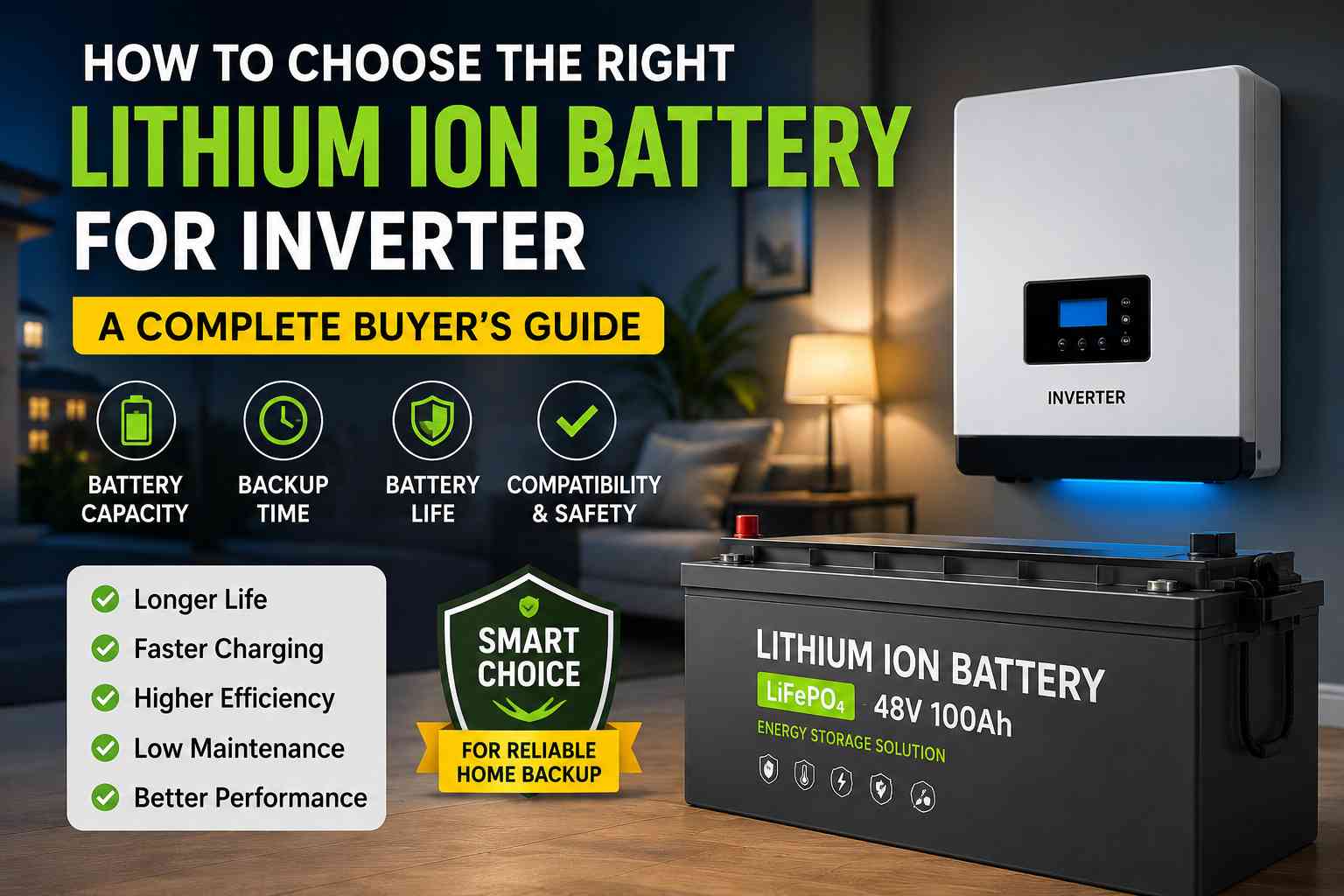
compare battery capacity, backup time, battery chemistry, lifespan, compatibility, and long-term value.
If you were buying a new inverter battery today, would you still choose the same technology that households have relied on for the past three decades?
This is a question many homeowners are now asking as lithium battery technology becomes increasingly popular for home backup and solar energy storage systems.
A lithium ion battery for inverter applications can offer longer lifespan, faster charging, higher efficiency, and lower maintenance compared to traditional lead-acid batteries. However, with different battery chemistries, capacities, voltages, and compatibility options available, choosing the right battery can feel overwhelming.
This complete buyer’s guide explains everything you need to know before investing in a lithium ion battery for your inverter system.
However, choosing the right lithium ion battery for an inverter is not always straightforward.
Questions such as:
- What battery capacity should I choose?
- Which lithium battery chemistry is best?
- How much backup can I expect?
- Will my existing inverter support lithium batteries?
- Is a lithium battery worth the additional investment?
are common among homeowners planning to upgrade their backup systems.
This comprehensive buyer’s guide explains everything you need to know before purchasing a lithium ion battery for inverter applications, helping you make an informed decision that delivers reliable backup power, long battery life, and the best long-term value.
Why More Homeowners Are Switching to Lithium Ion Batteries for Inverters
For many years, lead-acid batteries dominated the home inverter market because they were affordable and widely available.
However, advances in battery technology have significantly changed the landscape.
Today’s lithium ion batteries offer several advantages:
- Faster charging
- Longer lifespan
- Higher efficiency
- Lower maintenance
- Reduced weight
- Greater usable capacity
- Better compatibility with solar systems
As a result, lithium battery systems are becoming increasingly popular for:
- Home inverter backup
- Solar energy storage
- Hybrid solar inverters
- Apartment backup systems
- Commercial backup applications
- Energy storage systems (ESS)
What Is a Lithium Ion Battery for Inverter?
A lithium ion battery for inverter is a rechargeable battery system designed to store electrical energy and supply power during outages.
Unlike traditional batteries that use lead plates and acid electrolyte, lithium batteries use lithium-based electrochemical materials that provide:
- Higher energy density
- Faster charging capability
- Improved cycle life
- Better efficiency
- Lower maintenance requirements
Modern inverter batteries typically include:
- Battery cells
- Battery Management System (BMS)
- Protection circuitry
- Communication interfaces
- Temperature monitoring systems
- Battery balancing circuits
These components work together to ensure safe and reliable operation.
Why Lithium Batteries Are Better Than Traditional Inverter Batteries
Longer Lifespan
One of the biggest advantages of lithium batteries is their extended service life.
Typical battery lifespan comparison:
| Battery Type | Expected Lifespan |
| Lead Acid Battery | 3–5 years |
| Tubular Battery | 4–6 years |
| Lithium Ion Battery | 8–15 years |
| LiFePO4 Battery | 10–15 years |
Although lithium batteries require a higher initial investment, they often deliver better long-term value.
Faster Charging
Lithium batteries charge significantly faster than lead-acid batteries.
For example:
| Battery Type | Typical Charging Time |
| Lead Acid | 8–12 hours |
| Tubular | 6–10 hours |
| Lithium Ion | 2–4 hours |
This becomes especially important when:
- Grid availability is limited
- Solar charging windows are short
- Frequent power cuts occur
Greater Usable Capacity
Traditional lead-acid batteries typically allow only about:
- 40–50% usable capacity
Lithium batteries can safely provide:
- 80–95% usable capacity
This means you obtain substantially more backup power from the same battery rating.
Maintenance-Free Operation
Lead-acid batteries often require:
- Water topping
- Terminal cleaning
- Periodic maintenance
- Ventilation management
Lithium batteries eliminate these requirements entirely.
Understanding Lithium Battery Chemistry
Not all lithium batteries are identical.
Several lithium chemistries exist, but only some are suitable for inverter applications.
Lithium Iron Phosphate (LiFePO4)
LiFePO4 batteries have become the preferred choice for:
- Home inverters
- Solar energy storage
- Hybrid solar systems
- Backup power systems
Advantages include:
- Excellent safety
- Long cycle life
- High thermal stability
- Low maintenance
- Superior reliability
NMC (Nickel Manganese Cobalt)
NMC batteries offer:
- Higher energy density
- Smaller size
- Lower weight
However:
- Thermal management is more critical
- Cycle life is generally lower than LiFePO4
How Much Battery Capacity Do You Need?
One of the most common mistakes buyers make is choosing the wrong battery capacity.
Battery sizing depends on:
- Connected load
- Backup duration
- Future expansion
- Solar generation
- Budget
Step 1: Calculate Your Load
Example:
| Appliance | Power |
| Fans | 250W |
| Lights | 100W |
| TV | 150W |
| Refrigerator | 250W |
| Laptop | 100W |
Total load:
850W
Step 2: Determine Backup Duration
Suppose you need:
4 hours backup
Required energy:
850 × 4=3400 Wh
Step 3: Choose Battery Size
For example:
48V 100Ah battery
48 × 100=4800 Wh
Usable energy:
4800 × 90%=4320 Wh
This battery would comfortably support your requirement.
Which Voltage Battery Should You Choose?
Common lithium inverter battery voltages include:
| Voltage | Application |
| 12V | Small backup systems |
| 24V | Small homes |
| 48V | Most residential systems |
| 96V+ | Commercial systems |
For most modern home inverter systems:
48V batteries are usually the best option.
Is Your Existing Inverter Compatible?
Many homeowners ask:
Can I replace my lead-acid battery with a lithium ion battery?
The answer is:
Sometimes.
Before upgrading, verify:
- Charging voltage
- Float voltage
- Battery communication
- BMS compatibility
- Current limits
- Charging algorithm
Hybrid solar inverters generally provide better lithium battery support.
Understanding Battery Management Systems (BMS)
The Battery Management System(BMS) is one of the most important components of a lithium battery.
The BMS continuously monitors:
- Cell voltage
- Temperature
- Current
- Battery balancing
- State of charge
- State of health
It protects against:
- Overcharging
- Deep discharge
- Short circuits
- Overheating
- Excessive current
A high-quality BMS significantly improves battery lifespan and safety.
How Long Does a Lithium Ion Battery Last?
Battery life depends on:
- Temperature
- Charging habits
- Depth of discharge
- Battery quality
- BMS performance
- Usage pattern
Typical cycle life:
| Battery Type | Cycle Life |
| Lead Acid | 300–700 |
| Tubular | 1000–1500 |
| Lithium Ion | 2000–5000 |
| LiFePO4 | 4000–8000 |
For most homeowners, this translates to:
10–15 years of service.
How Much Does a Lithium Ion Battery for Inverter Cost?
Battery prices depend on:
- Capacity
- Cell quality
- Battery chemistry
- BMS features
- Warranty
Approximate pricing:
| Battery Size | Price Range |
| 12V 100Ah | ₹20,000–₹35,000 |
| 24V 100Ah | ₹35,000–₹60,000 |
| 48V 100Ah | ₹60,000–₹1,00,000 |
| 48V 200Ah | ₹1,00,000–₹2,00,000 |
Although the upfront investment is higher, lifetime ownership costs are often lower.
Lithium Battery vs Lead Acid Battery for Inverter
Understanding the differences between lithium and lead-acid batteries can help you choose the most reliable and cost-effective backup solution for your home.
| Feature | Lead Acid | Lithium Ion |
| Lifespan | 3–5 years | 10–15 years |
| Maintenance | High | Minimal |
| Charging Speed | Slow | Fast |
| Efficiency | 70–80% | 90–98% |
| Weight | Heavy | Light |
| Usable Capacity | 50% | 90% |
| Solar Compatibility | Moderate | Excellent |
| Total Cost of Ownership | Higher | Lower |
Common Mistakes Buyers Make
Buying Only Based on Price
Cheaper batteries often provide:
- Lower cycle life
- Poor BMS quality
- Reduced reliability
Ignoring Battery Compatibility
Not every inverter supports every lithium battery.
Underestimating Backup Requirements
Many homeowners buy insufficient battery capacity.
Ignoring Future Expansion
Power requirements often increase over time.
Choosing Low-Quality Cells
Battery performance depends heavily on cell quality.
Questions to Ask Before Buying
Before purchasing a lithium ion battery for inverter systems, ask:
What is the battery chemistry?
What is the cycle life?
What BMS is used?
What warranty is offered?
Is the battery expandable?
Is it compatible with my inverter?
What backup time can I expect?
What safety protections are included?
Why Lithium Batteries Work Best With Solar Systems
Lithium batteries are especially effective with:
- Hybrid solar inverters
- Solar energy storage systems
- Net metering systems
- Home backup systems
Their advantages include:
- Faster solar charging
- Better efficiency
- Longer lifespan
- Greater usable capacity
- Intelligent battery management
This makes them ideal for modern energy storage applications.
Should You Buy a Lithium Ion Battery for Your Inverter?
A lithium battery is usually the best investment when:
✔ You want long battery life
✔ You need faster charging
✔ You prefer maintenance-free operation
✔ You have a solar system
✔ You experience frequent power cuts
✔ You want better long-term value
Traditional batteries may still be suitable if:
✔ Budget is the primary concern
✔ Backup requirements are minimal
✔ Maintenance is not an issue
Final Thoughts
Choosing the right lithium ion battery for inverter applications involves much more than comparing battery prices.
Battery chemistry, capacity, backup requirements, inverter compatibility, cycle life, BMS quality, warranty support, and future expansion capabilities all play important roles in determining the long-term value of your investment.
For most modern homes, LiFePO4 lithium batteries have emerged as the preferred choice because they offer exceptional lifespan, fast charging, superior efficiency, and minimal maintenance.
Before making a purchase decision, evaluate your energy requirements carefully, calculate your expected backup time, and ensure compatibility with your inverter system.
Companies specializing in lithium batteries, solar energy storage, and inverter backup systems, such as PowerKart, can help homeowners select the right battery capacity, inverter compatibility, and energy storage solution based on their current and future power requirements.
The cheapest battery is not always the best investment. The right battery is the one that delivers reliable backup power, long service life, and the greatest value over many years of ownership. 🔋⚡🏠☀️