
What Is a Hybrid Solar Inverter?
Before we go deeper into hybrid systems, it’s important to understand one thing clearly—every solar setup depends heavily on the inverter.
If you’re new to this topic or want a complete breakdown of how solar power inverters work, types of solar inverters, and how to choose the right one, you can read our detailed guide on solar power inverters for home use. This will help you clearly understand the basics before moving on to hybrid systems.
Now coming to hybrid technology.
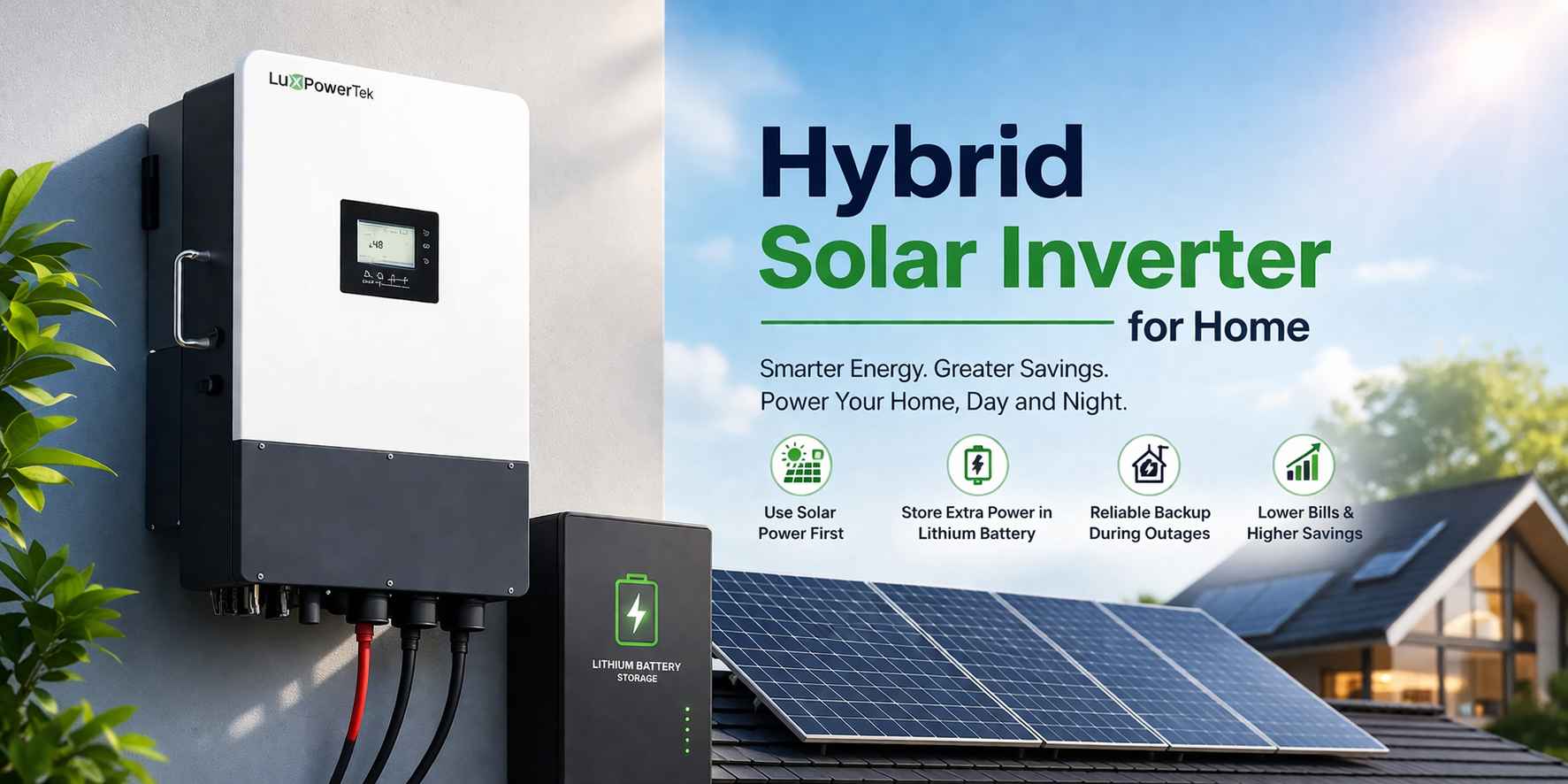
A hybrid solar inverter is an advanced type of inverter designed to work with multiple energy sources at the same time:
- Solar panels
- Lithium battery
- Grid electricity
Unlike a basic inverter that only converts electricity, a hybrid inverter actively manages how energy flows inside your home.
It intelligently decides:
👉 Should your home use:
- Solar power during the day
- Stored battery energy when needed
- Grid electricity as backup
This ability to switch between sources automatically makes it one of the most practical and future-ready solutions for modern homes, especially in areas where both cost savings and power reliability matter.
🔋 Benefits of Hybrid Solar Inverter
Now let’s focus on what most homeowners actually want to understand:
👉 Why should you choose a hybrid solar inverter for home instead of a basic system?
The answer lies in how modern energy needs have changed. Today, people don’t just want to reduce electricity bills—they want reliability, control, and long-term value. A hybrid solar inverter delivers all of this in one system.
Let’s break it down in detail.
🔥 1. Lower Electricity Bills with Smarter Energy Use
One of the biggest reasons people install solar systems is to reduce their electricity bills. But the way a hybrid system achieves this is much more efficient compared to a basic on grid setup.
In a typical system with a hybrid solar inverter, your home follows a smart energy flow:
- In the daytime, your home mainly uses electricity generated from solar panels.
- Any extra electricity generated is stored in a lithium battery
- Only when both solar and battery are insufficient does the system use grid power
This approach ensures that you are using maximum solar energy instead of relying on expensive grid electricity.
In contrast, an on grid system may send excess power to the grid, but you don’t always get full value for it. With a hybrid system, that extra energy stays with you.
👉 The result is simple:
You reduce your monthly electricity bill significantly while also gaining control over how your energy is used.
🔋 2. Reliable Backup During Power Cuts
In many parts of India, including cities like Bangalore, power cuts may not be frequent—but they still happen. And when they do, they can disrupt work, daily routines, and even essential appliances.
This is where a hybrid solar inverter for home becomes extremely valuable.
When paired with a lithium battery:
- When a power cut happens, the system shifts to battery backup on its own.
- Lights, fans, Wi-Fi, and essential appliances continue to run
- There is no need for a generator or manual switching
Unlike an on grid system, which shuts down during a power cut, a hybrid system keeps your home running smoothly.
👉 This is not just convenience—it’s reliability.
⚡ 3. Smart Energy Management and Automation
A hybrid inverter is not just a converter—it is an intelligent energy manager.
It continuously monitors:
- Solar generation
- Battery charge level
- Household consumption
- Grid availability
Based on this, it makes real-time decisions such as:
- When to use solar power
- When to store energy in the battery
- When to draw power from the grid
This automatic decision-making improves overall efficiency without requiring any manual intervention.
👉 In simple terms:
Your system becomes smart enough to optimize energy usage on its own.
📈 4. Maximum Utilization of Solar Power
One of the biggest problems with traditional solar setups is underutilization of generated energy.
In an on grid system:
- Excess energy is exported to the grid
- You may not get full value for it
- You lose control over your own generated power
With a hybrid solar inverter:
- Any extra solar energy is stored in a solar battery—typically a lithium battery—for use later.
- This stored energy is used later in the evening or at night
- Your dependence on grid power reduces significantly
👉 This means:
You are using more of your own solar power instead of giving it away.
Over the long run, this helps you get better value from your investment.
🏙️ 5. Perfect Fit for Indian Homes
A hybrid solar inverter is especially suitable for Indian households due to practical reasons.
In cities like Bangalore:
- Electricity tariffs are relatively high
- Power reliability can vary by area
- Homes have a mix of day and night energy usage
A hybrid system handles all of this effectively:
- Reduces dependency on expensive grid power
- Provides backup when needed
- Balances energy usage throughout the day
👉 It is not just a solar system—it becomes a complete energy solution.
⚠️ Challenges of Hybrid Solar Inverter (Detailed Reality Check)
While hybrid systems offer many advantages, it’s important to understand their limitations as well. A well-informed decision always considers both benefits and challenges.
💰 1. Higher Initial Investment
Compared to an on grid solar system, a hybrid setup requires:
- A hybrid inverter (more advanced technology)
- A lithium battery (major cost component)
This increases the upfront cost of installation.
However, this should not be viewed as an expense alone. It is an investment that provides:
- Backup power
- Better energy usage
- Long-term savings
👉 Still, for budget-conscious users, the initial cost can be a deciding factor.
🔋 2. Battery Replacement Over Time
Even though lithium batteries are highly efficient and long-lasting, they do not last forever.
- Typical lifespan: 8–12 years
- After that, replacement is required
This is an important long-term cost consideration.
However, compared to traditional lead-acid batteries Lithium batteries last longer:
- Require almost no maintenance
- Offer better performance
👉 So while replacement is needed eventually, the overall value remains strong.
⚙️ 3. More Complex System Design
A hybrid solar system is more advanced than a simple on grid system.
It involves:
- Solar panels
- Hybrid inverter
- Battery system
- Smart energy management
Because of this, proper system design is critical.
- Incorrect sizing can reduce efficiency
- Poor installation can cause performance issues
👉 This is why choosing the right solar panel installer And best solar company is just as important as choosing the right equipment.
🔧 4. Dependence on Quality Installation and Service
Hybrid systems require professional setup and good after-sales support.
If installation is not done properly:
- Battery performance may suffer
- Energy flow may not be optimized
- System efficiency may drop
👉 In simple terms:
A good system can perform poorly if installed incorrectly.
🛠️ How to Overcome the Challenges of Hybrid Solar Inverter
While hybrid solar systems offer powerful advantages like savings, backup, and energy control, the real difference between a good decision and a great investment lies in how you handle the challenges.
Instead of seeing these as problems, think of them as planning checkpoints. If you address them correctly from the beginning, a hybrid solar inverter for home becomes one of the most reliable long-term investments you can make.
Let’s go deeper into each challenge—and more importantly, how to fix it.
💰 1. Managing the Higher Initial Investment
The biggest concern for most homeowners is the upfront cost. A hybrid system costs more because it includes a hybrid solar inverter and a lithium battery, which are both advanced components.
But here’s the mistake many people make:
👉 They compare only initial cost, not long-term value.
✅ How to Fix This
✔ Think in Terms of Lifetime Savings, Not Price
Instead of asking:
❌ “How much does it cost today?”
Ask:
✔ “How much money could this save me in the long run?”
A hybrid system:
- Reduces electricity bills every month
- Provides backup (saving generator cost)
- Protects against rising tariffs
👉 Over time, these savings often offset the higher initial investment.
✔ Start with a Scalable System
You don’t have to set up the entire system all at once.
You can:
- Install hybrid inverter now
- Add lithium battery later
👉 This reduces initial burden while keeping future flexibility.
✔ Explore Financing Options
Today, many homeowners are using:
- Solar loans
- EMI-based installation
- BNPL (Buy Now Pay Later) solar models
👉 This allows you to pay monthly while saving monthly, balancing cash flow.
✔ Optimize System Size
Oversizing your system increases cost unnecessarily.
A good installer will:
- Match system size to your actual usage
- Avoid overinvestment
👉 Smart sizing = lower cost + better ROI
🔋 2. Handling Battery Replacement Smartly
Yes, lithium batteries do not last forever. But this is not a disadvantage if planned properly.
✅ How to Fix This
✔ Choose High-Quality Lithium Battery
Not all batteries are equal.
Look for:
- Proven brand
- Strong warranty (5–10 years)
- Good BMS (Battery Management System)
👉 A better battery lasts longer and performs more efficiently.
✔ Plan Replacement as Part of Lifecycle Cost
Instead of treating replacement as a surprise:
- Include it in long-term planning
- Spread cost over 10 years mentally
👉 This removes financial shock later.
✔ Avoid Deep Discharge Habits
Battery life depends on usage.
To extend lifespan:
- Avoid draining battery to 0% regularly
- Maintain healthy charge cycles
👉 Smart usage can increase battery life significantly.
✔ Use Battery Only Where Needed
Not all loads need backup.
You can:
- Connect only essential appliances
- Reduce battery load
👉 Less stress = longer battery life
⚙️ 3. Solving Complex System Design Issues
A hybrid solar system is more advanced than a basic setup. It requires proper integration of solar panels, inverter, and battery.
Poor design is one of the biggest reasons systems underperform.
✅ How to Fix This
✔ Focus on Load-Based Design (Not Just Panel Count)
Instead of saying:
❌ “I want 5kW system”
You should ask:
✔ “How much electricity do I use during the day compared to at night?”
A proper design considers:
- Hourly consumption
- Peak loads
- Backup requirements
👉 This ensures the system is designed for your real usage, not assumptions.
✔ Choose the Right Type of Inverter
Depending on your needs:
- On grid solar inverter → only savings
- Hybrid solar inverter → savings + backup
- 48V off grid inverter → full independence
👉 Wrong inverter choice = wrong system performance
✔ Plan for Future Expansion
Your energy needs will grow.
Design system with:
- Extra capacity margin
- Expandable battery option
👉 Future-ready system saves rework cost.
✔ Avoid Mixing Incompatible Components
Using mismatched:
- Batteries
- Inverters
- Panels
👉 Leads to inefficiency or failure
Always ensure:
✔ System components are compatible
🔧 4. Ensuring Proper Installation and Service
Even the best hybrid solar inverter can fail if installation is poor.
Many people ignore this risk, even though it can be quite serious.
✅ How to Fix This
✔ Choose Experienced Solar panel Installer (Most Important Step)
Don’t choose based only on price.
Look for:
- Real project experience
- Technical knowledge
- After-sales support
👉 A good installer ensures:
- Correct wiring
- Proper safety
- Optimal performance
✔ Check Installation Quality Points
Before finalizing, confirm:
- Proper earthing
- Correct cable sizing
- Safe battery installation
- Clean layout
👉 These directly impact system life and safety.
✔ Ensure Monitoring System Is Installed
A good hybrid system should allow you to track:
- Daily solar generation
- Battery usage
- Grid consumption
👉 This helps detect issues early.
✔ Prioritize After-Sales Support
Ask clearly:
- Who will handle service?
- What is response time?
👉 Because long-term performance depends on support.
🧠 Final Practical Advice (Most Important Section)
If you handle these four areas correctly:
- Cost planning
- Battery strategy
- System design
- Installation quality
👉 Then a hybrid solar inverter system becomes:
✔ Highly efficient
✔ Long-lasting
✔ Financially rewarding
📌 Simple Summary
Challenge → Solution:
- High cost → Plan ROI + financing + scalable setup
- Battery replacement → Choose quality + plan lifecycle
- Complex design → Focus on usage-based design
- Installation risk → Choose experienced installer
If you want to understand how these factors affect real installation cost, system sizing, and government subsidy in Bangalore, read our detailed guide by powerkart on solar panel installation in Bangalore.
Final Thought
Most people think solar is just about panels.
But the truth is:
👉 A successful solar system is built on good decisions, not just good equipment.
And when you solve these challenges correctly, a hybrid solar inverter for home becomes one of the smartest long-term investments you can make.
FAQS
Which company is best for hybrid solar inverters?
There isn’t one single “best” company for hybrid solar inverters because the right choice depends on your home’s needs, budget, and how well the system is installed. That said, some well-known and trusted brands in India include Luminous, Microtek, V-Guard, Deye, and Luxpower.
Among these, Luxpower hybrid solar inverters are becoming increasingly popular for modern homes. They are known for:
- High efficiency for better energy output
- Smart control between solar, battery, and grid
- Compatibility with lithium battery systems
- Reliable backup during power cuts
- Options for both single-phase and three-phase setups
In Bangalore, companies like PowerKart supply and install Luxpower inverters with proper system design, correct sizing, and dependable after-sales support—this makes a big difference in real-world performance.
How much does a hybrid solar inverter cost in Bangalore?
The price of a hybrid solar inverter in Bangalore mainly depends on its capacity, brand, and features like lithium battery compatibility.
Typical price range:
- 1–3 kW → ₹30,000 to ₹80,000
- 3–5 kW → ₹80,000 to ₹1.2 lakh
- 5–10 kW → ₹1.2 lakh to ₹2.5 lakh
- 3-phase systems → ₹2 lakh to ₹5 lakh+
For most homes, a 3–5 kW inverter is common and usually costs around ₹80,000 to ₹1.5 lakh, depending on the brand and features.
What are the disadvantages of a hybrid solar inverter?
While hybrid systems offer many advantages, there are a few things to consider:
- Higher upfront cost compared to on-grid systems
- Battery adds to the total cost and needs replacement after some years
- System design and installation are more complex
- Requires good service support for smooth long-term performance
In short, you get more features and flexibility—but at a higher cost and complexity.
What is the lifespan of a hybrid solar inverter?
A hybrid solar inverter usually lasts around 8 to 12 years, depending on how it is used and maintained.
With proper installation and good care, high-quality inverters can last even longer. However, the battery connected to the system may need replacement earlier.
Can I run an AC on a hybrid solar system?
Yes, running an AC on a hybrid solar system is absolutely possible, provided the system is properly sized.
- A 3–5 kW system or higher can run a 1–1.5 ton AC
- During the day, the AC runs directly on solar power
- At night or during outages, it can run on battery backup (if capacity allows)
The key is correct sizing of both the inverter and battery.
What is the cost of a 3kW hybrid solar system?
A 3kW hybrid solar system in India typically costs:
₹2.1 lakh to ₹3 lakh before subsidy
Around ₹1.3 lakh to ₹1.6 lakh after subsidy
The final price depends on battery type, inverter brand, and installation quality.