
How Do You Choose the Right Battery for Running a Split AC Efficiently?
Running a split air conditioner on solar or an inverter is no longer just an idea — it’s becoming a real need for many homes and businesses.
With rising electricity bills, frequent power cuts, and increasing temperatures, people are actively looking for reliable solar battery backup solutions. But one question comes up almost every time:
What type of battery should I use to run a split AC efficiently?
This is not a small decision. Choosing the wrong battery can lead to poor backup, frequent breakdowns, and unnecessary expenses. On the other hand, the right setup can give you smooth performance, long backup, and peace of mind.
In this guide, we’ll explain everything in simple terms so you can make the right choice.
⚡ Why Running an AC is Different from Other Appliances
Before selecting a battery, it’s important to understand how an AC behaves.
Unlike lights, fans, or TVs, an air conditioner:
- Requires a high starting current
- Runs continuously for long hours
- Consumes a significant amount of power
This makes it one of the heaviest loads in a home.
Because of this, the battery you choose must be capable of:
- Handling sudden load spikes
- Delivering consistent power
- Maintaining performance over long durations
Not all batteries are designed for this.
🔍 Types of Batteries Used in Solar Panels and Inverter Systems
When people look for battery options, they usually come across two broad categories:
- Traditional deep-cycle batteries
- Modern lithium-based batteries
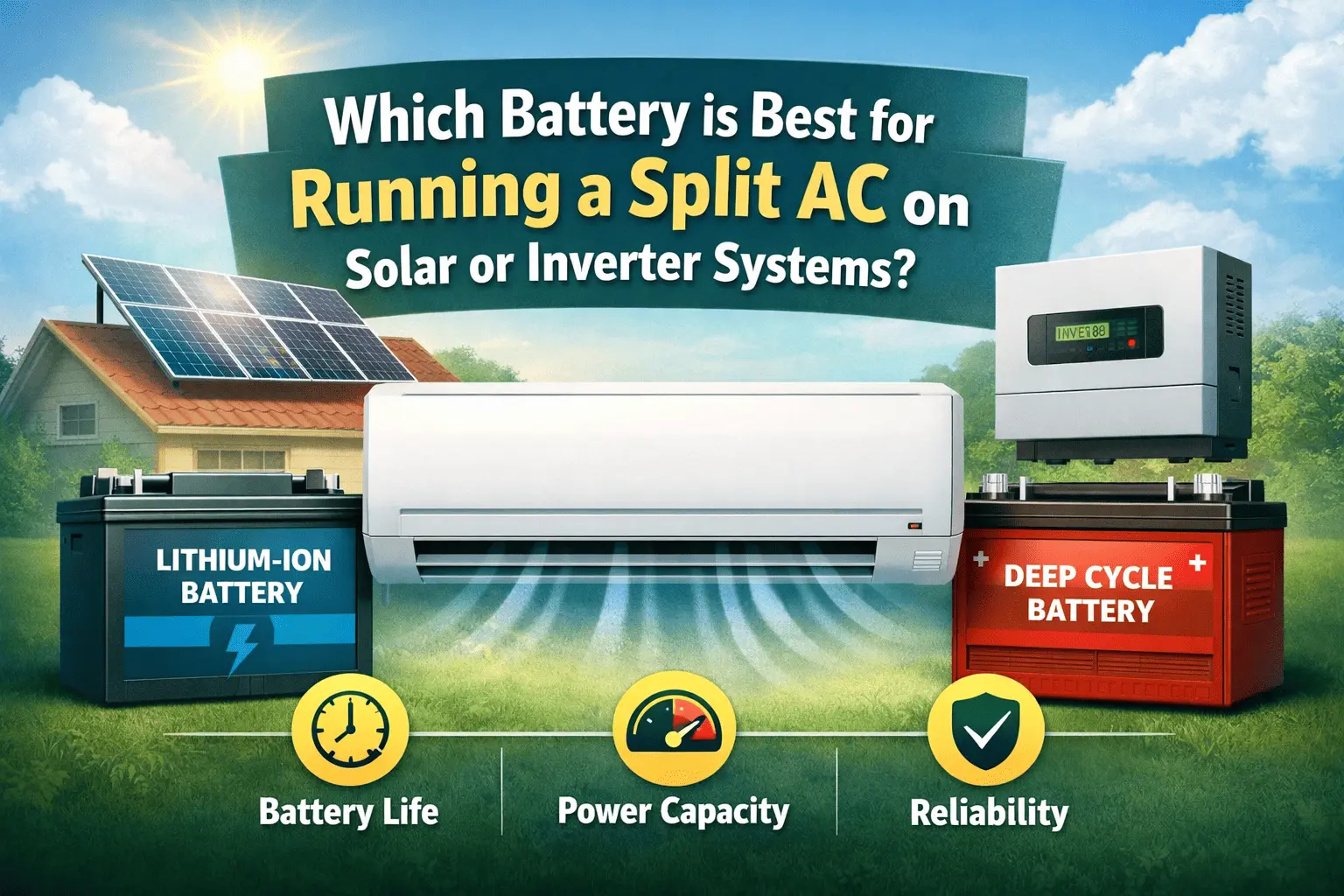
Both are used in homes and solar systems, but their performance in real-world applications can be very different.
👉 The choice of battery plays a crucial role in running a split AC efficiently. While traditional and modern battery technologies both exist, their real-world performance differs significantly in terms of backup, efficiency, and lifespan. We’ve explained this in detail in our battery comparison guide, where you can understand which option is best for your needs
🔋 Understanding Power Requirement of a Split AC
To choose the right battery, you must first understand how much power your AC consumes.
For a typical split AC:
- 1 Ton AC → ~1–1.2 kW
- 1.5 Ton AC → ~1.5–2 kW
- 2 Ton AC → ~2–3 kW
Also, when the compressor starts, it can draw 2–3 times higher power for a few seconds.
This means your system must be designed not just for running load, but also for starting load.
⚙️ What Makes a Battery Suitable for AC Load?
Not every battery that works for lights or fans will work efficiently for an AC.
A good battery for AC should:
- Deliver high current instantly
- Maintain stable voltage
- Support long discharge cycles
- Recharge efficiently
If any of these are missing, you may face:
- AC not starting properly
- Frequent system trips
- Reduced backup time
⚡ Importance of System Voltage (Very Critical)
One of the most important but ignored factors is system voltage.
For heavy loads like AC:
- 12V systems (12V Solar inverter with battery) are not suitable
- 24V(24V Solar inverter with battery) systems are also limited
- 48V (48V Solar inverter with battery ) systems are recommended
👉 Higher voltage means:
- Lower current
- Better efficiency
- Reduced stress on system
So if you are planning to run a split AC, a 48V system is almost a must.(48V system means the entire setup — including the battery and inverter — is designed to operate at 48 volts, which is essential for handling heavy loads like air conditioners efficiently)
🔄 Role of Inverter in the System
The battery alone cannot run the AC. The inverter plays a crucial role.
For AC applications, you should use:
- Hybrid Solar inverter
- High-capacity inverter (at least 3 kVA or more depending on AC size)
The Solar inverter must:
- Handle compressor load
- Work efficiently with battery
- Manage solar input (if connected)
A weak inverter can cause failure even if the battery is good.
☀️ Running AC on Solar: What Changes?
If you are using solar power inverter with battery, the system becomes more efficient.
During daytime:
- Solar panels supply power directly
- Solar Battery acts as support
At night:
- Battery provides backup
This reduces:
- Battery load
- Electricity bill
- Stress on system
- This is one of the key reasons why solar-based systems are becoming more popular in cities like Bengaluru. With the right setup, you can significantly reduce dependency on the grid and improve overall reliability
But for this to work well, the battery must:
- Charge quickly
- Store energy efficiently
🧠 Practical Scenarios (Real-Life Understanding)
Let’s understand how different setups behave in real life.
Scenario 1: Small Backup System
- Low battery capacity
- Low inverter rating
👉 Result:
- AC may not start
- System may trip
Scenario 2: Medium Setup
- Decent battery
- Proper inverter
👉 Result:
- AC runs but backup is limited
Scenario 3: Optimized System
- Proper battery capacity
- 48V system(48V Battery And 48V Inverter)
- Hybrid Solar inverter
- Solar integration
👉 Result:
- Smooth AC operation
- Good backup
- Efficient energy usage
🔋 How Much Battery Do You Actually Need?
This depends on:
- AC capacity
- Number of hours you want backup
- Other loads in your home
Example Calculation (Simple)
For 1.5 Ton AC:
- Power ≈ 1.5–2 kW
If you want 2 hours backup:
- Energy needed ≈ 3–4 kWh
👉 Practical battery setup:
- 48V system (48V Battery And 48V Solar hybrid inverter)
- 100–200Ah capacity (depending on usage)
⚠️ Common Mistakes People Make
Many people make these mistakes while setting up AC backup:
❌ 1. Choosing Battery Based Only on Price
Cheap Solar battery = poor performance + frequent replacement
❌ 2. Ignoring Starting Load
System may fail to start AC properly
❌ 3. Using Low Voltage System
Leads to inefficiency and overheating
❌ 4. Not Matching Inverter and Battery
Mismatch leads to poor performance
❌ 5. No Proper Planning
System fails under real usage
🛠️ Importance of Proper System Design
Running an AC is not just about buying a battery.
It’s about designing a system that works together:
- Solar Battery
- Hybrid Solar Inverter
- Solar panels
- Load requirement
A properly designed system:
- Performs better
- Lasts longer
- Saves money
📈 Benefits of Choosing the Right Battery Setup
When the system is designed correctly, you get:
- Smooth AC operation
- Longer backup time
- Lower electricity bills
- Reduced maintenance issues
- Better long-term value
💡 When Should You Upgrade Your Existing System?
You should consider upgrading if:
- AC is not running properly on backup
- Backup time is too low
- System trips frequently
- Batteries are aging
Instead of repeatedly replacing components, upgrading to a better system often gives better results.
🚀 Future of Solar + Battery + AC Systems
Energy systems are evolving quickly.
Today, more people are moving towards:
- Solar-powered homes
- Efficient battery systems
- Smart energy management
This shift is making it easier to run heavy appliances like AC without depending fully on grid electricity.
🧠 Final Thoughts
Running a split AC on solar or inverter is completely possible — but only if the system is designed correctly.
The battery plays a critical role in this setup. It determines:
- How long your AC runs
- How smoothly it operates
- How reliable your system is
Instead of focusing only on price, it’s important to look at:
- Performance
- Efficiency
- Long-term value
Because in the long run, the right battery doesn’t just power your AC — it powers your comfort.
🔚
Choosing the right battery for running a split AC is not just a technical decision — it’s a practical one.
A well-designed system can give you:
- Reliable backup
- Lower electricity costs
- Peace of mind during power cuts
Take the time to understand your requirements, plan your system properly, and choose a solution that works for your actual usage.
If you’re planning to run an AC on solar or facing issues with your current setup, it’s always a good idea to evaluate your system properly and choose the right solution based on your needs.