
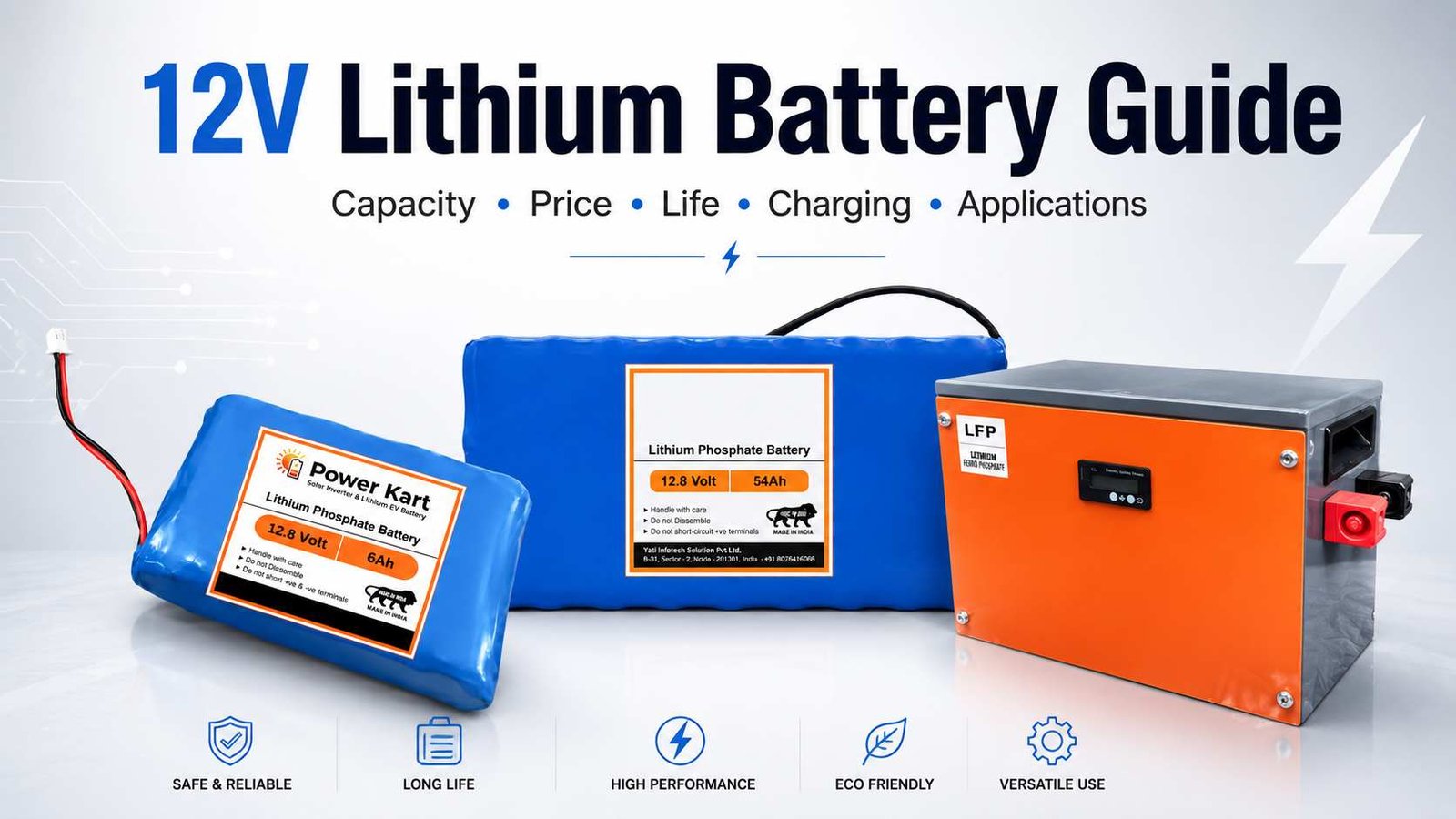
12V Lithium Ion Battery | Buyer’s Guide to Capacity, Price, Life, Charging and Applications
A 12V lithium battery has become a popular choice for backup power, solar systems, portable equipment, electric mobility, camping, UPS systems and many other applications. Compared with traditional lead-acid batteries, lithium batteries are generally lighter, charge faster, provide more usable energy and can last for many more charge cycles.
But buying a 12V lithium ion battery is not as simple as choosing the largest Ah rating available.
You need to understand battery chemistry, capacity, BMS rating, charging voltage, discharge current, physical size and the type of equipment you want to power. Two batteries that both say “12V 100Ah” on the label can perform very differently depending on the cells and electronics used inside them.
This guide explains everything a general buyer should know before choosing a 12V li ion battery, including how capacity works, what a BMS does, how long a battery may run your equipment, charging requirements, expected lifespan and the factors that affect 12 volt lithium battery price.
What Is a 12V Lithium Ion Battery?
A 12 volt li ion battery is a rechargeable battery pack made by connecting multiple lithium cells together to provide a voltage suitable for equipment designed around a 12V electrical system.
The term “12V” is often used as a convenient system-voltage description. The battery’s actual voltage changes depending on its chemistry and state of charge.
For example, different lithium chemistries can have different nominal and fully charged voltages.
A battery marketed as lithium ion 12V may therefore not always have exactly 12.00 volts at its terminals.
This is important because the battery must be compatible with your charger, inverter, controller and connected equipment.
Understanding the Different Chemistries Used in 12V Lithium Batteries
One of the first things buyers should check is the cell chemistry.
Two common types are:
Lithium-Ion NMC
NMC stands for Nickel Manganese Cobalt.
A common lithium-ion cell has a nominal voltage of approximately 3.6V or 3.7V.
Three cells connected in series create a pack generally described as:
3S lithium-ion
Typical values are approximately:
- Nominal voltage: 11.1V
- Fully charged voltage: 12.6V
Such batteries are often sold for portable electronics, robotics, lighting, small mobility products and custom battery applications.
LiFePO4
LiFePO4 stands for Lithium Iron Phosphate and is commonly called LFP.
An LFP cell has a nominal voltage of approximately 3.2V.
Four cells connected in series create:
4S LiFePO4
Typical values are approximately:
- Nominal voltage: 12.8V
- Fully charged voltage: around 14.6V
This configuration is widely used for solar storage, inverter batteries, caravans, boats, camping equipment and lead-acid replacement applications.
Therefore, before ordering a 12v li ion battery, always check the chemistry and charging voltage instead of relying only on the “12V” description.
Understanding Ah: What Does Battery Capacity Mean?
Battery capacity is normally expressed in ampere-hours, written as Ah.
You may see batteries labelled:
- 12V 7Ah
- 12V 12Ah
- 12V 20Ah
- 12V 30Ah
- 12V 50Ah
- 12V 100Ah
- 12V 150Ah
- 12V 200Ah
In simple terms, a larger Ah rating means the battery can store more energy.
For example, a 100Ah battery theoretically contains more stored energy than a 50Ah battery of the same voltage.
However, the Ah rating by itself does not show the battery’s total stored energy.
For that, watt-hours are more useful.
How Much Power Is Stored in a 12V 100Ah Battery?
Battery energy can be estimated using:
Energy in Wh = Voltage × Capacity in Ah
For a battery rated exactly at 12V and 100Ah:
12 × 100 = 1,200Wh
That equals approximately:
1.2kWh
For a 12.8V 100Ah LiFePO4 battery:
12.8 × 100 = 1,280Wh
That is approximately:
1.28kWh
Therefore, a 12v 100ah lithium ion battery provides around 1.2 to 1.28kWh of nominal stored energy depending on its chemistry and rated voltage.
This is a much more useful number when estimating how long appliances can run.
What Can You Power with a 12V 100Ah Lithium Battery?
The answer depends on the power consumption of the connected equipment.
Suppose you have a battery containing approximately 1,200Wh of energy.
If you connect a 100W load, the ideal theoretical runtime would be:
1,200Wh ÷ 100W = 12 hours
A 300W load would theoretically run for:
1,200Wh ÷ 300W = 4 hours
And a 600W load:
1,200Wh ÷ 600W = 2 hours
These figures are only theoretical.
Actual runtime can be lower because of:
- Inverter losses
- Wiring losses
- BMS cutoff
- Battery temperature
- Cell condition
- Discharge current
- Usable state-of-charge limits
For an inverter system, an efficiency of around 85–95% is common depending on the equipment and operating load.
So when estimating runtime from a li ion battery 12v 100ah, allow some margin instead of assuming every watt-hour printed on the battery can reach your appliance.
Why a 12V 100Ah Lithium Battery Works for So Many Applications
A 12v 100ah lithium ion battery sits in a useful capacity range.
It is large enough for many backup and energy-storage applications while still being manageable compared with very large battery banks.
Common uses include:
- Home inverter backup
- Solar energy storage
- Camping systems
- RV and caravan power
- Marine electronics
- Communication equipment
- Portable power systems
- Emergency backup
- Small off-grid installations
- Medical equipment backup
- DC appliances
- CCTV systems
- Robotics
- Telecom applications
A li ion battery 12v 100ah may also be combined with other batteries in specially designed systems, although series or parallel connections should only be made when the battery manufacturer supports them.
12V Lithium Battery vs Lead-Acid Battery
Many people considering a 12V lithium battery are replacing an older lead-acid battery.
Here is a simple comparison:
| Feature | 12V Lithium Battery | 12V Lead-Acid Battery |
| Weight | Usually lighter | Heavier |
| Usable capacity | Generally higher | More limited |
| Charging speed | Usually faster | Generally slower |
| Cycle life | Usually longer | Usually shorter |
| Voltage under load | More stable | Drops more noticeably |
| Maintenance | Very low | Depends on battery type |
| Initial cost | Higher | Lower |
| Long-term value | Often better | Depends on usage |
| BMS | Normally required | Not normally used |
The biggest mistake is comparing lithium and lead-acid batteries only by Ah.
For example, both may say 100Ah, but their usable energy and voltage behaviour can be quite different.
Why Lithium Batteries Make Better Use of Their Rated Capacity
Lead-acid batteries generally do not benefit from being deeply discharged on a regular basis.
Frequent deep discharge can significantly reduce their useful life.
Lithium batteries can normally use a greater percentage of their rated capacity, although the exact recommended depth of discharge depends on chemistry, cell manufacturer and BMS settings.
This means a lithium battery may deliver more practically usable energy even when the printed Ah rating appears similar.
If you are comparing both technologies, our detailed guide on lead-acid vs lithium batteries explains the differences in lifespan, usable capacity, charging, weight and overall value.
That is one reason why people upgrading solar, inverter or mobile power systems often consider a 12 volt li ion battery.
What Is a BMS and Why Is It Important?
A BMS, or Battery Management System, is one of the most important parts of a lithium battery pack.
The BMS monitors and protects the cells.
Based on its design, the BMS can guard the battery against problems such as:
- Overcharging
- Over-discharge
- Excessive current
- Short circuit
- Cell overvoltage
- Cell undervoltage
- Excessive temperature
- Low temperature
- Cell imbalance
Some advanced BMS units also provide:
- Bluetooth monitoring
- State-of-charge information
- Individual cell voltage
- Temperature readings
- Current measurement
- Fault logs
- Charge/discharge control
When buying a 12v lithium ion battery, do not look only at capacity.
The BMS current rating should also match your application.
Why BMS Current Rating Matters
Imagine you buy a 12V 100Ah battery with a BMS rated for 50A continuous discharge.
The approximate theoretical power available at 12V would be:
12V × 50A = 600W
At 12.8V:
12.8V × 50A = 640W
If your inverter tries to draw significantly more current than the BMS allows, the battery may shut down for protection.
A 100Ah battery does not automatically mean that it can safely supply 100A.
Capacity and discharge current are different specifications.
When buying a li ion battery 12v 100ah, check:
- Continuous discharge current
- Peak discharge current
- BMS rating
- Recommended charging current
- Maximum charging current
These specifications become especially important when running an inverter, motor, compressor or other high-power equipment.
How Much Current Does an Inverter Draw?
A common mistake is to look at the inverter’s AC output current rather than the battery current.
For example, a 1,000W inverter operating from a 12V battery may need approximately:
1,000W ÷ 12V = 83A
After accounting for inverter losses, actual battery current could be even higher.
Therefore, a small 30A or 50A BMS may not be suitable for a 1,000W inverter operating near full load.
For high-power applications, check the inverter’s maximum DC input current and choose the battery accordingly.
This is especially important when selecting a 12v 100ah lithium ion battery for home backup.
How Long Does a 12V Lithium Ion Battery Last?
Battery life can mean two different things:
- Runtime per charge
- Overall service life
Runtime depends mainly on battery capacity and load.
Service life is usually measured in charge cycles.
One cycle roughly represents using the equivalent of the battery’s full capacity once.
Lithium batteries can often provide significantly more cycles than traditional lead-acid batteries, but the actual life depends on several factors:
- Cell chemistry
- Cell quality
- Depth of discharge
- Charging voltage
- Charging current
- Discharge current
- Temperature
- BMS quality
- Storage conditions
- Manufacturing quality
There is no single cycle-life number that applies to every lithium ion 12V battery.
Always check the manufacturer’s rated cycle life and the conditions under which that rating is specified.
How Heat and Cold Influence Lithium Battery Lifespan
Lithium batteries generally perform best when they are not exposed to excessive heat.
High temperature can accelerate cell ageing.
A battery installed next to a hot engine, inside a sealed metal enclosure or in direct sunlight can experience much harsher conditions than a battery installed in a cool ventilated area.
Good installation practice should include:
- Adequate ventilation where required
- Protection from direct sunlight
- Proper cable sizing
- Secure terminals
- Avoiding nearby heat sources
- Enough space around the battery
For high-current applications, cables and connectors matter just as much as the battery itself.
How Should a 12V Lithium Battery Be Charged?
Lithium batteries require the correct charging profile.
This point cannot be ignored.
Different chemistries have different charging voltages.
For example:
3S Lithium-Ion
A typical 3S lithium-ion pack may reach approximately:
12.6V when fully charged
4S LiFePO4
A typical 4S LiFePO4 battery may have a maximum charging voltage of approximately:
14.6V
The charger must match the battery chemistry and manufacturer specification.
Never choose a charger simply because it says “12V”.
A charger intended for a lead-acid battery may use charging stages or voltages that are not suitable for a particular lithium battery.
Before connecting a charger to a 12v li ion battery, verify:
- Battery chemistry
- Maximum charging voltage
- Recommended charging current
- Charger output voltage
- Charger charging algorithm
Can You Use a Lead-Acid Charger with a Lithium Battery?
Sometimes certain chargers are compatible, but you should never assume they are.
Lead-acid chargers may use:
- Bulk charging
- Absorption charging
- Float charging
- Equalisation
- Desulfation modes
Some of these charging behaviours may not be appropriate for lithium batteries.
For example, an equalisation or desulfation mode that intentionally applies a higher voltage can be unsuitable for a lithium pack.
The safer approach is to use a charger specifically approved for your battery chemistry.
How Long Does It Take to Recharge a 12V 100Ah Lithium Battery?
Charging time depends mainly on battery capacity and charger current.
For a simple estimate:
With a 10A Charger
100Ah ÷ 10A = around 10 hours
With a 20A Charger
100Ah ÷ 20A = around 5 hours
With a 50A Charger
100Ah ÷ 50A = around 2 hours
Real charging time can be somewhat longer because charging current may reduce near full charge.
Also, you should never assume that a battery can safely accept any charging current.
Always follow the manufacturer’s maximum and recommended charge-current ratings.
What Determines 12 Volt Lithium Battery Price?
The 12 volt lithium battery price can vary considerably.
A battery with the same voltage and Ah rating can cost much more—or much less—than another model.
The difference is often due to the components inside the battery rather than the label on the outside.
Important price factors include:
Cell Quality
Premium cells generally cost more than low-cost or recycled cells.
Cell quality affects:
- Capacity
- Internal resistance
- Heat generation
- Cycle life
- Reliability
- Performance under load
Battery Capacity
A 100Ah battery requires substantially more cell capacity than a 20Ah or 40Ah battery.
More energy storage generally increases cost.
BMS Quality
A basic BMS may provide essential protection.
More advanced models may include:
- Higher current capability
- Temperature sensors
- Active balancing
- Bluetooth connectivity
- Communication ports
- Better protection accuracy
Battery Enclosure
Battery casing can range from simple heat-shrink construction to strong ABS or metal enclosures.
The enclosure affects protection, durability and installation convenience.
Warranty
Products with established warranty support can cost more because after-sales service is included in the overall product value.
Certification and Testing
Properly tested battery packs may involve additional manufacturing and quality-control costs.
Therefore, while comparing 12 volt lithium battery price, compare specifications and build quality rather than simply choosing the cheapest Ah rating available.
Questions to Ask Before Buying a 12V Lithium Battery
Before ordering, ask the seller or manufacturer the following:
1. What Chemistry Is Used?
Confirm whether it is:
- NMC
- LiFePO4
- Another lithium chemistry
If you are unsure which chemistry suits your application, our detailed NMC vs LiFePO4 battery comparison comparison explains the differences in safety, cycle life, energy density, weight and typical use cases.
2. What Is the Nominal Voltage?
Do not assume all “12V” batteries have exactly the same voltage.
3. What Is the Maximum Charging Voltage?
This determines charger compatibility.
4. What Is the Actual Capacity?
Ask for the Ah and Wh rating.
5. What Is the BMS Rating?
Find out both continuous and peak current capability.
6. What Is the Maximum Charging Current?
This helps you choose an appropriate charger.
7. What Are the Battery Dimensions?
Check:
- Length
- Width
- Height
- Weight
Make sure it physically fits your application.
8. What Type of Terminals or Connector Are Used?
Your cables must connect securely.
9. What Is the Warranty?
Understand both duration and coverage.
10. Are Cells New and Grade A?
For expensive batteries, cell quality should be an important part of your buying decision.
Choosing the Right Capacity
Do not automatically buy the largest battery.
Start by calculating how much energy your system actually needs.
Suppose your equipment consumes:
200W
and you want approximately:
4 hours of backup
Required energy:
200W × 4 hours = 800Wh
After accounting for inverter and system losses, you may want approximately 900–1,000Wh or more of available battery energy.
A 12V 100Ah battery with approximately 1.2kWh of nominal energy could therefore be a suitable starting point, subject to its usable capacity and current rating.
Calculating your load before buying prevents both undersizing and unnecessary overspending.
Where Are 12V Lithium Batteries Commonly Used?
A 12v lithium battery is extremely versatile.
Solar Energy Storage
Small solar systems use lithium batteries to store energy generated during the day for use later.
Inverter Backup
Lithium batteries can power compatible home or office inverters during grid outages.
RVs and Caravans
Their lighter weight and higher usable capacity make lithium batteries attractive for mobile applications.
Marine Systems
They can power lighting, navigation equipment and other electrical loads when properly designed for marine use.
Camping
Portable refrigerators, lighting, fans and charging equipment can run from 12V battery systems.
Telecom and CCTV
A 12 volt li ion battery can provide DC backup for communication and surveillance systems.
Robotics and Electronics
Smaller lithium packs are widely used in custom electronics, robots, instruments and portable equipment.
Important Safety Considerations
Lithium batteries contain a large amount of energy in a compact package.
They should be treated as electrical energy-storage equipment, not as simple disposable batteries.
For safer use:
- Use the correct charger.
- Do not short-circuit the terminals.
- Use correctly rated cables.
- Install appropriate fuses.
- Avoid crushing or puncturing cells.
- Do not use visibly swollen or damaged batteries.
- Keep the battery away from excessive heat.
- Ensure correct polarity.
- Do not bypass the BMS.
- Follow the manufacturer’s installation instructions.
If a battery becomes unusually hot, swollen, damaged or emits an unusual smell, disconnect it safely if possible and stop using it.
Common Mistakes Buyers Make
Choosing Only by Ah
A large Ah number does not automatically mean a better battery.
Check cell quality and BMS rating too.
Ignoring Discharge Current
A battery may have plenty of stored energy but still be unable to supply a high-power inverter.
Using the Wrong Charger
“12V” on the charger and battery does not guarantee compatibility.
Ignoring Dimensions
A battery is useless if it does not fit the available space.
Buying Only by Price
The lowest 12 volt lithium battery price may look attractive initially, but cell quality, warranty and cycle life can have a much bigger effect on long-term value.
Ignoring Warranty Support
A high-capacity lithium battery is a long-term investment. Reliable after-sales support is important.
12V 100Ah vs Smaller Lithium Batteries
A 12v 100ah lithium ion battery is not necessary for every application.
For smaller loads such as:
- LED lighting
- Routers
- CCTV systems
- Small electronics
a 10Ah, 20Ah or 30Ah battery may be sufficient.
A li ion battery 12v 100ah makes more sense when you need longer backup or higher total energy.
Typical examples include:
- Inverter systems
- Solar storage
- Camping refrigerators
- RV electrical systems
- Long-duration DC backup
The best battery is the one properly sized for your actual energy requirement.
LFP or NMC: Which Is Better for a 12V System?
There is no universal winner because each chemistry has different strengths.
NMC lithium-ion cells offer high energy density and can be useful where weight and space are important.
LiFePO4 is widely used in stationary and deep-cycle applications because it is known for good cycle life and thermal stability.
For a lead-acid replacement, solar battery or inverter system, 12.8V LiFePO4 is especially common.
For compact equipment and custom electronic systems, NMC-based 12v li ion packs may be more suitable.
The correct choice depends on the application rather than simply choosing one chemistry as “better”.
Final Buying Advice
A 12V lithium ion battery can be an excellent upgrade for many applications, but choosing the right one requires more than comparing voltage and Ah.
Before buying, check:
- Battery chemistry
- Nominal voltage
- Fully charged voltage
- Capacity in Ah
- Energy in Wh
- BMS current rating
- Continuous discharge capability
- Peak current capability
- Charging voltage
- Charging current
- Physical dimensions
- Weight
- Terminal type
- Warranty
- Cell quality
If you are considering a 12v 100ah lithium ion battery, remember that a 100Ah label tells you how much charge the battery can store, but it does not tell you how much current the battery can safely deliver.
For inverter and high-power applications, BMS and discharge-current specifications are just as important as capacity.
Similarly, when comparing 12 volt lithium battery price, look beyond the purchase amount. A battery with better cells, stronger BMS protection, longer cycle life and reliable warranty support may provide significantly better value over its lifetime.
Whether you need a small 12v li ion battery for electronics or a larger li ion battery 12v 100ah for solar and backup power, matching the battery to your actual load, charger and installation is the best way to achieve safe, reliable and long-lasting performance. Buying from a trusted lithium battery supplier in Bangalore can also make it easier to get the right battery specification, technical guidance and after-sales support.
Frequently Asked Questions
Is a 12V lithium battery better than lead-acid?
For many applications, lithium offers advantages such as lower weight, more usable capacity, faster charging and longer cycle life. However, the charging system and connected equipment must be compatible.
How many watts are in a 12V 100Ah battery?
A battery rated at 12V and 100Ah contains approximately:
12 × 100 = 1,200Wh
or 1.2kWh of nominal energy.
A 12.8V 100Ah LiFePO4 battery contains approximately 1.28kWh.
Can I use a 12V lithium battery with an inverter?
Yes, provided the inverter voltage range is compatible and the battery’s BMS and discharge-current rating can support the inverter load.
Can I replace a 12V lead-acid battery with lithium?
Often yes, but not automatically. You must check charging voltage, charger compatibility, current requirements, dimensions and terminal arrangement.
What charger should I use for a 12V lithium battery?
Use a charger designed for the battery’s specific lithium chemistry and charging voltage. A typical 3S lithium-ion pack and a 4S LiFePO4 battery require different charging voltages.
How long will a 12V 100Ah lithium battery run an inverter?
It depends on the load. A battery containing around 1.2–1.28kWh could theoretically run a 300W load for around four hours before losses are considered. Actual runtime will usually be lower.
Is a 100Ah lithium battery suitable for solar?
It can be, provided the solar charge controller, charging voltage, BMS and system load are correctly matched.
What affects the price of a 12V lithium battery?
The main factors include capacity, chemistry, cell brand and quality, BMS rating, enclosure, warranty, certifications and manufacturer support.
What is the difference between 12V li ion and 12.8V LiFePO4?
They may use different cell chemistry and series configurations. A conventional three-series lithium-ion battery commonly charges to around 12.6V, while a four-series LiFePO4 battery is nominally around 12.8V and typically charges to around 14.6V. Always use the charger specified for the battery.
Which 12V lithium battery capacity should I buy?
Calculate your equipment’s wattage, desired backup time and maximum current requirement first. Then choose a battery that provides enough usable energy and discharge current with a reasonable safety margin.