
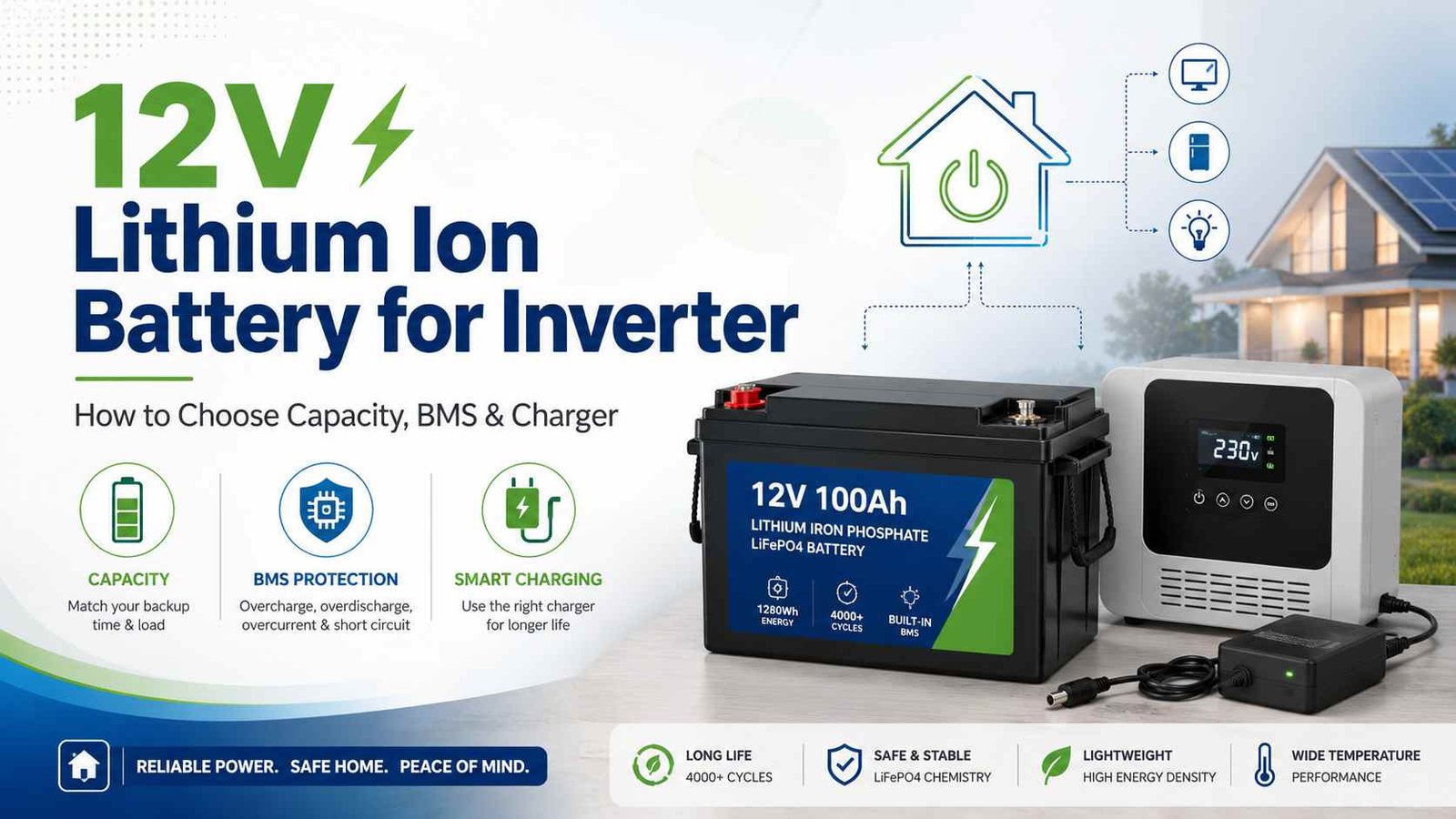
A power cut usually exposes one simple problem: the battery is either too small for the load or it cannot deliver enough current when the inverter needs it.
This is why choosing a 12V lithium battery for inverter use should not begin with the question, “Should I buy 100Ah or 150Ah?” Capacity matters, but it is only one part of the decision.
A good inverter battery must also have the correct voltage, suitable lithium chemistry, enough discharge current, a properly rated BMS and a charging system that matches the battery.
For many homes, shops and small offices, switching from a lead-acid battery to a lithium inverter battery can reduce weight, improve usable backup capacity and shorten charging time. But simply replacing one battery with another because both are labelled “12V” can create compatibility problems.
This guide explains how to choose a lithium battery for an inverter in practical terms, without requiring an electrical engineering background.
What Does a 12V Lithium Battery for an Inverter Actually Mean?
A battery described as 12V does not necessarily remain at exactly 12.00 volts.
Battery voltage changes with:
- Cell chemistry
- Number of cells connected in series
- State of charge
- Load
- Charging condition
This becomes particularly important with lithium batteries because different lithium chemistries have different operating voltages.
For inverter applications, the 12V LiFePO4 battery has become a common option.
A LiFePO4 cell has a nominal voltage of around 3.2V. Four cells connected in series form a 4S battery:
3.2V × 4 = 12.8V nominal
A fully charged 4S LiFePO4 battery may reach around 14.4–14.6V, depending on the battery manufacturer’s specification.
This voltage range is relatively close to conventional 12V lead-acid systems, which is one reason LiFePO4 is widely considered for inverter and solar applications.
By comparison, a typical NMC lithium-ion cell has a nominal voltage of around 3.6–3.7V. A three-series NMC pack is usually around 11.1V nominal and 12.6V fully charged.
That voltage profile may not suit every inverter originally designed around a 12V lead-acid battery.
So before buying, do not stop at the words “12V lithium battery.”
Check the actual chemistry and voltage range.
Why LiFePO4 Is Commonly Chosen for Inverter Backup
For home backup and energy-storage applications, LiFePO4 has several useful characteristics.
A properly designed 12V LiFePO4 battery can offer:
- Good cycle life
- Relatively stable voltage during discharge
- High usable capacity
- Lower weight than an equivalent lead-acid system
- Faster charging when the battery supports it
- Low routine maintenance
- Good thermal stability
- Built-in BMS protection
That does not mean every LiFePO4 battery is automatically suitable for an inverter.
The quality of the cells, BMS, wiring, terminals and overall pack construction still matters.
A professionally built 100Ah battery with suitable cells and a correctly sized BMS can be a much better choice than a poorly designed 150Ah battery that cannot safely supply the required inverter current.
Start With Your Load, Not the Battery Ah Rating
One of the easiest ways to buy the wrong battery is to decide the capacity first.
Instead, list what you actually want to run during a power cut.
For example:
| Appliance | Approximate Power |
| LED bulb | 8–15W |
| Ceiling fan | 50–80W |
| Wi-Fi router | 10–20W |
| LED television | 60–150W |
| Laptop | 40–100W |
| Desktop computer | 150–400W |
| Small refrigerator | Varies considerably |
These are only general examples. Use the actual rated power shown on your appliance whenever possible.
Imagine your backup load consists of:
- 3 fans × 60W = 180W
- 4 LED lights × 10W = 40W
- Wi-Fi router = 15W
- Television = 100W
Total:
180 + 40 + 15 + 100 = 335W
Now you have something useful to work with.
How to Calculate the Battery Capacity You Need
A simple starting formula is:
Required energy = Load in watts × Required backup hours
Suppose your load is 300W and you need three hours of backup:
300W × 3 hours = 900Wh
You cannot simply buy a 900Wh battery and assume you will get exactly three hours.
There are losses in the system.
Your inverter itself consumes some energy while converting DC battery power into AC electricity.
You should also avoid designing a system that depends on completely exhausting the battery every day.
A more practical formula is:
Required Ah = (Load × Backup Hours) ÷ (Battery Voltage × Inverter Efficiency × Usable Battery Fraction)
Suppose:
- Load = 300W
- Backup = 3 hours
- Battery = 12.8V
- Inverter efficiency = 90%
- Planned usable battery capacity = 90%
Then:
900 ÷ (12.8 × 0.90 × 0.90)
= approximately 87Ah
In this example, a 12V 100Ah lithium battery would be a reasonable starting point, provided its BMS can also support the load.
Always keep some operating margin instead of sizing a battery to the absolute minimum.
What Does a 12V 100Ah Lithium Battery Actually Store?
For a 12.8V 100Ah LiFePO4 battery:
12.8V × 100Ah = 1,280Wh
That equals:
1.28kWh nominal energy
This is why a 12V 100Ah lithium battery is popular for small and medium inverter backup systems.
But 1.28kWh does not mean that exactly 1.28kWh will reach your AC appliances.
Energy is lost through:
- Inverter conversion
- Wiring resistance
- BMS operation
- Connectors
- Battery discharge characteristics
If you plan to use around 90% of the battery and the inverter operates at approximately 90% efficiency:
1,280Wh × 0.9 × 0.9 ≈ 1,037Wh
So roughly 1kWh reaching the load is a more realistic planning figure in this example.
Actual performance will vary with the battery, inverter and operating conditions.
How Long Can a 12V 100Ah Lithium Battery Run an Inverter?
Once you know usable energy, estimating runtime becomes easier.
Using approximately 1,000Wh of practical AC energy for illustration:
At a 100W Load
Approximately:
1,000 ÷ 100 = 10 hours
At a 250W Load
Approximately:
1,000 ÷ 250 = 4 hours
At a 500W Load
Approximately:
1,000 ÷ 500 = 2 hours
At a 1,000W Load
Approximately:
1,000 ÷ 1,000 = 1 hour
These are planning estimates, not guaranteed runtimes.
At higher loads, factors such as battery voltage drop, inverter efficiency and BMS current limits become increasingly important.
Battery Capacity and BMS Rating Are Not the Same Thing
This is one of the most important points for anyone buying a lithium battery for home inverter use.
A 100Ah battery does not automatically mean it can continuously supply 100A.
The Ah number tells you mainly about stored capacity.
The BMS current rating tells you how much current the battery management system is designed to allow.
For example:
Battery A
- 12.8V
- 100Ah
- 50A continuous BMS
Battery B
- 12.8V
- 100Ah
- 100A continuous BMS
Both store approximately the same nominal energy.
But Battery B may be able to support a substantially larger inverter load, assuming its cells, wiring and terminals are also designed for that current.
This is why BMS specifications should never be ignored.
How Much Current Does a 12V Inverter Need?
Low-voltage systems require surprisingly high current.
The approximate current drawn from a battery can be estimated using:
Battery Current = AC Load ÷ (Battery Voltage × Inverter Efficiency)
Assume a 12.8V battery and 90% inverter efficiency.
500W Load
500 ÷ (12.8 × 0.9)
≈ 43A
600W Load
≈ 52A
1,000W Load
≈ 87A
1,500W Load
≈ 130A
This explains why a battery with a 50A BMS may operate lights and fans comfortably but may shut down when used with a heavily loaded 1,000W inverter.
The inverter wattage printed on the front is therefore not enough information.
You must consider battery-side current.
How to Select the Correct BMS Rating
Your BMS should comfortably exceed the expected continuous battery current.
Suppose your normal inverter load requires approximately 70A.
Using a BMS rated exactly at 70A provides little operating margin.
A battery designed for a higher continuous current would be preferable.
You should also check:
- Continuous discharge rating
- Peak or surge current
- Duration allowed at peak current
- Maximum charging current
- Temperature protection
- Cell balancing
- Low-voltage protection
- High-voltage protection
Do not assume that every manufacturer defines “100A BMS” in exactly the same way.
Ask whether the stated number represents:
continuous current or short-duration peak current.
That distinction matters.
Starting Surge Can Be Higher Than Normal Load
Some appliances need much more power for a brief moment when starting.
Examples include:
- Refrigerator compressors
- Pumps
- Some motors
- Compressors
- Certain power tools
A refrigerator may consume a moderate amount of power while running but demand much more during compressor startup.
Your inverter and battery must handle this temporary surge.
If the BMS overcurrent limit is too close to your normal operating current, the battery can shut off when a motor starts.
For these applications, ask the battery supplier about the permitted peak discharge current and how long the BMS can sustain it.
Choosing Between 50Ah, 100Ah, 150Ah and 200Ah
There is no universal “best” capacity.
The correct choice depends on your load and required backup duration.
50Ah
A 12.8V 50Ah battery stores approximately:
640Wh
Suitable for smaller loads where backup requirements are limited.
Possible uses include:
- Lights
- Router
- A fan
- Small electronics
100Ah
A 12V 100Ah lithium battery provides approximately:
1.28kWh nominal energy
This is a practical capacity for many small home inverter systems.
It can support combinations of:
- Fans
- Lights
- Router
- Television
- Laptop
provided the total load and BMS rating are suitable.
150Ah
Approximate energy:
12.8 × 150 = 1.92kWh
This may suit users who want longer backup or have higher average loads.
200Ah
Approximate energy:
12.8 × 200 = 2.56kWh
This can provide substantial backup for a 12V system, but current becomes increasingly important as inverter power rises.
At this level, it is also worth asking whether moving to a 24V or 48V inverter system would be more appropriate for a high-power installation.
Why Larger Inverters Often Move Beyond 12V Systems
Consider a 2,000W load.
At 12.8V and 90% efficiency:
2,000 ÷ (12.8 × 0.9) ≈ 174A
That is a lot of current.
High current requires:
- Thick cables
- Strong terminals
- Proper connectors
- Correct fuses
- Suitable busbars
- High-current BMS
- Careful installation
The same 2,000W load on a 24V or 48V battery system requires substantially less current.
This is one reason higher-power inverter installations frequently use higher battery-system voltages.
If your backup requirement is large, do not automatically build everything around 12V simply because 12V batteries are easy to find.
Charger Compatibility Is Just as Important as Battery Capacity
Buying the correct battery and then using the wrong charger can create problems.
A lithium inverter battery should be charged according to its chemistry and manufacturer’s specifications.
For a common 4S 12V LiFePO4 battery, the maximum charge voltage is often around 14.4–14.6V.
However, you should use the exact value recommended by your battery manufacturer.
Lithium batteries generally do not require the same charging behaviour as flooded lead-acid batteries.
Features such as:
- Equalisation
- Desulfation
- High-voltage recovery pulses
may be unsuitable for a lithium battery.
This is why an inverter or charger with a dedicated lithium/LiFePO4 charging mode is preferable.
Can an Existing Home Inverter Charge a Lithium Battery?
Sometimes yes, but compatibility must be checked rather than assumed.
Find the following information in your inverter manual or settings:
- Bulk/boost voltage
- Absorption voltage
- Float voltage
- Equalisation function
- Maximum charging current
- Low battery cutoff voltage
- Battery type selection
Then compare these values with the specification supplied by the lithium battery manufacturer.
Some modern inverters provide selectable battery modes such as:
- Flooded lead acid
- AGM
- GEL
- Lithium
- User-defined
A user-defined mode can be useful when it allows charging and cutoff voltages to be configured according to the battery manufacturer.
An older inverter with fixed lead-acid settings may not be an ideal match.
Avoid Equalisation on a LiFePO4 Battery
Traditional flooded lead-acid batteries may use an equalisation stage.
Lithium batteries do not use lead-acid equalisation charging.
If your inverter automatically applies a high equalisation voltage, check whether that feature can be disabled before connecting a 12V LiFePO4 battery.
Similarly, avoid lead-acid desulfation modes unless the lithium battery manufacturer explicitly approves the charger.
Using the correct charging profile helps both performance and battery life.
How Much Charging Current Does a 100Ah Battery Need?
Charging current affects charging time.
A simple estimate is:
Charging Time ≈ Battery Capacity ÷ Charger Current
For a 100Ah battery:
10A Charger
100 ÷ 10 = about 10 hours
20A Charger
100 ÷ 20 = about 5 hours
30A Charger
100 ÷ 30 = about 3.3 hours
Actual charging will usually take somewhat longer.
More current does not automatically mean better charging.
Every battery has a recommended and maximum charging current.
For example, if a particular 100Ah battery is designed for a maximum charging current of 30A, connecting a 60A charger simply to reduce charging time would be inappropriate.
Follow the battery manufacturer’s limits.
Charger Current and BMS Charge Rating Must Match
A BMS can have separate charging and discharge limits.
For example, a battery may allow:
- 100A continuous discharge
- 50A maximum charge
This means it can deliver substantial power to an inverter while accepting a lower charging current.
Check both specifications.
Do not select a charger based only on Ah.
How Much 12V Battery Backup Do You Actually Need?
Think about your normal power cuts.
If outages are usually 30–60 minutes, an oversized 200Ah battery may not provide much practical advantage over 100Ah.
If you regularly experience four-hour cuts, additional capacity may be valuable.
Your daily usage pattern matters too.
Ask yourself:
- Which appliances are essential?
- What is their combined wattage?
- How many hours of backup do I need?
- Do any appliances have motors or compressors?
- How quickly must the battery recharge before the next outage?
Answering these five questions upfront can help you avoid paying for capacity or features you may not actually need.
Example 1: Basic Home Backup
Suppose you want to run:
- 2 fans at 60W each = 120W
- 4 LED bulbs at 10W = 40W
- Router = 15W
Total:
175W
Required backup:
4 hours
Energy needed:
175 × 4 = 700Wh
After allowing for inverter losses and battery reserve, a 12V 100Ah lithium battery could be a practical choice.
A smaller battery may also work if your required backup time is shorter.
Example 2: Fans, Lights and Television
Load:
- 3 fans = 180W
- 4 LEDs = 40W
- Television = 100W
- Router = 15W
Total:
335W
For three hours:
335 × 3 = 1,005Wh
A 100Ah battery would be operating relatively close to its practical available energy.
If you frequently require three or more hours at this load, moving to a 150Ah battery may provide a more comfortable reserve.
Example 3: A High-Power Inverter
Suppose your load regularly reaches:
1,000W
At around 12.8V and 90% inverter efficiency, battery current could approach:
87A
In this case, buying a 100Ah battery with a 50A BMS would be a poor match.
You need to pay close attention to:
- BMS continuous rating
- Cell discharge rating
- Battery terminals
- Cable size
- Fuse rating
- Inverter surge current
This example shows why Ah alone cannot determine whether a battery is suitable.
Cable Size Matters More Than Many Buyers Realise
A 12V inverter system can carry very high DC current.
Undersized battery cables can result in:
- Voltage drop
- Heating
- Reduced inverter performance
- Premature low-voltage shutdown
- Damaged connectors
- Safety risks
Keep battery cables appropriately sized and as short as practical.
Cable selection should account for:
- Maximum continuous current
- Cable length
- Allowable voltage drop
- Insulation temperature rating
- Installation method
For high-current systems, have the wiring designed or checked by a competent technician.
A premium battery cannot compensate for inadequate wiring.
Battery Terminals and Connectors Also Need the Correct Rating
The current must pass through more than the cells and BMS.
It also travels through:
- Internal busbars
- Battery terminals
- Cable lugs
- Fuses
- Isolators
- Connectors
A poor or loose connection can create resistance.
Resistance produces heat.
This becomes particularly important in 12V systems because high inverter power requires high current.
Always use clean, secure and properly rated connections.
Should You Install a Fuse Between the Battery and Inverter?
A properly designed battery installation should include suitable overcurrent protection.
The fuse helps protect the cable and system during an abnormal high-current event.
Fuse selection should consider:
- Cable current rating
- Expected inverter current
- Surge requirements
- Battery capability
Do not simply install an extremely large fuse to stop nuisance blowing.
The purpose of the fuse is protection.
If you are uncertain about fuse sizing, use a qualified installer.
Lithium Battery vs Lead-Acid for Home Inverter
Lead-acid batteries remain widely used because they are familiar and generally have a lower initial purchase price.
Lithium batteries can offer advantages such as:
- Lower weight
- Higher usable capacity
- Longer cycle life in many applications
- Faster charging capability
- More stable discharge voltage
- Less routine maintenance
If you are deciding between the two technologies, our detailed lithium battery vs lead-acid battery comparison explains the differences in usable capacity, charging, lifespan, weight, maintenance and long-term cost.
For example, two batteries may both carry a 100Ah label, but their practical usable energy can differ significantly depending on allowable depth of discharge and operating conditions.
This is why comparing only Ah does not provide the full picture.
When evaluating a lithium battery for home inverter, consider lifetime energy delivered rather than only the initial purchase cost.
What Determines 12 Volt Lithium Battery Price?
The 12 volt lithium battery price varies widely even for batteries carrying the same capacity rating.
There are several reasons.
Cell Quality
Battery cells represent a major part of the pack cost.
Quality cells generally provide more predictable:
- Capacity
- Internal resistance
- Cycle life
- Temperature behaviour
- Performance under load
BMS Rating
A 200A smart BMS costs more than a very basic low-current protection circuit.
Additional features may include:
- Bluetooth
- State-of-charge calculation
- Temperature sensors
- Active balancing
- Communication ports
- Configurable limits
Enclosure
Battery packaging ranges from shrink-wrapped packs to strong metal or ABS enclosures.
Current Capability
A high-current battery requires more than just a bigger BMS.
It may need:
- Heavier busbars
- Larger cables
- Better connectors
- Cells designed for higher discharge current
Warranty and Support
Reliable technical and after-sales support adds genuine value, particularly when the battery is part of an inverter system that must work every day.
The cheapest battery is therefore not automatically the lowest-cost battery over its complete service life.
Ask These Questions Before Buying
Before ordering a 12V lithium battery for inverter use, ask the seller for these details:
- What is the cell chemistry?
- What is the nominal voltage?
- What is the maximum charging voltage?
- What is the capacity in Ah?
- What is the capacity in Wh?
- What is the continuous discharge current?
- What is the peak discharge current?
- How long can peak current be sustained?
- What is the BMS rating?
- What is the maximum charging current?
- Does the BMS include temperature protection?
- What are the battery dimensions?
- What terminals are provided?
- What is the battery weight?
- What cycle-life specification is given?
- What warranty is provided?
- Is my inverter charging profile compatible?
A lithium battery supplier who only tells you “12V 100Ah” has not given you enough information to properly size an inverter battery.
Should You Buy One Large Battery or Multiple Smaller Batteries?
Some buyers consider connecting two or more lithium batteries in parallel to increase capacity.
For example:
2 × 12V 100Ah batteries in parallel ≈ 12V 200Ah
But lithium batteries should only be paralleled if the battery manufacturer approves it.
Before connecting packs together, consider:
- Same chemistry
- Same voltage
- Same model
- Similar state of charge
- Compatible BMS design
- Correct cable arrangement
- Current sharing
Never connect unmatched lithium packs casually.
Follow the manufacturer’s instructions.
Series Connections Need Even More Care
Connecting batteries in series increases system voltage.
For example:
Two 12.8V batteries in series create approximately a 25.6V nominal system.
But not every lithium battery is designed to be connected in series.
The BMS and pack design must support it.
If you need a 24V inverter battery, buying a battery designed as a 24V pack can sometimes be simpler than attempting to series-connect batteries that were only intended for standalone 12V operation.
Where a 12V Lithium Inverter Battery Makes the Most Sense
A 12V lithium system can work particularly well when:
- Your inverter is relatively small
- Your backup load is moderate
- You want a compact battery
- You need faster recharge
- Battery weight is important
- You regularly cycle the battery
- You want to replace an existing 12V lead-acid system
For very large inverter loads, consider whether a higher-voltage battery architecture would provide a more efficient solution.
Common Mistakes to Avoid
Buying Only by Capacity
A 200Ah battery with an inadequate BMS may be less useful than a properly designed 100Ah battery.
Assuming Every 12V Lithium Battery Is the Same
NMC and LiFePO4 voltage characteristics are different.
Ignoring Charger Settings
Battery and charger voltage must be compatible.
Using Lead-Acid Equalisation
Do not apply lead-acid equalisation to a LiFePO4 battery unless the battery manufacturer specifically instructs you to do so.
Ignoring Inverter Surge Current
Motors and compressors can demand significant startup current.
Using Thin DC Cables
A 12V high-power system can draw more than 100A.
Buying Without Checking Dimensions
Lithium batteries come in many shapes and enclosure sizes.
Selecting the Cheapest Product
Battery quality depends on much more than the printed Ah number.
A Simple Selection Method
You can make the buying decision easier by following this order:
Step 1: Calculate Your Normal Load
Add the wattage of the appliances you intend to operate together.
Step 2: Decide Required Backup Time
Be realistic about how long your normal power cuts last.
Step 3: Calculate Required Energy
Load × Hours = Wh required
Step 4: Choose Battery Capacity
Add allowance for inverter losses and reserve capacity.
Step 5: Calculate Maximum Battery Current
Use:
Load ÷ (Battery Voltage × Inverter Efficiency)
Step 6: Select a Suitable BMS
Make sure continuous and peak current ratings comfortably support your system.
Step 7: Confirm Charger Compatibility
Check voltage, charging current and charging profile.
Step 8: Check Physical Installation
Verify battery dimensions, terminals, cable size, fuse and ventilation requirements.
This approach is much more reliable than simply asking whether a 100Ah or 150Ah battery is “better.”
Final Thoughts
Choosing a 12V lithium battery for inverter use becomes much easier once you separate three different requirements:
Capacity determines how long the battery can run your load.
BMS and cell discharge ratings determine how much power the battery can safely deliver.
The charger determines whether the battery can be charged correctly.
All three must work together.
For many small and medium home backup systems, a 12V 100Ah lithium battery offers a useful balance between energy storage, physical size and cost. However, that does not mean it will work correctly with every inverter.
A 100Ah battery connected to a lightly loaded inverter may provide several hours of backup. The same battery connected to a high-power inverter could reach its BMS current limit long before its stored energy becomes the main concern.
A well-matched 12V LiFePO4 battery with suitable BMS protection and a compatible lithium charging profile can provide an effective alternative to conventional lead-acid backup systems.
When comparing 12 volt lithium battery price, look beyond Ah. Check the cells, BMS, current rating, charger compatibility, warranty and installation requirements.
The right lithium battery for home inverter is not necessarily the battery with the highest capacity or lowest price. It is the battery whose voltage, energy capacity, current capability and charging requirements correctly match the inverter and the appliances you actually need to run.
Frequently Asked Questions
Is a 12V 100Ah lithium battery enough for a home inverter?
It can be sufficient for a small or medium backup load. A 12.8V 100Ah LiFePO4 battery contains approximately 1.28kWh of nominal energy. Actual backup time depends on the load, inverter efficiency and usable battery capacity.
Can I directly replace my 12V lead-acid battery with lithium?
Sometimes, but check the inverter charging voltage, low-voltage cutoff, equalisation behaviour, charging current and battery chemistry first.
What BMS rating should I choose for a 1,000W inverter?
A 1,000W load can draw roughly 85–90A from a 12.8V battery after accounting for inverter losses. The battery should therefore have a continuous discharge rating comfortably above the expected current, plus enough peak capability for surge loads.
Is a 100A BMS enough for a 1,000W inverter?
It may be, depending on actual inverter efficiency, load, surge requirements and how the BMS manufacturer defines its rating. Operating continuously at the absolute BMS limit is generally not desirable, so allow reasonable margin.
How many hours will a 12V 100Ah lithium battery last?
Runtime depends on load. A battery delivering around 1kWh of practical AC energy could theoretically provide approximately 4 hours at 250W, 2 hours at 500W or 1 hour near 1,000W. Actual results vary.
Which lithium chemistry is better for an inverter?
LiFePO4 is widely used for inverter and solar storage because its voltage profile, cycle life and thermal characteristics make it well suited to many deep-cycle applications. Compatibility still needs to be confirmed.
What charging voltage does a 12V LiFePO4 battery need?
A 4S LiFePO4 pack is commonly charged to approximately 14.4–14.6V, but the correct setting should always come from the battery manufacturer.
Can I charge a lithium inverter battery with my existing inverter?
Only if the inverter’s charging profile is compatible with the battery. Check charging voltage, current, float settings and whether equalisation or desulfation can be disabled.
Is a larger BMS always better?
Not necessarily. The BMS should match the cells, wiring and application. Installing a BMS with an enormous current rating does not make cells capable of safely supplying that current.
Why is one 12V 100Ah lithium battery much cheaper than another?
Differences can include cell quality, true capacity, BMS rating, enclosure, discharge capability, warranty, certification and manufacturing quality.
Should I choose 100Ah or 150Ah?
Choose based on required backup energy. If a 100Ah battery leaves little reserve for your normal load and outage duration, a 150Ah battery may be more appropriate.
Can I use a 12V lithium battery for solar and inverter backup together?
Yes, when the inverter/charger or solar charge controller supports the battery’s chemistry, voltage and current requirements. All charging sources should be configured correctly.