
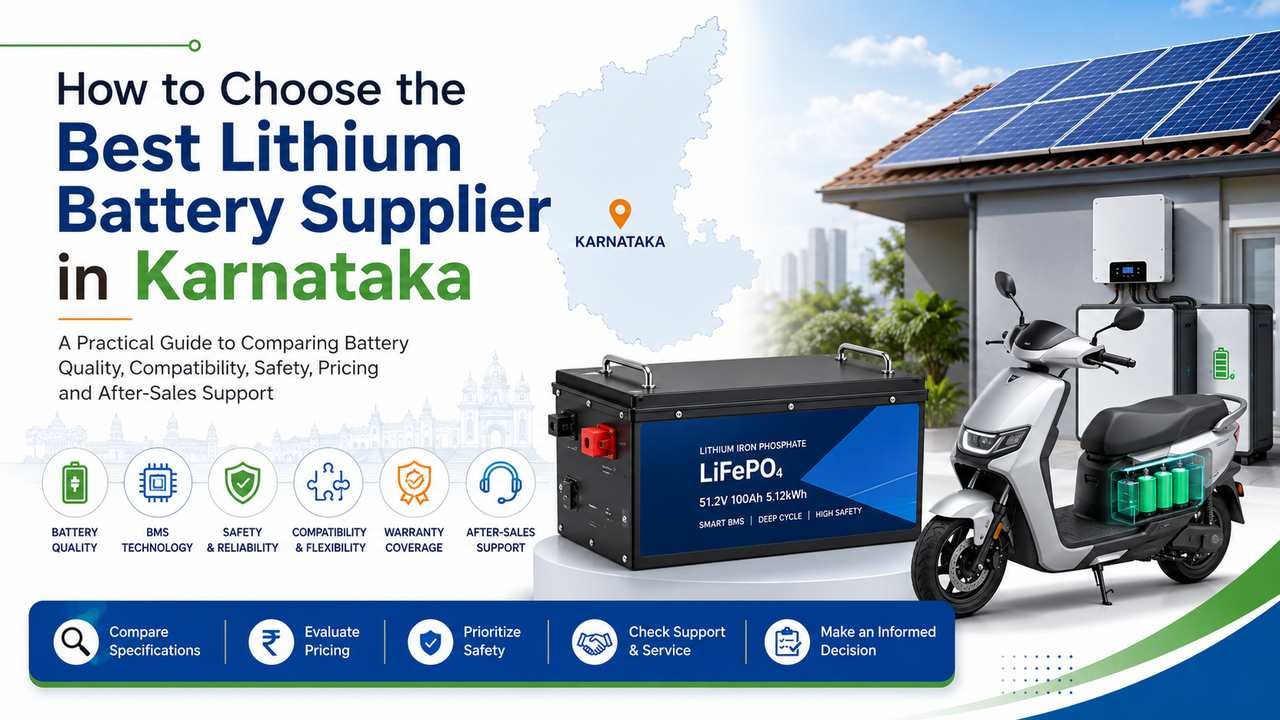
A Practical Guide to Comparing Lithium Battery Quality, Compatibility, Safety, Pricing and After-Sales Support
Lithium batteries now power electric scooters, e-rickshaws, solar installations, home inverters, commercial backup units and various industrial machines.
As demand grows across Karnataka, more businesses are offering lithium battery packs, cells, chargers, BMS units and repair services.
The problem is that not every supplier offers the same level of quality.
Two batteries may have the same voltage and Ah rating but perform very differently. One battery may remain dependable for years, while another could lose range, overheat, cut off under load or need repairs within just a few months.
Choosing the best lithium battery supplier in Karnataka therefore requires more than comparing price.
A dependable supplier should understand battery chemistry, cell quality, BMS selection, charger compatibility, current requirements, application conditions and after-sales support. The right supplier should also help you choose a battery that matches your actual use instead of simply selling the largest or cheapest option.
This guide explains what to check before buying a lithium battery, whether you need a solar lithium battery, a lithium battery for an electric scooter, an EV battery pack or a lithium iron phosphate battery for energy storage.
Why Lithium Battery Supplier Selection Matters
A lithium battery pack is made up of several connected parts working together.
It is a complete electrical system made from several parts working together.
A typical battery pack may include:
- Lithium cells
- Battery Management System
- Busbars or nickel strips
- Temperature sensors
- Fuse
- Connectors
- Battery cables
- Charger
- Mechanical enclosure
- Insulation and cushioning materials
If even one of these parts is unsuitable, the entire battery may become unreliable.
For example, a battery may use good cells but an undersized BMS. It may work during light use but disconnect during acceleration. Another battery pack may have a suitable BMS but poor-quality connectors that heat up under high current.
A professional lithium battery supplier should therefore evaluate the complete system, not only the battery voltage and Ah capacity.
Start by Identifying the Application
The first step is to clearly define where the battery will be used.
A Lithium battery for an electric scooter has different requirements from a battery used with a solar inverter. Similarly, an e-rickshaw battery has different current, vibration and daily-cycle requirements from a home backup battery.
Before speaking to a supplier, identify:
- Required voltage
- Required capacity in Ah or kWh
- Continuous load
- Peak load
- Charging source
- Daily usage
- Expected backup or driving range
- Available installation space
- Indoor or outdoor operation
- Communication requirements
- Existing charger or inverter model
A good Lithium Battery supplier will ask these questions before recommending a battery.
A supplier who quotes immediately without understanding the application may be selecting the battery only by voltage and Ah rating.
Choosing a Lithium Battery for an Electric Scooter
A lithium battery for an electric scooter must handle repeated acceleration, road vibration, heat, charging cycles and sudden current demand from the motor controller.
Common electric scooter battery voltages include:
- 48V lithium battery for an electric scooter
- 60V lithium battery for an electric scooter
- 72V lithium battery for an electric scooter
However, the voltage alone does not determine compatibility.
The supplier must also check:
- Motor power
- Controller current
- Peak acceleration current
- Charger voltage
- Charger current
- Battery connector
- Communication protocol
- Battery enclosure dimensions
- Vehicle cut-off settings
For example, two 72V batteries may have the same nominal voltage but use different cell chemistries, series counts and communication systems.
One scooter may work with a simple battery output connection. Another may require CAN communication between the battery, controller and display.
A replacement battery can therefore have the correct voltage and Ah rating yet still fail to operate in the vehicle.
Questions to ask for an electric scooter battery
Ask the supplier:
- Which cell chemistry is being used?
- What is the exact series and parallel configuration?
- What is the continuous discharge rating?
- What peak current can the battery support?
- Which BMS is installed?
- Does the battery communicate with the scooter?
- Will the existing charger work?
- What connector will be supplied?
- Is the battery tested under load?
- What warranty support is available?
A knowledgeable supplier should be able to answer these questions in clear, simple terms.
NMC or Lithium Iron Phosphate Battery?
The two common chemistries used in EV and energy-storage applications are NMC and LiFePO4
LiFePO₄ refers to lithium iron phosphate, a widely used lithium battery chemistry.People may use the phrase “lithium ion phosphate battery,” but the correct technical term is lithium iron phosphate battery.
NMC lithium battery
NMC cells offer high energy density and are often selected when battery size and weight are important. This makes NMC battery packs for electric scooters suitable for electric motorcycles, removable EV batteries and compact portable power systems.
Typical applications include:
- Electric scooters
- Electric motorcycles
- Removable EV batteries
- Compact portable battery packs
Benefits may include:
- Higher energy in a smaller enclosure
- Lower battery weight for a given capacity
- Good suitability for compact EV applications
The BMS and charger must be configured specifically for the NMC series count and voltage limits.
Lithium iron phosphate battery
Lithium iron phosphate batteries are widely chosen for applications such as:
- Solar energy storage
- Home inverter backup
- E-rickshaws
- Commercial energy-storage systems
- Telecom backup
- Industrial batteries
Advantages include:
- Good cycle life
- Stable thermal behaviour
- Suitability for frequent charging and discharging
- Availability in large prismatic cell formats
A good supplier should not claim that one chemistry is always better. The correct choice depends on the application.
For an electric scooter, NMC may be preferred when space and weight are limited.
For a solar lithium battery, LiFePO₄ is often selected because of its suitability for stationary energy storage and repeated cycling.
How to Select a Solar Lithium Battery Supplier
A solar lithium battery must work correctly with the inverter, solar charger and load.
The supplier should understand both the battery and the inverter settings.
Important points include:
- Battery nominal voltage
- Maximum charging voltage
- Recommended charging current
- Maximum discharge current
- Low-voltage cut-off
- Back-to-grid setting
- BMS communication
- CAN or RS485 compatibility
- Parallel battery support
- Battery capacity in kWh
For example, a 51.2V 100Ah LiFePO4 battery stores approximately 5.12kWh of nominal energy.
However, usable energy will depend on:
- Depth of discharge
- BMS cut-off limits
- Inverter efficiency
- Load type
- Battery temperature
- Battery age
A supplier should not promise backup only on the basis of Ah capacity.
The correct method is to calculate the actual load in watts or kilowatts.
For example, a 5kWh battery will provide different backup times for:
- A 500W home load
- A 2kW inverter load
- A 3kW commercial load
- A motor with high starting current
The supplier should also check whether the inverter supports closed-loop BMS communication.
With compatible communication, the battery can send information such as:
- State of Charge
- Maximum charge current
- Maximum discharge current
- Temperature alerts
- Fault status
Without communication, the inverter may operate using manually configured voltage settings. This can still work, but the settings must be matched carefully.
Check the Cell Brand and Cell Grade
The cells are the most important part of the battery.
Ask the supplier to identify:
- Cell manufacturer
- Cell model
- Rated capacity
- Cell chemistry
- Manufacturing batch
- Cell grade
- Test data
A professional supplier should not describe cells only as “high quality” or “imported.”
Those terms do not provide enough technical information.
New cells versus used cells
Confirm whether the cells are:
- Brand-new cells
- Grade A cells
- Grade B cells
- Recovered cells
- Used cells removed from another battery
Used or recovered cells may be suitable for some low-cost experiments, but they should not be sold as new cells.
For EV and solar applications, cell consistency is important.
Cells should ideally be matched for:
- Voltage
- Capacity
- Internal resistance
- Age
- Manufacturing batch
Mismatched cells may cause imbalance, reduced backup and early BMS cut-off.
Ask How the Battery Is Tested
A trustworthy lithium battery supplier should perform more than a simple voltage check.
A battery can show the correct voltage at rest and still fail under load.
Ask whether the supplier performs:
- Cell-voltage inspection
- Capacity testing
- Internal resistance testing
- Charge test
- Discharge test
- Load test
- BMS protection test
- Temperature monitoring
- Connector-heating inspection
- Communication test
For an EV battery, the supplier should test whether the pack can handle realistic acceleration current.
For a solar battery, the supplier should verify charging, discharge and inverter compatibility.
A proper test report is especially important for commercial, OEM and high-capacity battery orders.
Evaluate the Battery Management System
The BMS is responsible for monitoring and protecting the battery.
It may provide:
- Overcharge protection
- Deep-discharge protection
- Overcurrent protection
- Short-circuit protection
- Temperature protection
- Cell balancing
- State of Charge estimation
- Communication
Ask the supplier:
- Which BMS brand is used?
- What chemistry does it support?
- What series count is configured?
- What is the continuous current rating?
- What is the peak current rating?
- Is balancing passive or active?
- How many temperature sensors are installed?
- Does it support Bluetooth, CAN or RS485?
- Are protection settings configurable?
Do not select a BMS only because it carries a high ampere rating.
A 100A BMS may not necessarily handle 100A continuously in every installation. Actual performance depends on cooling, MOSFET quality, PCB design, cable size and ambient temperature.
Check Charger Compatibility
The charger must match the battery chemistry and series count.
An unsuitable charger may cause:
- Incomplete charging
- Repeated BMS cut-off
- Overvoltage protection
- Excessive heating
- Reduced battery life
Ask the supplier to confirm:
- Charger output voltage
- Charger current
- Charging profile
- Connector polarity
- Communication requirement
- Cooling method
Do not assume that a charger used with a lead-acid battery can automatically be used with a lithium battery.
Similarly, a charger designed for one lithium chemistry may not suit another.
The battery supplier should either provide a compatible charger or approve the existing charger after checking its specifications.
Compare Capacity Honestly
Battery capacity is commonly specified in Ah or kWh.
Ah alone does not show the complete energy capacity because voltage also matters.
Energy can be estimated using:
Energy in watt-hours = Voltage × Ah
For example:
- 51.2V × 100Ah = 5,120Wh
- This equals approximately 5.12kWh
When comparing batteries, check:
- Nominal capacity
- Usable capacity
- Recommended depth of discharge
- Discharge rate
- Capacity at expected load
- Capacity after ageing
A low-cost battery may use cells that deliver less than the advertised Ah rating.
Ask whether the capacity is verified through a controlled discharge test.
Check Enclosure and Mechanical Construction
Battery reliability is not only about electronics.
The enclosure must protect the cells from:
- Vibration
- Water
- Dust
- Impact
- Heat
- Movement inside the box
For electric scooters and e-rickshaws, the battery experiences continuous road vibration.
The supplier should use:
- Secure cell holders or compression
- Proper insulation
- Cable strain relief
- Strong connectors
- Suitable cushioning
- Fire-resistant materials where appropriate
- Correct enclosure ventilation or sealing
Prismatic cells may require mechanical compression depending on the cell design and application.
Cylindrical cells should be held securely so that welds and interconnections are not stressed during vibration.
Inspect Wiring, Busbars and Connectors
High current creates heat when resistance is present.
Poor-quality connections can cause:
- Voltage drop
- Reduced performance
- Connector melting
- Local overheating
- BMS cut-off
- Fire risk
Ask the supplier about:
- Cable size
- Busbar thickness
- Nickel strip quality
- Welding method
- Terminal torque
- Connector current rating
- Fuse protection
The cable and connector must be selected for the actual continuous and peak current.
A large BMS rating does not make undersized wiring safe.
Compare Warranty Terms Carefully
A warranty should be clear and written.
Ask:
- How long is the warranty?
- Is the warranty based on months, cycles or both?
- What parts are covered?
- Is capacity loss covered?
- Is the charger covered?
- Is transport included?
- Who pays for inspection?
- What conditions cancel the warranty?
- How long will repair or replacement take?
A “three-year warranty” may sound attractive, but the conditions matter.
Some warranties cover manufacturing defects only. Others may exclude:
- Water damage
- Wrong charger
- Physical damage
- Overloading
- Tampering
- Incorrect installation
- Deep discharge during storage
Read the terms before buying.
Look for Local Support in Karnataka
Local support can be valuable, especially for EV and solar batteries.
A Karnataka-based supplier may be able to provide faster assistance in cities such as:
- Bengaluru
- Mysuru
- Mangaluru
- Hubballi
- Dharwad
- Belagavi
- Tumakuru
- Davanagere
- Shivamogga
For customers in Bengaluru and nearby industrial areas, local access can make battery inspection, customisation and warranty service easier.
Ask whether the supplier provides:
- Workshop inspection
- Pickup and delivery
- On-site support
- Installation
- Battery testing
- Charger testing
- BMS diagnosis
- Emergency replacement support
A supplier with no technical support may simply forward the battery to another company, increasing repair time.
Manufacturer, Assembler or Distributor?
Lithium battery sellers may operate as:
- Cell distributors
- Battery-pack assemblers
- Importers
- Dealers
- OEM suppliers
- Repair workshops
None of these categories is automatically better than the others.
A distributor may provide access to multiple brands and ready stock.
A battery assembler may offer custom voltage, capacity, BMS and enclosure options.
An OEM supplier may support bulk orders and repeat production.
What matters is whether the supplier is transparent about its role.
Ask:
- Do you manufacture cells?
- Do you assemble battery packs?
- Which components are imported?
- Can you customise the battery?
- Who handles warranty?
- Who performs testing?
- Are replacement parts available?
Avoid assuming that every company using the word “manufacturer” produces lithium cells. Many businesses assemble packs from purchased cells, which is normal, but it should be clearly explained.
Compare Price, but Do Not Choose Only by Price
Lithium batteries can differ greatly in price because of:
- Cell brand
- Cell grade
- Battery chemistry
- BMS quality
- Enclosure
- Charger
- Connectors
- Warranty
- Testing
- Communication features
- Production volume
The cheapest battery may become expensive if it needs early repair or replacement.
Instead of asking only for the total price, request a clear quotation showing:
- Battery voltage
- Battery Ah
- Battery kWh
- Cell chemistry
- Cell brand
- BMS rating
- Charger details
- Connector type
- Warranty
- GST
- Delivery
- Installation
This makes comparison easier.
Check Reviews and Business Credibility
Before selecting a lithium battery supplier in Karnataka, review the company’s business presence.
Check:
- Website
- Google Business Profile
- Product information
- Customer reviews
- Company address
- GST details
- Contact information
- Technical content
- Warranty policy
However, do not rely only on ratings.
Some reviews may be incomplete, old or unrelated to the product you plan to buy.
Speak directly with the supplier and ask technical questions.
A capable supplier should be able to explain the battery without avoiding details.
Red Flags to Avoid
Be cautious if a supplier:
- Refuses to identify the cell brand
- Promises unrealistic range or backup
- Gives no written warranty
- Cannot explain the BMS rating
- Recommends one battery for every application
- Claims any charger will work
- Does not ask about motor or inverter power
- Uses only total voltage to test a battery
- Offers no local service process
- Cannot provide a proper GST invoice
- Uses an undersized connector
- Claims balancing can repair damaged cells
- Promises extremely high cycle life without conditions
A genuine supplier will explain both the advantages and limitations of the battery.
Questions to Ask Before Placing an Order
Use this checklist before buying.
Battery details
- What chemistry is used?
- Which cell brand and model are installed?
- Are the cells new?
- What is the exact pack configuration?
- What is the nominal and usable energy?
Performance
- What is the continuous discharge current?
- What is the peak current?
- What charging current is recommended?
- Has the battery been capacity-tested?
- Has it been tested under load?
BMS
- Which BMS is installed?
- Does it support balancing?
- How many temperature sensors are used?
- Does it offer Bluetooth, CAN or RS485?
- Are the settings matched to the cells?
Compatibility
- Will it work with the existing charger?
- Will it communicate with the scooter or inverter?
- Are the connectors compatible?
- Will the battery fit in the available space?
Support
- What warranty is provided?
- Where is the service centre?
- What is the repair turnaround time?
- Are spare BMS units and connectors available?
- Will technical support be provided after installation?
Choosing the Best Supplier for Different Applications
Electric scooter battery
Prioritise:
- Correct NMC or LFP chemistry
- High-current capability
- Controller compatibility
- Compact enclosure
- Vibration resistance
- Charger compatibility
- Communication support
Solar lithium battery
Prioritise:
- LiFePO₄ cell quality
- Capacity in kWh
- Inverter compatibility
- CAN or RS485 communication
- Cycle performance
- Parallel operation
- Local installation support
E-rickshaw battery
For E rickshaw Battery Prioritise:
- Daily-cycle durability
- Load capacity
- Strong enclosure
- High-current connections
- Charger matching
- Service availability
Commercial ESS battery
Prioritise:
- Modular design
- Communication
- Protection coordination
- Scalability
- Monitoring
- Documentation
- After-sales support
Why PowerKart Focuses on Complete Battery Compatibility
At PowerKart, battery selection is approached as a complete system rather than only a voltage-and-Ah purchase.
Customers may require:
- Lithium battery cells
- LiFePO₄ prismatic cells
- NMC cells
- BMS units
- Active balancers
- Battery chargers
- EV battery packs
- Solar lithium batteries
- Battery-building components
The correct solution depends on the load, current, charger, controller, inverter and operating conditions.
For an electric scooter, this may mean checking motor-controller current, battery dimensions, connector type and communication.
For a solar battery, it may involve matching the battery BMS with the inverter’s voltage settings and communication protocol.
This technical matching helps reduce unexpected cut-offs, charging problems and compatibility issues.
Final Thoughts
Choosing the best lithium battery supplier in Karnataka should not be based only on the lowest quotation.
A reliable supplier should understand the complete battery system, including the cells, BMS, charger, wiring, connectors, enclosure and application.
Before buying a lithium battery, confirm:
- Battery chemistry
- Cell brand and grade
- Actual capacity
- Continuous and peak current
- BMS specifications
- Charger compatibility
- Communication requirements
- Enclosure quality
- Warranty
- Local technical support
For a lithium battery for an electric scooter, check motor current, controller compatibility, battery dimensions and charger voltage.
For a solar lithium battery, check inverter compatibility, usable kWh, communication and charging settings.
For a lithium iron phosphate battery, confirm the prismatic cell quality, BMS series count and balancing requirement.
A trustworthy supplier will not simply sell a battery. The supplier will help you understand why that battery is suitable for your vehicle, inverter or energy-storage system.
The right lithium battery may cost more initially, but proper cell selection, testing, protection and support can improve reliability and reduce long-term repair and replacement expenses.