
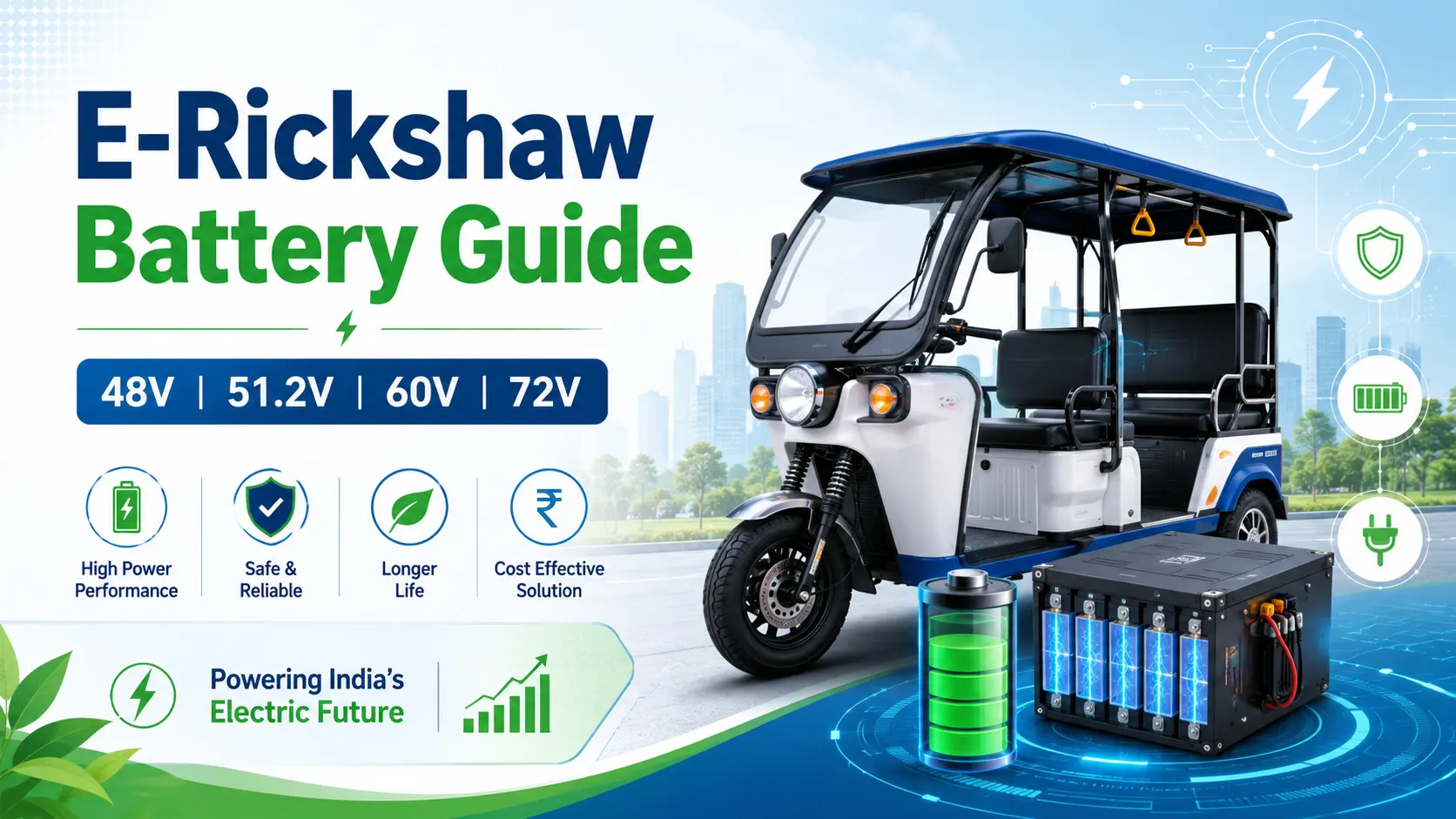
Understanding E Rickshaw Batteries, Types, Benefits & Choosing the Right Battery
The e rickshaw battery is the most important component of an electric rickshaw. Whether you are a driver, fleet owner, dealer, or someone planning to buy an electric three-wheeler, selecting the right battery directly affects your vehicle’s driving range, charging time, operating cost, reliability, and long-term profitability.
With rising fuel prices and increasing government support for electric mobility, e-rickshaws have become one of the fastest-growing commercial vehicles in India. However, many buyers still struggle to answer basic questions such as:
- Which is the best e rickshaw battery?
- Should I choose a lithium battery or a lead acid battery?
- What is the ideal battery capacity?
- Which voltage should I buy—48V, 51.2V, 60V, or 72V?
- How long does an e rickshaw battery last?
- What is the latest e rickshaw battery price in India?
This comprehensive guide answers all these questions in simple language while helping you make an informed purchase decision.
Whether you are buying your first battery or upgrading from lead acid to lithium, this guide covers everything you need to know.
What is an E Rickshaw Battery?
An e rickshaw battery stores electrical energy and powers the electric motor of an e-rickshaw. Unlike petrol or diesel vehicles, an electric rickshaw depends entirely on its battery pack for movement.
The battery stores the energy that powers an electric vehicle, much like a fuel tank stores fuel in a conventional vehicle.
A good battery should provide:
- Long driving range
- Fast charging
- High efficiency
- Long service life
- Low maintenance
- Safe operation
- Reliable performance in Indian weather conditions
Modern electric vehicle batteries have evolved significantly over the past few years. Earlier, most e-rickshaws used traditional lead acid batteries. Today, an increasing number of owners are switching to Lithium-ion and LiFePO₄ (Lithium Iron Phosphate) batteries because of their superior performance and lower operating costs.
Why is Choosing the Right Battery So Important?
Many buyers focus only on the purchase price. However, the battery is actually an investment that determines your daily earnings.
A high-quality battery offers several advantages:
- Longer distance per charge
- Reduced charging time
- Lower maintenance costs
- Better acceleration
- Improved reliability
- Longer battery lifespan
- Higher resale value
On the other hand, choosing a low-quality battery can result in:
- Frequent breakdowns
- Reduced backup
- High replacement costs
- Loss of daily income
- Increased charging expenses
For commercial e-rickshaw operators, battery quality directly impacts profitability.
Types of E Rickshaw Batteries
Today, three main battery technologies are available in the Indian market.
1. Lead Acid Battery
Lead acid batteries have been used in electric rickshaws for many years because of their low initial cost.
Advantages
- Lower purchase price
- Easily available
- Simple charging system
- Established service network
Limitations
- Heavy weight
- Shorter lifespan
- Regular water topping required
- Lower efficiency
- Longer charging time
- Reduced performance during frequent deep discharge
Lead acid batteries are suitable for buyers with a limited initial budget but usually have higher maintenance and replacement costs over time.
2. Lithium-ion Battery
Lithium-ion batteries are becoming increasingly popular because they are lighter, more efficient, and offer a better overall ownership experience.
Benefits
- Lightweight
- Faster charging
- Longer life
- Better efficiency
- Higher energy density
- Minimal maintenance
Lithium batteries are ideal for commercial operators who drive long distances every day.
3. LiFePO₄ Battery (Lithium Iron Phosphate)
Among all available options, LiFePO₄ batteries are widely considered one of the best choices for electric rickshaws.
Why LiFePO₄?
Compared to conventional lithium-ion batteries, LiFePO₄ offers:
- Excellent thermal stability
- Improved safety
- Longer cycle life
- Consistent performance
- Lower maintenance
- Better temperature tolerance
Many premium e rickshaw battery manufacturers now recommend LiFePO₄ technology for commercial applications.
Lead Acid vs Lithium Battery for E Rickshaw
| Feature | Lead Acid | Lithium Battery |
| Weight | Heavy | Lightweight |
| Charging Time | 8–10 Hours | 3–5 Hours |
| Maintenance | Regular | Almost Zero |
| Battery Life | Lower | Much Higher |
| Energy Efficiency | Moderate | Excellent |
| Performance | Average | Superior |
| Running Cost | Higher | Lower |
| Initial Cost | Lower | Higher |
Although lithium batteries cost more initially, they generally provide a lower cost per kilometer over their usable life, making them an attractive option for commercial operators.
Which is the Best E Rickshaw Battery?
The answer depends on your daily usage.
For Daily Commercial Use
A LiFePO₄ battery is often the preferred option because it offers:
- Longer life
- Better range
- Faster charging
- Reduced downtime
- Minimal maintenance
For Fleet Owners
Fleet operators usually benefit from lithium batteries because:
- Vehicles spend less time charging
- Maintenance requirements are lower
- Battery replacement intervals are longer
- Operating costs are more predictable
For Budget Buyers
If the lowest upfront cost is the main priority, a lead acid battery may still be considered. However, it’s important to evaluate the total cost of ownership, including maintenance and replacement over several years.
Understanding Battery Voltage
One of the most common questions buyers ask is:
Should I buy a 48V, 51.2V, 60V, or 72V e rickshaw battery?
Battery voltage must always match your vehicle’s electrical system and controller specifications.
Let’s understand the most common options.
48V E Rickshaw Battery
A 48V e rickshaw battery is commonly used in entry-level electric rickshaws and light-duty applications.
Suitable for:
- Short-distance travel
- Light passenger load
- Urban commuting
Benefits:
- Lower cost
- Simple charging
- Widely available
51.2V E-Rickshaw Battery
A 51.2V E-Rickshaw battery is commonly made using 16 LiFePO₄ cells connected in series. It is often used as a lithium replacement for certain 48V battery systems.
Although it is sometimes described as a 48V-class battery, its nominal voltage is 51.2V and its fully charged voltage is usually around 58.4V. Therefore, the controller and charger must be compatible with this voltage range.
Suitable for:
- Passenger e-rickshaws
- Lithium upgrades from compatible lead-acid systems
- Daily commercial operation
- Applications requiring longer battery life
Benefits:
- Stable LiFePO₄ chemistry
- Long cycle life
- Lower maintenance
- Better usable capacity
- More consistent voltage during discharge
- Improved efficiency compared with many lead-acid batteries
60V E Rickshaw Battery
The 60V e rickshaw battery is one of the most popular configurations in India.
It provides a good balance between:
- Performance
- Driving range
- Cost
- Efficiency
Many commercial operators prefer 60V systems for daily passenger transport.
72V E Rickshaw Battery
A 72V lithium battery delivers higher power and improved performance.
Advantages include:
- Better acceleration
- Improved climbing ability
- Higher efficiency
- Longer range (depending on battery capacity)
72V systems are commonly used in premium electric three-wheelers and cargo applications.
Does Higher Voltage Mean Longer Range?
Not necessarily.
Many people assume that simply increasing voltage automatically increases driving range.
In reality, range depends on multiple factors, including:
- Battery capacity (Ah)
- Total battery energy (Wh or kWh)
- Vehicle weight
- Passenger load
- Road conditions
- Driving habits
- Motor efficiency
- Controller tuning
- Tyre pressure
Voltage mainly determines how the electrical system operates, while the overall battery energy determines how much distance the vehicle can cover.
How to Choose the Right Voltage
When selecting an e rickshaw battery:
✔ Follow your vehicle manufacturer’s recommendations.
✔ Ensure compatibility with the motor and controller.
✔ Avoid mixing batteries with different voltages.
✔ Purchase batteries from a trusted e rickshaw battery supplier or battery manufacturer.
✔ Choose batteries with a quality Battery Management System (BMS) if opting for lithium technology.
Why Battery Quality Matters More Than Price
Budget batteries may appear identical on the outside, but their internal quality can vary greatly.
A high-quality battery typically includes:
- Grade-A lithium cells
- Advanced Battery Management System (BMS)
- Cell balancing
- Overcharge protection
- Over-discharge protection
- Short-circuit protection
- Temperature monitoring
- Quality connectors and wiring
Choosing a reliable battery from a reputable supplier can improve safety, performance, and long-term value.
Battery Capacity, Driving Range, Charging Guide & Battery Life
This is next section of our complete guide to E Rickshaw Batteries in India. In this section, you’ll learn how battery capacity affects driving range, how to calculate battery backup, charging best practices, and how to maximize battery life. Whether you’re looking for the best e rickshaw battery, comparing lithium e rickshaw batteries, or trying to understand e rickshaw battery price, these insights will help you make a smarter investment.
Understanding Battery Capacity (Ah)
After choosing the right battery type and voltage, the next important specification is battery capacity, measured in Ampere-hours (Ah).
Simply put, Ah tells you how much electrical energy a battery can store. A higher Ah rating generally means the battery can supply power for a longer duration before it needs recharging.
Think of it like a water tank:
- Voltage = Water pressure
- Capacity (Ah) = Size of the water tank
A larger tank doesn’t increase pressure, but it lets you use water for a longer time. Similarly, a higher Ah battery doesn’t necessarily make your e-rickshaw faster—it helps it travel farther.
Common E Rickshaw Battery Capacities
The most common options vary based on the type of vehicle and how it is used:
- 80Ah Battery
- 100Ah Battery
- 120Ah Battery
- 150Ah Battery
- 200Ah Battery
Each serves different driving requirements.
80Ah Battery
Best suited for:
- Light-duty applications
- Short-distance travel
- Small commercial operations
Advantages:
- Lower purchase cost
- Faster charging
- Lower weight
100Ah Battery
One of the most popular choices in India 100 Ah E Rikshaw Battery
Suitable for:
- Daily passenger transport
- Medium-distance travel
- Regular city operation
It offers an excellent balance between cost, driving range, and charging time.
120Ah Battery
Ideal for:
- Heavy daily use
- Longer city routes
- Operators carrying passengers throughout the day
150Ah Battery
Preferred by commercial operators who:
- Travel long distances
- Carry heavier loads
- Want fewer charging breaks
200Ah Battery
Suitable for:
- Fleet operators
- Cargo e-rickshaws
- High-utilization commercial vehicles
Although more expensive initially, higher-capacity batteries can improve productivity by reducing charging frequency.
Battery Energy Explained (Wh & kWh)
Many buyers confuse Ah with actual battery energy.
The correct way to compare batteries is by calculating:
Energy (Wh) = Voltage × Capacity (Ah)
For example:
48V × 100Ah = 4,800Wh = 4.8kWh
Similarly:
- 60V × 100Ah = 6kWh
- 72V × 100Ah = 7.2kWh
This is why two batteries with the same Ah rating but different voltages can provide different total energy.
Understanding battery energy helps compare batteries more accurately.
What Distance Can an E-Rickshaw Cover on a Full Charge?
One of the most searched questions on Google is:
“What is the range of an e rickshaw battery?”
The answer depends on multiple factors.
Driving range is influenced by:
- Battery capacity
- Battery voltage
- Passenger load
- Vehicle weight
- Motor efficiency
- Controller tuning
- Tyre pressure
- Driving style
- Road gradient
- Traffic conditions
- Battery age
- Weather conditions
No manufacturer can honestly guarantee an exact fixed range because real-world usage varies.
Typical Driving Range
The exact performance may differ, but most e-rickshaws used for commercial work generally operate within the following ranges:
| Battery Type | Typical Commercial Range |
| Lead Acid | Lower range with noticeable drop as the battery discharges |
| Lithium-ion | More consistent range throughout the discharge cycle |
| LiFePO₄ | Stable performance with excellent range consistency |
One major advantage of lithium batteries is that performance remains more consistent even as the battery charge decreases.
Lead acid batteries often experience noticeable power reduction near the end of the discharge cycle.
What Affects Battery Range?
Passenger Load
An e-rickshaw can cover more distance with a lighter load than when carrying its full capacity.
Additional weight requires more energy from the motor.
Driving Style
Aggressive acceleration and sudden braking consume significantly more energy.
Smooth driving helps increase battery range.
Road Conditions
Driving on:
- Flyovers
- Steep roads
- Uneven roads
- Rural roads
requires more power compared to smooth city roads.
Tyre Pressure
Under-inflated tyres increase rolling resistance.
This reduces efficiency and decreases driving range.
Regular tyre pressure checks can improve both battery performance and tyre life.
Weather
Battery performance can vary with temperature.
Very high temperatures may accelerate battery ageing, while extremely low temperatures can temporarily reduce performance.
LiFePO₄ batteries generally perform well across a broad range of Indian climatic conditions.
How to Calculate Battery Backup
Although actual driving conditions differ, understanding the concept helps compare battery options.
The calculation starts with:
Battery Energy (kWh) = Voltage × Ah ÷ 1000
Then compare this energy with your vehicle’s average energy consumption.
For example, a battery with higher stored energy generally supports longer driving distances, assuming similar vehicle efficiency and operating conditions.
When comparing batteries, focus on usable energy, not just Ah.
Charging an E Rickshaw Battery
Proper charging has a direct impact on:
- Battery lifespan
- Daily range
- Safety
- Operating cost
- Performance
Many premature battery failures are actually caused by poor charging habits rather than manufacturing defects.
Charging Time
Charging time depends on:
- Battery capacity
- Charger rating
- Battery chemistry
- State of charge
Generally:
Lead acid batteries require longer charging periods.
Lithium batteries usually charge much faster because of their higher charging efficiency.
Can You Fast Charge an E Rickshaw Battery?
Modern lithium batteries can often support faster charging when paired with:
- Compatible chargers
- Appropriate Battery Management Systems (BMS)
- Manufacturer-approved charging limits
Charging the battery faster than its recommended rate can shorten its useful life.
Always use the charger specified by the battery manufacturer.
Best Charging Practices
To maximize battery life:
✔ Use only compatible chargers.
✔ Charge in a dry, well-ventilated area.
✔ Avoid charging near flammable materials.
✔ Disconnect damaged chargers immediately.
✔ Inspect connectors regularly.
✔ Keep charging terminals clean.
✔ Follow manufacturer-recommended charging voltage.
✔ Ensure proper earthing where applicable.
Charging Mistakes to Avoid
Many battery problems originate from simple mistakes.
Avoid:
- Using low-quality chargers
- Charging with loose connectors
- Exposing batteries to water
- Ignoring damaged charging cables
- Charging continuously for unnecessary periods
- Mixing incompatible chargers
These mistakes can reduce battery performance and create safety risks.
Understanding Battery Management System (BMS)
A Battery Management System (BMS) is one of the most important components inside a lithium battery.
Think of it as the battery’s intelligent control system.
A quality BMS continuously monitors:
- Cell voltage
- Current
- Temperature
- State of charge
- Cell balancing
It also protects the battery from:
- Overcharging
- Deep discharge
- Short circuits
- Overcurrent
- Overheating
Even high-quality lithium cells need a dependable BMS to provide their best performance and achieve a long service life.
Why Cell Balancing Matters
A lithium battery consists of multiple individual cells connected together.
Over time, these cells may develop slight differences in voltage.
Cell balancing helps:
- Improve battery life
- Increase usable capacity
- Prevent overcharging of individual cells
- Maintain consistent performance
This is one reason why batteries from reputable manufacturers generally outperform low-cost alternatives.
How Long Does an E Rickshaw Battery Last?
Battery life depends on:
- Battery chemistry
- Charging habits
- Operating temperature
- Daily usage
- Maintenance
- Battery quality
- BMS quality
Premium lithium batteries generally offer a significantly longer service life than traditional lead acid batteries under comparable usage conditions.
Rather than focusing only on purchase price, buyers should consider the total cost of ownership, including replacement frequency and maintenance expenses.
How to Increase Battery Life
Following a few simple practices can greatly improve battery longevity:
- Charge the battery regularly.
- Use the recommended charger.
- Avoid exposing the battery to excessive heat.
- Keep terminals clean.
- Inspect wiring periodically.
- Keep the vehicle’s load within the manufacturer’s specified limit.
- Follow the manufacturer’s maintenance schedule.
- Purchase batteries from a trusted supplier with genuine warranty support.
Proper care not only extends battery life but also improves safety and ensures more consistent daily performance.
Key Takeaways
- Battery capacity (Ah) determines how much energy the battery can store.
- Driving range depends on several factors—not just battery size.
- Lithium batteries provide more consistent performance than lead acid batteries.
- A high-quality BMS is essential for safety and long-term reliability.
- Proper charging habits can significantly increase battery lifespan.
- When comparing batteries, consider total cost of ownership rather than just the initial purchase price.
Maintenance, Common Problems, Battery Price, Replacement & Safety
This is section of our comprehensive guide to E Rickshaw Batteries in India. In this section, we’ll discuss battery maintenance, common problems, battery replacement, safety, pricing, and how to choose a reliable e rickshaw battery supplier.
E Rickshaw Battery Maintenance Guide
Whether you use a lead acid battery or a lithium e rickshaw battery, proper maintenance is essential for getting maximum performance and lifespan.
Poor maintenance often causes batteries to fail earlier than expected, even when there is no manufacturing defect.
Fortunately, maintaining an e-rickshaw battery doesn’t require technical expertise. A few simple habits can significantly improve reliability and reduce operating costs.
Daily Battery Maintenance Tips
Develop these daily habits:
✔ Charge the battery after completing your daily trips.
✔ Park your e-rickshaw in a shaded or covered area whenever possible.
✔ Check charging connectors for dirt or damage.
✔ Ensure the charger is functioning properly.
✔ Listen for unusual noises or warning indications during charging.
✔ Keep the battery compartment dry and clean.
Weekly Maintenance Checklist
Every week:
- Inspect battery cables for looseness.
- Check terminal connections.
- Clean dust from the battery compartment.
- Inspect charging socket.
- Check tyres for proper pressure (this improves battery efficiency).
- Look for any warning lights on the dashboard.
Monthly Maintenance
At least once a month:
- Inspect wiring harnesses.
- Check battery mounting brackets.
- Ensure ventilation openings are not blocked.
- Examine charger cables for cracks or damage.
- Verify all electrical connections are tight.
Lead Acid Battery Maintenance
Lead acid batteries require additional care.
Typical maintenance includes:
- Checking electrolyte level
- Adding distilled water when required
- Cleaning corrosion from terminals
- Preventing sulphation
- Equal charging (if recommended)
Neglecting these tasks can significantly reduce battery life.
Lithium Battery Maintenance
One of the biggest advantages of a LiFePO₄ battery for e rickshaw is its low maintenance.
Generally, lithium batteries do not require:
- Water topping
- Acid level checks
- Frequent cleaning of corrosion
- Equalization charging
However, they still benefit from:
- Proper charging
- Quality charger
- Clean connectors
- Periodic inspection
Common E Rickshaw Battery Problems
Let’s look at the most common issues faced by e-rickshaw owners.
1. Reduced Driving Range
Symptoms
- Vehicle covers fewer kilometers than before.
- Battery discharges quickly.
- Frequent charging required.
Possible Causes
- Ageing battery
- Improper charging
- Low tyre pressure
- Overloading
- Weak cells
- Poor battery quality
Solution
- Check tyre pressure.
- Verify charger operation.
- Get the battery tested by an authorized service centre.
- Replace ageing batteries if required.
2. Battery Charging Slowly
Possible Reasons
- Faulty charger
- Loose charging connector
- Damaged charging cable
- Low input voltage
- Internal battery issue
Solution
Always use the charger recommended by the battery manufacturer.
3. Battery Overheating
Battery heating may occur because of:
- Overloading
- High charging current
- Poor ventilation
- Faulty charger
- Internal battery damage
Never ignore excessive battery heating.
Stop using the battery and have it inspected immediately.
4. Battery Swelling
A swollen battery should never be used.
Possible causes include:
- Overcharging
- Internal failure
- Physical damage
- Poor-quality cells
Replace the battery immediately if swelling is observed.
5. Battery Not Charging
Possible reasons include:
- Charger failure
- Loose wiring
- Blown fuse
- Battery protection activated
- Internal cell fault
- Damaged charging port
Diagnosis should always begin with checking the charger before assuming the battery is faulty.
6. Low Power During Driving
If the e-rickshaw feels sluggish:
Possible causes:
- Weak battery
- Motor issue
- Controller issue
- Loose battery connection
- Excessive vehicle load
A complete inspection helps identify the actual cause.
Warning Signs That Your Battery Needs Replacement
Watch for these signs:
- Driving range has dropped significantly.
- Battery requires frequent charging.
- Charging takes much longer than before.
- Vehicle loses power on inclines.
- Battery overheats frequently.
- Physical swelling or leakage.
- Dashboard shows repeated battery faults.
- Battery fails load testing.
Ignoring these warning signs can lead to unexpected breakdowns and loss of daily income.
E Rickshaw Battery Price in India
One of the most searched queries online is:
“What is the price of an e rickshaw battery?”
The answer depends on several factors:
- Battery chemistry
- Voltage
- Capacity (Ah)
- Cell quality
- Brand
- Battery Management System (BMS)
- Warranty period
- Manufacturer reputation
Rather than choosing the lowest-priced battery, buyers should compare the total cost of ownership over several years.
A battery with a higher initial cost may deliver better value if it lasts longer and requires less maintenance.
Factors Affecting Battery Price
Battery prices vary depending on:
Battery Technology
- Lead Acid
- Lithium-ion
- LiFePO₄
Capacity
Higher Ah batteries generally cost more because they store more energy.
Cell Quality
Premium Grade-A cells usually offer:
- Better cycle life
- Improved reliability
- Higher efficiency
- Better safety
BMS Quality
A high-quality Battery Management System adds value by improving safety, protecting the cells, and extending battery life.
Warranty
Longer warranties often indicate greater manufacturer confidence in product quality.
However, buyers should always read warranty terms carefully to understand what is covered.
Why Cheap Batteries Can Cost More
A low purchase price may seem attractive initially.
However, low-cost batteries may result in:
- Shorter lifespan
- Reduced driving range
- Frequent repairs
- Longer downtime
- Higher replacement frequency
Commercial operators should evaluate batteries based on long-term operating costs rather than only the purchase price.
When Should You Replace an E Rickshaw Battery?
Battery replacement becomes necessary when performance no longer meets daily operational needs.
Typical indicators include:
- Significant reduction in range
- Frequent charging interruptions
- Battery fails professional load testing
- Physical damage
- Repeated breakdowns
- Safety concerns
Replacing the battery at the right time helps maintain vehicle reliability and protects other electrical components.
Can You Upgrade from Lead Acid to Lithium?
Yes.
Many e-rickshaw owners are upgrading to lithium e rickshaw batteries because of their advantages.
However, before converting, ensure compatibility with:
- Vehicle voltage
- Motor
- Controller
- Charger
- Mounting space
- Electrical wiring
Always seek guidance from an experienced installer or battery supplier.
Battery Safety Tips
Battery safety should never be ignored.
Follow these best practices:
✔ Use only approved chargers.
✔ Never short-circuit battery terminals.
✔ Avoid exposing the battery to water.
✔ Protect the battery from physical impacts.
✔ Do not modify the battery pack.
✔ Keep children away from charging areas.
✔ Stop using the battery if unusual smell, smoke, or excessive heating occurs.
✔ Store batteries in a cool, dry location.
✔ Dispose of old batteries responsibly through authorized recycling channels.
Importance of Battery Certifications
When purchasing an electric vehicle battery, ask whether it complies with relevant quality and safety standards.
Reliable manufacturers often use:
- Grade-A battery cells
- Certified BMS
- Quality-tested components
- Controlled manufacturing processes
- Comprehensive quality checks
Choosing certified products improves both safety and long-term reliability.
How to Choose the Best E Rickshaw Battery Manufacturer
Not all manufacturers offer the same quality.
Before purchasing, evaluate:
Experience
How long has the company been manufacturing lithium batteries?
Technical Expertise
Do they understand EV battery technology and BMS integration?
Cell Quality
Which battery cells do they use?
Are the cells Grade-A?
Warranty Support
Is warranty service available locally?
How quickly are claims handled?
After-Sales Service
Can the company provide:
- Technical assistance?
- Spare parts?
- Battery diagnostics?
- Installation support?
Customer Reviews
Look for genuine customer feedback rather than relying solely on advertisements.
Consistent positive reviews and repeat customers are good indicators of reliability.
Why Choosing the Right Battery Supplier Matters
A trusted e rickshaw battery supplier doesn’t just sell batteries—they provide guidance before and after the sale.
An experienced supplier can help you choose:
- Correct voltage
- Appropriate capacity
- Compatible charger
- Suitable BMS
- Installation recommendations
- Maintenance advice
- Warranty support
This reduces the risk of purchasing an unsuitable battery for your vehicle.
Key Takeaways
- Regular maintenance extends battery life.
- Lithium batteries need far less routine care than lead-acid batteries.
- Many drivers upgrading from lead acid to LiFePO₄ batteries often tell us that routine maintenance becomes much simpler because there’s no need for regular water topping or corrosion checks associated with traditional flooded batteries. The exact maintenance requirements depend on the battery model and manufacturer’s recommendations
- Most battery problems can be prevented through proper charging and routine inspections.
- Look beyond the initial price and consider the product’s overall cost throughout its useful life.
- Choose a reputable manufacturer and supplier with strong technical support and warranty service.
- Prioritize battery quality, safety features, and after-sales support over the lowest price.
Government Policies, FAQs, Buyer’s Checklist & Why Choose PowerKart
This is the final section of our comprehensive guide on E Rickshaw Batteries in India. By now, you understand battery types, voltage, capacity, charging, maintenance, safety, and replacement. In this section, we’ll answer the most frequently asked questions, provide a buyer’s checklist, discuss government initiatives, and help you choose the right e rickshaw battery for your business.
Government Support for Electric Vehicles in India
India is rapidly transitioning towards cleaner transportation, and electric vehicles—including e-rickshaws—play an important role in this transformation.
The Government of India and various state governments have introduced policies to encourage electric mobility through:
- Promotion of EV manufacturing
- Development of charging infrastructure
- Support for battery manufacturing
- Battery recycling initiatives
- Local production under the Make in India program
These initiatives continue to improve the availability, quality, and affordability of electric vehicle batteries across the country.
Before purchasing a new battery or electric vehicle, check your state government’s latest EV policy for any applicable incentives or schemes.
Future of E Rickshaw Batteries
The battery industry is evolving rapidly.
Over the next few years, buyers can expect:
- Better battery technology
- Higher energy density
- Faster charging
- Improved safety
- Longer battery life
- Smarter Battery Management Systems (BMS)
- Connected battery monitoring through mobile apps
- More affordable lithium batteries
Lithium-based technologies, especially LiFePO₄ batteries, are expected to dominate the commercial electric vehicle market due to their reliability, efficiency, and low maintenance.
Buyer’s Checklist Before Purchasing an E Rickshaw Battery
Buying a battery is a long-term investment. Before placing your order, verify the following:
Vehicle Compatibility
✔ Battery voltage matches the vehicle specification.
✔ Battery dimensions fit inside the battery compartment.
✔ Motor and controller are compatible.
Battery Quality
✔ Grade-A battery cells
✔ Advanced Battery Management System (BMS)
✔ Cell balancing
✔ Short-circuit protection
✔ Overcharge protection
✔ Over-discharge protection
✔ Temperature protection
Performance
✔ Suitable battery capacity (Ah)
✔ Fast charging support (if required)
✔ Good driving range
✔ Reliable performance under commercial use
Warranty
Check:
- Warranty duration
- Warranty terms
- Service process
- Replacement policy
- Availability of service centres
Manufacturer
Choose manufacturers with:
- Proven experience
- Strong technical support
- Quality manufacturing processes
- Good customer reviews
Supplier
Buy only from trusted suppliers who can provide:
- Genuine products
- Installation guidance
- Technical assistance
- Warranty support
- Spare parts availability
Frequently Asked Questions (FAQs)
Which is the best battery for an e-rickshaw?
For most commercial operators, LiFePO₄ lithium batteries are an excellent choice due to their longer lifespan, faster charging, lower maintenance, and consistent performance. The ideal battery still depends on your vehicle’s voltage requirements, daily driving distance, and budget.
Can I replace a lead acid battery with a lithium battery?
Yes, in many cases you can upgrade from lead acid to lithium. However, you should confirm compatibility with your vehicle’s motor, controller, charger, voltage, and battery compartment before making the switch.
How long does it take to charge an e-rickshaw battery?
Charging time depends on battery chemistry, capacity, charger rating, and the battery’s current state of charge. Lithium batteries usually charge faster than lead acid batteries.
How can I increase battery life?
- Use the recommended charger.
- Avoid overloading the vehicle.
- Keep charging connectors clean.
- Perform regular inspections.
- Store the battery in a cool, dry location.
- Follow the manufacturer’s charging recommendations.
Does a bigger Ah battery always provide a longer range?
A higher Ah rating means the battery stores more energy, but actual driving range also depends on factors such as vehicle weight, passenger load, terrain, driving style, motor efficiency, tyre pressure, and weather conditions.
Although the initial investment may be higher, lithium batteries often deliver better long-term value through lower operating costs and fewer replacements.
Why Choose PowerKart for E Rickshaw Batteries?
At PowerKart, we understand that a commercial vehicle cannot afford unnecessary downtime. That’s why we focus on supplying battery solutions designed for reliability, safety, and long-term performance.
What We Offer
✔ High-quality lithium battery solutions
✔ LiFePO₄ battery technology
✔ Grade-A battery cells
✔ Advanced Battery Management Systems (BMS)
✔ Multiple voltage options
✔ Multiple capacity options
✔ Battery packs for different e-rickshaw models
✔ Technical guidance before purchase
✔ After-sales support
✔ Reliable warranty assistance
✔ Bulk supply for dealers and fleet operators
Whether you’re a fleet owner, battery dealer, OEM, or individual e-rickshaw operator, our team can help you select a battery solution that matches your vehicle and usage requirements.
Final Thoughts
The battery you choose today will influence your operating costs, vehicle reliability, charging time, and overall business profitability for years to come.
Instead of focusing only on the lowest purchase price, evaluate:
- Battery quality
- Battery chemistry
- Battery capacity
- Safety features
- Battery Management System (BMS)
- Manufacturer reputation
- Warranty
- Technical support
- Total cost of ownership
For many commercial operators, investing in a high-quality LiFePO₄ e-rickshaw battery can result in better efficiency, fewer maintenance issues, and improved long-term value.
Battery quality, warranty, service support and technical compatibility are also important when choosing a lithium battery supplier in Karnataka, particularly for commercial vehicles that operate for long hours every day.
By understanding the differences between battery technologies and selecting the right solution for your vehicle, you’ll be well positioned to maximize performance and reduce operating costs.