
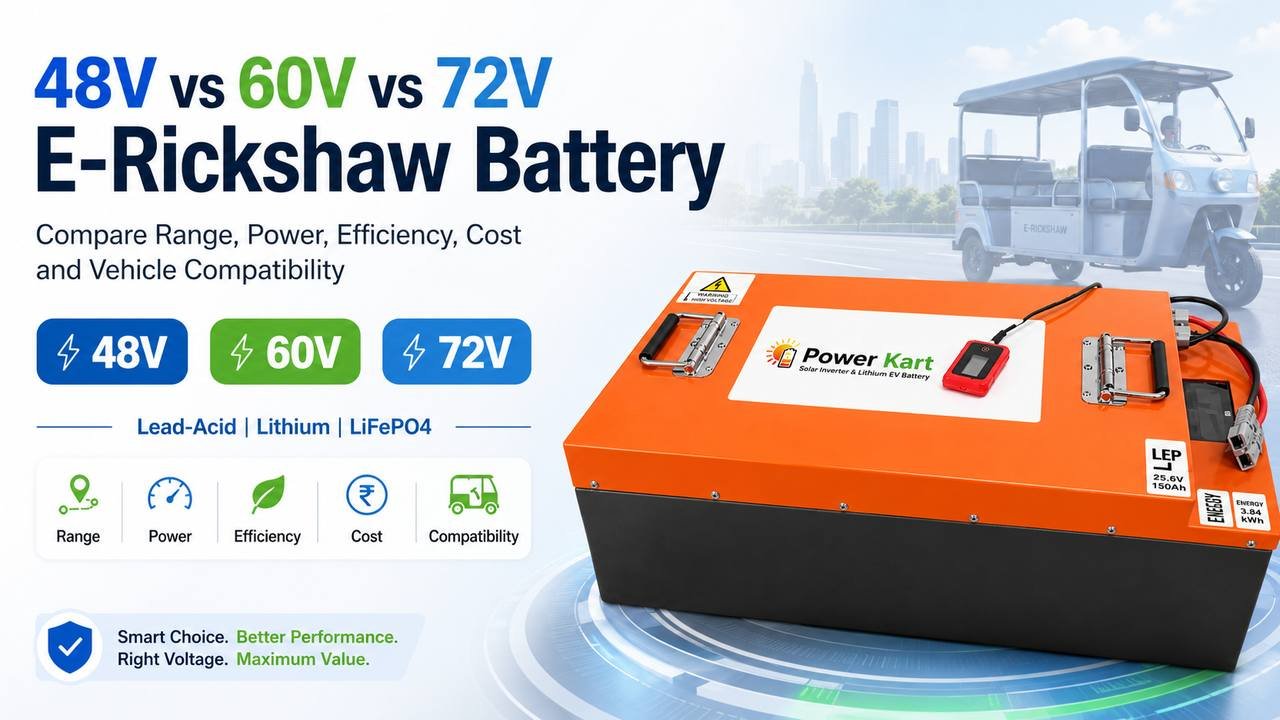
Compare Range, Power, Efficiency, Cost and Electric Vehicle Compatibility
Choosing an e-rickshaw battery often begins with a simple question:
Should I buy a 48V, 60V, or 72V battery?
At first, the answer may appear obvious. A 72V battery has a higher voltage than a 60V or 48V battery, so many buyers assume it must provide the highest speed, longest range, and best overall performance.
That assumption is only partly correct.
Battery voltage affects how an e-rickshaw’s electrical system delivers power, but it does not independently determine driving range, acceleration, load capacity, or battery life. Actual performance is shaped by how the battery voltage and capacity work with the motor, controller, battery type, vehicle weight, transmission, road conditions, and the way the vehicle is driven.
A properly designed 48V system may perform better than a poorly matched 72V system. A high-capacity 60V battery can sometimes take the vehicle farther than a lower-capacity 72V pack.
The best battery is therefore not always the one with the highest voltage. It is the one that matches the vehicle and the work it must perform.
New to e-rickshaw batteries? Read our complete E-Rickshaw Battery Guide to understand battery types, capacity, lifespan, charging, maintenance and buying factors before comparing 48V, 60V and 72V options.
This guide explains the technical differences between 48V, 60V, and 72V e-rickshaw batteries and helps you decide which system is most suitable for passenger transport, cargo movement, short routes, hill climbing, and everyday commercial use.
What Does Battery Voltage Mean?
Voltage can be understood as the electrical pressure that pushes current through the motor and controller.
A higher system voltage allows the same amount of power to be delivered with less current.
The basic electrical relationship is:
Power = Voltage × Current
For example, suppose an electric motor needs 3,000 watts of electrical power.
At 48V:
Current = 3,000 ÷ 48 = 62.5A
At 60V:
Current = 3,000 ÷ 60 = 50A
At 72V:
Current = 3,000 ÷ 72 = 41.7A
All three systems can theoretically supply the same 3,000 watts. However, the 72V system requires less current than the 48V system to deliver that power.
Lower current can reduce electrical losses in the cables, connectors, controller, fuse, and battery interconnections.
Electrical heating increases roughly with the square of the current:
Heat loss is proportional to Current² × Resistance
Using the example above, a 48V system carrying 62.5A may generate considerably more resistive heating than a 72V system carrying 41.7A, assuming both systems have similar wiring resistance.
However, this does not mean every 72V e-rickshaw will be more efficient. The controller, motor, battery, wiring, and gearing must all be designed for the higher voltage.
Voltage Does Not Directly Tell You the Range
A common mistake is to compare e-rickshaw batteries only by voltage.
Driving range is influenced more directly by the total energy stored in the battery.
Battery energy is measured in watt-hours or kilowatt-hours.
The calculation is:
Battery energy in watt-hours = Voltage × Ampere-hours
Consider three batteries:
- 48V 100Ah E-rikshaw Battery
- 60V 100Ah E- rikshaw Battery
- 72V 100Ah E- rikshaw Battery
Their nominal stored energy is:
- 48V × 100Ah = 4,800Wh or 4.8kWh
- 60V × 100Ah = 6,000Wh or 6kWh
- 72V × 100Ah = 7,200Wh or 7.2kWh
In this comparison, the 72V battery stores more energy because all three batteries have the same Ah rating.
Now compare these instead:
- 48V 150Ah = 7.2kWh
- 60V 120Ah = 7.2kWh
- 72V 100Ah = 7.2kWh
All three batteries contain approximately the same nominal energy.
Their actual driving range could therefore be reasonably similar if they power vehicles with comparable weight, efficiency, speed, motor design, and road conditions.
This demonstrates an important rule:
Voltage tells you how the electrical system operates.Kilowatt-hours show the total amount of energy available inside the battery.
Understanding 48V E-Rickshaw Batteries
The 48V system is one of the most familiar configurations in the traditional low-speed e-rickshaw market.
A lead-acid 48V battery bank is often created by connecting four 12V batteries in series.
A lithium version may be sold as a 48V-class battery, although its exact nominal voltage depends on the cell chemistry and series configuration.
For example, a LiFePO₄ replacement may have a nominal voltage of 51.2V because it usually contains 16 cell groups connected in series.
Several established low-speed e-rickshaw models use 48V motors and controllers. Saera’s Mayuri Star, for example, lists a 48V, 1,000W BLDC motor and a 48V controller. Saera also specifies a 130Ah battery for the model.
Another manufacturer, Skyride, lists a 48V system using four batteries, a 1,000W motor, a 48V controller, and an advertised approximate range of 100km per charge under its stated conditions.
These examples confirm that a well-matched 48V setup can provide reliable performance for regular low-speed passenger e-rickshaws.
Advantages of a 48V system
A 48V e-rickshaw battery can offer:
- Lower initial system cost
- Wide availability of motors, chargers, controllers, and spare parts
- Easier servicing in many local markets
- Compatibility with many traditional low-speed e-rickshaws
- Simpler lead-acid battery replacement
- Suitability for short and moderate daily routes
For owners already using a 48V vehicle, replacing the battery with another correctly specified 48V system is usually simpler than converting the entire vehicle to a different voltage.
Limitations of a 48V system
A 48V system may require higher current to produce the same power as a 60V or 72V system.
Higher current can increase:
- Cable heating
- Connector heating
- Controller stress
- Voltage drop
- BMS current requirement
- Energy loss through resistive components
This becomes more important when the e-rickshaw carries heavy loads, climbs slopes, or uses a higher-power motor.
A 48V system is not automatically weak, but high-power operation requires correctly sized cables, connectors, controller MOSFETs, fuse protection, and battery cells.
Who should consider a 48V battery?
A 48V battery is often suitable for:
- Standard low-speed passenger e-rickshaws
- Flat urban or semi-urban routes
- Short and medium daily distances
- Vehicles with 1,000W to 1,200W-class motors
- Owners seeking widely available replacement components
- Operators who do not want to modify the existing controller or motor
The system is especially practical when the current vehicle was originally designed and approved for 48V operation.
What About a 51.2V LiFePO₄ Battery?
Although this article compares the commonly used market descriptions of 48V, 60V, and 72V, buyers should also understand the 51.2V category.
A 51.2V LiFePO₄ battery usually contains 16 series-connected cell groups, each with a nominal voltage of about 3.2V.
Its nominal voltage is:
16 × 3.2V = 51.2V
At approximately 3.65V per cell when fully charged, the pack may reach:
16 × 3.65V = 58.4V
This battery is frequently used in vehicles described as 48V-class lithium systems, but compatibility must be checked carefully.
The controller and charger must support the battery’s full operating-voltage range.
Modern electric three-wheelers demonstrate that moderate-voltage systems can still deliver substantial power. The Piaggio Apé E-City Ultra uses a 51.2V lithium-ion battery, a rated capacity of about 10.2kWh, peak motor power of 9.5kW, and a listed typical on-road range of 205 ± 5km.
Similarly, Piaggio’s Apé E-Xtra FX Max cargo model uses a 51.2V, 8.34kWh battery and a motor rated at up to 9.55kW, with a listed typical range of 130 ± 5km.
These figures do not mean every 51.2V battery will produce the same result. They show that system engineering, battery energy, motor efficiency, and vehicle design are more important than voltage alone.
Understanding 60V E-Rickshaw Batteries
A 60V system sits between the familiar 48V architecture and the higher-voltage 72V option.
In a lead-acid arrangement, 60V is commonly produced using five 12V batteries connected in series.
For lithium packs, the exact nominal and fully charged voltages depend on chemistry and cell count.
A 60V system may provide a useful balance between manageable component cost and lower current demand.
For the same 3,000W output:
- A 48V system draws approximately 62.5A
- A 60V system draws approximately 50A
- A 72V system draws approximately 41.7A
Compared with 48V, the 60V system requires about 20% less current to deliver the same theoretical power.
That reduction can ease the load on cables and connectors when the system is designed properly.
Advantages of a 60V system
A 60V battery can offer:
- Better current management than a comparable 48V system
- Suitable support for moderately higher-power motors
- Improved performance under passenger or cargo load
- A useful compromise between cost and power
- More stored energy than 48V when Ah capacity is equal
- Potentially lower voltage sag under heavy acceleration
For example, a manufacturer offering both 48V and 60V variants may use a 60V system for a heavier cargo model or a motor with a higher power rating. One manufacturer’s published range includes passenger models with 48V or 60V lead-acid or lithium options and cargo models using 60V systems, with motor ratings extending to around 1,500W.
The exact performance still depends on how that battery is paired with the controller and motor.
Limitations of a 60V system
A 60V upgrade may require replacement of:
- Motor
- Controller
- Charger
- DC-DC converter
- Dashboard components
- Relays or contactors
- Low-voltage protection
- BMS
- Fuses
- Connectors
A 48V charger must not be used with a 60V battery.
Similarly, a controller designed only for 48V may be damaged by a 60V pack, particularly when the battery is fully charged.
Owners should not assume that adding another 12V battery to a 48V lead-acid bank is a safe method of upgrading to 60V.
The extra voltage may exceed the limits of the existing electronics.
Who should consider a 60V battery?
A 60V battery may be suitable for:
- Passenger e-rickshaws with moderately higher power demand
- Vehicles that regularly operate with a full load
- Light cargo e-rickshaws
- Routes with frequent flyovers or modest slopes
- Owners purchasing a purpose-built 60V vehicle
- Applications where 48V produces excessive current but 72V is unnecessary
The key phrase is purpose-built. A vehicle designed from the beginning for 60V is preferable to an unplanned conversion from 48V.
Understanding 72V E-Rickshaw Batteries
A 72V battery is commonly associated with higher-power e-rickshaws, cargo vehicles, faster electric three-wheelers, and applications with demanding load or terrain requirements.
A lead-acid 72V bank is usually assembled using six 12V batteries in series.
A lithium system may use a different number of cells depending on whether it uses NMC, LiFePO₄, or another chemistry.
At the same power level, a 72V system draws less current than a 48V or 60V system.
For a 5,000W motor:
- At 48V: approximately 104A
- At 60V: approximately 83A
- At 72V: approximately 69A
This current reduction can become important in higher-power commercial systems.
Advantages of a 72V system
A properly designed 72V system may provide:
- Better support for higher motor power
- Lower current for the same power output
- Reduced cable loss when wire size and design are appropriate
- Stronger acceleration potential
- Better ability to handle heavier cargo
- Improved hill-climbing capability
- More energy than lower-voltage batteries when Ah ratings are equal
- Greater design flexibility for faster L5-category vehicles
Some manufacturers offer products across a 48V-to-72V range, including lead-acid and lithium options, depending on the motor and application.
However, the voltage alone does not confirm the system’s range, payload, or efficiency.
Limitations of a 72V system
A 72V system can be:
- More expensive
- Less familiar to local technicians
- More demanding in terms of electrical insulation
- Dependent on specialised chargers and controllers
- More difficult to retrofit into a 48V vehicle
- Potentially more dangerous if incorrectly assembled or serviced
More batteries connected in series also create more interconnections and additional opportunities for imbalance in a lead-acid bank.
For example, a 72V lead-acid system using six batteries will perform only as well as its weakest battery. If one battery loses capacity or develops high internal resistance, the entire bank can suffer from reduced range and early charger cut-off.
A 72V lithium pack requires a BMS specifically designed for its cell count, voltage range, continuous current, peak current, and temperature conditions.
Who should consider a 72V battery?
A 72V system may suit:
- Heavy cargo e-rickshaws
- Higher-speed electric three-wheelers
- Vehicles with powerful motors
- Routes with steep inclines
- Applications involving continuous high load
- Purpose-built commercial EV platforms
- Operators who need stronger acceleration and sustained power
It should not be selected only because it sounds more powerful.
Direct Comparison: 48V vs 60V vs 72V
| Feature | 48V System | 60V System | 72V System |
| Typical role | Standard low-speed e-rickshaw | Medium-duty passenger or light cargo | Higher-power passenger or cargo vehicle |
| Current for equal power | Highest | Medium | Lowest |
| Component availability | Generally wide | Moderate | More specialised |
| Initial cost | Usually lower | Medium | Usually higher |
| Upgrade complexity | Lowest for existing 48V vehicles | Requires matched components | Often requires complete conversion |
| Suitability for heavy loads | Limited to moderate, depending on design | Better for medium-duty use | Strong potential for demanding use |
| Cable and connector demand | Higher current rating required | Moderate current | Lower current for equal power |
| Common lead-acid arrangement | 4 × 12V | 5 × 12V | 6 × 12V |
| Risk of battery-bank imbalance | Present | Higher number of units | More series-connected units |
| Best use case | Standard passenger routes | Balanced commercial use | Heavy load and high-power operation |
These comparisons describe typical engineering behaviour, but actual performance can vary from one vehicle to another.
A premium 48V lithium system may outperform a low-quality 72V battery bank.
Does 72V Always Mean Faster Speed?
No.
Vehicle speed depends on:
- Motor design
- Motor winding
- Controller programming
- Gear or differential ratio
- Tyre diameter
- Vehicle weight
- Aerodynamic resistance
- Legal or electronic speed limits
- Battery voltage under load
Increasing voltage can increase a motor’s potential rotational speed in some systems, but only if the motor and controller are designed to handle it.
Connecting a 72V battery to a 48V motor-controller system can damage the controller, overheat the motor, or cause unsafe overspeed.
Does 72V Always Give More Range?
No.
Compare:
- 48V 150Ah = 7.2kWh
- 60V 120Ah = 7.2kWh
- 72V 100Ah = 7.2kWh
The stored energy is the same.
A 72V system may operate with lower current, but the real difference in range will depend on overall system efficiency.
Range is also affected by:
- Passenger load
- Cargo weight
- Average speed
- Stop-and-go traffic
- Road gradient
- Tyre pressure
- Motor efficiency
- Battery depth of discharge
- Battery age
- Weather
- Driving style
An OEM example shows why battery capacity must be considered alongside voltage. Piaggio lists a 48V, 6.26kWh swappable battery with a certified range of 120km for one Apé E-City model, while another 51.2V model uses a larger 10.2kWh battery and lists a typical on-road range around 205km. The large energy-capacity difference is a major factor; the small voltage difference alone does not explain the range increase.
Lead-Acid vs Lithium at Different Voltages
Voltage should not be considered separately from battery chemistry.
Lead-acid battery bank
A lead-acid system may have:
- Lower purchase cost
- Higher weight
- Longer charging time
- More maintenance
- Lower usable depth of discharge
- Greater voltage drop under load
- Multiple individual batteries requiring matching
A published L3 e-rickshaw specification from Joy E-Rik lists a 48V lead-acid system using four batteries, a rated 1.2kW motor, approximately 8 to 8.5 hours of charging, and a claimed range of 100–120km under its stated conditions.
Lithium or LiFePO₄ battery
A lithium system generally offers:
- Lower weight
- Faster charging capability
- Higher usable energy
- Better voltage stability
- Lower routine maintenance
- Integrated BMS protection
- Easier monitoring in smart packs
The same manufacturer lists a 51.2V, 200Ah LFP system with 10.24kWh capacity, a 4.39kW rated motor, approximately 4 to 4.5 hours of charging at 50A, and a stated range of 140km for an L5 passenger vehicle.
These two vehicles are in different categories and should not be compared as identical machines. The data does demonstrate how voltage, chemistry, battery energy, motor power, vehicle design, and charger rating work together.
How to Choose the Best Voltage
Use the following process rather than selecting a voltage from an advertisement.
Step 1: Check the controller
Confirm:
- Nominal operating voltage
- Maximum battery voltage
- Low-voltage cut-off
- Continuous-current rating
- Peak-current rating
The controller must tolerate the battery’s fully charged voltage, not only its nominal label.
Step 2: Check the motor
Verify:
- Rated voltage
- Rated power
- Peak power
- Current demand
- Thermal limits
- Speed rating
Step 3: Calculate your required energy
Estimate daily distance and energy consumption.
For example, if an e-rickshaw consumes an average of 50Wh per kilometre and must travel 100km:
Required usable energy = 50 × 100 = 5,000Wh or 5kWh
Add a practical reserve for traffic, load, battery ageing, and route variation.
A battery providing approximately 6kWh of usable energy may therefore be more appropriate than one that offers exactly 5kWh.
This is an example calculation. Actual consumption must be measured or confirmed for the particular vehicle.
Step 4: Check maximum current
Suppose the motor-controller combination may demand 4kW.
At 48V:
4,000 ÷ 48 = approximately 83A
At 60V:
4,000 ÷ 60 = approximately 67A
At 72V:
4,000 ÷ 72 = approximately 56A
The battery cells, BMS, fuse, cable, terminals, and connectors must safely support this load, including temporary peaks.
Step 5: Match the charger
The charger must match:
- Battery chemistry
- Number of series cells
- Maximum charging voltage
- Recommended charging current
- BMS limits
- Connector and polarity
Step 6: Consider service availability
A technically advanced battery is less useful if no trained technician or replacement charger is available nearby.
Commercial operators should consider:
- Local repair support
- Warranty response time
- Spare BMS availability
- Charger availability
- Connector availability
- Diagnostic support
Which e-rickshaw Battery Is Best for Each User?
Best for standard passenger e-rickshaw use
A correctly sized 48V or compatible 51.2V lithium system is often sufficient for standard passenger routes, particularly when the vehicle is already designed for that voltage.
Best for mixed passenger and light cargo use
A 60V purpose-built system can provide a useful middle ground between cost, current demand, and motor power.
Best for heavy cargo or demanding routes
A 72V system may be the better choice when the vehicle is designed for high power, heavy load, steeper roads, or sustained commercial use.
Best for an existing 48V vehicle
Stay with the manufacturer-approved voltage unless the motor, controller, charger, wiring, protection devices, and certification implications have been professionally evaluated.
Final Verdict
There is no single voltage that is best for every e-rickshaw.
Choose 48V e-rickshaw battery when you need a practical, widely supported system for standard low-speed passenger travel.
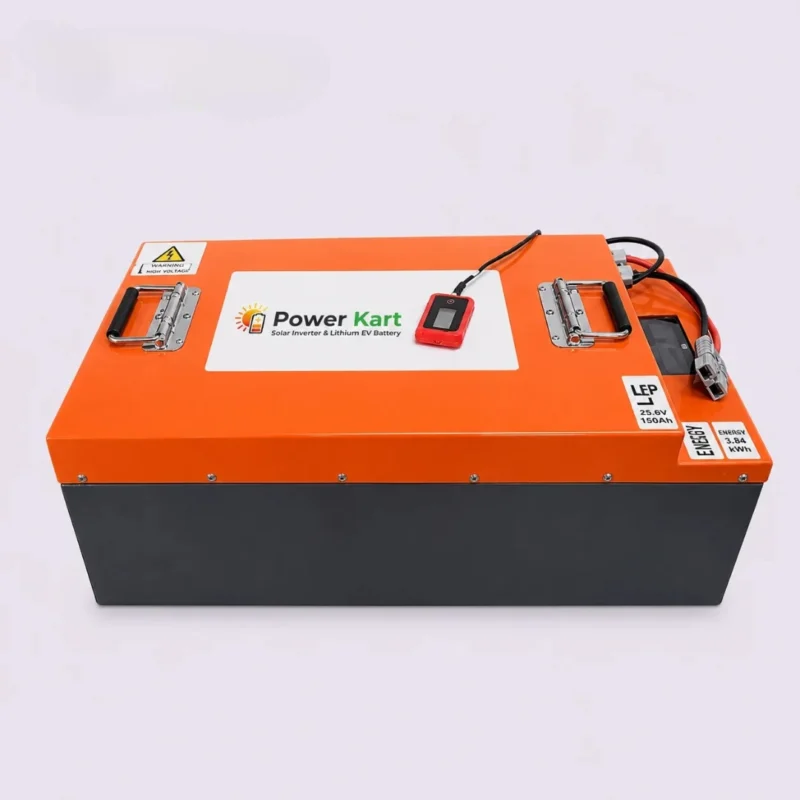
Choose 60V e-rickshaw battery when you need a balanced system for moderately higher power, full passenger loads, or light cargo work.
Choose 72V e-rickshaw battery when the vehicle is purpose-built for heavier loads, higher power, difficult terrain, or faster commercial operation.
Most importantly, do not compare batteries only by voltage.
Compare:
- Total energy in kWh
- Battery chemistry
- Usable capacity
- BMS current rating
- Motor power
- Controller voltage
- Charging time
- Cell quality
- Vehicle payload
- Real operating conditions
- Warranty and service support
A well-matched 48V battery is safer and more useful than an incorrectly installed 72V battery.
The best e-rickshaw battery is the one that can complete your daily route, carry the expected load, remain within safe current and temperature limits, and provide reliable performance over its service life.
Before purchasing, share your electric vehicle’s motor label, controller label, existing battery specification, daily distance, passenger or cargo load, and route conditions with a qualified battery supplier.
At PowerKart, we help e-rickshaw owners, dealers, and fleet operators select compatible 48V, 51.2V, 60V, and 72V battery solutions based on motor power, controller rating, required range, battery capacity, and commercial usage.