
How a 4.2kVA hybrid inverter, 9.6kWh battery and 3kW solar panels work together
Electricity is now a basic need in our daily lives.
Fans, lights, refrigerators, televisions, Wi-Fi routers, computers and water pumps all depend on a stable power supply.
At the same time, electricity bills are increasing, and power cuts continue to affect many homes. This is why homeowners are looking for a solution that can provide both daytime solar savings and reliable backup.
A 3kW off-grid solar system for home can be a practical option for families that want to use solar energy without exporting power to the electricity grid. When the system includes a hybrid inverter, lithium battery and Grid Assist function, it can manage solar, battery and grid power according to the available energy and connected load.
This guide explains:
- What a 3kW off-grid hybrid solar system is
- How Grid Assist works
- Which household appliances it can operate
- How long a 9.6kWh lithium battery may provide backup
- Whether net metering is required
- What affects the total system cost
- How to decide whether the system is suitable for your home
What Is a 3kW Off-Grid Solar System?
A 3kW off-grid solar system uses solar panels to generate electricity for household appliances and battery charging.
Unlike a conventional on-grid solar system, an off-grid system does not depend on exporting surplus electricity to the grid. The solar energy is used within the property.
A complete off-grid hybrid solar system normally includes:
- Solar panels
- A hybrid solar inverter
- A lithium battery
- Solar and battery protection devices
- DC and AC cables
- Earthing and lightning protection
- A changeover arrangement
- A mounting structure for the solar panels
The solar panels generate DC electricity. The hybrid inverter converts it into AC electricity for household appliances. It can also use solar power to charge the lithium battery.
When solar power is unavailable or insufficient, the battery or grid can support the connected loads depending on the system settings.
Understanding the 3kW Solar, 4.2kVA Inverter and 9.6kWh Battery Ratings
Solar system specifications can be confusing because solar panels, inverters and batteries use different units.
Knowing what these ratings mean will make it easier to select the right system.
3kW solar-panel capacity
A 3kW solar array may include six 500Wp solar panels.
The 3kW rating indicates the maximum combined output of the solar panels under standard test conditions. It does not mean that the panels will continuously generate 3kW throughout the day.
Solar output changes according to:
- Time of day
- Weather conditions
- Roof direction
- Panel angle
- Dust accumulation
- Shading
- Temperature
- Location
- Cable and conversion losses
Generation usually rises during the morning, reaches its highest level around the middle of the day and then reduces during the evening.
4.2kVA hybrid-inverter capacity
The inverter rating determines how much connected load the system can support.
A 4.2kVA hybrid inverter can operate several normal household appliances together, but the exact watt capacity depends on the inverter’s power factor, operating mode and manufacturer specifications.
The starting surge of appliances must also be considered.
A refrigerator, water pump or air conditioner may draw extra power for a few seconds when it starts.
Therefore, appliance selection should be based on both running load and starting load.
9.6kWh lithium-battery capacity
A 48V 200Ah lithium battery stores approximately:
48V × 200Ah = 9,600Wh or 9.6kWh
This is the battery’s nominal energy capacity.
However, the entire 9.6kWh is normally not delivered to household appliances. Some energy is reserved to protect the battery, and some is lost during conversion through the inverter.
The actual usable backup will depend on:
- Battery discharge limit
- Inverter efficiency
- Battery condition
- Connected load
- Battery-management settings
- Temperature
- Solar generation during the backup period
How Does Grid Assist Work?
Grid Assist is one of the most useful features of an off-grid hybrid solar system.
A basic off-grid inverter may select only one power source at a time. A Grid Assist system can use available solar power and take the remaining required power from the grid when solar generation is lower than the load.
For example, suppose the connected household load is 2,000W and the solar panels are producing 1,300W.
Instead of drawing the complete 2,000W from the grid, the system may use:
- 1,300W from solar
- Approximately 700W from the grid
The exact operation will depend on inverter settings and system design.
This allows the homeowner to use available solar energy even when it is not enough to operate the complete load.
During strong sunlight
When sufficient sunlight is available, solar energy can:
- Operate the connected home appliances
- Charge the lithium battery
- Reduce electricity drawn from the grid
During weak sunlight
Clouds, shading or the early morning and evening hours may reduce solar output.
In this situation, Grid Assist can combine available solar power with grid electricity. Solar continues contributing energy, while the grid supplies the balance.
During a power cut
When the grid fails, the lithium battery supplies the connected backup loads.
If sunlight is available during the power cut, the solar panels may continue supporting the appliances and charging the battery.
This can extend the backup duration compared with using the battery alone.
When the battery becomes low
When the battery reaches its configured lower limit, the inverter can shift the load to the grid if grid power is available.
Depending on the settings and available solar generation, it may also recharge the battery using solar, grid power or both.
What Can a 3kW Off-Grid Solar System Run?
A 3kW solar system can operate many common household appliances, but it is important to separate two questions:
- How much energy can the solar panels generate during the day?
- How much load can the inverter operate at one time?
The 3kW solar rating relates to generation. The inverter rating relates to the supported load.
Here are approximate running-power values for common household appliances:
| Appliance | Typical running load |
| LED bulb | 8–15W |
| Ceiling fan | 50–80W |
| Wi-Fi router | 10–20W |
| LED television | 70–150W |
| Laptop | 45–100W |
| Desktop computer | 150–400W |
| Refrigerator | 100–300W |
| Washing machine | 400–800W |
| Mixer grinder | 500–1,000W |
| Microwave oven | 1,000–1,500W |
| Water pump | 500–1,500W |
| Air conditioner | 900–2,000W or more |
These are general values.Check the appliance label to confirm its actual power consumption.
Example of an essential home load
Consider the following appliances:
| Appliance | Quantity | Estimated total load |
| LED lights | 8 | 80W |
| Ceiling fans | 5 | 350W |
| Refrigerator | 1 | 200W |
| Television | 1 | 120W |
| Wi-Fi router | 1 | 15W |
| Laptops | 2 | 130W |
| Mobile chargers | Multiple | 30W |
| Approximate running load | 925W |
This type of essential load can generally be managed comfortably by a properly designed 4.2kVA hybrid-inverter system.
However, the refrigerator’s starting surge must still be considered.
Can it run a water pump?
It may operate a small water pump if the inverter supports the pump’s running and starting current.
Motor loads can require two to five times their normal running current for a short period while starting. The pump rating, cable size, inverter surge capacity and other connected loads should therefore be checked before installation.
It may also be better to operate the pump during strong sunlight instead of using battery energy at night.
Can it run an air conditioner?
A 3kW solar system may support a small, energy-efficient inverter air conditioner under suitable conditions. However, this cannot be decided only from the solar-panel rating.
The installer must check:
- Air-conditioner input power
- Starting current
- Inverter surge rating
- Other loads operating at the same time
- Available solar output
- Battery discharge-current limit
- Required backup duration
Running an air conditioner from the battery can reduce backup time quickly. Homeowners who require long AC backup may need a larger inverter, more solar panels or additional battery storage.
Can it run a geyser or room heater?
Heating appliances consume large amounts of electricity.
A geyser, induction cooktop, electric kettle, iron or room heater may use between 1,000W and 3,000W. Operating one of these appliances can consume a major portion of the system’s available power.
Such loads should preferably be used during strong solar generation and only after confirming the inverter capacity.
For reliable backup, it is normally better to keep heavy heating appliances outside the essential backup circuit.
Estimated Backup Time of a 9.6kWh Lithium Battery
Battery backup depends mainly on the connected load.
In actual use, the appliances will receive slightly less energy than the battery’s full 9.6kWh rating.
Assuming approximately 7.5kWh to 8.2kWh is available after the configured discharge limit and conversion losses, the estimated backup may be:
| Average connected load | Estimated backup time |
| 300W | 25–27 hours |
| 500W | 15–16 hours |
| 750W | 10–11 hours |
| 1,000W | 7.5–8 hours |
| 1,500W | 5–5.5 hours |
| 2,000W | 3.7–4 hours |
| 3,000W | 2.5–2.7 hours |
These are planning estimates, not guaranteed backup figures.
Actual backup may be shorter or longer depending on appliance cycling, battery settings, inverter losses, battery age and available solar power.The actual backup time may vary based on appliance usage, battery settings, inverter efficiency, battery condition and available sunlight.
For instance, a refrigerator uses power in cycles because its compressor does not run continuously.
Similarly, water pumps, washing machines and other appliances may be used only for short periods.
The average load over time is more important than the maximum load at one moment.
How solar can extend the backup
For example, during a daytime power cut, the home may need 1,000W while the solar panels are producing 700W.
The battery may need to supply only the remaining 300W.
As a result, the battery can last much longer than it would at night when no solar power is available.
During strong sunlight, solar generation may even be sufficient to operate the load and charge the battery at the same time.
How Much Electricity Can 3kW Solar Panels Generate?
Solar generation is measured in kilowatt-hours, commonly called electricity units.
A 3kW system does not produce three units every hour from sunrise to sunset. The output changes continuously with sunlight.
For basic planning, a shadow-free 3kW solar array may generate roughly 9 to 13 units on a good day after considering normal system losses. This range can change significantly according to location, season, roof orientation, weather and panel maintenance.
India has strong solar potential, but solar radiation varies across regions and seasons. The Ministry of New and Renewable Energy states that most parts of India receive approximately 4–7kWh of solar energy per square metre per day.
A professional site survey and generation simulation should be used for a more accurate estimate.
Why actual generation may be lower
Solar generation can reduce because of:
- Shadows from nearby buildings
- Water tanks
- Trees
- Mobile towers
- Dust and bird droppings
- Incorrect panel direction
- Poor ventilation under panels
- Long or undersized cables
- Loose electrical connections
- High temperature
- Cloudy or rainy weather
Even a small shadow across part of a solar panel can affect the output of the connected string.
Correct Solar Panel installation is therefore as important as the panel capacity.
Does This System Require Net Metering?
A zero-export hybrid solar system uses all generated solar power within the property.
. Surplus solar power is not sent to the electricity grid.
Solar energy is used for:
- Operating household appliances
- Charging the lithium battery
- Reducing grid consumption
Because the inverter does not export power, the configuration does not require net metering for its normal zero-export operation. The PowerKart system is specifically designed for self-consumption, battery backup and Solar + Grid sharing without grid export.
This makes it suitable for customers who:
- Do not want to export electricity
- Cannot obtain net metering
- Want power-cut backup
- Want to use solar directly during the day
- Prefer a lithium battery-based solution
- Want to upgrade from a conventional home inverter
Electrical safety rules, building permissions and local requirements may still apply. Installation should be carried out by a qualified professional.
Off-Grid vs On-Grid vs Hybrid Solar Systems
The right solar system depends on what the homeowner wants to achieve.
| Feature | On-grid solar | Basic off-grid solar | Off-grid hybrid with Grid Assist |
| Battery included | Usually no | Yes | Yes |
| Backup during power cuts | Usually no | Yes | Yes |
| Grid connection | Required | Optional | Used for assistance |
| Grid export | Usually supported | No | No |
| Net metering | Usually required for export | Not required | Not required for zero export |
| Solar savings | Yes | Yes | Yes |
| Solar and grid sharing | Depends on inverter | Usually limited | Supported |
| Best suited for | Bill reduction | Remote or backup use | Savings plus reliable backup |
When an on-grid system may be better
An on-grid system may be suitable when:
- Power cuts are rare
- The main goal is electricity-bill reduction
- Net metering is available
- Battery backup is not required
- The roof has sufficient solar-panel space
When an off-grid hybrid system may be better
An off-grid hybrid system may be suitable when:
- Power cuts are frequent
- Reliable backup is important
- Net metering is unavailable or not preferred
- The customer wants a lithium battery
- Solar should work during a grid failure
- The home needs both savings and backup
Government rooftop-solar subsidy programmes are generally structured around eligible grid-connected residential systems. Customers considering an off-grid or zero-export system should confirm current subsidy eligibility with the vendor and local DISCOM before making a purchase.
Benefits of a LiFePO4 Battery for Home Solar
LiFePO₄ stands for lithium iron phosphate. It is widely used in solar-storage applications because of its safety, cycle life and stable performance.
Greater usable capacity
Lead-acid batteries are normally not discharged deeply every day because deep discharge can shorten their life.
A properly configured LiFePO4 battery can generally provide a larger usable portion of its rated capacity.
Longer operating life
LiFePO₄ batteries are designed for repeated charge and discharge cycles. Their useful life still depends on cell quality, temperature, charge voltage, discharge depth and BMS settings.
Faster charging
Lithium batteries can generally accept charging more efficiently than conventional lead-acid batteries. This can be useful when the available solar-charging window is limited.
Lower maintenance
A sealed LiFePO₄ battery does not require regular water topping-up.
However, it should still be installed in a dry and ventilated location and inspected periodically for loose connections, unusual heating or physical damage.
Stable voltage
Lithium batteries maintain a relatively stable voltage through much of their discharge cycle. This can help the inverter operate more consistently.
What Is Included in the Complete PowerKart System?
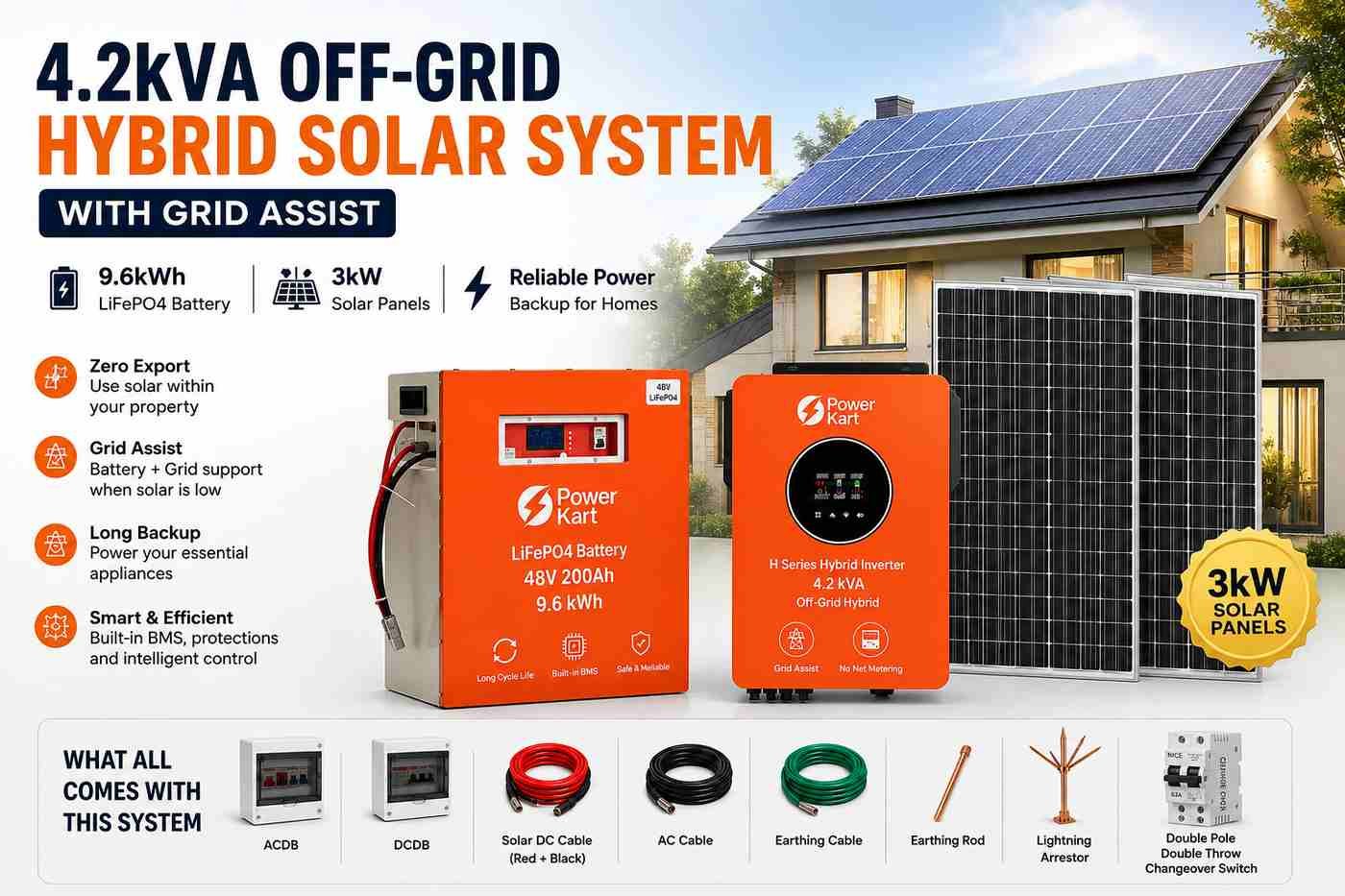
PowerKart’s complete configuration includes:
- One 4.2kVA H Series hybrid inverter
- One 48V 200Ah LiFePO₄ battery
- Six 500Wp solar panels
- Total solar capacity of 3kW
- Total battery capacity of 9.6kWh
- AC distribution box
- DC distribution box
- Lightning arrestor
- Earthing rod
- Double-pole double-throw changeover switch
The 4.2kVA off-grid hybrid solar system with a 9.6kWh LFP battery and 3kW solar panels system is designed for apartments, villas and independent homes that require solar savings during the day and lithium battery backup during power cuts.
Solar DC cable, AC cable and earthing-cable costs may be calculated after the site inspection because the required lengths differ from one property to another.
What Affects the Price of a 3kW Off-Grid Solar System?
The price of an off-grid solar system cannot be calculated only from the number of solar panels.
The final installed cost depends on the complete design.
Solar-panel brand and technology
Panel efficiency, warranty, manufacturer reputation and technology can affect the price.
Lithium-battery quality
The battery is a major part of the total system cost.
Its price depends on:
- Cell manufacturer
- Cell grade
- Battery capacity
- BMS quality
- Enclosure
- Communication features
- Warranty
- Cycle-life specification
Hybrid-inverter features
An inverter with Grid Assist, wide MPPT range, lithium-battery communication and programmable operating modes may cost more than a basic solar inverter.
Mounting structure
The structure cost depends on the roof type, installation height, wind load and whether a standard or customised structure is needed.
Cable length
A property with a large distance between the panels, inverter, battery and distribution board will require more cable.
Using the correct cable size is essential for safety and reducing voltage loss.
Earthing and electrical protection
A complete installation may require separate earthing arrangements, distribution boxes, isolators, breakers, surge-protection devices and a lightning arrestor.
Installation complexity
A simple flat-roof installation will usually cost less than an installation involving a high-rise building, difficult cable routing or a custom elevated structure.
A site inspection is therefore necessary before giving a final installed price.
Is a 3kW Off-Grid Solar System Suitable for Your Home?
This system may be suitable when your priorities include:
- Backup for essential appliances
- Lower daytime grid consumption
- Lithium battery storage
- Solar operation during power cuts
- No export to the grid
- No dependence on net metering
- Grid support when solar is insufficient
Before choosing the system, prepare a list of appliances that must operate during a power cut.
For each appliance, note:
- Quantity
- Running wattage
- Starting wattage
- Expected daily operating hours
- Whether it is essential
- Whether it needs daytime or night-time backup
This load study will help determine whether a 4.2kVA inverter and 9.6kWh battery are sufficient.
Frequently Asked Questions
1. Is 3kW solar enough for a home?
A 3kW solar system can support many essential household loads, including fans, lights, a refrigerator, television, Wi-Fi router and computers. Suitability depends on the home’s daily energy consumption and simultaneous load.
2. How many solar panels are required for 3kW?
Six 500Wp panels provide a total capacity of 3,000Wp or 3kW.
The number of panels will change if a different panel wattage is used.
3. How much roof space is required?
The required space depends on panel dimensions, orientation, maintenance gaps and mounting structure.
A site survey should confirm whether sufficient shadow-free space is available.
4. How long will a 9.6kWh lithium battery last?
At an average 1,000W load, the battery may provide approximately 7.5 to 8 hours of backup under suitable conditions.
At a 2,000W load, the backup may be approximately 3.7 to 4 hours.
These are estimates and depend on battery and inverter settings.
5. Can the battery charge during a power cut?
Yes. When sunlight is available, the solar panels can continue supporting the loads and charging the battery, subject to available solar power and system settings.
6. Can solar and grid power work together?
A compatible Grid Assist inverter can use available solar power and obtain the remaining required energy from the grid.
7. Is net metering required?
Net metering is not required for a system that does not export surplus solar energy to the grid. Local installation and electrical-safety requirements should still be followed.
8. Will the system work at night?
Solar panels do not generate power at night. The connected loads can operate using the lithium battery or grid supply depending on the selected settings.
9. Can I add more solar panels later?
Expansion depends on the inverter’s maximum PV input power, MPPT voltage range, current limit and available roof space. The inverter specifications must be checked before adding panels.
10. Can battery capacity be expanded later?
Battery expansion depends on battery voltage, BMS compatibility, communication protocol, inverter settings and whether the battery manufacturer supports parallel operation.
Do not connect batteries of different voltage, capacity, age or chemistry without professional evaluation.
Final Thoughts
A 3kW off-grid solar system is not only a solution for power cuts.
When combined with a 4.2kVA hybrid inverter, Grid Assist and a 9.6kWh LiFePO₄ battery, it can become a complete home-energy system.
During the day, solar energy can operate household appliances and charge the battery. When solar production is insufficient, grid electricity can support the remaining load. During a power cut, the lithium battery provides backup, while available sunlight can continue supporting the system.
The main advantages include:
- Daytime solar savings
- Reliable lithium battery backup
- Better use of available solar energy
- Solar and grid load sharing
- No power export
- No net metering for zero-export operation
- Lower maintenance than conventional lead-acid storage
- Greater control over household energy use
However, correct system sizing is essential.
The inverter must support the maximum running and starting load. The lithium battery must provide the required backup duration. The solar array must be installed in a suitable, shadow-free location.
A professional site inspection and load assessment can help avoid under-sizing, unnecessary oversizing and unrealistic backup expectations.
For homeowners who need both solar savings and dependable backup, a 4.2kVA off-grid hybrid solar system with Grid Assist, a 9.6kWh LFP battery and 3kW solar panels can offer a balanced and practical solution.
Explore the Complete System
Explore the Complete System
Looking for daytime solar savings and dependable lithium battery backup during power cuts?
PowerKart, a trusted lithium battery supplier in Bangalore and a reliable choice for customers searching for the best lithium battery supplier in Karnataka, offers a complete 4.2kVA Off-Grid Hybrid Solar System with Grid Assist, a 9.6kWh LFP battery and 3kW solar panels.
This system is designed for apartments, villas and independent houses that need solar savings, reliable backup and zero-export operation without net metering.