

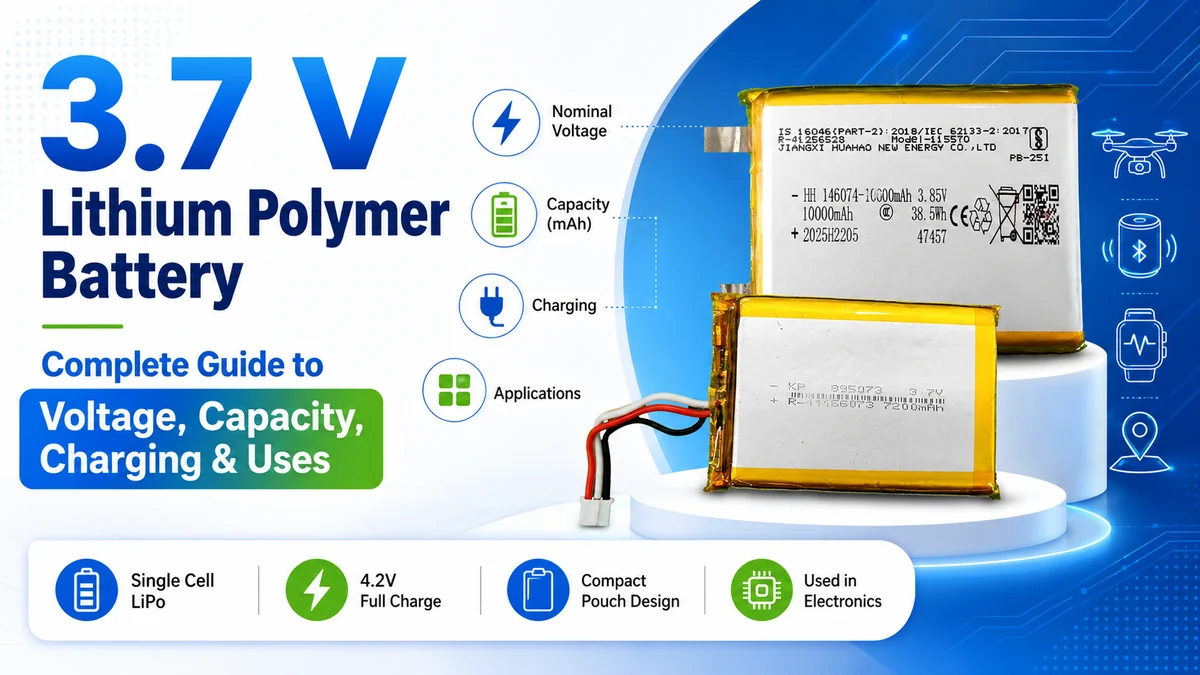
3.7 V Lithium Polymer Battery | Voltage, Capacity, Charging & Uses
A small rechargeable battery powers far more devices than most people realise.
Bluetooth speakers, GPS trackers, handheld electronics, medical devices, toys, portable instruments, IoT products and many rechargeable gadgets commonly use a 3.7 V lithium polymer battery.
At first glance, selecting one seems easy. You check the old battery, find “3.7V” printed on it and buy another 3.7V battery.
But voltage alone is not enough.
Two batteries can both be marked 3.7V and still differ significantly in:
- Capacity
- Physical dimensions
- Connector
- Polarity
- Discharge current
- Protection circuit
- Charging requirements
- Cell chemistry
- Maximum charging voltage
For example, replacing a 3.7V 500mAh battery with a 3.7V 2000mAh battery may be electrically possible in some devices, but only if the larger battery physically fits and the other important specifications are compatible.
This guide explains how a 3.7 V lithium polymer battery works, what 3.7V actually means, how capacity affects runtime, how these batteries are charged and what to check before buying a replacement.
What Is a 3.7 V Lithium Polymer Battery?
A lithium polymer battery, commonly called a LiPo battery, is a type of rechargeable lithium-ion battery.
Instead of the rigid cylindrical metal casing commonly associated with cells such as the 18650, many LiPo cells use a thin aluminium-laminated pouch.
This gives manufacturers much greater freedom in battery shape and size.
You will therefore find LiPo batteries that are:
- Very thin
- Wide and flat
- Long and narrow
- Small enough for wearable electronics
- Large enough for portable equipment
This flexible form factor is one reason LiPo batteries are so popular in compact electronics.
A typical single-cell LiPo battery is commonly described as:
3.7V nominal
It may also be referred to as:
- 3.7V LiPo battery
- 3.7V lithium battery
- 3.7V lithium-ion polymer battery
- Rechargeable 3.7V battery
- 1S lithium battery
- 3.7 volt Li-ion battery
People searching online may also use phrases such as 3 7v li ion battery, 3.7 volt li ion battery, or simply 3.7 battery. In many cases they are looking for a single-cell rechargeable lithium battery, although the exact chemistry and physical format should always be checked.
Why Is It Called a 3.7V Battery?
One of the most confusing things about lithium batteries is that a battery labelled 3.7V does not stay at exactly 3.7V.
The 3.7V figure is its nominal voltage.
Think of nominal voltage as a convenient reference value used to describe the battery.
For many standard single-cell lithium-ion and LiPo batteries:
- Nominal voltage: around 3.6–3.7V
- Fully charged voltage: typically 4.2V
- Voltage falls as the battery discharges
The exact lower operating limit depends on the cell manufacturer and the device’s protection system.
So if you measure a healthy fully charged 3.7V LiPo battery with a multimeter and see something close to 4.2V, that does not automatically mean something is wrong.
It is normal for many standard lithium cells.
Is 4.2V Too High for a 3.7V Battery?
For a conventional 3.7V lithium-ion or LiPo cell designed for a 4.2V maximum charge voltage, no.
A typical charging cycle gradually raises the battery toward approximately 4.2V.
However, you should not assume every lithium battery uses exactly the same voltage limits.
Some specialised high-voltage lithium polymer cells use different nominal and maximum voltages.
Always follow the specification printed on the battery or supplied by the cell manufacturer.
Never increase charging voltage simply because another lithium cell appears similar.
What Does 1S Mean?
If you shop for lithium batteries, you may see terms such as:
- 1S
- 2S
- 3S
- 4S
The letter S refers to cells connected in series.
A standard single 3.7V LiPo cell is:
1S
Two 3.7V cells connected in series would give approximately:
3.7V × 2 = 7.4V nominal
This is called:
2S
Three cells:
3.7V × 3 = 11.1V nominal
or:
3S
So if your device is designed for a single 3.7V battery, do not replace it with a 7.4V 2S pack.
The voltage would be completely different.
Lithium Polymer vs Lithium-Ion: Are They the Same?
The terms are often used loosely.
A lithium polymer battery is part of the broader rechargeable lithium-ion battery family.
The biggest practical difference seen by consumers is often the cell construction.
Cylindrical lithium-ion cells
Common examples include:
- 18650
- 21700
- 26650
These normally use a rigid cylindrical metal case.
Lithium polymer pouch cells
LiPo batteries commonly use a flat pouch.
This gives LiPo cells advantages when a product needs:
- Low thickness
- Unusual dimensions
- Low weight
- Maximum use of internal space
That is why LiPo batteries are commonly found inside thin portable electronics.
Understanding 3.7V Battery Capacity
After voltage, the next specification most people notice is:
mAh
This stands for:
milliamp-hours
It describes battery capacity.
You may see batteries rated:
- 200mAh
- 300mAh
- 500mAh
- 800mAh
- 1000mAh
- 1200mAh
- 1500mAh
- 2000mAh
- 3000mAh
- 5000mAh
In simple terms, a higher mAh rating means the battery stores more charge.
If everything else remains the same, a higher-capacity battery can normally power the device for longer.
500mAh vs 1000mAh vs 2000mAh
Suppose three batteries all have the same nominal voltage:
| Battery | Capacity | Relative Stored Charge |
| 3.7V 500mAh | 500mAh | 1× |
| 3.7V 1000mAh | 1000mAh | 2× |
| 3.7V 2000mAh | 2000mAh | 4× |
The 2000mAh battery has four times the nominal capacity of the 500mAh battery.
That does not mean it can necessarily supply four times more current.
Capacity and maximum discharge current are different specifications.
The larger battery mainly gives you more available energy.
Converting mAh Into Ah
Battery specifications may use either mAh or Ah.
The conversion is simple:
1000mAh = 1Ah
Therefore:
- 500mAh = 0.5Ah
- 1000mAh = 1Ah
- 1500mAh = 1.5Ah
- 2000mAh = 2Ah
- 5000mAh = 5Ah
How Much Energy Does a 3.7V Battery Store?
For comparing batteries, watt-hours can be more useful than mAh alone.
Use:
Energy (Wh) = Voltage × Capacity (Ah)
For a 3.7V 1000mAh battery:
1000mAh = 1Ah
Therefore:
3.7V × 1Ah = 3.7Wh
A 2000mAh battery gives:
3.7V × 2Ah = 7.4Wh
A 5000mAh battery gives:
3.7V × 5Ah = 18.5Wh
This makes it easier to compare how much nominal energy different batteries contain.
How Long Will a 3.7V Battery Run a Device?
Runtime depends on the device current.
A simple estimate is:
Runtime in hours ≈ Battery Capacity in mAh ÷ Device Current in mA
Suppose a device consumes:
200mA
and the battery is:
1000mAh
Theoretical runtime:
1000 ÷ 200 = 5 hours
A 2000mAh battery under the same load:
2000 ÷ 200 = 10 hours
Real runtime may be lower because of:
- Battery age
- Voltage cutoff
- Conversion losses
- Temperature
- High current draw
- Battery quality
- Device behaviour
So treat the calculation as an estimate rather than a guaranteed runtime.
Can I Replace a 3.7V 1000mAh Battery With 2000mAh?
This is a very common question.
In many cases, increasing capacity can be possible while keeping the same voltage.
For example:
Original battery:
3.7V 1000mAh
Replacement:
3.7V 2000mAh
The larger-capacity battery may offer longer runtime.
But several conditions must be checked first.
1. Voltage must match
A device designed for a standard 3.7V single lithium cell should use a compatible single-cell battery.
2. Physical dimensions must fit
Higher capacity usually requires a larger cell.
If the battery compartment cannot accommodate it, the battery is unsuitable.
3. Connector must match
The plug type must be compatible.
4. Polarity must match
Two connectors may look identical while the positive and negative wires are reversed.
Never assume connector appearance guarantees correct polarity.
5. Discharge capability must be sufficient
The replacement battery must safely supply the current required by the device.
6. Charging system must be compatible
The device charger must be designed for the battery chemistry and charging voltage.
If these requirements are satisfied, a higher mAh rating mainly means longer potential runtime.
Physical Size Is Extremely Important With LiPo Batteries
Unlike standard cylindrical cells, lithium polymer batteries are available in thousands of dimensions.
Two batteries can both be:
3.7V 1000mAh
yet have very different shapes.
One may be:
- Thin and wide
while another may be:
- Thick and narrow
This is why you should always measure:
Thickness × Width × Length
before buying a replacement.
Even a difference of 1 or 2 mm can matter inside tightly packed electronics.
What Do LiPo Battery Numbers Mean?
You may come across numbers such as:
- 402030
- 503040
- 603040
- 704050
- 103450
These are often used as dimensional model codes.
A common convention is that the digits approximately represent:
Thickness × Width × Length
For example, a code such as:
603040
may indicate dimensions around:
6.0 mm × 30 mm × 40 mm
However, naming conventions are not perfectly universal.
Always verify the actual dimensions from the seller or manufacturer’s datasheet rather than relying entirely on the model number.
Why Battery Thickness Is Easy to Misunderstand
LiPo battery dimensions can change slightly during manufacturing and use.
The pouch itself also needs some mechanical allowance.
A battery listed as 6 mm thick should not automatically be installed into a compartment that is exactly 6 mm deep with no clearance.
You also need space for:
- Protection PCB
- Wires
- Tape
- Connector
- Natural manufacturing tolerance
Never compress a LiPo pouch to force it into a device.
3.7V LiPo Battery Connectors Explained
A replacement battery may have the correct voltage and capacity but still be unusable because the connector is different.
Common small battery connectors include several types from families such as:
- JST
- Molex
- PH-style connectors
- Micro connectors
- Custom manufacturer connectors
Connector pitch can also differ.
Even more importantly:
wire polarity can differ between batteries using similar-looking connectors.
Typically:
- Red = positive
- Black = negative
But always verify rather than relying only on wire colour.
Connecting a lithium battery with reversed polarity can damage the device.
Protected vs Unprotected 3.7V Battery
Some LiPo pouch cells have a small protection circuit attached.
This may be hidden under tape near the battery terminals.
Depending on the design, the protection circuit can disconnect the cell if it detects:
- Overcharge
- Excessive discharge
- Overcurrent
- Short circuit
A protected battery is often preferable in general consumer applications where the equipment expects that protection.
Some products, however, integrate protection into the main device electronics.
Do not remove or bypass battery protection unless you understand the complete battery and device design.
How Is a 3.7V Lithium Polymer Battery Charged?
Lithium batteries require controlled charging.
You should not simply connect 5V directly to a 3.7V LiPo battery.
A standard single-cell lithium battery charger generally uses a controlled charging method commonly described as:
Constant Current / Constant Voltage — CC/CV
During the first part of charging, the charger controls current.
As the battery approaches its maximum charging voltage, the charger controls voltage while current gradually falls.
For many conventional 3.7V LiPo cells, the maximum charge voltage is around:
4.2V
The exact battery manufacturer’s specification must always take priority.
Can I Charge a 3.7V Battery From USB?
USB can provide power to a proper lithium charging circuit.
But USB power should not normally be connected directly to the battery.
Standard USB may provide around:
5V
while many conventional single-cell lithium batteries require controlled charging to approximately:
4.2V maximum.
The charger circuit manages this difference.
Examples of products using this arrangement include:
- Bluetooth speakers
- Rechargeable toys
- Portable electronics
- DIY electronics
- IoT devices
The USB socket supplies the charger electronics.
The charger electronics then safely control battery charging.
How Long Does a 3.7V LiPo Battery Take to Charge?
Charging time depends mainly on:
- Battery capacity
- Charging current
- Battery state of charge
- Charger behaviour
A simple starting estimate is:
Charging Time ≈ Battery Capacity ÷ Charging Current
Suppose you have:
1000mAh battery
and:
500mA charger
The basic calculation gives:
1000 ÷ 500 = 2 hours
Actual charging normally takes longer because charging current reduces near full charge.
A larger charging current does not automatically mean it is safe.
The maximum charging current must remain within the battery manufacturer’s limit.
What Is C-Rate?
C-rate describes battery current relative to its capacity.
Suppose a battery is:
1000mAh = 1Ah
Then:
1C = 1A
For a 2000mAh battery:
1C = 2A
So if a 2000mAh cell is rated for a 1C continuous discharge, that corresponds to approximately 2A.
A high-discharge LiPo used in RC applications may support much higher C-rates than a thin battery designed for a GPS tracker.
This is why capacity alone does not determine how much current a battery can deliver.
Low-Current LiPo vs High-Discharge LiPo
Not all 3.7V LiPo batteries are built for the same job.
Low or moderate current cells
Common applications:
- GPS trackers
- IoT sensors
- Wearables
- Small electronics
- Data loggers
These products usually care more about compact size and runtime.
High-discharge cells
Common applications:
- Drones batteries
- RC models
- Robotics
- High-power portable devices
These applications may require significantly higher instantaneous current.
A 3.7 battery designed for a small sensor should not automatically be used in a high-power motor application merely because the voltage matches.
Where Are 3.7V Lithium Polymer Batteries Used?
Their thin shape and useful energy density make them popular across many industries.
Common uses include:
Bluetooth Speakers
LiPo batteries make it possible to build compact rechargeable speakers without using bulky cylindrical cells.
GPS Trackers
Small size and low weight make pouch cells useful for location trackers.
IoT Devices
Wireless sensors and connected devices often use small single-cell lithium batteries.
Wearable Electronics
Fitness devices and portable medical equipment can use very thin pouch batteries.
Toys
Rechargeable electronic toys commonly use 3.7V lithium cells.
Portable Instruments
Handheld test equipment, scanners and measuring products can use custom-sized pouch batteries.
Robotics
Small robots may use LiPo cells where weight and size are important, although the required discharge rate must be carefully checked.
Power Banks and Portable Electronics
Some compact products use pouch cells instead of cylindrical 3 7v li ion battery formats.
Medical Devices
Portable monitoring and diagnostic equipment may also use specialised LiPo batteries.
LiPo Battery vs 18650 Battery
Both may use lithium-ion chemistry, but their construction is very different.
| Feature | LiPo Pouch Battery | 18650 Li-ion Cell |
| Shape | Flat pouch | Cylindrical |
| Typical nominal voltage | 3.7V class | 3.6–3.7V class |
| Size flexibility | Very high | Standardised |
| Metal casing | No rigid cylindrical can | Yes |
| Common uses | Thin electronics | Battery packs, tools, lights |
| Replacement | Often dimension-specific | Easier due to standard size |
If a product has a narrow battery cavity, a pouch cell may use the available space much better than an 18650.
But an 18650 has the advantage of a standardised physical format.
Can Two 3.7V Batteries Be Connected in Parallel?
Connecting identical lithium batteries in parallel can increase capacity while keeping voltage approximately the same.
For example:
Two compatible:
3.7V 1000mAh
cells in parallel could theoretically form approximately:
3.7V 2000mAh
But lithium cells should not be casually connected together.
Safe parallel design requires consideration of:
- Cell type
- Voltage matching
- State of charge
- Capacity
- Internal resistance
- Protection
- Current sharing
- Charging arrangement
For most consumers, buying a battery pack that was professionally designed at the required capacity is safer than improvising parallel connections.
Can Two 3.7V Batteries Be Connected in Series?
Series connection increases voltage.
Two cells:
3.7 + 3.7 = 7.4V nominal
Three cells:
11.1V nominal
Series lithium packs require appropriate multi-cell protection and balancing.
Do not connect two individual protected 3.7V batteries in series simply because you need 7.4V unless the complete system has been designed for that arrangement.
What Causes a LiPo Battery to Swell?
A swollen lithium polymer battery should be taken seriously.
Possible contributors include:
- Aging
- Excessive heat
- Overcharging
- Internal cell deterioration
- Manufacturing defects
- Physical damage
- Repeated operation outside recommended conditions
A pouch battery that becomes visibly swollen should not be compressed, punctured or forced back into its enclosure.
Stop using damaged batteries and follow appropriate local procedures for lithium battery disposal or recycling.
Signs That a 3.7V Battery May Need Replacement
Possible signs include:
- Runtime has dropped sharply
- Battery becomes unusually hot
- Battery has swollen
- Device switches off at moderate charge level
- Battery no longer charges properly
- Battery voltage falls rapidly under load
- Physical damage is visible
Voltage alone does not reveal battery health.
An aged battery may show apparently normal voltage without load while its capacity and current capability have significantly deteriorated.
How to Choose a Replacement 3.7V LiPo Battery
Use this checklist before ordering.
1. Match the chemistry
Confirm that the replacement is compatible with the original lithium chemistry.
2. Match nominal voltage
For a conventional single-cell application, this will commonly be around 3.7V.
3. Confirm maximum charge voltage
Do not assume every lithium cell has identical charging limits.
4. Check capacity
Choose sufficient mAh for your required runtime.
5. Measure physical dimensions
Check:
Thickness × Width × Length
6. Check connector type
The plug must physically match.
7. Verify polarity
Confirm positive and negative positions.
8. Check discharge current
The battery must safely supply the device’s peak and continuous current.
9. Check protection
Determine whether the original battery contains a protection circuit.
10. Buy from a supplier who provides specifications
A listing that only says “3.7V lithium battery” does not provide enough information for confident replacement selection.
Common Mistakes When Buying a 3.7V Battery
Buying Only by Voltage
Two 3.7V batteries may have completely different dimensions and capacities.
Assuming More mAh Always Fits
Higher capacity usually means a physically larger battery.
Ignoring Polarity
Similar-looking connectors can be wired differently.
Connecting 5V Directly to the Battery
A lithium battery requires a proper charging circuit.
Ignoring Discharge Current
A high-load device may require more current than a generic cell can safely deliver.
Using a Swollen Battery
Physical swelling is a warning sign and should not be ignored.
Assuming Every Li-ion Cell Uses Identical Charging Voltage
Check the actual cell specification.
What Capacity Should You Choose?
There is no universal best mAh.
Choose based on the device.
For example:
300–500mAh
May suit:
- Very small trackers
- Wearables
- Tiny electronics
800–1500mAh
Common for:
- Portable devices
- Small Bluetooth products
- Electronic instruments
2000–3000mAh
Useful when:
- Longer runtime is needed
- More physical space is available
4000mAh and Above
Can suit larger portable devices where size and weight are less restrictive.
These are only general application examples.
The physical design and electrical requirements of the device remain more important than the capacity category.
Final Thoughts
A 3.7 V lithium polymer battery may look like a simple component, but choosing the right one requires more than matching the voltage printed on the label.
Start with the voltage and chemistry.
Then check:
- Capacity in mAh
- Physical dimensions
- Connector
- Polarity
- Maximum discharge current
- Protection circuit
- Charging requirements
A 3.7 volt Li ion battery with a larger mAh rating may provide longer runtime, but only when the device can physically accommodate it and the electrical specifications remain compatible.
Likewise, two batteries with the same 3.7V and 1000mAh labels may still have different dimensions, connectors or discharge capabilities.
The safest approach is to treat the battery as a complete set of specifications rather than just a voltage number.
If you are sourcing cells for replacement, electronics manufacturing or custom battery projects, choosing a reliable 3.7V Li ion polymer pouch battery supplier can help ensure you get the correct size, capacity, connector, polarity and electrical specifications for your application.
Frequently Asked Questions
Is a 3.7V lithium polymer battery rechargeable?
Yes. LiPo batteries are rechargeable. They require a charger designed for the battery’s chemistry and charging limits.
Why does my 3.7V battery measure 4.2V?
Many conventional 3.7V lithium-ion and LiPo cells reach approximately 4.2V when fully charged. The 3.7V figure is the nominal voltage.
Can I use a 2000mAh battery instead of 1000mAh?
Potentially yes if voltage, chemistry, maximum charging voltage, connector, polarity, discharge capability and physical dimensions are compatible. The higher-capacity battery will generally take longer to charge and may provide longer runtime.
Is a 3.7V LiPo the same as a 3.7V Li-ion battery?
LiPo is part of the broader lithium-ion battery family, but physical construction and performance characteristics can differ. Do not replace one battery based on voltage alone.
Can I charge a 3.7V battery with 5V?
Do not connect 5V directly to a lithium battery. A suitable lithium charging circuit can use a 5V supply and regulate the charging process correctly.
What charger is needed for a 3.7V LiPo battery?
Use a charger designed for a single-cell lithium battery and compatible with the cell manufacturer’s maximum charging voltage and recommended charging current.
How do I know what size LiPo battery I need?
Measure the available space and compare the required thickness, width and length with the battery specification. Also leave room for wires, connector and protection electronics.
Does higher mAh mean more power?
Not necessarily. Higher mAh means greater capacity. Maximum power depends on the cell’s permitted discharge current as well as its voltage.
What does 1000mAh mean on a 3.7 battery?
1000mAh equals 1Ah of capacity. At 3.7V nominal, that corresponds to approximately 3.7Wh of nominal stored energy.
Can a 3.7V LiPo battery be used in robotics?
Yes, particularly in compact or lightweight robots. The battery must have sufficient discharge-current capability for the motors and electronics.
Can I use any 3.7V battery as a replacement?
No. Match voltage, chemistry, dimensions, connector, polarity, protection and current capability before replacing the original battery.
How should a damaged LiPo battery be handled?
Stop using batteries that are swollen, punctured, leaking, excessively hot or physically damaged. Do not puncture or compress them. Follow local lithium battery recycling or disposal requirements.