
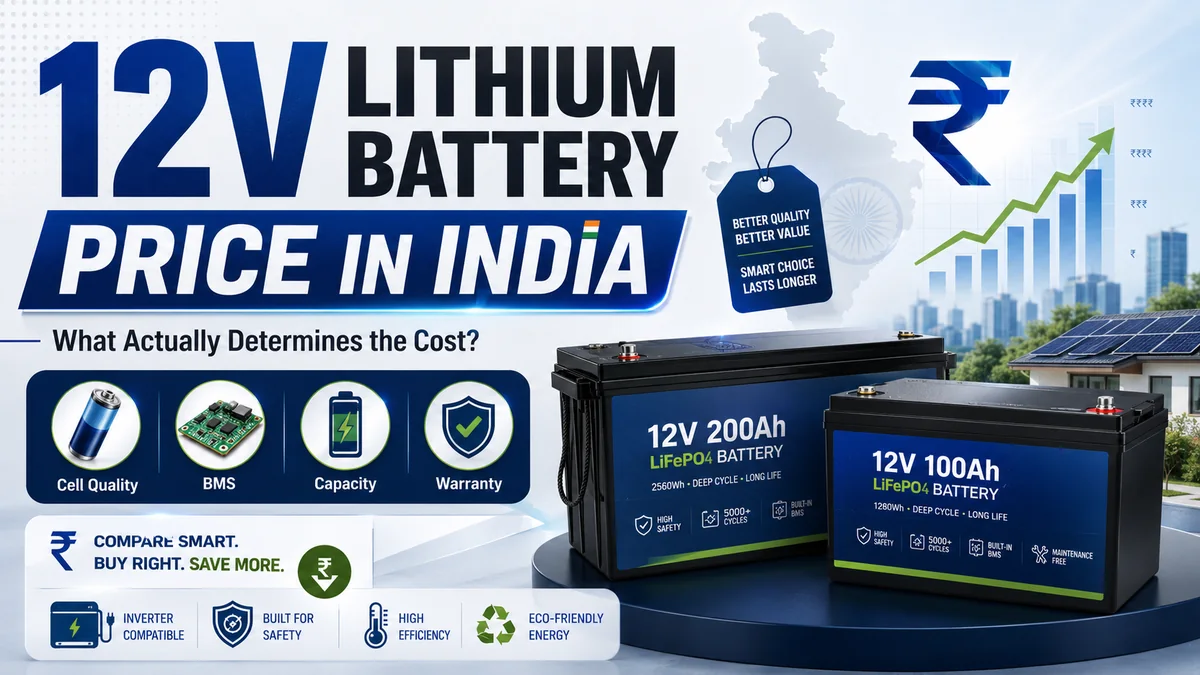
Search for a 12V lithium battery price in India, and you can quickly end up confused.
One 12V 100Ah battery may be listed near ₹17,000, another around ₹20,000, while a seemingly similar battery can cost ₹27,000 or more. Smaller 12Ah batteries may cost only a few thousand rupees.
At first glance, this makes little sense. If two batteries are both labelled 12V 100Ah, why should one cost so much more?
The reason is simple: voltage and Ah capacity tell only part of the story.
The cells inside the battery, lithium chemistry, BMS rating, discharge capability, enclosure, warranty, testing, connectors and even the way the pack is assembled can all influence its price.
Current Indian listings show just how wide the difference can be. For example, 12Ah LiFePO4 batteries are available around ₹2,700–₹3,100, while a 50Ah model can be around ₹10,500. Current 100Ah LiFePO4 listings range from roughly ₹16,500 to ₹27,000 depending on the product, seller and specification. These are examples rather than fixed market prices.
So instead of asking only:
“How much does a 12V lithium battery cost?”
a better question is:
“What am I actually getting for that price?”
This guide explains exactly that.
What Does a 12V Lithium Battery Actually Mean?
Before comparing prices, it helps to understand what sellers mean by 12V lithium battery.
Lithium-ion is a broad family of battery chemistries. Two common examples are:
- LiFePO4 — lithium iron phosphate
- NMC — nickel manganese cobalt lithium-ion
They are not electrically identical.
For inverter, solar and home-backup applications, LiFePO4 batteries are commonly used.
A LiFePO4 cell has a nominal voltage of about:
3.2V
Four cells connected in series give:
3.2V × 4 = 12.8V
This is normally called a:
4S LiFePO4 battery
It is commonly marketed as a 12V lithium battery, even though its nominal voltage is actually 12.8V.
A typical 4S LiFePO4 pack may reach around 14.4–14.6V when fully charged, depending on the manufacturer’s recommended charging specification.
By comparison, a conventional 3S NMC pack is approximately:
3.7V × 3 = 11.1V nominal
and around:
12.6V fully charged
So two products both advertised as “12V lithium batteries” may have completely different cell chemistry, operating voltage and intended application.
That alone can affect price.
What Is the 12V Lithium Battery Price in India?
There is no single price because capacities range from very small packs to large inverter batteries.
A rough snapshot of current Indian retail listings illustrates the spread:
| 12V Battery Capacity | Example Current Price Level | Nominal Energy at 12.8V |
| 12Ah | Around ₹2,700–₹3,100 | 154Wh |
| 50Ah | Around ₹10,500 | 640Wh |
| 100Ah | Roughly ₹16,500–₹27,000+ | 1,280Wh |
The listings behind these examples vary in brand, BMS, warranty and construction, so the table should not be treated as a universal price list.
That variation is actually the main point of this article.
Two 100Ah batteries may contain roughly the same nominal amount of energy but still differ considerably in quality and capability.
1. Battery Capacity Is One of the Biggest Price Factors
The first obvious factor is capacity.
Battery capacity is normally given in:
Ah — amp-hours
For example:
- 12V 12Ah
- 12V 24Ah
- 12V 30Ah
- 12V 50Ah
- 12V 60Ah
- 12V 72Ah
- 12V 100Ah
- 12V 150Ah
- 12V 200Ah
More Ah generally means more lithium cells are required.
More cells mean higher material cost.
But Ah by itself is not the best way to compare batteries.
A more useful measurement is:
Wh — watt-hours
The formula is:
Energy (Wh) = Battery Voltage × Battery Capacity (Ah)
For a 12.8V LiFePO4 battery:
12Ah
12.8 × 12 = 154Wh
30Ah
12.8 × 30 = 384Wh
50Ah
12.8 × 50 = 640Wh
100Ah
12.8 × 100 = 1,280Wh
200Ah
12.8 × 200 = 2,560Wh
A 100Ah battery therefore contains roughly twice the nominal energy of a 50Ah battery of the same voltage.
That is one reason larger batteries cost more.
2. Look at Price per Wh, Not Just Battery Price
Suppose you find:
Battery A:
12.8V 50Ah for ₹11,000
and:
Battery B:
12.8V 100Ah for ₹19,000
Battery B costs more overall, but that doesn’t automatically mean it is more expensive for the amount of energy supplied.
Battery A:
12.8 × 50 = 640Wh
Price per Wh:
₹11,000 ÷ 640 ≈ ₹17.19/Wh
Battery B:
12.8 × 100 = 1,280Wh
Price per Wh:
₹19,000 ÷ 1,280 ≈ ₹14.84/Wh
So the larger battery actually costs less per unit of nominal stored energy.
This is a useful method when comparing 12V LiFePO4 battery prices.
But price per Wh still does not tell the whole story.
You also need to compare BMS capability, cell quality, warranty and construction.
3. Cell Chemistry Has a Major Effect on Cost
Not every lithium battery uses the same chemistry.
For many home inverter and solar applications, the comparison is often between LiFePO4 and other lithium-ion chemistries such as NMC.
LiFePO4
Commonly chosen for:
- Home inverter batteries
- Solar energy storage
- UPS backup
- Telecom backup
- RV and camper systems
- Deep-cycle applications
LiFePO4 is attractive for stationary energy storage because of its cycle-life potential, stable discharge characteristics and thermal behaviour.
NMC
Common in applications where compact size and energy density are important, including:
- Electric scooters
- E-bikes
- Portable electronics
- Power tools
- Some EV battery packs
A 12V battery built for an inverter and a compact 12V NMC battery designed for another application should therefore not be compared only on ₹/Ah.
The chemistry, voltage profile, energy density and typical applications can vary significantly between different lithium battery types. If you want to understand these differences in more detail, read our guide on NMC vs lithium batteries
They are designed for different jobs.
4. The Cells Inside the Battery Matter
The enclosure may look impressive, but most of the battery’s value is inside it.
A lithium battery pack may use cells from a well-established cell manufacturer, lesser-known cells or reclaimed/second-life cells.
The cells influence:
- Actual capacity
- Internal resistance
- Charge capability
- Discharge capability
- Cycle life
- Voltage consistency
- Temperature performance
- Long-term reliability
This is one reason two 12V 100Ah lithium battery prices can be very different.
A buyer should ask:
Which cells are used inside the pack?
Do not stop at:
“Grade A cells.”
Ask for information such as:
- Manufacturer
- Cell model
- Rated capacity
- Maximum continuous discharge
- Recommended charging current
- Cycle-life specification
- Datasheet where available
A meaningful specification is more useful than a marketing label.
5. New Cells vs Reused Cells
This is particularly important when a battery seems unusually cheap.
Lithium cells can come from:
- New production
- Surplus inventory
- Second-life battery modules
- Recovered EV packs
- Rejected production batches
- Previously cycled cells
A professionally tested second-life battery can have legitimate applications.
The problem arises when buyers believe they are purchasing new cells but actually receive used or mismatched cells.
Older cells may still show normal voltage when measured without load.
That does not mean they have full capacity or low internal resistance.
For this reason, an unusually low lithium battery price in India deserves closer inspection rather than an automatic purchase.
6. BMS Quality Can Change the Price Significantly
Every properly designed lithium battery requires a Battery Management System, or BMS.
The BMS protects and monitors the cells.
Depending on its design, it can provide protection against:
- Overcharge
- Over-discharge
- Excess current
- Short circuit
- High temperature
- Low temperature
- Cell imbalance
But BMS units themselves vary greatly.
A simple low-current BMS costs much less than an advanced high-current smart BMS.
7. BMS Current Rating Is Particularly Important for Inverters
Consider two batteries:
Battery A
12.8V
100Ah
50A continuous BMS
Battery B
12.8V
100Ah
100A continuous BMS
Both have approximately:
1.28kWh nominal energy
But they do not necessarily have the same power capability.
The approximate battery current required by an inverter is:
Battery Current = Load ÷ (Battery Voltage × Inverter Efficiency)
Assume 12.8V battery voltage and 90% inverter efficiency.
At a 500W load:
500 ÷ (12.8 × 0.9) ≈ 43A
At 1,000W:
1,000 ÷ (12.8 × 0.9) ≈ 87A
The 50A BMS battery may therefore work perfectly well with a moderate load but may not be suitable for continuously supplying a 1,000W load.
The 100A version needs a BMS, cells, busbars and wiring designed for greater current.
That can increase manufacturing cost.
8. Bigger BMS Does Not Automatically Mean Better Battery
There is an important qualification.
Suppose a seller advertises:
12V 100Ah battery with 150A BMS
That sounds impressive.
But can the cells actually deliver 150A?
Can the busbars carry it?
Can the terminals handle it?
Are the internal cables properly sized?
A large current number printed on a BMS specification is meaningful only when the entire battery pack is designed for that current.
Otherwise, it is simply a number.
9. Smart BMS Features Add Cost
Some batteries use a basic BMS that works silently inside the enclosure.
Others use a smart BMS.
Depending on the model, a smart BMS may allow you to monitor:
- Cell voltage
- Total battery voltage
- Charging current
- Discharge current
- Temperature
- State of charge
- Protection alarms
- Cycle information
Connectivity may include:
- Bluetooth
- RS485
- CAN
- UART
Communication can be particularly useful when the lithium battery needs to communicate with a compatible inverter or energy-management system.
A battery with a quality communication-capable BMS can therefore cost more than a basic battery of identical Ah capacity.
10. Cell Balancing Also Matters
Cells connected in series do not always remain at exactly the same voltage.
The BMS may therefore include balancing.
There are two broad approaches.
Passive balancing
Excess energy from higher-voltage cells is dissipated, usually as heat.
It is widely used and relatively simple.
Active balancing
Energy is redistributed between cells using additional electronics.
Active balancing hardware can add cost and complexity.
For a small, well-matched 4S battery, an expensive active balancer is not automatically necessary.
What matters is that the balancing method is appropriate for the cells and application.
11. Battery Discharge Rate Changes the Cost
Two 100Ah batteries can store the same energy but be designed for very different currents.
Suppose one is designed for:
0.5C continuous discharge
For a 100Ah battery:
0.5C = 50A
Another may support:
1C continuous
which equals:
100A
A higher-current battery may need:
- Higher-discharge cells
- Heavier busbars
- Larger internal cables
- Better terminals
- Higher-current BMS
- Improved thermal design
All of these can increase price.
This explains why comparing 100Ah lithium battery price alone is incomplete.
12. Charging Capability Can Also Affect Price
Most people ask how much current the battery can deliver.
Fewer ask:
How quickly can it charge?
Suppose a 100Ah battery allows:
20A maximum recommended charge
Another allows:
50A
The second battery may be more useful where fast charging is important.
For example, approximate theoretical charging time from empty would be:
At 20A:
100Ah ÷ 20A = 5 hours
At 50A:
100Ah ÷ 50A = 2 hours
Actual charging normally takes longer and must follow the manufacturer’s specifications.
Higher charging capability depends on the cells, BMS and thermal design, so it can influence cost.
13. Plastic Box vs Metal Enclosure
The battery enclosure may appear cosmetic, but it performs several practical jobs.
It protects against:
- Accidental contact
- Mechanical damage
- Dust
- Loose objects
- Short circuits
- Vibration
Small lithium batteries often use ABS or similar plastic cases.
Larger inverter batteries may use:
- Metal enclosures
- Rack-mounted cases
- Wall-mounted cabinets
- ABS cases
- Custom sheet-metal boxes
A strong metal enclosure costs more than simple shrink wrapping.
It also adds fabrication, coating, assembly and shipping cost.
14. Terminals and Connectors Affect Cost
A 12Ah battery supplying a few amps does not need the same terminals as a 100Ah battery supplying 100A.
High-current batteries may require:
- Copper terminals
- Threaded studs
- Heavy cable lugs
- Anderson-type connectors
- High-current DC connectors
- Busbars
Poor terminals create resistance.
Resistance generates heat.
So terminal quality becomes increasingly important as battery current rises.
15. Internal Busbars Are Easy to Ignore
Open two 100Ah batteries and the internal construction can be completely different.
One may use properly sized copper or aluminium busbars.
Another may rely on undersized conductors.
The buyer normally cannot see these parts before purchase, but they have a direct effect on:
- Voltage drop
- Heat generation
- Current capability
- Reliability
Better material and better mechanical assembly generally cost more.
16. Temperature Sensors Add Protection
Temperature monitoring is particularly useful in high-current battery packs.
A BMS may monitor:
- Cell temperature
- MOSFET temperature
- Charging temperature
- Discharging temperature
Cheaper BMS designs may have minimal temperature monitoring.
Better-designed batteries may include multiple sensors placed at useful points inside the pack.
This adds only a small amount to material cost but can substantially improve protection.
17. Cycle-Life Claims Need Context
You may see claims such as:
- 2,000 cycles
- 3,000 cycles
- 5,000 cycles
- 6,000+ cycles
Do not compare these numbers without knowing the test conditions.
Cycle life depends on factors including:
- Depth of discharge
- Charging voltage
- Discharge rate
- Temperature
- Cell chemistry
- End-of-life definition
For example, a manufacturer’s cycle specification may define end of life as the point where remaining capacity falls to a particular percentage of original capacity.
So:
“6,000 cycles”
without test conditions is much less useful than:
“6,000 cycles under these stated conditions.”
18. Warranty Can Explain Some of the Price Difference
Battery warranties vary considerably.
You may find:
- 1-year warranty
- 2-year warranty
- 3-year warranty
- 5-year warranty
- Longer limited warranties
A longer warranty has value only when the company providing it is likely to support you.
Before paying extra, check:
- What exactly is covered?
- Is replacement full or pro-rata?
- Who pays transport?
- Is on-site service available?
- Where is the service centre?
- What conditions void the warranty?
- Is the warranty transferable?
A battery priced ₹2,000 cheaper may not actually be cheaper if obtaining service later becomes difficult.
Current Indian listings illustrate how warranty and positioning can vary: one 12V 50Ah product is listed with a one-year warranty, while some current 100Ah products advertise longer coverage.
19. Testing and Quality Control Cost Money
Proper battery manufacturing requires more than connecting cells together.
A battery pack may undergo checks for:
- Cell voltage
- Cell capacity
- Internal resistance
- Cell matching
- BMS operation
- Charge cutoff
- Discharge cutoff
- Overcurrent protection
- Temperature sensing
- Capacity verification
- Insulation
- Load testing
Manufacturers performing proper incoming inspection and final testing incur additional labour and equipment costs.
That expense may not be visible from the outside, but it matters.
20. Certification and Compliance Can Affect Price
Depending on the battery type, application, transportation method and market, various standards or certifications may become relevant.
A supplier may need documentation connected with areas such as:
- Cell safety testing
- Battery transport
- Product compliance
- UN38.3 transportation testing
- IEC requirements
- BIS requirements where applicable
Do not assume every certificate mentioned in a listing is relevant to every battery.
Ask the supplier for the actual certificate and verify:
- Model number
- Manufacturer
- Scope
- Validity
- Standard referenced
Testing and certification increase legitimate manufacturing costs.
21. Local Assembly vs Fully Imported Battery
A battery sold in India may be:
- Fully imported
- Imported as cells and assembled locally
- Built locally using imported cells and BMS
- Made using a mix of domestic and imported components
This can influence:
- Import duty
- Freight
- Inventory cost
- Lead time
- Serviceability
- Spare-parts availability
A locally assembled battery is not automatically better or worse.
What matters is:
who made it, which components were used, and how well it was assembled and tested.
22. Retail, Wholesale and Manufacturer Prices Will Differ
Suppose a battery leaves the assembler at one price.
Before it reaches the final customer, the channel may include:
Manufacturer → Distributor → Dealer → Retailer → Customer
Each stage can add:
- Margin
- Logistics
- Inventory cost
- Support
- GST-related pricing
- Marketplace commission
An online marketplace price may also include platform fees and promotional discounts.
This is why a direct quotation from a lithium ion battery supplier in Bangalore may differ from the price of a similar-looking battery on a national e-commerce marketplace.
Compare the complete specification rather than price alone.
23. GST and Shipping Can Change the Final Amount
When comparing quotations in India, always ask:
Is GST included?
Also ask:
Is transport included?
Lithium batteries can be expensive to ship because of:
- Weight
- Dangerous-goods transport requirements
- Packaging
- Insurance
- Handling
- Destination
A ₹19,000 quotation plus tax and freight may eventually cost more than a ₹21,000 delivered quotation.
Always compare the landed cost.
24. Why Online Prices Can Look Extremely Low
Online marketplaces frequently show very large discounts.
For example:
MRP: ₹30,000
Offer price: ₹16,000
The displayed percentage discount can look attractive.
But MRP is not the most useful reference point.
Compare:
- Actual capacity
- Cell chemistry
- Cell brand
- BMS continuous current
- Charging current
- Warranty
- Seller reputation
- Return conditions
- Manufacturing date
Current marketplace tracking shows 100Ah 12.8V LiFePO4 products around ₹16,500–₹19,000, while another manufacturer currently lists a 12.8V 100Ah model at roughly ₹27,000. The difference demonstrates why headline price alone cannot establish whether one battery is a better deal.
25. A 12V 100Ah Lithium Battery Is Not Automatically Suitable for a 1kW Inverter
This is an important purchasing mistake.
A 100Ah battery tells you how much charge it stores.
It does not automatically tell you the maximum power it can deliver.
At approximately 12.8V and 90% inverter efficiency:
A 1,000W load requires approximately:
1,000 ÷ (12.8 × 0.90)
≈ 87A
So the battery needs:
- Cells capable of supplying this current
- BMS rated appropriately
- Suitable busbars
- Suitable terminals
- Proper DC cables
- Adequate surge capability
A cheap 100Ah battery with a 50A BMS may not be suitable even though its capacity appears large enough.
26. Inverter Surge Rating Also Matters
Certain appliances briefly consume much more power while starting.
Examples include:
- Refrigerator
- Water pump
- Compressor
- Motor
- Some power tools
Suppose your normal current is 60A, but a motor temporarily pushes battery current above 100A.
If the BMS trips at that level, your inverter may shut down.
A battery designed for such loads may require a BMS with higher short-duration current capability.
Again, that can increase cost.
27. A Bigger Capacity Does Not Necessarily Mean Higher Power
Consider two batteries.
Battery A
12.8V 100Ah
50A BMS
Battery B
12.8V 60Ah
100A BMS
Battery A stores more energy.
Battery B may be capable of delivering more power at a given moment if its cells and internal components are designed for the higher current.
So:
Ah affects how long you can run the load.
Current capability affects how large a load you can run.
This distinction is essential when comparing lithium inverter battery prices.
28. Lithium Battery vs Lead-Acid Battery Price
Lithium batteries often cost more upfront than traditional lead-acid inverter batteries.
But purchase price is only one way to compare them.
Consider:
- Usable depth of discharge
- Cycle life
- Charging efficiency
- Weight
- Maintenance
- Charging speed
- Replacement frequency
A lower-cost battery that needs replacement frequently can eventually cost more than a higher-priced battery with a longer useful life.
A lower-cost battery that needs replacement frequently can eventually cost more than a higher-priced battery with a longer useful life. This is one reason it helps to compare lithium battery vs lead acid battery performance over the full ownership period rather than looking only at the initial purchase price.
A better comparison is:
Total cost over the years you actually use it.
29. Calculate Cost per Usable kWh Over Battery Life
For serious comparisons, you can go beyond ₹/Ah.
Suppose Battery A costs ₹20,000.
Nominal energy:
1.28kWh
If you normally use 90%:
1.28 × 0.9 = 1.152kWh usable per cycle
If the battery actually delivers 3,000 useful cycles:
Lifetime energy:
1.152 × 3,000 = 3,456kWh
Approximate battery purchase cost per lifetime kWh:
₹20,000 ÷ 3,456 ≈ ₹5.79/kWh
This calculation ignores factors such as financing, degradation, electricity cost and maintenance, but it demonstrates an important principle:
A battery should be evaluated over its useful life, not only on the purchase date.
30. Why Very Cheap Lithium Batteries Deserve Extra Questions
A low price does not automatically mean poor quality.
Manufacturers may obtain lower prices through:
- Bulk cell purchasing
- Efficient assembly
- Direct sales
- Lower dealer margins
- Local manufacturing
- Promotional offers
But if one battery is dramatically cheaper than every comparable product, investigate why.
Ask for:
- Cell manufacturer
- Cell model
- New or second-life cells
- Actual Ah
- Nominal Wh
- Continuous BMS current
- Peak current
- Maximum charging current
- Warranty
- Battery weight
- Manufacturing date
- Test report where available
Price should trigger questions—not conclusions.
31. Battery Weight Can Sometimes Reveal Useful Information
Weight alone cannot prove quality.
But it can help identify an obvious mismatch.
If several genuine 100Ah LiFePO4 batteries of similar construction weigh around a certain range and one supposed 100Ah battery weighs dramatically less, it deserves further investigation.
Different cell types, enclosure materials and busbar designs can legitimately change weight.
So use weight only as one clue, not as proof of capacity.
32. Custom Lithium Battery Packs Usually Cost More
Off-the-shelf batteries are produced repeatedly in the same design.
Custom packs may require:
- Different dimensions
- Custom enclosure
- Special connector
- Different BMS
- Communication ports
- High-current terminals
- Custom cable
- Different mounting
- Small production quantity
Engineering and setup costs are spread over fewer units.
Therefore, a custom 12V lithium-ion battery pack often costs more per unit than a standard model.
33. Quantity Has a Big Effect on Price
Someone buying one battery and someone ordering 500 batteries will rarely receive the same unit price.
Bulk buyers may receive lower pricing because of:
- Cell-volume discounts
- Lower packaging cost per unit
- Lower logistics cost
- Production efficiency
- Reduced sales overhead
So when comparing supplier quotations, also compare the ordered quantity.
34. Does Location Affect Lithium Battery Price?
Yes, to some extent.
A buyer purchasing from a nearby supplier may save on:
- Shipping
- Handling
- Return freight
- Service logistics
For example, someone purchasing from a lithium ion battery supplier in Bangalore may find local technical support particularly useful if the battery is being integrated with an inverter, solar system or custom application.
A slightly higher local price can sometimes be worthwhile when troubleshooting or warranty service is readily available.
35. What Should You Ask a Lithium Battery Supplier Before Buying?
Before paying for a battery, ask for the following information.
| Specification | What to Ask |
| Chemistry | LiFePO4, NMC or something else? |
| Voltage | Actual nominal voltage? |
| Capacity | Tested Ah and Wh? |
| Cells | Manufacturer and model? |
| BMS | Brand and current rating? |
| Continuous discharge | How many amps? |
| Peak discharge | How many amps and for how long? |
| Charge current | Recommended and maximum? |
| Full-charge voltage | Exact recommended setting? |
| Cycle life | Under what test conditions? |
| Terminals | Current rating and type? |
| Enclosure | ABS, metal or other? |
| Communication | Bluetooth/CAN/RS485? |
| Warranty | Years and exact terms? |
| Service | Where is warranty handled? |
A professional supplier should be able to answer most of these questions.
36. Which 12V Lithium Battery Capacity Should You Buy?
Choose capacity from your required energy rather than simply purchasing the largest battery you can afford.
Use:
Required Energy = Load × Backup Time
Suppose your load is:
250W
and you need:
4 hours
Energy required at the load:
250 × 4 = 1,000Wh
You then need to account for:
- Inverter efficiency
- Battery reserve
- Wiring losses
- Actual operating conditions
A 12.8V 100Ah LiFePO4 battery has approximately:
1,280Wh nominal energy
So it may be a sensible starting point for such a load, depending on the actual battery and inverter.
37. 12V 50Ah vs 100Ah Lithium Battery
A simple comparison:
| Specification | 50Ah | 100Ah |
| Nominal voltage | 12.8V | 12.8V |
| Nominal energy | 640Wh | 1,280Wh |
| Relative capacity | 1× | 2× |
| Backup potential | Lower | Higher |
| Weight | Usually lower | Usually higher |
| Price | Usually lower | Usually higher |
But BMS capability must still be checked separately.
A 50Ah high-current battery can sometimes handle a larger load than a 100Ah battery designed for low-current energy storage.
38. When Is a 12V System the Right Choice?
A 12V LiFePO4 battery can work well for:
- Small home inverter
- UPS backup
- Lighting
- Router backup
- TV
- CCTV
- Small solar installations
- Camping
- RV applications
- Portable power systems
For very high inverter loads, 24V or 48V may be more practical because increasing voltage reduces battery current for the same power.
For example, a 2,000W load on a 12V-class system requires extremely high current.
Higher-current systems need heavier cables, larger BMS units and stronger connections.
Sometimes the cheapest solution is not a larger 12V battery.
It is moving to a higher system voltage.
39. How to Compare Two 12V Lithium Battery Quotations
Suppose Supplier A quotes:
₹18,000
Supplier B quotes:
₹22,000
Do not automatically choose Supplier A.
Put both specifications side by side:
| Feature | Supplier A | Supplier B |
| Chemistry | ? | ? |
| Capacity | 100Ah | 100Ah |
| Cell brand | ? | Known |
| BMS | 50A | 100A |
| Peak current | ? | Specified |
| Smart monitoring | No | Yes |
| Enclosure | Plastic | Metal |
| Warranty | 1 year | 5 years |
| Service location | Unknown | Local |
| GST | Extra | Included |
Once you fill in the missing information, the price difference may become easier to understand.
Sometimes the cheaper battery is genuinely the better deal.
Sometimes it is simply a different product hidden behind the same 12V 100Ah label.
What Actually Determines 12V Lithium Battery Price in India?
To summarise, the major price factors are:
- Battery capacity in Ah
- Total energy in Wh/kWh
- Lithium chemistry
- Cell manufacturer
- Cell quality and consistency
- New vs second-life cells
- Cell current capability
- BMS continuous current
- BMS peak current
- Smart BMS features
- Bluetooth/CAN/RS485 communication
- Cell balancing
- Charging-current capability
- Busbar size
- Internal wiring
- Battery terminals
- Enclosure material
- Thermal protection
- Testing and quality control
- Compliance and certification
- Warranty
- After-sales service
- Order quantity
- Dealer/distributor margin
- GST
- Shipping and dangerous-goods logistics
That is why asking only for 12V lithium battery price rarely provides enough information to make a good purchasing decision.
Final Thoughts
The 12V lithium battery price in India can vary dramatically even when two products carry the same voltage and Ah rating.
That does not necessarily mean one seller is expensive and another is cheap.
The batteries themselves may be very different.
A 12V 100Ah LiFePO4 battery with quality cells, a properly rated 100A BMS, strong terminals, adequate busbars, temperature protection and a meaningful warranty is not directly comparable with a basic 100Ah battery designed for a 30A or 50A load.
Start by calculating how much energy you need.
Then calculate how much current your equipment requires.
After that, compare the cells, BMS, charging capability, construction and warranty.
Finally, compare the price.
The cheapest lithium battery is not necessarily the battery with the lowest invoice value. The better purchase is the one that delivers the required capacity and current safely for its intended application at a sensible cost over its useful life.
Frequently Asked Questions
What is the price of a 12V lithium battery in India?
It depends heavily on capacity and specification. Current retail examples include roughly ₹2,700–₹3,100 for some 12Ah LiFePO4 batteries, about ₹10,500 for one 50Ah listing, and approximately ₹16,500–₹27,000 or more among current 100Ah examples. Prices change frequently and the products are not necessarily equivalent.
What is the 12V 100Ah lithium battery price in India?
Current examples show a considerable range. Some 12.8V 100Ah LiFePO4 products are around ₹16,500–₹19,000, while another published 100Ah product is around ₹27,000. Cell quality, BMS, warranty, enclosure and seller channel can all affect the final price.
Why are two 12V 100Ah lithium batteries priced differently?
Because Ah does not describe cell quality, discharge capability, BMS, internal construction, warranty or support. Two batteries can store similar nominal energy while having very different current capability and expected service life.
Is LiFePO4 suitable for a home inverter?
LiFePO4 is widely used for inverter and solar-storage applications. Compatibility must still be checked for charging voltage, charging current, low-voltage cutoff and inverter load.
How much energy does a 12V 100Ah LiFePO4 battery store?
A nominal 12.8V 100Ah battery stores approximately:
12.8 × 100 = 1,280Wh, or 1.28kWh.
Actual usable AC energy will be lower because of inverter losses, reserve capacity and operating conditions.
Does a 100Ah lithium battery need a 100A BMS?
Not necessarily. Ah represents capacity, while BMS amperage relates to current capability. The correct BMS should be selected from the required load and the cell’s safe discharge rating.
Is a more expensive lithium battery always better?
No. A higher price does not prove better quality. Compare the complete technical specification, warranty and supplier support.
What should I check before buying a lithium battery for an inverter?
Check the chemistry, capacity, nominal Wh, cell manufacturer, BMS continuous current, peak current, charging current, charging voltage, terminals, enclosure, cycle-life conditions, warranty and inverter compatibility.
Is buying from a local lithium battery supplier better?
It can be useful when you need technical support, customisation or quick warranty service. For buyers in Karnataka, purchasing from an established lithium ion battery supplier in Bangalore may also reduce shipping and service delays. Still compare specifications and pricing before deciding.
What is more important: Ah or BMS rating?
Both are important for different reasons. Ah determines approximately how much energy the battery can store, while the BMS and cell current ratings help determine how much power it can safely deliver.