
Electricity bills are rising every year 📈
👉 Power cuts are still common in many areas
👉 And EV adoption is increasing fast 🚗
That’s why more homeowners are now installing solar panel
If you’re planning to install a solar panel system, one of the biggest questions you’ll face is:
👉 “Should I include a battery in my solar setup or skip it?”
The answer depends on your goal: saving money or having backup power.
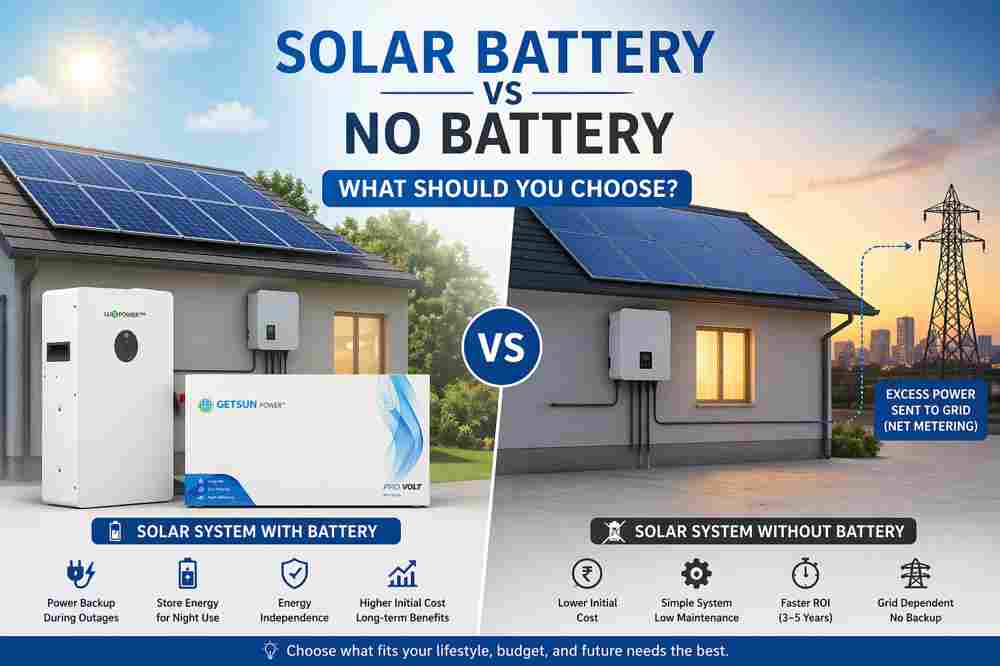
A solar system without a battery is more affordable, offers faster ROI, and works best with net metering. A solar system with a solar battery provides power backup, allows night usage, and gives more energy independence.
👉 In simple terms:
- No battery = maximum savings
- Battery = backup + control
In India, especially in cities like Bangalore, most homes choose no battery, while independent houses and EV owners prefer battery systems.
At first, it might look like an easy choice. But in reality, this choice can affect your cost, savings, backup, and overall system performance for the next 20–25 years.
Many homeowners and businesses in India — especially in cities like Bangalore — struggle with this confusion.
So in this guide, let’s break it down in the simplest way possible, based on real-world usage, not just theory.
☀️ Understanding Solar Battery Basics First
Before comparing, let’s understand how a solar system works.
A typical solar setup includes:
- Solar panels (generate electricity)
- Solar inverter (convert DC to AC)
- Optional battery (stores energy)
- Grid connection
👉 During the day, solar panels generate electricity
👉 Your home uses that electricity
👉 Extra power either goes to the grid or gets stored (if battery is present)
🔌 What is a Solar System WITHOUT Battery?
This is called an on-grid solar system.
How it works:
- Solar panels generate electricity
- You use it instantly
- Extra electricity is sent to the grid
- You get credits through net metering
✅ Advantages of Solar Without Battery
💰 1. Lower Initial Cost
This is the biggest reason people choose this setup.
- No battery cost
- Simple installation
- Faster ROI
👉 Ideal for budget-conscious users
⚡ 2. High Efficiency
No energy storage = no energy loss
👉 Direct usage = maximum efficiency
📉 3. Faster Payback
Since investment is lower:
👉 Payback period = 3–5 years
🔧 4. Low Maintenance
No battery = fewer components to maintain
❌ Limitations of No Solar Battery System
🌙 1. No Backup
If power cut happens:
👉 Your system stops working
Even if sun is shining ☀️
⚠️ 2. Grid Dependency
You still depend on electricity board
📊 3. Limited Control
You can’t store or manage your energy
🔋 What is a Solar System WITH Battery?
This is called a hybrid or off-grid system.
How it works:
- Solar panels generate electricity
- Your home uses it
- Extra energy is stored in battery
- Battery supplies power when needed
✅ Advantages of Solar With Battery
🔌 1. Power Backup
This is the biggest benefit
👉 During power cuts:
- Your home still runs
- Even at night
🔋 2. Energy Independence
You are less dependent on grid
🌙 3. Night Usage
Store solar energy → use at night
📈 4. Smart Energy Management
Modern systems optimize:
- Solar usage
- Battery storage
- Grid usage
❌ Limitations of Battery System
💸 1. Higher Cost
Battery is expensive
👉 Adds ₹2–4 lakh (approx)
🔄 2. Replacement Cost
Batteries don’t last 25 years
- Lithium battery: 8–12 years
- Replacement needed
⚡ 3. Efficiency Loss
Some energy is lost during storage
⚖️ Solar Battery vs No Battery (Simple Comparison)
| Feature | Without Battery | With Battery |
| Cost | Lower | Higher |
| Backup | ❌ No | ✅ Yes |
| ROI | Faster | Slightly longer |
| Independence | Medium | High |
| Maintenance | Low | Medium |
| Night Usage | ❌ No | ✅ Yes |
🧠 Which One Should You Choose?
This depends on your situation 👇
🏠 Choose WITHOUT Battery if:
- You want maximum savings
- Budget is limited
- Power cuts are rare
- You have net metering
👉 Best for most urban homes
🔋 Choose WITH Solar Battery if:
- You need power backup
- Frequent power cuts
- You want independence
- You plan EV charging at night
👉 Best for:
- Villas
- Businesses
- EV owners
⚡ Special Case: EV Charging + Solar
If you own an electric vehicle:
👉 Battery becomes more useful
Why?
- You can store solar energy
- Charge your EV anytime
- Reduce grid usage
Planning to charge your EV using solar?
👉 Read our detailed guide on charging an electric car at home with solar panels to see real setup, cost, and savings.
📍Real Scenario (Bangalore – Practical Example)
Let’s look at a realistic situation based on typical homes in Bangalore, so you can understand how this decision works in real life.
🏠 Case 1: Solar System WITHOUT Battery
A 3 kW solar system is installed on the rooftop of a home.
- Average monthly electricity bill: ₹4,500 – ₹6,000
- Solar system generates enough power to cover 60–75% of usage
👉 What happens after solar installation?
- Daytime appliances (AC, fridge, washing machine, etc.) run on solar
- Any extra electricity is sent back to the grid through net metering.
- Nighttime usage still comes from the grid
👉 Result:
- Monthly bill drops to around ₹1,000 – ₹1,500
- Savings of nearly 70%
⚠️ Limitation
During a power cut:
👉 The system shuts down (for safety reasons)
👉 No electricity, even if sunlight is available
🔋 Case 2: Solar System WITH Battery
Now let’s take the same home, but with a battery added to the system.
- Same 3 kW solar panel system
- Added lithium-ion battery storage
👉 What changes?
- Daytime solar powers the home
- Extra energy is stored in the battery
- At night or during power cuts → battery supplies power
👉 Result:
- Similar electricity bill savings (60–70%)
- Plus backup power during outages
⚡ Key Advantage
During a power cut:
👉 Lights, fans, and essential appliances continue to work
👉 No disruption to daily life
💰 Cost Difference
- Without battery: Lower investment, faster returns
- With battery: Higher upfront cost, slightly longer payback
🧠 So What’s the Real Decision?
It comes down to one simple question:
👉 What matters more to you?
- Saving more money upfront 💰
- Or having uninterrupted power + independence ⚡
🎯 Real Insight
In Bangalore:
- Many apartments and urban homes prefer without battery
- Independent houses and EV users often choose with battery
👉 If your area has reliable electricity supply, go without battery
👉 If you face frequent power cuts or want full control, choose battery
👉 In the end, it’s not about right or wrong —
it’s about choosing what fits your lifestyle and priorities best.
💡 What Most People Do Today
👉 Start WITHOUT solar battery
Then later:
👉 Upgrade to solar lithium battery
🔧 Role of Hybrid Solar Inverter
Even if you don’t install solar battery now:
👉 Use a hybrid solar inverter
Why?
- Future-ready
- Easy battery addition later
- Better energy management
🔋 Why Lithium Batteries are Preferred
Modern systems use:
👉 Lithium-ion / LiFePO4 batteries
Benefits:
- Longer lifespan
- Faster charging
- Low maintenance
- Higher efficiency
💰 Cost Breakdown (India)
Approximate:
- Solar system: ₹1.5–3 lakh
- Battery: ₹2–4 lakh
👉 Total depends on:
- Size
- Brand
- Installer
📈 ROI Comparison
| System | Payback |
| Without Battery | 3–5 years |
| With Battery | 5–7 years |
🚀 Future Trend
India is moving towards:
- Smart homes
- EV adoption
- Energy independence
👉 Battery systems will grow
But currently:
👉 On-grid systems dominate
⚠️ Common Mistakes to Avoid
❌ Choosing based only on price
This is the biggest mistake.
Many people go for the cheapest solar system thinking they are saving money.
👉 But in reality:
- Low-quality panels reduce generation
- Cheap inverters fail faster
- Poor wiring affects safety
👉 Result:
You save initially… but lose money in the long run.
Instead of focusing only on price, it’s important to choose a trusted solar panel installer in Bangalore who can design and install a system that delivers long-term savings and reliability.
❌ Ignoring Future Needs
Most people design a system based only on their current usage.
But think about the next 5–10 years:
- Planning to buy an EV? 🚗
- Adding ACs or appliances?
- Increasing family or business usage?
👉 If your system is not future-ready:
- You may need reinstallation
- Costs will increase later
👉 Smart approach:
Plan for future expansion from day one
❌ Poor solar panel installer selection
👉 Installation quality matters most
Even the best solar panels can fail if installed incorrectly.
A well-installed system with good design can:
- Generate more power
- Last longer
- Give better ROI
Not sure how to choose the best rooftop solar installer?
Check out our complete guide on how to choose the best solar panel installer in Bangalore to avoid costly mistakes and get maximum savings.
🏁 Final Conclusion
✔ Best Practical Approach 🚀
For most people, the smartest approach is:
👉 Start simple → Upgrade later
How?
- Install a solar system without battery initially
- Use a hybrid solar inverter
- Add battery later when needed
👉 This gives you:
- Lower initial investment
- Flexibility to upgrade
- Future-ready system
🧠 Real Insight
Many homeowners in Bangalore follow this approach:
👉 First reduce electricity bills with solar with by working with an experienced solar panel installer in Bangalore
👉 Then gradually move towards energy independence
🏁 Final Takeaway
👉 Don’t overcomplicate the decision
Just ask yourself:
- Do I want maximum savings now? → No battery
- Do I want backup + independence? → Battery
👉 In the end, the best system is not the most expensive one…
it’s the one designed according to your actual needs.
🔥 Final Thought
Solar is not just about panels.
👉 It’s about how intelligently you use solar energy
And whether you choose battery or not:
👉 The biggest step is starting.
👉 If you’re planning solar panel installation in Bangalore, choosing the right system design is critical. Best solar energy company PowerKart based in Bangalore, helps you decide whether you need a lithium battery or not, based on your usage, budget, and future needs — ensuring maximum savings and performance.
FAQS
❓ Do I really need a lithium ion battery for my solar system?
👉 Not necessarily. If your goal is to reduce electricity bills and you have a stable grid connection, you can install a solar system without a battery. A battery is useful if you need backup power and energy independence.
❓ Is solar better with a battery or without a battery?
👉 Solar without a battery is more affordable and gives faster returns. Solar with a battery provides backup during power cuts and allows you to use solar energy at night.
❓ What happens to solar power without a battery?
👉 Any extra electricity generated is sent back to the grid through net metering, and you receive credits that reduce your electricity bill.
❓ Does a solar system work during power cuts without a battery?
👉 No, most on-grid solar systems shut down during power cuts for safety reasons, even if sunlight is available.
❓ Can I add a Solar battery to my solar system later?
👉 Yes, if you install a hybrid solar inverter, you can easily add a battery later without changing your entire system.
❓ How much does a solar battery cost in India?
👉 A solar battery typically costs between ₹2 lakh and ₹4 lakh, depending on capacity, brand, and technology.
❓ How long do solar batteries last?
👉 Lithium-ion solar batteries usually last between 8 to 12 years, depending on usage and maintenance.
❓ Which is better for homes in Bangalore: solar with battery or without?
👉 Most homes in Bangalore prefer solar without a battery due to stable electricity supply. However, solar batteries are useful for independent houses and areas with frequent power cuts.