
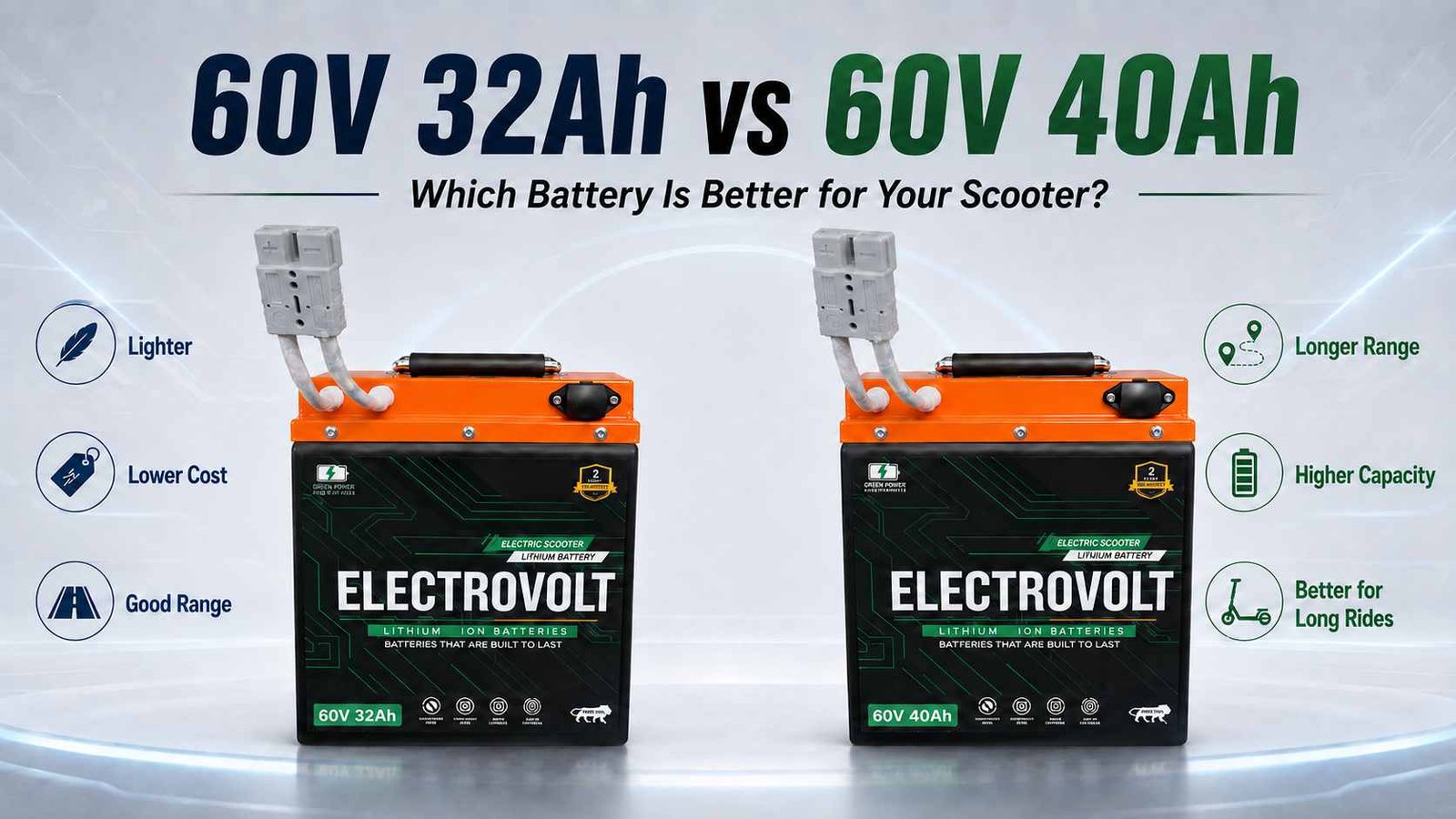
If you are planning to replace or upgrade the battery in your electric scooter, one of the most common questions is whether you should choose a 60V 32Ah lithium battery or a 60V 40Ah Lithium battery.
At first glance, the difference may appear small. Both are 60V batteries, and the only visible difference is the capacity: 32Ah versus 40Ah. However, that extra 8Ah can make a noticeable difference in riding range, battery weight, charging time, price, and even the way you use your scooter every day.
The right choice depends on how far you ride, the power of your scooter motor, your charging habits, and how much space is available inside your scooter.
In this guide, we will explain the difference between a 60V 32Ah and 60V 40Ah lithium battery for electric scooter applications in simple language so that you can choose the right battery without getting confused by technical terms.
What Does 60V 32Ah or 60V 40Ah Actually Mean?
Before comparing the two batteries, it is useful to understand the numbers.
60V – Battery Voltage
The 60V refers to the nominal voltage of the battery pack.
Your scooter controller and motor are designed to work within a particular voltage range. Therefore, if your scooter originally uses a 60V battery, you normally need another compatible 60V battery.
You should not simply replace a 60V battery with a 48V or 72V battery unless the controller, motor, charger, wiring and other components are designed for it.
32Ah or 40Ah – Battery Capacity
Ah stands for Ampere-hour.
In simple terms, Ah tells you how much electrical energy the battery can store.
A 40Ah battery stores more energy than a 32Ah battery.
Think of it like a fuel tank:
- Voltage is similar to the operating system or pressure required by the vehicle.
- Ah is similar to the size of the fuel tank.
A larger Ah rating generally means that you can travel farther before charging again.
Comparing the Energy Capacity of 60V 32Ah and 60V 40Ah Batteries
A more useful way to compare batteries is by calculating their approximate energy in watt-hours.
The formula is:
Battery Energy = Voltage × Capacity
60V 32Ah Battery
60 × 32 = 1,920Wh
That is approximately:
1.92kWh
60V 40Ah Battery
60 × 40 = 2,400Wh
That is approximately:
2.4kWh
So a 60V 40Ah battery stores around 25% more energy than a 60V 32Ah battery.
This is the key factor that clearly separates the two battery options.
If everything else on the scooter remains the same, the 40Ah battery can theoretically provide roughly 25% more riding range.
Quick Comparison: 60V 32Ah vs 60V 40Ah
| Feature | 60V 32Ah Battery | 60V 40Ah Battery |
| Nominal Voltage | 60V | 60V |
| Capacity | 32Ah | 40Ah |
| Approx. Energy | 1.92kWh | 2.4kWh |
| Energy Difference | Base | About 25% more |
| Expected Range | Lower | Higher |
| Weight | Usually lighter | Usually heavier |
| Physical Size | Usually smaller | Usually larger |
| Charging Time | Shorter | Longer |
| Price | Lower | Higher |
| Best For | Short to medium daily travel | Longer daily travel |
The exact size, weight and range depend on the battery manufacturer, chemistry, cell type, scooter efficiency and battery design.
How Much Extra Riding Distance Can You Expect from a 60V 40Ah Battery?
This is usually the biggest reason people consider upgrading.
Because the 40Ah battery stores approximately 25% more energy, it can potentially provide around 25% more range under similar riding conditions.
For example, suppose your scooter gives approximately:
70 km range with a 60V 32Ah battery
A similar 60V 40Ah battery might provide roughly:
85–90 km
However, this is only an example.
Real-world range is affected by many factors, including:
- Rider weight
- Passenger weight
- Road slope
- Tyre pressure
- Riding speed
- Traffic
- Frequent acceleration
- Motor efficiency
- Controller efficiency
- Battery age
- Temperature
- Cell quality
- Wind
- Road condition
Therefore, do not choose an Electric scooter battery only by looking at the manufacturer’s maximum claimed range.
Your actual riding pattern matters much more.
Who Should Choose a 60V 32Ah Battery?
A 60V 32Ah EV battery can be an excellent choice for many electric scooter users.
You do not always need the largest available battery.
1. Your Daily Travel Is Limited
If you normally travel around 20–40 km per day and you can charge your scooter regularly, a 32Ah battery may be more than enough.
Buying a 40Ah battery may simply increase your cost without providing much practical benefit.
2. You Want a Lighter Battery
More capacity generally requires more battery cells.
More cells usually mean:
- More weight
- Larger battery dimensions
- Higher cost
If your scooter uses a removable battery that you regularly carry upstairs or into your home, the weight difference can become important.
A lighter lithium battery for electric scooter use can be much easier to handle.
3. Your Scooter Has Limited Battery Space
Battery size is extremely important.
Even if both batteries are rated 60V, a 40Ah pack may not physically fit inside the compartment designed for a 32Ah pack.
Before ordering any ev battery, check:
- Battery length
- Battery width
- Battery height
- Connector position
- Cable length
- Mounting arrangement
Never assume that two batteries with the same voltage will have the same dimensions.
4. You Want to Keep the Cost Lower
A 32Ah lithium battery requires fewer cells than a comparable 40Ah battery.
Therefore, it will usually cost less.
If your present range is already sufficient, the 32Ah battery may offer better value for money.
5. You Can Charge Regularly
If you have charging available at home every night, you may not need a very large battery.
For example, a rider travelling 30 km daily may not benefit much from having enough battery for 80–100 km.
Who Should Choose a 60V 40Ah Battery?
The larger 40Ah battery becomes more useful when range and flexibility are important.
1. You Travel Longer Distances Daily
If you regularly travel 50 km, 60 km or more, the extra battery capacity can be very useful.
You will have more reserve range and will not need to worry as much about reaching home with a nearly empty battery.
For delivery riders, commercial users and people with long daily commutes, a 40Ah lithium battery for EV applications can be the better choice.
2. You Cannot Charge Frequently
Not everyone has convenient charging access.
You may live in an apartment where charging is difficult, or your workplace may not have a charging point.
In such cases, the larger 40Ah battery can reduce how often you need to charge.
3. You Frequently Carry a Passenger or Heavy Load
More weight generally increases energy consumption.
If you frequently ride with:
- A pillion passenger
- Delivery boxes
- Tools
- Goods
- Heavy luggage
your scooter may use more energy per kilometre.
A higher-capacity Electric scooter battery provides more usable range under these conditions.
4. Your Route Includes Hills
Climbing slopes requires more power than riding on flat roads.
If your daily commute includes many flyovers, hills or steep roads, the extra energy stored in the 40Ah battery may be helpful.
5. You Want a Larger Range Buffer
Suppose you normally travel 50 km per day.
If your battery can provide only around 55–60 km under real conditions, you may frequently experience range anxiety.
A larger battery gives you more reserve capacity.
That reserve can be useful when:
- You take an unexpected detour
- Traffic increases
- You need to make an additional trip
- The battery ages
- Weather conditions reduce efficiency
Will Upgrading to a 40Ah Battery Increase Your Scooter’s Speed?
Normally, no.
A common misunderstanding is that a higher Ah battery will automatically make an electric scooter faster.
The Ah rating mainly affects capacity and range, not top speed.
Scooter speed is more directly affected by:
- Battery voltage
- Motor power
- Controller settings
- Controller current limit
- Motor RPM
- Wheel size
- Vehicle weight
If both batteries are 60V and both can safely provide the current demanded by the controller, the top speed should remain broadly similar.
However, a good-quality 40Ah battery may maintain voltage better under load because it can contain more cells in parallel.
This can sometimes make acceleration feel more consistent, especially at lower battery charge levels.
But you should not purchase a 40Ah battery expecting a major increase in speed.
What About Motor Power?
Battery capacity should also be considered along with the motor and controller.
For example, scooters may use motors such as:
- 1,000W
- 1,500W
- 2,000W
- 2,500W
- 3,000W or more
A higher-power motor can draw more current.
This means your lithium battery for electric scooter must not only have enough Ah capacity but must also have the correct discharge capability.
For example, two different 60V 40Ah batteries may both have the same voltage and capacity, but one may support a much higher continuous discharge current than the other.
That depends on:
- Cell type
- Number of cells in parallel
- BMS rating
- Nickel or busbar design
- Wire thickness
- Connector rating
Therefore, when selecting an ev battery, capacity is only one part of the specification.
BMS Rating Is Important
A lithium battery contains a Battery Management System, commonly called a BMS.
The BMS helps safeguard the battery from issues including:
- Overcharging
- Excessive discharge
- Overcurrent
- Short circuit
- Cell imbalance
- High or low temperature, depending on the BMS
Your battery’s BMS should be able to support the current required by your scooter controller.
For example, if your scooter regularly draws 35A, using a battery with a BMS designed for only 20A would be unsuitable even if the battery voltage and Ah rating appear correct.
When buying a lithium battery for EV, always check both:
Capacity in Ah
and
Continuous discharge current in amps
Will a 40Ah Battery Take Longer to Charge?
Usually, yes.
If the same charger is used, a larger battery takes longer to charge.
For a simple example, imagine both batteries are charged using a 5A charger.
The theoretical charging time can be estimated as:
32Ah Battery
32Ah ÷ 5A = approximately 6.4 hours
40Ah Battery
40Ah ÷ 5A = approximately 8 hours
Actual charging may take somewhat longer because lithium charging does not remain at maximum current during the entire charging process.
Near full charge, the charging current gradually reduces.
Therefore, actual charging time depends on:
- Charger current
- Battery state of charge
- BMS
- Battery temperature
- Cell characteristics
- Charger charging profile
If faster charging is important, ask the battery supplier what maximum charging current the battery supports.
Do not simply purchase a higher-current charger without confirming battery compatibility.
What About Battery Weight?
The 40Ah battery will normally be heavier.
The exact difference depends on the cells and construction.
For a removable scooter battery, even a few additional kilograms can matter.
Imagine carrying the battery every day from:
- Parking basement to apartment
- Ground floor to second or third floor
- Scooter to office
- Scooter to charging room
In that situation, the lighter 32Ah battery may actually be more practical, even if it offers less range.
For fixed batteries, the weight difference may be less important.
Why Battery Dimensions Matter Just as Much as Capacity
One of the biggest mistakes people make when buying an Electric scooter battery online is checking only voltage and capacity.
Before buying, measure your battery compartment carefully.
Check:
Length
Measure the longest side of the battery compartment.
Width
Measure the available side-to-side space.
Height
Check the vertical clearance.
Connector Location
A battery may physically fit but still be unusable if the connector or wires are blocked.
Extra Space for Wiring
Do not select a battery that fits so tightly that the cables are crushed.
There should be safe clearance for:
- Power wires
- Charging wires
- Connectors
- Fuse
- Battery mounting hardware
32Ah vs 40Ah Battery Life
A larger battery may sometimes experience fewer deep discharge cycles for the same daily distance.
For example:
Suppose your daily journey consumes 20Ah.
With a 32Ah battery, you are using a large percentage of the available capacity.
With a 40Ah battery, you are using a smaller percentage.
Lithium batteries generally prefer moderate charge and discharge cycles rather than being completely drained every day.
Therefore, a larger battery may experience less depth of discharge during the same journey.
However, battery lifespan depends much more on factors such as:
- Cell quality
- Charging voltage
- Operating temperature
- Discharge current
- Storage conditions
- BMS quality
- Manufacturing quality
- Number of charge cycles
A high-quality 32Ah battery can easily be a better purchase than a poorly built 40Ah battery.
Cell Quality Matters More Than Just Ah
Do not choose an ev battery purely because one seller offers a larger Ah number.
Ask what cells are used.
Good battery cells normally provide:
- More consistent capacity
- Lower internal resistance
- Better cycle life
- Less heating
- Better voltage stability
- More predictable performance
A professionally designed battery pack should also have proper:
- Cell matching
- BMS
- Interconnections
- Insulation
- Welding
- Wiring
- Mechanical support
A 40Ah pack built with low-quality cells may perform worse over time than a properly manufactured 32Ah pack using good cells.
Can You Replace a 60V 32Ah Battery with a 60V 40Ah Battery?
In many cases, yes, provided several conditions are satisfied.
Check all of the following:
- Battery chemistry is compatible
- Voltage is compatible
- Fully charged voltage is compatible
- Controller supports the battery
- Charger is compatible
- Battery dimensions fit the scooter
- Connector is compatible
- Polarity is correct
- BMS current rating is sufficient
- Battery discharge current is sufficient
Do not assume that matching only the “60V” label is enough.
Different lithium chemistries can have different cell counts and charging voltages.
For a deeper look at the points to consider why to upgrade or replace your EV battery, our detailed guide explains what to check before choosing a new battery for your scooter
Which Battery Gives Better Value for Money?
This depends on how much you actually use the additional capacity.
Suppose:
- 32Ah is sufficient for your entire daily journey.
- You charge at home every night.
- You rarely travel long distances.
Then spending significantly more for the 40Ah battery may not provide much practical benefit.
On the other hand, if you regularly approach the maximum range of the 32Ah battery, the 40Ah option can be worth the additional cost.
It can provide:
- Extra range
- Reduced range anxiety
- Lower depth of discharge
- More flexibility for unexpected trips
The better battery is not automatically the larger one.
The better battery is the one that matches your actual requirements.
Simple Decision Guide
Choose a 60V 32Ah battery if:
- Your daily travel distance is moderate.
- You can charge regularly.
- Battery weight is important.
- Your scooter has limited battery space.
- You want a lower purchase price.
- Your current 32Ah range is already sufficient.
Choose a 60V 40Ah battery if:
- You regularly travel long distances.
- You want approximately 25% more stored energy.
- You cannot charge frequently.
- You regularly carry a passenger or load.
- Your route contains many hills.
- You want additional reserve range.
- Your scooter has enough space for the larger battery.
Example: Which Battery Should You Buy?
Consider two riders.
Rider A
Daily commute: 25 km
Charging: Available every night
Terrain: Mostly flat
Usage: Personal commuting
A 60V 32Ah battery may be completely sufficient.
Buying the 40Ah battery may simply add weight and cost that Rider A does not need.
Rider B
Daily travel: 55–70 km
Charging: Not available at work
Terrain: Mixed traffic and flyovers
Usage: Frequent long-distance travel
A 60V 40Ah battery would probably be the better choice.
The additional capacity provides a more comfortable range margin.
Frequently Asked Questions
Is 40Ah always better than 32Ah?
Not necessarily.
A 40Ah battery stores more energy, but it may also be larger, heavier and more expensive. If your daily range requirement is small, 32Ah may be the smarter purchase.
How Much Additional Capacity Does a 40Ah Battery Offer?
Compared with 32Ah:
40 ÷ 32 = 1.25
So the 40Ah battery has approximately 25% more capacity.
Will 40Ah increase my scooter speed?
Usually no. Ah primarily affects battery capacity and range. Voltage, controller and motor specifications influence speed more directly.
Can I use my existing charger?
Possibly, but charger voltage must match the battery chemistry and charging voltage.
A larger 40Ah battery may charge correctly with the same compatible charger, but it will generally take longer.
Always confirm charger compatibility with the battery supplier.
Which is better for long-distance riders?
For long-distance travel, a 60V 40Ah lithium battery for electric scooter applications is generally more practical because it stores more energy.
Which one is better for a removable battery?
If you frequently carry the battery, the smaller and lighter 32Ah battery may be more convenient.
Final Verdict: 60V 32Ah or 60V 40Ah?
Both batteries can be good choices.
A 60V 32Ah Electric scooter battery is usually better for riders who travel moderate distances, can charge regularly, want lower weight and want to keep the battery cost under control.
A 60V 40Ah lithium battery for electric scooter use is better for riders who need longer range, travel frequently, carry heavier loads or want more reserve capacity.
The 40Ah battery contains approximately 2.4kWh of energy compared with around 1.92kWh in the 32Ah battery, giving it roughly 25% more stored energy.
However, capacity should never be the only deciding factor.
Before buying any lithium battery for EV, confirm:
- Voltage
- Battery chemistry
- Full-charge voltage
- Ah capacity
- BMS current rating
- Maximum discharge current
- Physical dimensions
- Connector
- Polarity
- Charger compatibility
- Cell quality
If both batteries are properly designed and compatible with your scooter, the decision becomes simple:
Choose 32Ah when you want lower cost, lower weight and sufficient everyday range.
Choose 40Ah when longer range and extra battery reserve are more important.
A correctly selected ev battery from a reliable EV battery supplier or distributor will not only improve your riding experience but also help you avoid unnecessary expense, charging inconvenience and compatibility problems later.