
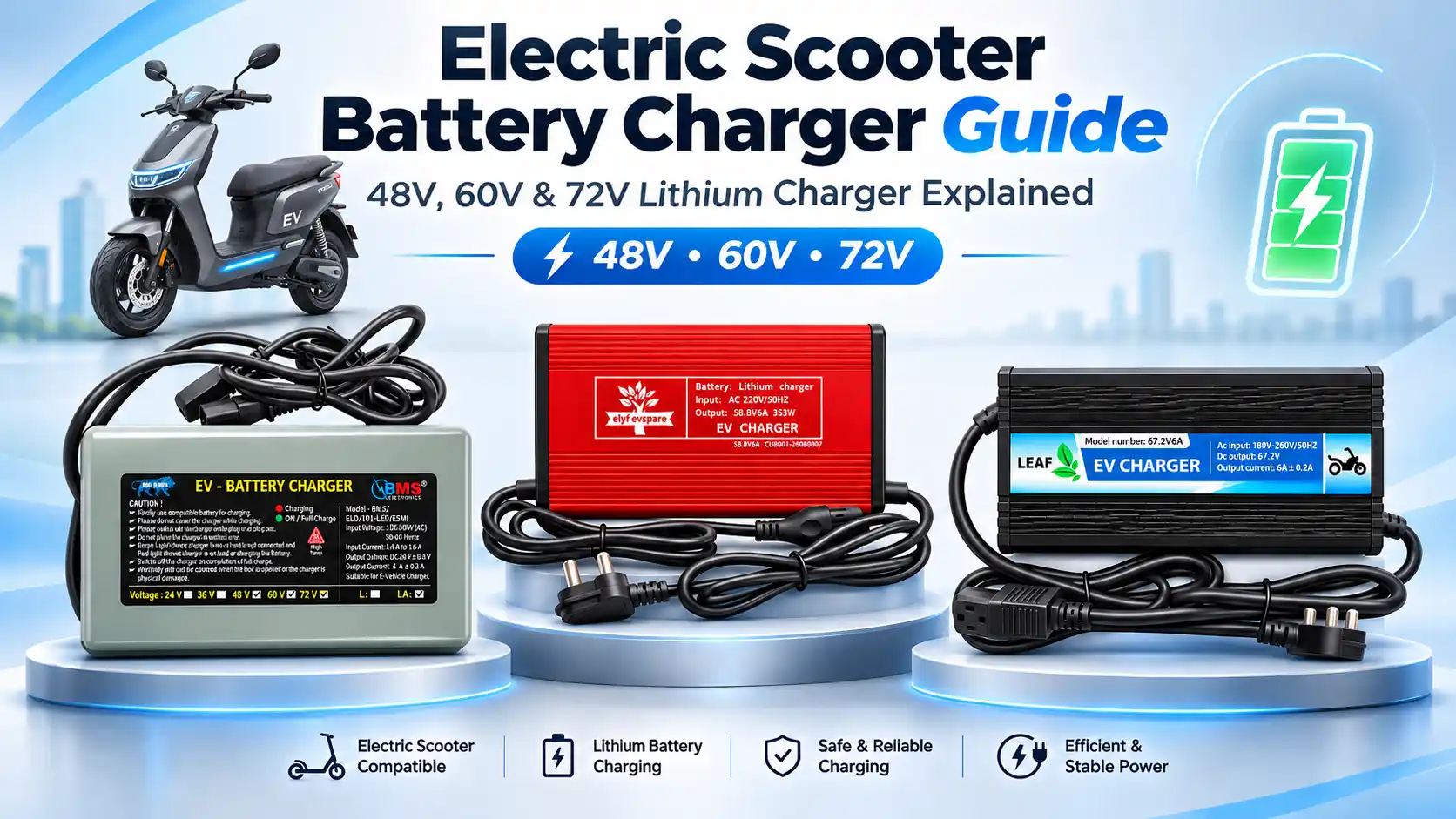
Choosing the correct electric scooter battery charger is not as simple as matching the number printed on the battery.
A battery may be sold as a 48V, 60V or 72V electric scooter battery, while its charger may be rated at 54.6V, 58.8V, 67.2V, 71.4V, 73V or 84V.
This is one of the biggest reasons buyers get confused while searching for an EV charger
For example:
- A 48V lithium-ion battery may require a 54.6V charger
- A 60V NMC battery may require a 67.2V or 71.4V charger
- A 60V-class LiFePO4 battery may require approximately a 73V charger
- A 72V NMC battery commonly requires an 84V charger
Using the wrong charger can result in incomplete charging, BMS protection activation or, more seriously, battery damage.
This guide explains how to choose the correct lithium battery charger for electric scooters, including battery voltage, chemistry, cell configuration, charger amperage and connectors.
Electric Scooter Charger Voltage Chart
The easiest place to start is with the battery’s cell configuration.
| Battery configuration | Common battery description | Typical charger voltage |
| 13S NMC / Li-ion | 48V-class battery | 54.6V |
| 14S NMC / Li-ion | 52V-class battery | 58.8V |
| 16S NMC / Li-ion | 60V-class battery | 67.2V |
| 17S NMC / Li-ion | 60V-class battery | 71.4V |
| 20S LiFePO4 | 60V / 64V-class battery | 73V approx. |
| 20S NMC / Li-ion | 72V-class battery | 84V |
Important: These are common configurations, not a universal rule. Always check the battery label, chemistry, BMS configuration and original charger specification before purchasing a replacement electric scooter charger.
Why Is Charger Voltage Higher Than Battery Voltage?
This is probably the most important thing to understand when buying an electric scooter battery charger.
The voltage printed on a battery is usually its nominal voltage, not its maximum fully charged voltage.
For example, a conventional NMC lithium-ion cell has a nominal voltage of approximately:
3.7V per cell
but it can be charged to approximately:
4.2V per cell
Therefore, a 13-series battery is approximately:
13 × 3.7V = 48.1V nominal
But at full charge:
13 × 4.2V = 54.6V
That is why a common 48V electric scooter lithium battery uses a 54.6V battery charger.
The same principle applies to 60V and 72V batteries.
48V Electric Scooter Charger Explained
A 48V electric scooter charger is one of the most commonly searched EV charging products.
However, simply searching for a “48V EV charger” is not enough.
For a conventional 13S NMC lithium-ion battery:
13 × 3.7V = 48.1V nominal
and:
13 × 4.2V = 54.6V maximum
Therefore, the appropriate charger is commonly:
54.6V Lithium Battery Charger
Typical search terms for this charger include:
- 48V electric scooter charger
- 48V lithium battery charger
- 54.6V battery charger
- 54.6V EV charger
- 54.6V electric scooter charger
- 48V e-scooter charger
- 48V electric scooty charger
- 48V EV battery charger
- electric bike 48V charger
- 48V lithium-ion battery charger
If your battery label specifies 54.6V charging voltage, choose a charger designed for that voltage and chemistry.
What about a 58.8V charger?
A 58.8V charger is normally associated with a conventional 14S NMC lithium-ion pack.
Calculation:
14 × 4.2V = 58.8V
The nominal battery voltage is approximately:
14 × 3.7V = 51.8V
This is normally called a 52V battery, although some sellers and applications may use different nominal marketing descriptions.
Do not use a 58.8V charger simply because your scooter is described as “48V”.
Check the actual battery specification first.
60V Electric Scooter Charger Explained
The 60V electric scooter charger category causes even more confusion because several different battery configurations may be marketed as 60V-class systems.
You may encounter:
- 67.2V charger
- 69.35V charger
- 71.4V charger
- 73V charger
These chargers are not automatically interchangeable.
Battery chemistry and the number of cells connected in series determine the correct charging voltage.
67.2V Charger for 60V Lithium Battery
A very common 60V-class NMC configuration is 16S.
Nominal voltage:
16 × 3.7V = 59.2V
Maximum charging voltage:
16 × 4.2V = 67.2V
Therefore:
16S NMC Battery → 67.2V Charger
This is why buyers searching for a 60V lithium battery charger frequently find products marked:
67.2V 5A charger
or
67.2V 6A charger
Common search variations include:
- 60V electric scooter charger
- 60V lithium battery charger
- 67.2V lithium charger
- 67.2V 6A charger
- 67.2V EV charger
- 60V EV battery charger
- 60V e-scooter charger
- 60V electric scooty charger
- 60V lithium-ion charger
- electric scooter charger 60V
- 60V smart battery charger
A 67.2V charger should normally be used only with a battery designed for that charging voltage.
71.4V Charger for 60V Lithium Battery
Another configuration found in 60V-class electric scooters is 17S NMC.
Nominal voltage:
17 × 3.7V = 62.9V
Maximum charge voltage:
17 × 4.2V = 71.4V
Therefore:
17S NMC Battery → 71.4V Charger
A 67.2V charger and 71.4V charger are not the same.
Using a 67.2V charger on a battery designed to charge to 71.4V may prevent the battery from reaching its intended full-charge voltage.
Using a charger with too high a voltage can be far more dangerous.
Always match the charger to the battery.
73V Charger for 60V LiFePO4 Battery
LiFePO4 batteries use a different cell voltage from NMC lithium-ion batteries.
A LiFePO4 cell has approximately:
3.2V nominal voltage
and a typical maximum cell charging voltage of around:
3.65V
For a 20S LiFePO4 pack:
Nominal:
20 × 3.2V = 64V
Maximum:
20 × 3.65V = 73V
Therefore:
20S LiFePO4 Battery → approximately 73V Charger
These batteries may sometimes be marketed in the 60V or 64V battery class.
Search terms buyers commonly use include:
- 60V LiFePO4 charger
- 73V lithium battery charger
- 73V EV charger
- 73V 6A charger
- LiFePO4 electric scooter charger
- 60V LFP battery charger
- 20S LiFePO4 charger
- 64V LiFePO4 charger
- electric scooter LiFePO4 charger
The important point is:
A 67.2V NMC charger and a 73V LiFePO4 charger are NOT interchangeable simply because both batteries may be sold as “60V”.
72V Electric Scooter Charger Explained
For many higher-voltage electric scooters and electric motorcycles, 72V batteries are used.
A common NMC configuration is 20S.
Nominal voltage:
20 × 3.7V = 74V
Maximum voltage:
20 × 4.2V = 84V
Therefore:
20S NMC Battery → 84V Charger
An 84V electric scooter charger is therefore commonly sold as a:
- 72V electric scooter charger
- 72V lithium battery charger
- 84V lithium battery charger
- 84V EV charger
- 84V electric scooter charger
- 72V EV battery charger
- 72V e-bike charger
- 72V e-scooter charger
- 72V electric scooty charger
- 84V 6A charger
- 20S lithium-ion charger
Before purchasing an 84V charger, confirm that your battery is actually a 20S NMC/Li-ion battery designed for an 84V maximum charging voltage.
NMC vs LiFePO4 Electric Scooter Charger
Battery chemistry is just as important as battery voltage.
Two batteries described as “60V” can require completely different EV chargers.
| Feature | NMC / Li-ion | LiFePO4 |
| Typical nominal cell voltage | ~3.7V | ~3.2V |
| Typical maximum cell voltage | ~4.2V | ~3.65V |
| Common EV use | Yes | Yes |
| Charger interchangeable? | No | No |
For example:
16S NMC
16 × 4.2V = 67.2V
Recommended charger voltage:
67.2V
20S LiFePO4
20 × 3.65V = 73V
Recommended maximum charger voltage:
approximately 73V
Both may appear in scooters marketed around the 60V class, but the charger voltages are significantly different.
Never select an EV charger only from the “48V”, “60V” or “72V” marketing description.
Check the actual charging voltage.
How to Choose the Correct Electric Scooter Battery Charger
Before buying a replacement electric scooter charger online, check these six parameters.
1. Battery Chemistry
Identify whether your battery is:
- NMC lithium-ion
- LiFePO4
- Lead-acid
- Another lithium chemistry
Different lithium batteries may need different chargers, so always check charger compatibility before use.
2. Battery Series Configuration
Look for information such as:
13S, 14S, 16S, 17S or 20S
If the series configuration is not written on the battery, the correct charger voltage may often be identified from the original charger label or battery manufacturer’s specification.
3. Charger Output Voltage
This is a key specification you should always check.
Examples include:
54.6V
58.8V
67.2V
71.4V
73V
84V
Your replacement lithium battery charger should match the charging voltage required by the battery.
4. Charging Current
Charger current may be written as:
2A, 3A, 5A, 6A, 8A, 10A, 15A, 18A, etc.
A higher-current charger can potentially charge a battery faster, but the battery and BMS must support that charging current.
Do not automatically replace a 5A charger with a 10A or 15A charger without checking the battery’s permitted charging current.
3A vs 5A vs 6A vs 10A Electric Scooter Charger
The charger current largely determines charging speed.
A simplified estimate is:
Charging Time ≈ Battery Capacity ÷ Charger Current
For a 40Ah battery:
| Charger | Basic theoretical calculation |
| 3A | 40 ÷ 3 ≈ 13.3 hours |
| 5A | 40 ÷ 5 = 8 hours |
| 6A | 40 ÷ 6 ≈ 6.7 hours |
| 10A | 40 ÷ 10 = 4 hours |
Actual charging normally takes somewhat longer because charging current is not necessarily constant throughout the entire charge cycle and losses also occur.
Therefore, a 10A fast EV charger is not automatically better than a 6A charger.
The battery manufacturer or BMS charging-current limit should determine what is safe.
5. Charger Connector
Even if voltage and current are correct, the charger may still not fit your scooter.
Electric Vehicle battery chargers come with different types of connectors, including:
- 3-pin connectors
- IEC-type connectors
- aviation connectors
- XLR-style connectors
- Chogori connectors
- custom EV connectors
- manufacturer-specific connectors
Also check the connector polarity.
Two connectors can physically look identical while having different pin wiring.
6. Battery BMS
Lithium electric scooter batteries normally use a Battery Management System or BMS.
The Battery Management System (BMS) helps keep the battery pack safe by monitoring its performance and protecting it from potential problems. Depending on the BMS design, it can offer protection against:
- cell over-voltage
- cell under-voltage
- charging over-current
- discharge over-current
- short circuit
- excessive temperature
Even if the battery has a BMS, always use a charger that matches the battery’s specifications.
The charger must still match the battery.
Can I Use a Higher Amp Electric Scooter Charger?
Possibly, but only if the battery is designed for the higher charging current.
For example, suppose you currently have:
60V 40Ah battery + 67.2V 6A charger
and you want to replace the charger with:
67.2V 10A charger
The voltage matches, but that does not automatically mean the 10A charger is suitable.
Check:
- battery manufacturer charging-current rating
- BMS charging-current limit
- connector current rating
- cable size
- battery temperature during charging
- cell charging specification
If those parameters support 10A charging, a higher-current charger may reduce charging time.
Otherwise use the recommended current.
Can I Use a Lower Amp Charger?
In many cases, a lower-current charger with the correct charging voltage and chemistry can charge the battery more slowly.
For example:
A battery normally charged using a 67.2V 6A charger may potentially charge with a compatible 67.2V 3A charger, but charging time will be considerably longer.
Again, verify the battery manufacturer’s recommendation before changing charger specifications.
Can I Use a 67.2V Charger Instead of a 71.4V Charger?
Usually, you should not substitute chargers simply because both are used with batteries marketed as 60V.
A:
67.2V charger commonly corresponds to 16S NMC
while a:
71.4V charger commonly corresponds to 17S NMC
They represent different battery configurations.
Use the charger voltage specified for your battery.
Is a 67.2V Charger Suitable for a LiFePO4 Battery?
Not simply because the battery says “60V”.
For example, a 20S LiFePO4 pack may require approximately 73V at full charge, while a 16S NMC pack commonly requires 67.2V.
The chemistry and cell configuration must match the charger.
Can I Use an 84V Charger on a 72V Battery?
An 84V charger is commonly correct for a 20S NMC lithium-ion battery, often marketed as a 72V battery.
Calculation:
20 × 4.2V = 84V
However, do not connect an 84V charger until the battery specification confirms an 84V maximum charging voltage.
Electric Scooter Charger Red and Green Light Meaning
Many EV battery chargers use LED indicators.
A common arrangement is:
Red Light
Usually indicates that the battery is charging.
Green Light
Often means charging is complete, the battery is not drawing significant charging current, or the charger is in standby.
However, LED behaviour varies between manufacturers.
Always check the charger’s instructions before diagnosing a fault solely from its LED colour.
Why Is My Electric Scooter Charger Not Charging?
If your electric scooter charger is not working, possible causes include:
- AC supply problem
- damaged charger cable
- loose connector
- incorrect connector polarity
- battery BMS protection
- battery voltage below the charger’s detection range
- damaged charging port
- charger failure
- battery cell problem
- incorrect charger voltage
- temperature protection
Do not repeatedly connect an incompatible charger to troubleshoot a lithium battery.
If the battery or charger gets unusually hot, stop charging and have the system inspected.
Why Does an Electric Scooter Charger Get Hot?
Some heating is normal because the EV charger converts AC mains power into regulated DC charging power.
Higher-power chargers may also use cooling fans.
However, excessive temperature, burning smell, abnormal fan noise, smoke or melted connectors are not normal.
Stop using the charger if you notice these symptoms.
Electric Scooter Charger Buying Checklist
Before clicking Buy Electric Scooter Charger Online, check this:
| Check | Example |
| Battery voltage class | 48V / 60V / 72V |
| Chemistry | NMC / Li-ion / LiFePO4 |
| Series count | 13S / 16S / 17S / 20S |
| Required charger voltage | 54.6V / 67.2V / 71.4V / 73V / 84V |
| Charger current | 3A / 5A / 6A / 10A etc. |
| Connector | Must physically match |
| Polarity | Must match |
| BMS charging limit | Charger current must be compatible |
If you are unsure about any of these specifications, do not buy only by matching “48V”, “60V” or “72V”.
Popular Electric Scooter Charger Types
54.6V Electric Scooter Charger
Commonly used for:
13S NMC / lithium-ion battery
Typical battery class:
48V
👉 Shop 54.6V Electric Scooter Chargers
58.8V Lithium Battery Charger
Commonly used for:
14S NMC battery
Typical battery class:
52V
👉 Shop 58.8V Lithium Battery Chargers
67.2V Electric Scooter Charger
Commonly used for:
16S NMC lithium-ion battery
Typical battery class:
60V
71.4V Lithium Battery Charger
Commonly used for:
17S NMC lithium-ion battery
Typical battery class:
60V
👉 Shop 71.4V Electric Scooter Chargers
73V LiFePO4 Battery Charger
Commonly used for:
20S LiFePO4 battery
Typical battery class:
60V / 64V
👉 Shop 73V LiFePO4 EV Chargers
84V Electric Scooter Charger
Commonly used for:
20S NMC lithium-ion battery
Typical battery class:
72V
👉 Shop 84V Electric Scooter Chargers
Which Electric Scooter Charger Should I Buy?
Instead of asking only:
“My scooter is 60V. Which charger should I buy?”
check the battery label and answer these questions:
1. What is the battery chemistry?
NMC or LiFePO4?
2. What is the maximum charging voltage?
67.2V, 71.4V, 73V, 84V or something else?
3. What charging current does the battery support?
4. Which connector does the battery use?
5. What is the connector polarity?
Once these five details match, selecting the correct EV battery charger becomes much easier.
Frequently Asked Questions About Electric Scooter Chargers
What charger do I need for a 48V electric scooter battery?
A conventional 13S NMC 48V lithium-ion battery normally requires a 54.6V charger. However, confirm the battery label and chemistry before purchasing.
What charger is used for a 60V electric scooter battery?
There is no single charger for every 60V battery. Depending on chemistry and series configuration, common charging voltages include 67.2V, 71.4V and approximately 73V.
What charger do I need for a 72V lithium battery?
A conventional 20S NMC 72V-class lithium-ion battery typically charges to 84V, so an 84V lithium battery charger is commonly used.
Is an EV charger the same as an electric scooter charger?
The term EV charger is broad and can refer to chargers for electric cars, electric scooters, electric bikes and other electric vehicles. For two-wheelers, terms such as electric scooter charger, EV battery charger, e-scooter charger and lithium battery charger are commonly used.
Can I charge an NMC battery with a LiFePO4 charger?
Do not do so unless the charger output characteristics are specifically approved for that battery. NMC and LiFePO4 cells have different voltage characteristics and typically require different charging profiles and maximum voltages.
How do I know whether my electric scooter charger is compatible?
Match the battery chemistry, series count, charger output voltage, charging current, connector and polarity.
Is a 6A electric scooter charger a fast charger?
A 6A charger will generally charge faster than a 2A or 3A charger for the same battery, but whether it qualifies as “fast charging” depends on battery capacity and its permitted charging rate.
Can I replace a 5A charger with a 6A charger?
Possibly, if the output voltage, chemistry, connector and polarity match and the battery/BMS permits at least 6A charging current.
Buy the Correct Electric Scooter Charger
Whether you are replacing a damaged charger or looking for an additional charger for your electric scooter, voltage compatibility should come before price.
PowerKart offers electric scooter battery chargers for different lithium battery configurations, including charger voltages such as:
54.6V
58.8V
67.2V
71.4V
73V
84V
for compatible EV battery systems.
Before ordering, compare your existing charger label or battery specification with the new charger.
Not Sure Which EV Charger You Need?
Send the following details before purchasing:
- Photo of battery label
- Photo of existing charger label
- Battery voltage
- Battery Ah capacity
- Battery chemistry, if known
- Charger connector photo
This makes it easier to identify a compatible electric scooter lithium battery charger and reduces the risk of ordering the wrong voltage or connector.
Shop Electric Scooter Chargers
👉 View Electric Scooter Battery Chargers
👉 Shop 48V Lithium Battery Chargers
👉 Shop 60V Electric Scooter Chargers
👉 Shop 72V Electric Scooter Chargers
Final Takeaway
When buying an EV charger for an electric scooter, remember one simple rule:
Do not match only the battery’s advertised voltage.
Match:
Battery chemistry + series configuration + charging voltage + charging current + connector + polarity
A 48V, 60V or 72V label alone is not enough to select the correct charger.
Choosing the correct electric scooter battery charger helps ensure proper charging, protects the battery system and gives you reliable everyday EV use.