1. Product Overview
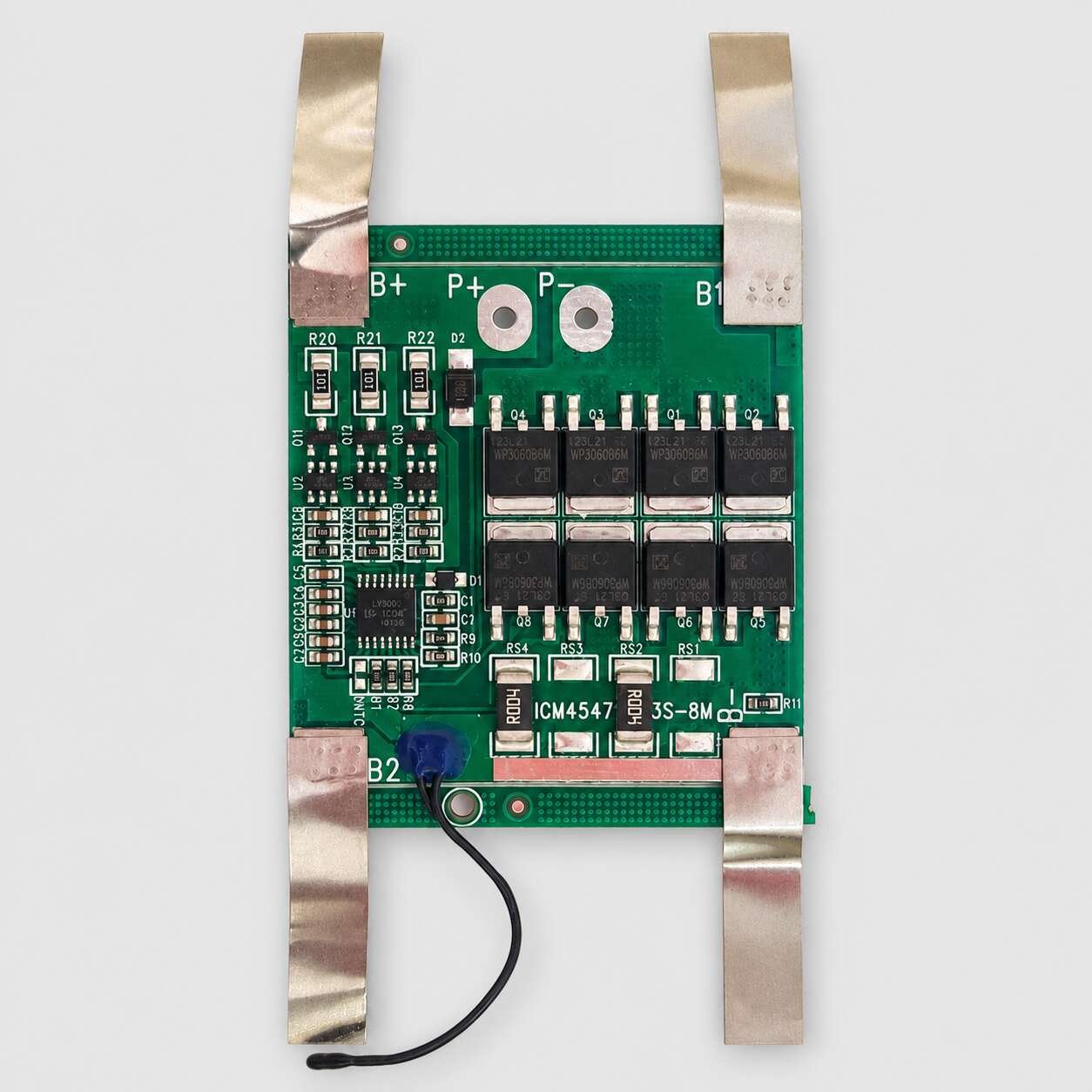
The ICM4547 3S-8M is a battery protection BMS board intended for compatible three-series lithium-ion battery packs. It is suitable for cells with a nominal voltage of 3.6V or 3.7V and a maximum charging voltage of 4.2V per cell.
A completed 3S pack has a nominal voltage of approximately 10.8V or 11.1V and a maximum charging voltage of 12.6V.
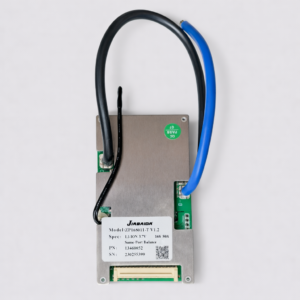
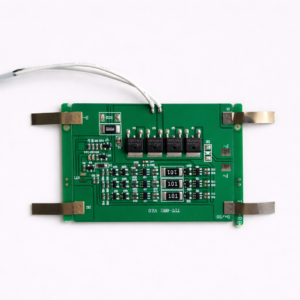
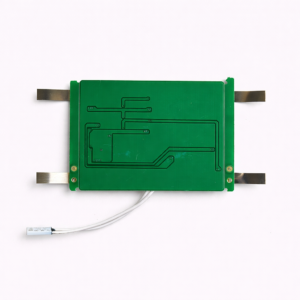
The board is supplied with four pre-fitted nickel strips for connection to the battery series groups. Separate P+ and P− terminals are provided for the pack’s external power connections. A black temperature-sensor lead is also visibly fitted.
The continuous-current and peak-current ratings are not printed on the board and must be confirmed before use.
2. Technical Specifications
| Specification |
Details |
| Product type |
Lithium-ion battery protection/BMS board |
| Board marking |
ICM4547 3S-8M |
| Cell configuration |
3S |
| Compatible cell voltage |
3.6V or 3.7V nominal |
| Nominal pack voltage |
10.8V–11.1V |
| Maximum pack voltage |
12.6V |
| Maximum cell voltage |
4.2V |
| Battery connections |
B+, B1, B2 and B− |
| External power connections |
P+ and P− |
| Power MOSFETs |
Eight visible |
| Nickel strips |
Four pre-fitted strips |
| Temperature sensor |
Pre-fitted black sensor lead |
| Continuous-current rating |
Not specified |
| Peak-current rating |
Not specified |
| Charging-current rating |
Not specified |
| Passive balancing |
Not verified |
| Bluetooth connectivity |
No |
| Communication interface |
Not provided |
3. Visible Connection Points
| Board marking |
Typical purpose |
| B− |
Main negative terminal of the battery pack |
| B1 |
First series-cell junction |
| B2 |
Second series-cell junction |
| B+ |
Main positive terminal of the battery pack |
| P+ |
External positive connection |
| P− |
External negative connection |
The table describes the typical purpose of the printed terminal markings. Verify the exact connection sequence and voltages with the appropriate wiring diagram and a multimeter before installing the board.
4. Main Features
- Designed for three lithium-ion cells or parallel cell groups connected in series
- Integrated battery-voltage monitoring connections
- Eight visible power MOSFETs for charge and discharge switching
- Pre-fitted nickel tabs for battery assembly
- Separate P+ and P− connection pads
- Pre-fitted temperature-sensing lead
- Compact construction for internal battery-pack installation
- Suitable for battery manufacturing, repair and replacement work
The precise overcharge, over-discharge, overcurrent, short-circuit and temperature thresholds are not specified and should not be assumed.
5. Suitable Applications
This protection board may be suitable for compatible 3S lithium-ion packs used in:
- Portable electronic equipment
- Rechargeable tools and small appliances
- Robotics projects
- RC equipment
- LED lighting systems
- DIY electronics
- Backup-power devices
- Battery repairs and replacements
- Custom 11.1V lithium-ion battery assemblies
Suitability depends on the battery chemistry, cell configuration, charging voltage, operating current, peak current and required protection characteristics.
6. Battery and Charger Compatibility
Use this board only when all the following conditions are satisfied:
- The battery uses lithium-ion, NMC, LCO or compatible 4.2V cells.
- The pack contains exactly three series groups.
- Each series group is at a similar voltage before connection.
- The charger is designed for a 3S lithium-ion pack.
- The charger’s maximum output voltage does not exceed 12.6V.
- The load and charging currents remain within the board’s verified rating.
- The board’s dimensions and nickel-tab arrangement suit the battery assembly.
Do not use this board with 3S LiFePO4 cells. A 3S LiFePO4 pack requires different charging and protection-voltage thresholds.
7. Installation Guidance
- Check the voltage of every cell group before connecting the BMS.
- Ensure all three series groups are closely voltage-matched.
- Identify B−, B1, B2 and B+ from the board markings.
- Connect the battery terminals in the correct sequence.
- Verify each intermediate voltage with a multimeter.
- Connect the charger and load only through the specified P+ and P− terminals.
- Use a suitable spot-welding method for the nickel strips.
- Avoid prolonged direct soldering near the cells or PCB.
- Position the temperature sensor securely against the battery cells.
- Insulate the board, nickel strips and all exposed electrical connections.
- Confirm the complete pack voltage before connecting a charger or load.
8. Important Current-Rating Note
The board’s current rating cannot be determined reliably from its physical appearance or the number of MOSFETs alone.
Before installation, confirm:
- Maximum continuous discharge current
- Short-duration peak current
- Maximum charging current
- Overcurrent protection threshold
- Short-circuit protection behaviour
- MOSFET and PCB temperature limits
- Required nickel-strip and output-wire capacity
Do not advertise or operate this board at a particular amperage unless the rating has been confirmed by the supplier or through controlled testing.
9. Safety Information
- Incorrect B1 or B2 connection can damage the BMS immediately.
- Never connect the series taps in the wrong order.
- Do not reverse the pack polarity.
- Do not short-circuit the nickel strips or P+/P− terminals.
- Use only a compatible 12.6V lithium-ion charger.
- Do not exceed the verified current rating of the board or battery cells.
- Keep the board away from water, conductive debris and loose metal objects.
- Do not use the board if it is burnt, cracked, corroded or unusually hot.
- Battery-pack assembly should be performed by a person familiar with lithium-ion battery wiring and safety.