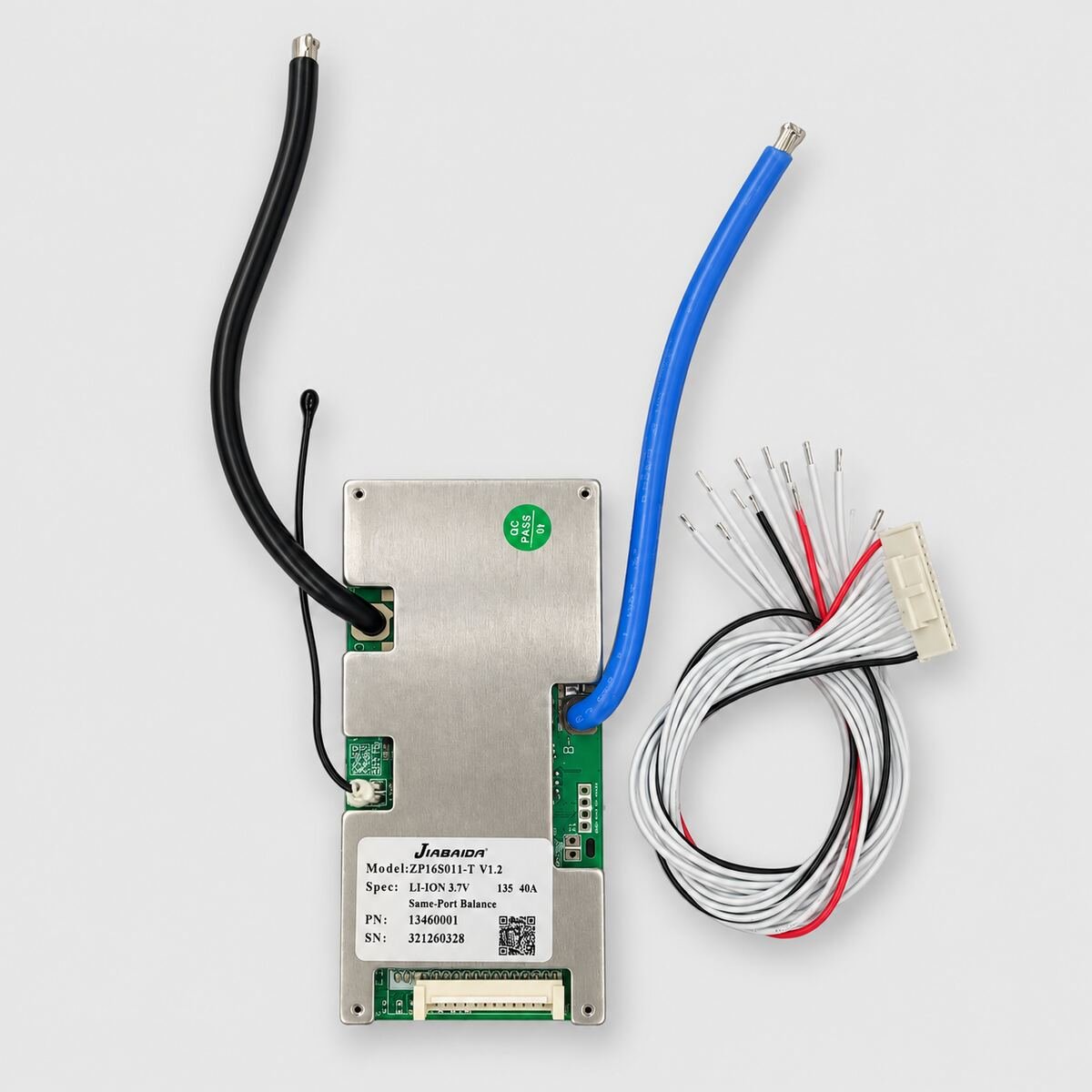
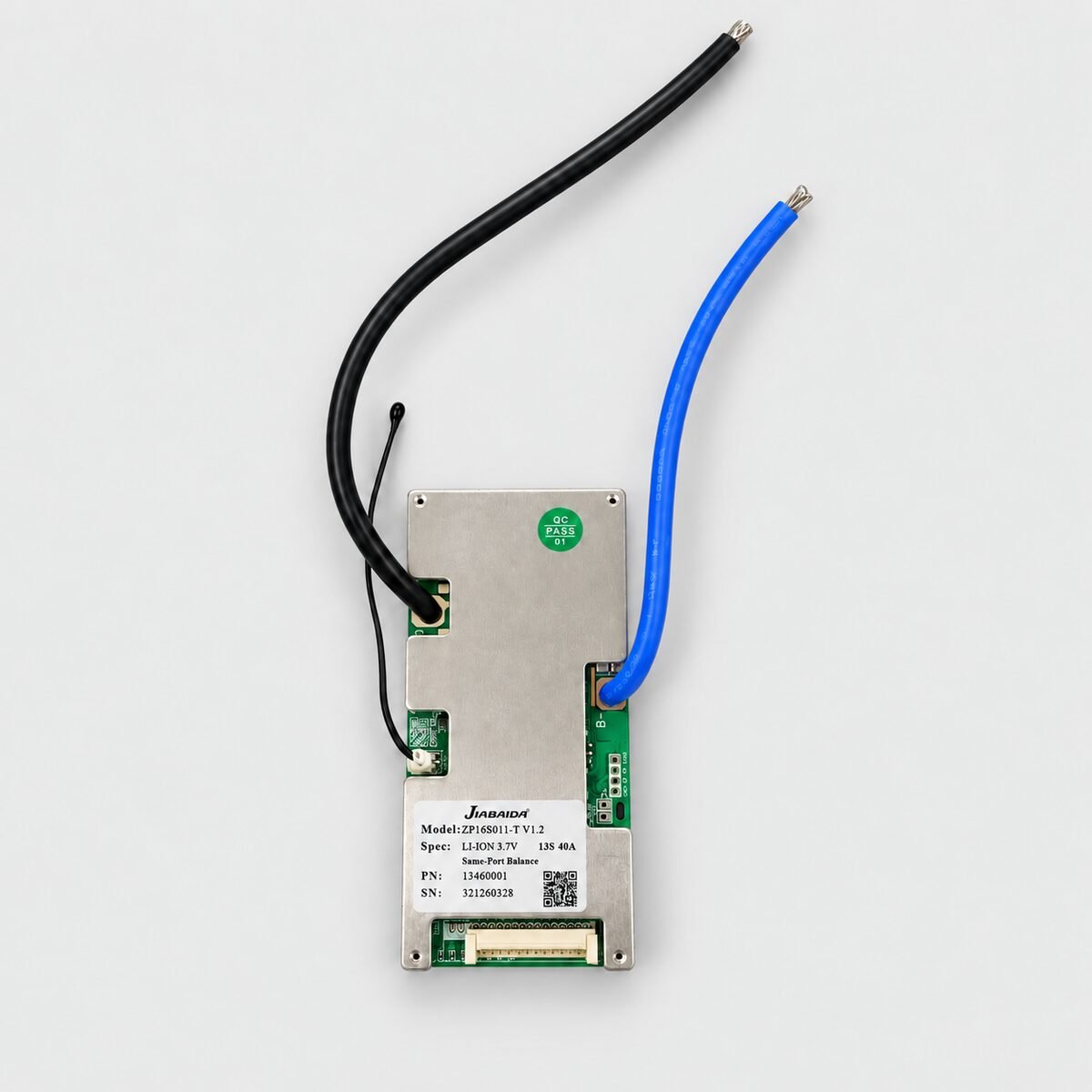
1. Product Overview
The JIABAIDA ZP16S011-T V1.2 is a 13S 40A Battery Management System designed for lithium-ion battery packs containing thirteen 3.6V or 3.7V cells or parallel cell groups connected in series.
A completed 13S lithium-ion battery pack has a nominal voltage of approximately 46.8V–48.1V and reaches 54.6V when fully charged.
The BMS monitors the voltage of each series group and is intended to protect the battery against abnormal charging, excessive discharge, overcurrent and short-circuit conditions. It also includes a cell-balancing function to help reduce voltage differences between the thirteen series groups.
This model uses a same-port configuration, which means charging and discharging normally share the same protected negative connection.
The circuit board is enclosed by a metal cover that provides physical protection and may assist with heat dissipation. A balance-wire harness, heavy-gauge power cables and a temperature-sensor lead are supplied with the unit.
2. Technical Specifications
| Specification |
Details |
| Brand |
JIABAIDA |
| Model |
ZP16S011-T V1.2 |
| Product type |
Lithium-ion battery protection BMS |
| Battery chemistry |
Lithium-ion/NMC |
| Cell configuration |
13S |
| Compatible cell voltage |
3.6V or 3.7V nominal |
| Nominal pack voltage |
46.8V–48.1V |
| Maximum charging voltage |
54.6V |
| Advertised current rating |
40A |
| Charge-port configuration |
Same port |
| Discharge-port configuration |
Same port |
| Cell balancing |
Yes |
| Balancing current |
Not specified |
| Overcharge protection |
Intended function; threshold not specified |
| Over-discharge protection |
Intended function; threshold not specified |
| Overcurrent protection |
Intended function; threshold not specified |
| Short-circuit protection |
Intended function; recovery behaviour not specified |
| Temperature monitoring |
Sensor lead visible |
| Metal protective cover |
Yes |
| Balance-wire harness |
Included |
| Communication interface |
Not confirmed |
| Bluetooth connectivity |
Not specified |
| Pack positive connection |
Normally direct from battery positive |
| Protected negative connection |
Through the BMS |
| Part number |
13460001 |
| Serial number |
May vary between units |
3. Visible Connections and Accessories
| Connection or component |
Typical function |
| B− |
Battery-pack negative connection |
| P− or common negative cable |
Protected charging and discharging negative connection |
| B+ |
Battery-pack positive connection, normally connected directly |
| Balance-wire harness |
Connects to each of the thirteen series-group voltage points |
| Thick black cable |
High-current negative connection; verify whether B− or P− before installation |
| Thick blue cable |
High-current negative connection; verify whether B− or P− before installation |
| Thin black sensor lead |
Temperature monitoring |
| Multi-pin balance connector |
Connects the sensing-wire harness to the BMS |
| Small auxiliary connectors |
Exact function must be confirmed from the PCB markings or manufacturer documentation |
Do not identify the thick black and blue cables only by colour. Confirm the B− and P− markings on the BMS before making any connection.
4. Protection and Management Functions
The JIABAIDA ZP16S011-T V1.2 is intended to provide essential protection and monitoring for compatible 13S lithium-ion battery packs, including:
- Individual series-group voltage monitoring
- Overcharge protection
- Over-discharge protection
- Overcurrent protection
- Short-circuit protection
- Charge and discharge control through onboard MOSFETs
- Battery-temperature monitoring
- Cell-voltage balancing
- Same-port charging and discharging
The exact protection thresholds, delay times, temperature limits, balancing current and recovery behaviour are not specified on the visible product label. These values should be confirmed before using the BMS in a critical or high-power application.
5. Suitable Applications
This BMS may be suitable for compatible 13S lithium-ion battery packs used in:
- Electric bicycles
- Electric scooters
- Low-power electric vehicles
- Portable power systems
- Solar-energy storage batteries
- Backup-power systems
- Robotics projects
- Battery-powered equipment
- DIY 48V lithium-ion battery packs
- Battery repair and replacement work
- Custom energy-storage projects
The continuous current, peak current and starting current of the connected equipment must remain within the verified capability of the BMS, battery cells, wiring and connectors.
6. Battery and Charger Compatibility
Use this BMS only when:
- The battery contains exactly thirteen series-connected lithium-ion groups.
- Each cell has a nominal voltage of 3.6V or 3.7V.
- Each cell has a maximum charging voltage of 4.2V.
- The charger is designed for a 13S lithium-ion battery pack.
- The charger’s maximum output voltage does not exceed 54.6V.
- The battery cells can safely supply the required continuous and peak current.
- The load current remains within the verified capability of the BMS.
- All thirteen series groups are at closely matched voltages before connection.
- The balance-wire sequence is checked before plugging the connector into the BMS.
Do not use this model with a 16S LiFePO4 battery pack. LiFePO4 cells require a BMS with different charging and protection-voltage settings.
7. Installation Guidance
- Measure the voltage of all thirteen series groups before installation.
- Confirm the B− and P− cable identification from the PCB markings.
- Connect B− to the battery-pack negative terminal.
- Connect the protected output negative to the load and charger negative.
- Connect the pack positive directly to the load and charger positive when required by the BMS design.
- Connect the balance wires in the correct sequence from battery negative toward battery positive.
- Verify each adjacent balance-wire voltage using a multimeter.
- Verify the total voltage across the complete balance connector before plugging it into the BMS.
- Connect the main power cables before inserting the balance connector unless the manufacturer specifies a different sequence.
- Use correctly sized cables, lugs and connectors for the expected current.
- Secure all cable lugs properly and insulate every exposed conductor.
- Mount the BMS where the metal cover cannot contact live terminals, nickel strips or busbars.
- Provide sufficient ventilation and avoid placing the BMS against flammable material.
- Fix the temperature sensor securely against the battery cells.
- Test charging, discharging and protection operation at a low current before applying the full load.
Incorrect balance-wire sequencing can permanently damage the BMS.
8. Important Current-Rating Note
The 40A BMS rating does not increase the current capability of the battery cells.
The safe current of the completed battery pack is determined by the lowest-rated component among:
- BMS
- Battery cells
- Nickel strips or busbars
- Output cables
- Cable lugs
- Connectors
- Fuse
- Charger
- Connected load
Before using the BMS near its advertised 40A rating, confirm whether the rating represents continuous current, peak current or a seller-advertised maximum.
For motor applications, also consider the controller’s peak current and the motor’s starting or acceleration current.
9. Package Contents
- 1 × JIABAIDA ZP16S011-T V1.2 13S 40A BMS
- 1 × Balance-wire harness
- Attached heavy-gauge power cables
- Attached temperature-sensor lead
Package contents should be confirmed from the supplied product before installation.
10. Safety Information
- Incorrect balance-wire connection can permanently damage the BMS.
- Never connect the balance wires in the wrong sequence.
- Do not reverse battery polarity.
- Do not short B+, B−, P+ or P−.
- Use only a compatible 54.6V 13S lithium-ion charger.
- Do not use the BMS with LiFePO4 cells unless the exact model is specifically configured for LiFePO4.
- Do not exceed the safe current of the battery cells or BMS.
- Install a correctly rated fuse near the battery-pack positive terminal.
- Keep the BMS away from water, conductive dust and loose metal objects.
- Do not use a damaged, burnt, corroded or unusually hot BMS.
- Insulate all exposed electrical connections.
- Installation should be performed by a person familiar with lithium-battery wiring and safety.