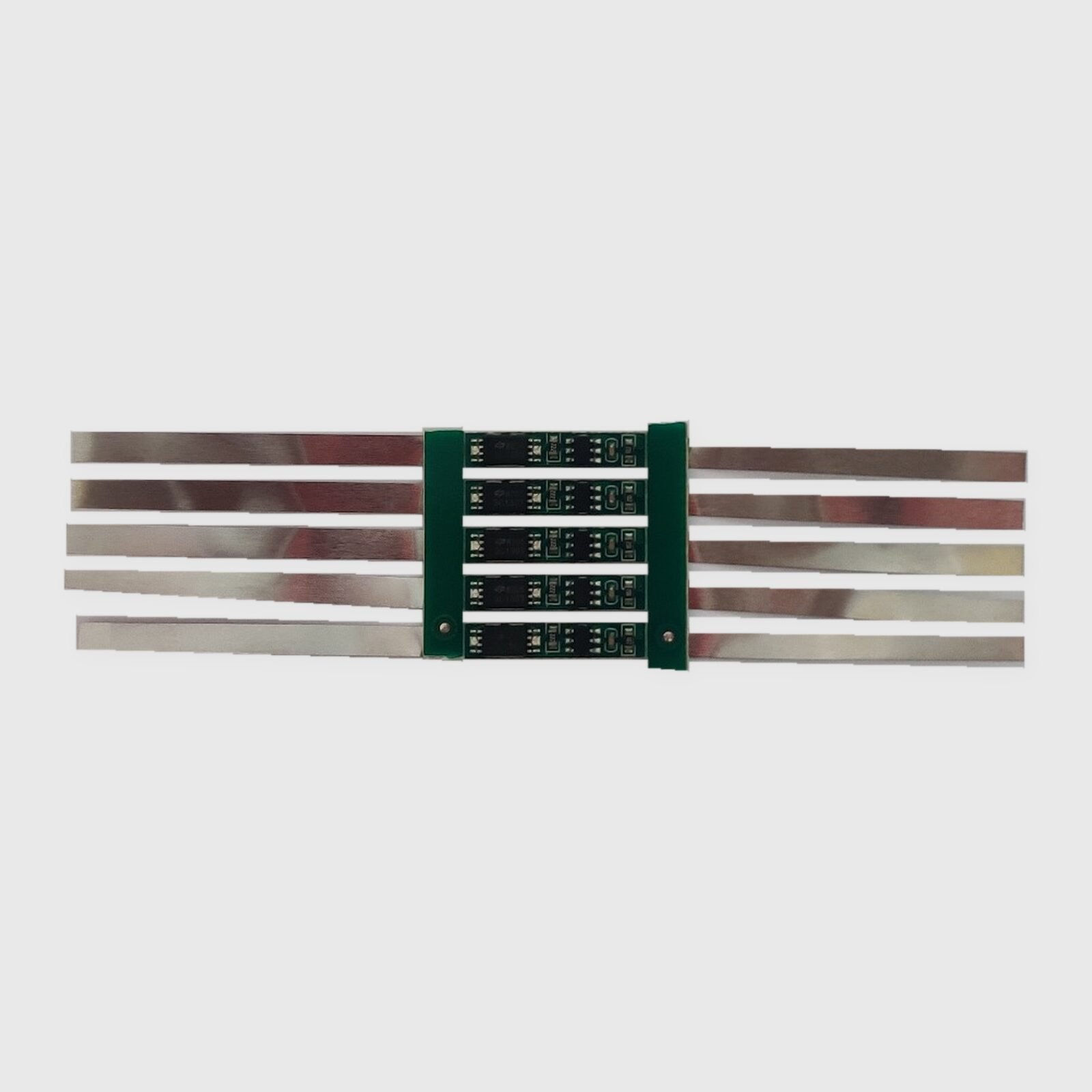
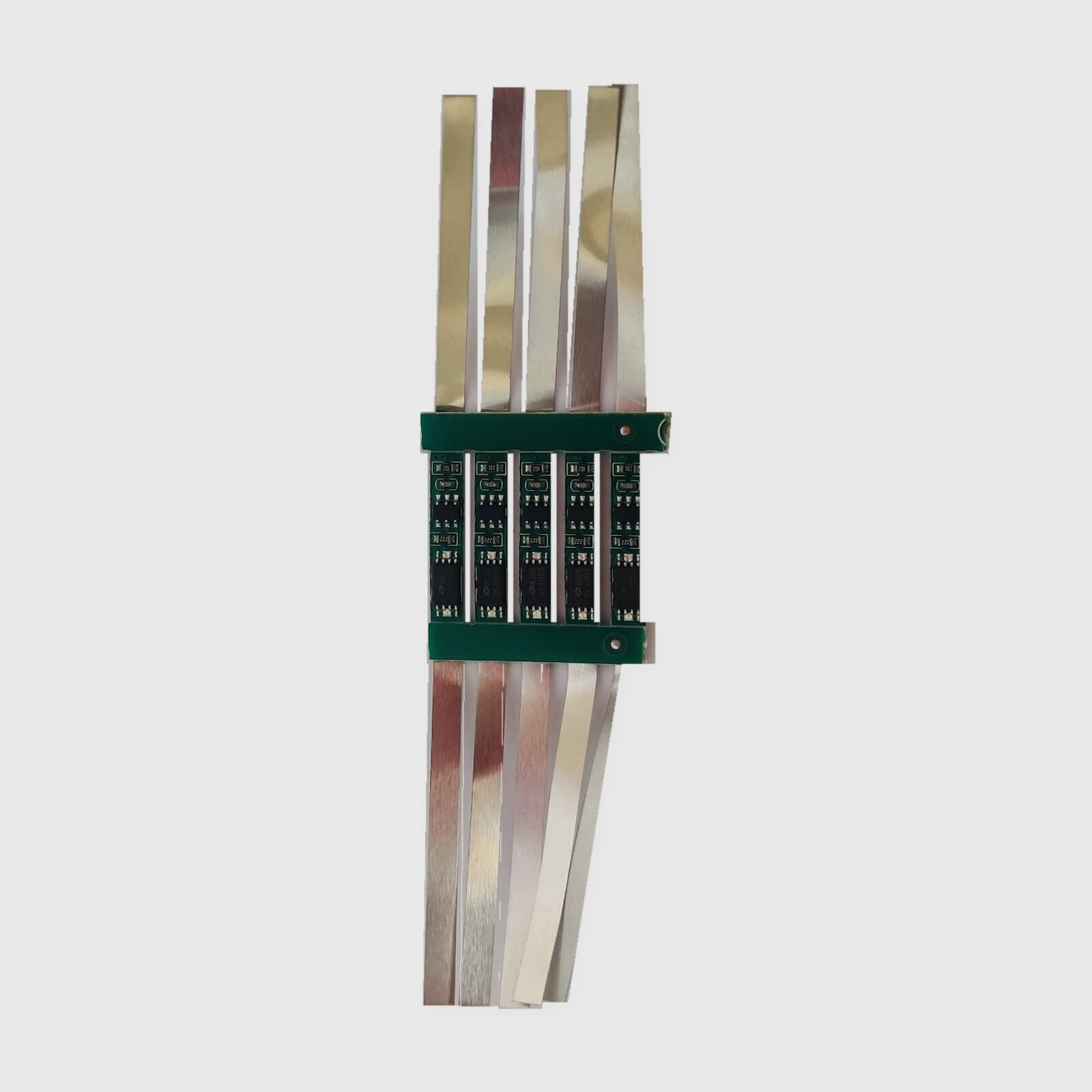
1. Product Overview
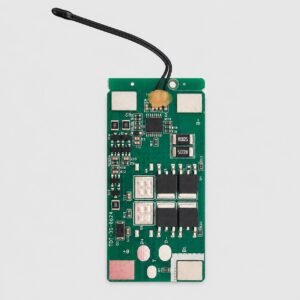
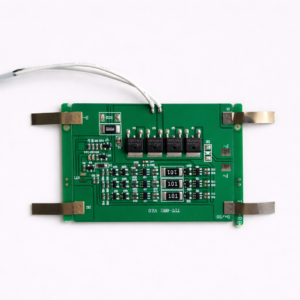
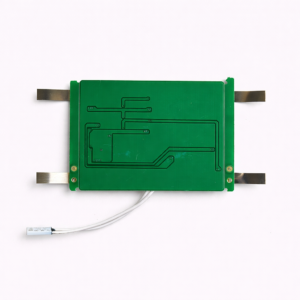
This product consists of five compact 1S lithium-ion battery protection PCB modules arranged in a single manufacturing panel. Each module is intended for use with one 3.6V or 3.7V lithium-ion/LiPo cell or one parallel-connected cell group.
Each protection circuit has pre-fitted metal strips extending from both sides, allowing it to be integrated into compatible pouch-cell or custom battery assemblies using a suitable connection method.
The product is supplied as a five-module panel. The individual modules may require separation before installation, depending on the intended battery construction.
This is not a 5S BMS. The five visible circuits must not be treated as the five sensing connections of a series-connected battery pack.
2. Technical Specifications
| Specification |
Details |
| Product type |
Lithium-ion battery protection PCB panel |
| Number of protection modules |
Five |
| Configuration of each module |
1S |
| Compatible chemistry |
Lithium-ion/LiPo with 4.2V maximum cell voltage |
| Nominal cell voltage |
3.6V or 3.7V |
| Maximum charging voltage |
4.2V per protected cell/group |
| Electrical connection |
Pre-fitted metal strips |
| Connection strips per module |
Two |
| Total visible connection strips |
Ten |
| Protection-board construction |
Compact surface-mounted PCB |
| Continuous-current rating |
Not specified |
| Peak-current rating |
Not specified |
| Maximum charging current |
Not specified |
| Protection thresholds |
Not specified |
| Cell balancing |
No |
| Bluetooth connectivity |
No |
| Communication interface |
Not provided |
3. Main Features
- Five compact 1S protection circuits supplied together
- Suitable for compatible lithium-ion and LiPo cells
- Pre-fitted metal connection strips simplify battery assembly
- Compact design for installation beside a pouch cell
- Surface-mounted protection components
- Suitable for battery manufacturing and repair applications
- Can be separated into individual modules where permitted by the PCB design
- No external cell-sensing harness required for normal 1S installation
The precise overcharge, over-discharge, overcurrent and short-circuit protection thresholds are not printed or verified.
4. Suitable Applications
These protection modules may be suitable for compatible:
- Single-cell lithium-polymer batteries
- 3.7V lithium-ion pouch batteries
- Rechargeable toys
- Bluetooth and portable audio devices
- GPS and tracking equipment
- IoT products
- Small portable electronic equipment
- Battery replacement and repair work
- Custom 1S rechargeable battery assemblies
Suitability depends on the cell chemistry, charging voltage, operating current, peak current and required protection thresholds.
5. Battery and Charger Compatibility
Use each protection circuit only when:
- The battery uses a 3.6V or 3.7V lithium-ion/LiPo cell
- The cell’s maximum charging voltage is 4.2V
- The charger is designed for a single-cell lithium-ion battery
- The charging current is within the verified PCB and cell ratings
- The load current is within the verified PCB and cell ratings
- The connection-strip material and dimensions suit the assembly method
- The physical size fits the intended battery pack
Do not use these boards with LiFePO4 cells unless the supplier specifically confirms compatible LiFePO4 protection thresholds.
6. Installation Guidance
- Separate individual modules only along the intended panel-separation lines.
- Do not cut through tracks, components or electrical connections.
- Identify the cell-side and output-side connections before installation.
- Verify polarity with a multimeter before connecting a cell.
- Use a suitable welding or controlled connection method for the metal strips.
- Avoid applying excessive heat near the cell or protection PCB.
- Insulate the circuit and all exposed metal connections after assembly.
- Confirm correct voltage at the protected output before connecting a charger or load.
- Test the protection behaviour safely before placing the battery into service.
7. Important Current-Rating Note
The current rating cannot be determined reliably from the PCB size or visible components alone.
Before using or advertising these protection modules, confirm:
- Maximum continuous discharge current
- Short-duration peak current
- Maximum charging current
- Overcurrent-protection threshold
- Short-circuit-protection behaviour
- Overcharge and over-discharge thresholds
- Recovery method after protection activation
- Maximum permitted PCB temperature
Do not operate the modules at a particular amperage unless the rating has been confirmed by the supplier or through controlled testing.
8. Important Configuration Note
This panel contains five 1S protection circuits; it should not be described as a 5S BMS.
- Each circuit is intended to protect an individual 1S cell or parallel group.
- The modules do not provide normal 5S series-pack monitoring.
- The product does not provide cell balancing between five series groups.
- A 5S battery pack requires a dedicated 5S BMS designed for the correct chemistry and voltage.
9. Safety Information
- Never reverse the cell polarity.
- Do not short-circuit the metal connection strips.
- Use only a compatible 4.2V single-cell lithium-ion charger.
- Do not exceed the verified current rating of the PCB or battery cell.
- Do not use a damaged, burnt or corroded protection board.
- Keep the circuit away from water, conductive dust and loose metal objects.
- Insulate unused modules and exposed strips during storage.
- Battery assembly should be performed by someone familiar with lithium-ion battery wiring and safety.