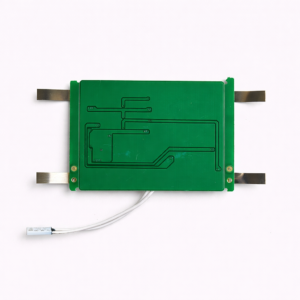
1. Product Overview
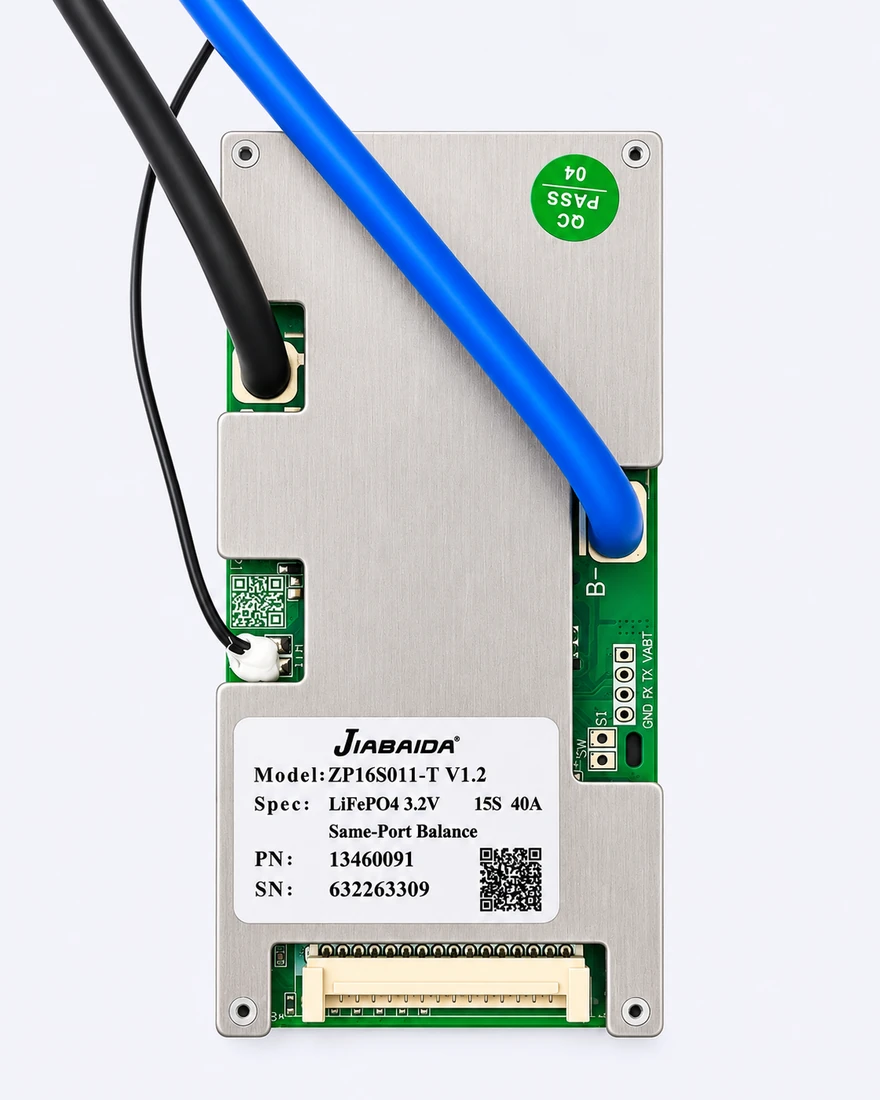
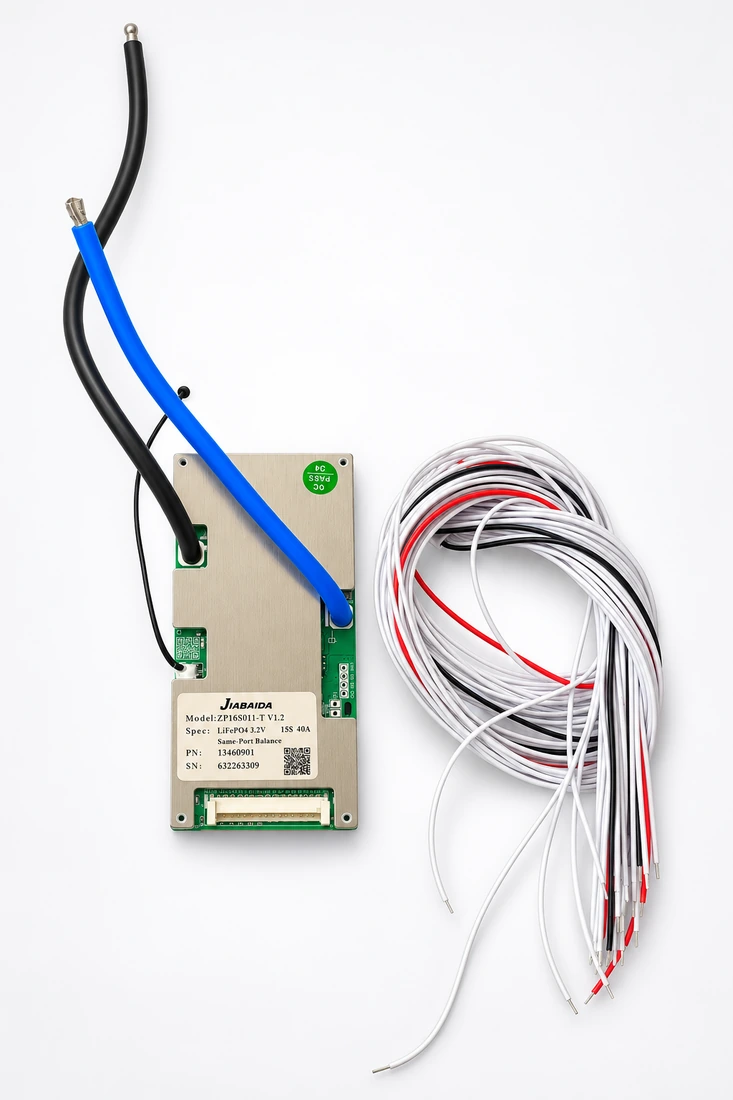
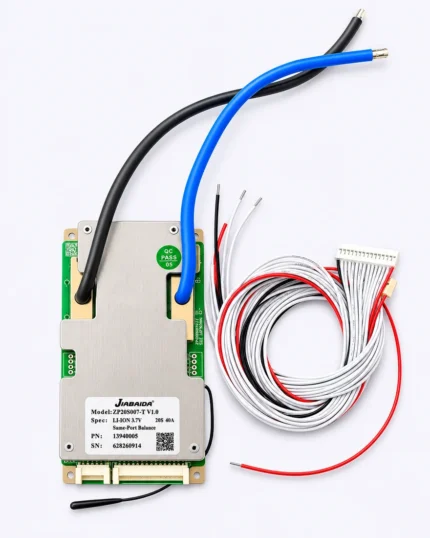
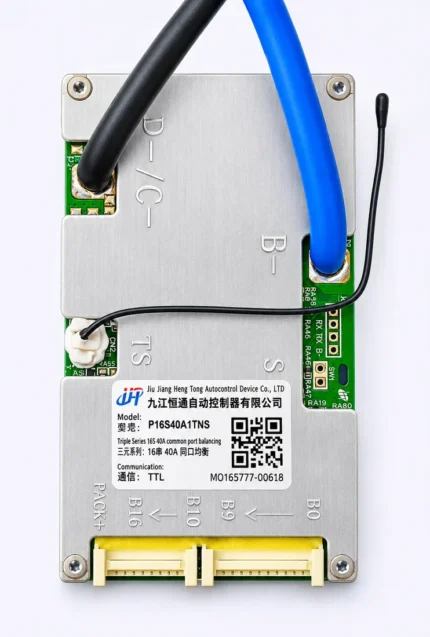
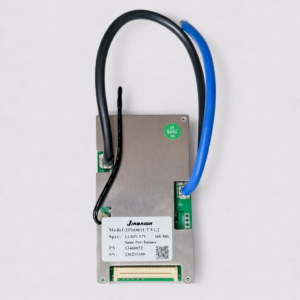
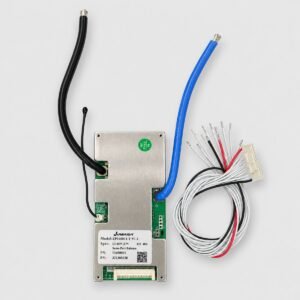
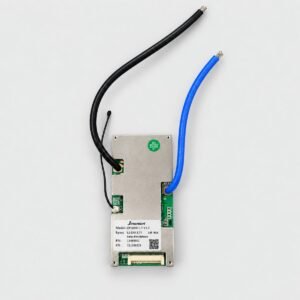
The JBD Jiabaida ZP16S011-T V1.2 15S 40A BMS is a hardware Battery Management System designed for 15-series LiFePO₄ battery packs.
The actual unit is marked:
- Brand: JBD / JIABAIDA
- Model: ZP16S011-T V1.2
- Battery Chemistry: LiFePO₄ / LFP
- Cell Nominal Voltage: 3.2V
- Configuration: 15S
- Current Rating: 40A
- Port Type: Same-Port
- Balancing: Built-in Balance Function
It is suitable for applications where a reliable, compact BMS is required to protect the battery pack against abnormal voltage, current and temperature conditions.
2. Electrical Specifications
- Battery Chemistry: Lithium Iron Phosphate – LiFePO₄ / LFP
- Series Configuration: 15S
- Nominal Cell Voltage: 3.2V
- Nominal Pack Voltage: 48V
- Continuous Current Rating: 40A
- Port Configuration: Same Port / Common Port
- Balancing: Built-in Passive Balancing
- BMS Type: Hardware BMS
- Application Class: 48V LiFePO₄ battery packs
Nominal Battery Voltage
15 × 3.2V = 48V
A fully charged 15S LiFePO₄ battery is typically around 54–54.75V, depending on the cell manufacturer’s recommended charge voltage and charger configuration.
3. Built-in Cell Balancing
The BMS incorporates a cell-balancing function to help reduce voltage differences between individual series groups.
Balancing helps:
- Maintain more uniform cell voltages
- Prevent one cell group from reaching the upper limit significantly before the others
- Improve overall pack stability
- Support better utilization of battery capacity
- Improve long-term battery performance
This is particularly important in multi-series LiFePO₄ battery packs where small differences between cells can increase over repeated charge/discharge cycles.
4. Same-Port Charge & Discharge
This BMS uses a Same-Port / Common-Port configuration.
Charging and discharging are controlled through the same BMS power path, which simplifies battery-pack wiring and makes the unit convenient for:
- Electric vehicles
- Solar battery systems
- Inverter batteries
- UPS systems
- General-purpose LFP battery packs
5. Battery Protection Functions
The JBD ZP16S011 platform provides the primary protection functions required for lithium battery management, including:
- Cell overcharge protection
- Cell over-discharge protection
- Charge over-current protection
- Discharge over-current protection
- Short-circuit protection
- Temperature protection
- Cell balancing
- Cell-voltage monitoring
- Battery pack protection during abnormal operating conditions
If an abnormal condition is detected, the BMS can disconnect the relevant charge or discharge path to help protect the cells and connected equipment.
6. 40A Continuous Current Rating
The BMS is rated for 40A continuous current.
This makes it suitable for medium-power 48V battery systems such as:
- Electric bicycles
- Electric scooters
- Light EV applications
- Solar storage batteries
- Inverter batteries
- UPS backup systems
- Robotics
- Portable energy-storage systems
The actual battery-pack current capability must also be within the limits of the cells, busbars, cables, connectors and other components used in the pack.
7. Hardware BMS Design
This is primarily a hardware protection BMS, designed to provide essential battery protection without requiring a mobile application for normal operation.
Advantages include:
- Simple installation
- No app required
- Automatic battery protection
- Low standby power consumption
- Compact construction
- Suitable for production and replacement battery packs
Communication pads visible on the PCB should not be assumed to provide Bluetooth or smart monitoring unless the required compatible module and firmware are specifically supplied.
8. Suitable Applications
The JBD Jiabaida 15S 40A LFP BMS is suitable for compatible battery packs used in:
- Electric bicycles
- Electric scooters
- Light electric vehicles
- Solar energy storage
- Home inverter batteries
- UPS backup batteries
- Portable power systems
- Robotics
- Industrial equipment
- Custom LiFePO₄ battery packs
- DIY 48V LFP battery projects
9. Why 15S LiFePO₄?
A 15S LiFePO₄ battery uses 15 cells or parallel cell groups connected in series.
With each LFP cell having approximately 3.2V nominal voltage:
15 × 3.2V = 48V nominal
This makes a 15S configuration suitable for many devices designed around a 48V battery system.
However, 15S and 16S LiFePO₄ packs are not electrically identical. Always confirm the equipment’s supported battery-voltage range before selecting the pack configuration.
10. Compatibility Check Before Ordering
Before ordering this BMS, confirm:
- Battery chemistry is LiFePO₄ / LFP
- Cell configuration is exactly 15S
- Cell nominal voltage is approximately 3.2V
- Pack nominal voltage is approximately 48V
- Required continuous current is within 40A
- Same-port BMS wiring suits your battery design
- Balance-wire harness matches the required 15S configuration
- Charger is suitable for a 15S LiFePO₄ battery
Do not select a BMS only on the basis of “48V”.
A 48V NMC battery and a 48V LiFePO₄ battery can use different cell counts and require different BMS protection settings.
11. Installation Guidelines
Correct installation is critical for safe BMS operation.
Before connecting the balance-wire harness:
- Measure every cell-group voltage
- Confirm all 15 series groups
- Verify the balance-wire sequence
- Check voltage progressively from B- to each balance-wire connection
- Confirm correct battery-negative and output connections
- Use appropriately rated cables and connectors
- Properly insulate all exposed terminals
- Secure the BMS against movement and vibration
Do not connect the balance connector until the cell-wire sequence has been verified.
12. Important Safety Note
Do not:
- Use this BMS with NMC cells
- Use with a different series configuration
- Reverse battery polarity
- Connect balance wires in the wrong sequence
- Exceed the 40A continuous-current rating
- Short-circuit the battery terminals
- Operate with damaged cells or wiring
- Install where the BMS can be exposed to water or conductive debris
Professional installation is recommended for high-capacity lithium battery packs.