
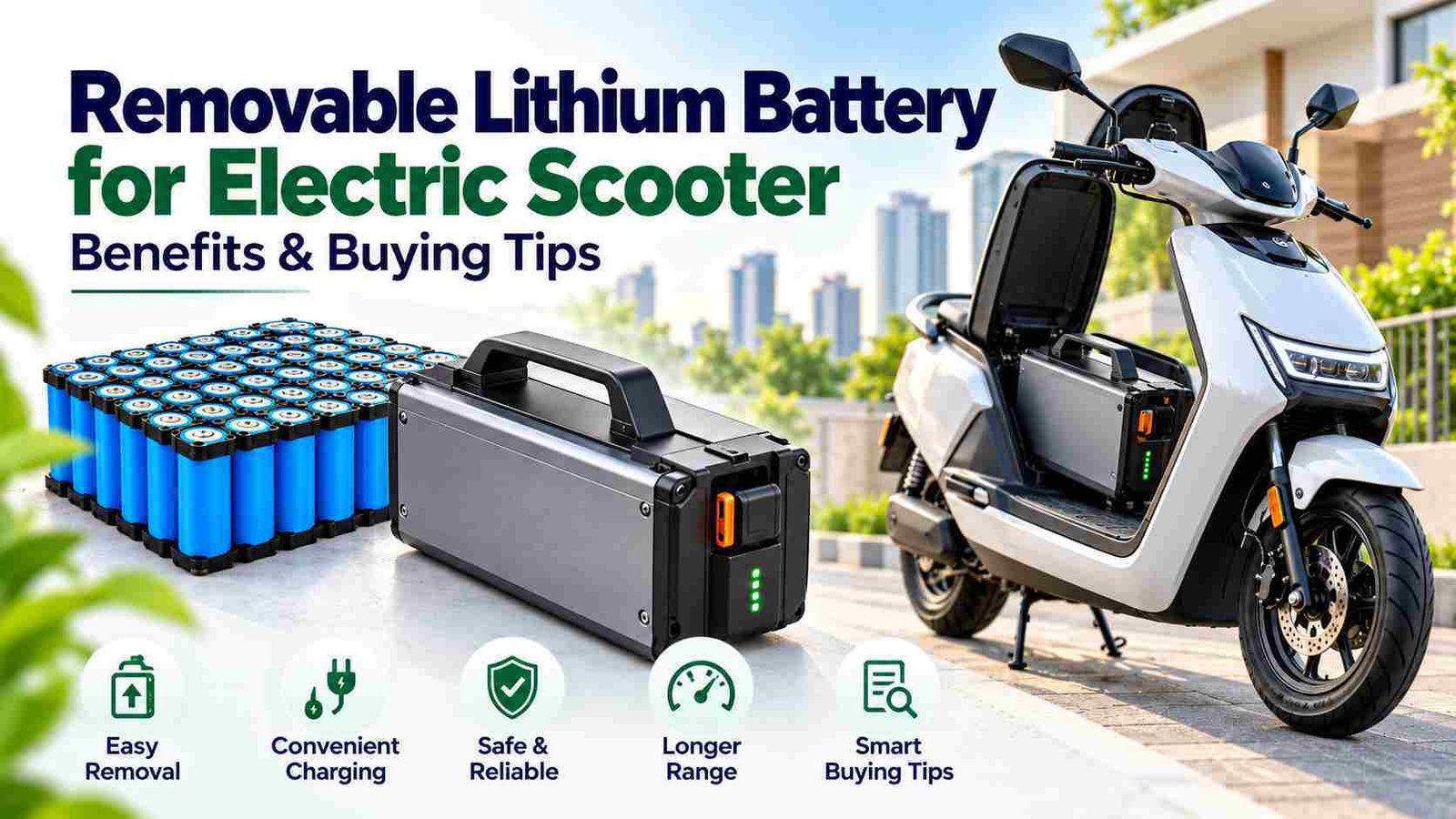
Looking for a convenient way to charge your electric scooter without having to park it next to a charging point? A removable lithium battery for an electric scooter could be exactly what you need.
Imagine living on the third floor of an apartment building, with your electric scooter parked downstairs. Instead of searching for a charging socket near your parking space, you could simply unlock the battery, carry it to a suitable charging area and recharge it using a compatible charger.
A detachable battery lets you recharge it at a suitable location without having to move your entire electric scooter.
But convenience isn’t the only reason to consider one. A well-designed portable lithium-ion battery for an electric scooter can also make battery replacement, maintenance and everyday charging more manageable.
However, not every removable EV battery is suitable for every electric scooter. Battery voltage, capacity, weight, connectors, Battery Management System (BMS) and charging compatibility all need attention before buying.
In this guide, we’ll explain how removable lithium-ion scooter batteries work, their advantages and limitations, and how to choose the right battery for your electric two-wheeler in India.
1. What is a removable lithium-ion battery for an electric scooter?
A removable lithium-ion battery is a rechargeable battery pack designed to be taken out of an electric scooter without dismantling major vehicle components.
Unlike a fixed battery that remains permanently installed inside the scooter, a removable battery generally uses a dedicated compartment, locking mechanism and detachable electrical connectors.
Once removed, the battery can be charged using a manufacturer-approved portable charger and charging arrangement.
A typical removable EV scooter battery contains several important components:
- Lithium-ion cells: Store the electrical energy needed to run the scooter.
- Battery Management System (BMS): Monitors battery operation and provides electrical protection.
- Battery enclosure: Protects the internal components from normal handling and environmental exposure.
- Power connectors: Connect the battery to the scooter’s electrical system.
- Charging interface: Allows connection to a compatible charger.
- Handle and locking mechanism: Help users carry and securely install the pack.
Some modern electric scooters also use communication connections between the battery, controller and dashboard.
This is why two lithium-ion batteries with identical voltage and capacity ratings aren’t necessarily interchangeable.
2. Removable vs fixed electric scooter battery: What’s the difference?
Before buying a new EV battery, it’s helpful to understand how these two designs compare.
| Feature | Removable battery | Fixed battery |
| Charging location | Can be charged separately where approved | Usually charged while installed |
| Battery removal | Designed for user removal | May require tools or professional assistance |
| Portability | Easier to transport if weight is manageable | Not intended for regular carrying |
| Replacement | May be straightforward with compatible packs | Often requires service assistance |
| Locking arrangement | Requires secure removable mounting | Usually secured within vehicle |
| Battery swapping | Possible with compatible designs | Generally not intended |
| Best suited for | Apartment residents, removable-battery scooters | Scooters with dedicated charging access |
A removable battery gives you more freedom to charge it wherever it’s convenient, while a built-in battery saves you the effort of lifting and carrying a heavy battery pack.
Which should you choose?
If your parking area lacks an accessible charging point, a scooter specifically designed with a detachable lithium-ion battery can be useful.
If you have convenient home charging and rarely need to move the battery, a fixed system may be equally practical.
Remember that a fixed-battery electric scooter cannot automatically be converted into a removable-battery model. The mounting, electrical connection, safety system and vehicle compatibility must support that modification.
3. Seven benefits of a removable lithium battery for electric scooters
1. Convenient charging away from the scooter
A detachable lithium-ion battery makes everyday scooter use more convenient by allowing you to remove and charge the battery wherever suitable charging facilities are available.
You don’t necessarily need to take your vehicle close to an electrical socket. Instead, the battery can be removed and connected to its approved charging equipment in a suitable location.
This is particularly useful for people who live in apartments or residential buildings where parking spaces and charging facilities are far apart.
However, the battery must be charged in a safe, ventilated location in accordance with the manufacturer’s instructions. Not every indoor space is appropriate for charging lithium-ion batteries.
2. Easier battery replacement
Every rechargeable EV battery gradually loses some of its original capacity as it ages.
When a removable battery reaches the end of its useful service life, replacing it may be easier than replacing a permanently installed battery pack.
For instance, if your scooter uses an approved removable 60V lithium battery, you may be able to replace the old pack with a compatible battery designed for the same vehicle.
The replacement must match more than just the voltage. Its physical dimensions, communication interface, connector, discharge capability and charging requirements must also be correct.
3. Flexibility for daily commuting
A removable electric scooter battery can be particularly convenient for people who use their scooters for regular city travel.
If your workplace provides an approved battery charging facility, you may be able to recharge your pack while the scooter remains parked elsewhere.
This can reduce dependence on parking-area charging infrastructure, provided carrying the battery is practical.
4. Possibility of carrying a compatible spare battery
Some electric scooters support interchangeable batteries.
For these vehicles, having an additional approved battery may allow riders to extend their usable travel distance without waiting for the first pack to recharge.
However, removable batteries are not automatically swappable batteries.
Battery swapping requires compatible electrical contacts, mounting, locking, battery specifications and, where applicable, communication or authentication systems.
Never connect a spare battery that hasn’t been approved for your scooter.
5. Easier access for maintenance and inspection
A detachable battery can be easier for a qualified technician to inspect or test.
Depending on the design, technicians may be able to check battery condition, diagnostic information and charging behaviour without bringing the entire vehicle into the workshop.
However, the battery enclosure should not be opened by an untrained user. Lithium-ion packs can contain hazardous voltages and substantial stored energy.
6. Lightweight options compared with lead-acid systems
Lithium-ion batteries generally offer higher energy density than conventional lead-acid batteries.
This means a lithium-ion EV battery can often store a similar amount of energy with considerably less weight.
For a removable scooter battery, lower weight is especially valuable because you may need to lift and carry the pack.
Still, a large lithium battery can be heavy. Always check the actual pack weight before purchasing.
7. More flexibility in choosing battery capacity
For scooters that support multiple manufacturer-approved battery options, riders may be able to choose a capacity suited to their usage.
Someone travelling shorter distances might prefer a lighter pack, while a commuter covering longer routes may benefit from more battery energy.
The key is finding a balance between range, weight, physical fit and compatibility.
4. Which removable lithium-ion battery voltage should you choose?
Electric scooter batteries are commonly described by voltage classes such as 48V, 60V and 72V.
These numbers matter because your scooter’s controller and charging system are designed to work within specific voltage limits.
48V removable lithium-ion battery
A removable 48V lithium-ion battery can be a good choice for low-power electric scooters and lightweight EVs that are specifically built to operate with a 48V battery system.
Common capacity configurations include 48V 20Ah and 48V 30Ah.
60V removable lithium battery
Many electric two-wheelers are designed to run on 60V lithium-ion batteries, making them a suitable choice for scooters that support this voltage range
Possible configurations include 60V 20Ah, 60V 30Ah, 60V 32Ah and 60V 40Ah.
A higher Ah capacity may provide longer riding range, but it will usually increase pack size, weight or both.
72V removable lithium-ion battery
A 72V-class lithium-ion battery is used in selected higher-voltage electric scooters and motorcycles.
Possible capacities include 72V 20Ah, 72V 30Ah and 72V 40Ah.
Not all 72V packs are practical as hand-carried batteries. Larger packs can be heavy and may require additional handling arrangements.
Battery voltage comparison
| Battery voltage class | Example capacities | Main consideration |
| 48V | 20Ah, 30Ah | Suitable only for compatible 48V-class scooters |
| 60V | 20Ah, 30Ah, 32Ah, 40Ah | Balance of energy capacity and physical size |
| 72V | 20Ah, 30Ah, 40Ah | Higher-voltage vehicle compatibility and pack weight |
The battery sizes mentioned above are common configurations, but not all of them are available in removable designs.
Keep in mind that the voltage printed on a battery may differ slightly from its actual nominal voltage, depending on the type of lithium-ion cells used and how they are connected inside the pack.
Important: Never replace a 60V battery with a 72V battery merely to increase speed or range. The scooter’s entire electrical system must be designed or approved for that voltage.
5. How much Ah capacity do you need in a removable EV scooter battery?
Battery capacity is an important factor when comparing portable lithium batteries for electric scooters.
Capacity is often stated in ampere-hours (Ah), while total battery energy is measured in watt-hours (Wh) or kilowatt-hours (kWh).
The basic formula is:
\[ \text{Battery Energy (Wh)}=\text{Voltage (V)}\times\text{Capacity (Ah)} \]
For example, a battery labelled 60V 30Ah has approximately 1,800Wh or 1.8kWh of energy when calculated using the simplified 60V rating.
Let’s compare a few configurations.
| Battery configuration | Approximate energy |
| 48V 20Ah | 960 Wh |
| 48V 30Ah | 1,440 Wh |
| 60V 20Ah | 1,200 Wh |
| 60V 30Ah | 1,800 Wh |
| 60V 40Ah | 2,400 Wh |
| 72V 30Ah | 2,160 Wh |
| 72V 40Ah | 2,880 Wh |
These figures use the advertised voltage classes.
For accurate battery energy details, always refer to the specifications provided in the manufacturer’s datasheet.
When comparing the prices of removable EV batteries, it’s better to look at how much energy each battery can store rather than relying only on Ah ratings, especially when the voltage differs.
6. NMC vs LFP: Which Battery Type Should You Choose for Your Removable Electric Scooter?
NMC (Nickel Manganese Cobalt) and LFP (Lithium Iron Phosphate) are two widely used types of lithium-ion batteries in electric vehicles.
Both are designed to store and supply rechargeable electrical energy, but they differ in weight, lifespan, safety characteristics and performance. Understanding these differences will help you choose the right battery for your electric scooter.
NMC lithium-ion battery
LFP lithium-ion battery
| Feature | NMC battery | LFP battery |
| Energy density | Generally higher | Generally lower |
| Weight for equal energy | Often lighter | Often heavier |
| Cycle life | Good | Generally longer |
| Thermal stability | Requires careful management | Generally more thermally stable |
| Pack dimensions | Can offer a compact design | May require more space |
| Key advantage | Portability and energy density | Cycle life and thermal stability |
For a removable battery that needs to be carried regularly, NMC’s higher energy density can be advantageous.
On the other hand, LFP batteries may be attractive when long cycle life is a priority and the scooter can accommodate the pack’s weight, size and voltage characteristics.
To ensure safe and reliable performance, both NMC and LFP batteries need a properly designed Battery Management System (BMS), a protective casing, and a charger that matches their specifications.
Buying recommendation: Rather than choosing NMC or LFP based only on the chemistry, first check what your scooter manufacturer supports.
7. Battery Management System (BMS): A feature you shouldn’t ignore
An electric scooter lithium-ion battery pack is more than a collection of cells.
One of its most important components is the Battery Management System, commonly called a BMS.
A Battery Management System (BMS) continuously checks the battery’s condition and helps keep it operating safely while your electric scooter is running.
The safety features available in a well-designed BMS may include:
- Overcharge protection
- Over-discharge protection
- Short-circuit protection
- Overcurrent protection
- Temperature monitoring and protection
- Cell voltage monitoring
- Cell balancing
Why BMS current rating matters
Suppose your scooter’s controller draws 35A during normal operation and requires a higher current briefly during acceleration.
The battery cells, BMS and connectors must all be capable of safely supporting those loads.
A battery fitted with an undersized BMS may repeatedly shut down under acceleration or climbing conditions.
The correct BMS rating should be selected according to the controller’s maximum battery current, peak current duration, cell specifications and thermal design—not motor wattage alone.
Smart BMS and communication compatibility
Some EV batteries use communication interfaces such as CAN or RS485 to exchange information with the scooter’s electronics.
Even if a battery fits perfectly and matches your scooter’s voltage and capacity requirements, it may not work unless it supports the communication system used by your vehicle.
Before purchasing a replacement removable scooter battery, check whether your vehicle requires a particular communication interface or battery authentication system.
8. How important are battery weight, dimensions and connectors?
These three specifications are easy to overlook while comparing lithium-ion batteries online.
These details play an important role in ensuring your replacement battery fits securely and performs as expected.
Battery Weight
Since you’ll be removing the battery for charging or storage, it should be easy enough to lift and carry.
Batteries with higher capacities generally contain more cells, which can increase their overall weight.
When choosing a removable lithium-ion battery for your electric scooter, check how much it weighs, whether it has a comfortable carrying handle, and how often you’ll need to take it out of the scooter.
Battery dimensions
Measure your existing battery compartment, including the available height, width and depth.
Check for extra clearance needed for handles, terminals, locking mechanisms and cable routing.
A battery that fits tightly into the compartment may still be unsuitable if it prevents proper connection or safe mounting.
Battery connectors
Electric scooters come with different types of connectors for supplying power from the battery to the motor and connecting the battery to its charger.
Examples include Anderson-style connectors, dedicated high-current connector systems and manufacturer-specific docking contacts.
Never assume that connectors with similar appearances have the same polarity, pin arrangement or current rating.
Confirm the exact connector specifications before purchasing a replacement.
9. How Much Time Does It Take to Fully Charge a Removable Lithium-Ion Electric Scooter Battery?
Charging time depends on the battery capacity, charger’s output current, battery condition and charging control.
A simplified calculation is:
ChargingTime(hours)BatteryCapacity(Ah)ChargerCurrent(A)
For example, a 30Ah removable lithium-ion battery connected to a suitable 5A charger has an ideal calculation of six hours.
In practice, charging usually takes longer because the charging current reduces near full charge and other losses are involved.
| Battery capacity | 5A charger | 10A charger |
| 20Ah | 4 hours | 2 hours |
| 30Ah | 6 hours | 3 hours |
| 40Ah | 8 hours | 4 hours |
Times shown are ideal full-capacity/current estimates, not guaranteed charging times.Before using a 10A charger, make sure the battery manufacturer has confirmed that the battery can safely handle a charging current of 10 amperes.
Important charging tip: The battery chemistry, series configuration, full-charge voltage, BMS, charger current and connector must all be compatible.
A charger intended for one lithium-ion chemistry or pack configuration should not be used on another without verification.
10. Is it safe to charge a removable lithium battery indoors?
With a detachable battery, you can charge it separately from your electric scooter, but proper handling and safety precautions are essential.
Lithium-ion batteries contain substantial energy, and incorrect charging, mechanical damage or manufacturing defects can create serious safety risks.
Follow these essential charging precautions:
- Charge only in a suitable, ventilated area approved by the manufacturer and building rules.
- Always charge your battery using a charger recommended or approved by its manufacturer.
- Choose a safe charging spot away from flammable objects and materials that could easily catch fire.
- Place the battery on a firm, stable, non-flammable surface instead of soft furniture like beds or sofas.
- If your battery becomes unusually hot, develops a bulge, starts leaking, or shows any visible damage, do not connect it to a charger.
- Make sure the battery and its electrical connectors are completely dry before connecting the charger.
- If the battery is too hot or cold, wait until it reaches the manufacturer’s recommended charging temperature.
- Keep your battery and charger in a cool, shaded location, away from direct sunlight and anything that generates excessive heat.
Lithium-ion batteries are particularly sensitive to inappropriate charging temperatures. High temperatures can accelerate degradation, while many conventional lithium-ion cells must not be charged below freezing unless specifically designed for it.
For Indian conditions, paying attention to heat during summer and moisture during monsoon season is especially important.
11. Electric scooter removable battery price in India: What affects the cost?
When searching online for a removable lithium-ion battery price for electric scooters, you’ll notice that prices vary considerably.
The main factors affecting price include:
| Price factor | Why it matters |
| Voltage | Influences pack configuration and electrical compatibility |
| Ah capacity | Higher energy usually needs more cells |
| Cell chemistry | NMC and LFP have different manufacturing characteristics |
| Cell quality | Authentic, tested cells are important for reliability |
| BMS | Current ratings, balancing and smart features influence cost |
| Enclosure | Durable, purpose-built removable casings add cost |
| Connectors | High-current and docking systems require suitable components |
| Warranty | Support, coverage and service arrangements affect value |
For example, a 60V 40Ah battery will generally cost more than a similarly constructed 60V 20Ah battery because it needs approximately twice the energy-storage capacity.
However, two battery packs with identical voltage and Ah ratings can still differ significantly in quality.
One may use genuine, tested cells and a suitably rated BMS, while another may use lower-grade components.
This is why choosing the cheapest lithium battery available online isn’t always the most economical decision.
Consider the overall value: battery specifications, usable energy, warranty terms, compatibility and expected service life.
12. Ten things to check before buying a removable EV scooter battery
Before ordering, use this checklist to compare suppliers and product specifications.
Battery Purchase Checklist
0/10 checked
My scooter is designed for a removable battery
Battery voltage and chemistry are compatible
Ah capacity meets my daily travel requirement
Battery dimensions fit the compartment
Pack weight is manageable
BMS and cell current ratings match the controller
Power and charging connectors are compatible
Any required CAN/RS485 communication is supported
The charger and charging arrangement are approved
Warranty, cell details and safety documentation are available
Copy checklist
Also ask the supplier whether the battery has been tested for its rated capacity and applicable safety requirements.
In India, EV traction battery safety requirements include standards such as AIS-156 for applicable vehicle categories. Check which requirements apply to the battery and vehicle, and request appropriate compliance documentation instead of relying on unverified claims.
13. How to increase the lifespan of a removable lithium-ion battery
A lithium-ion scooter battery gradually ages even when it isn’t used frequently.
The good news is that sensible charging and storage habits can help reduce avoidable battery degradation.
Here are some useful practices.
Avoid excessive heat. Keep the pack away from prolonged direct sunlight and hot enclosed spaces.
Use the right charger. Incorrect charging voltage or current can damage the cells or trigger BMS protection.
Avoid storing your battery with no charge remaining, as leaving it empty for too long can affect its health and performance. Very low battery voltage during storage can cause irreversible cell damage.
When you’re not using your electric scooter for a while, keep the battery partially charged rather than completely full or empty. Many lithium-ion batteries benefit from partial-charge storage, often around 40–60%, subject to manufacturer guidance.
Handle the pack carefully. Repeated impacts, dropping the battery or damaging its connector can create electrical and mechanical problems.
Inspect the terminals. Look for visible corrosion, deformation or damage. Have a qualified technician address any issue.
Follow the service instructions. Don’t bypass the BMS, modify connector wiring or open a sealed pack.
Research on lithium-ion batteries shows that elevated temperature, prolonged storage at high charge levels and deep cycling can contribute to battery ageing.
14. Where to buy lithium-ion batteries for electric scooters in India?
Finding the right electric scooter battery involves more than searching for a particular voltage and capacity.
A good battery supplier should help you evaluate the specifications before purchasing.
At PowerKart.in, customers can explore lithium-ion battery solutions for electric scooters and other EV applications.
Our electric scooter battery category includes selected NMC lithium-ion battery configurations, such as 60V 32Ah, 60V 40Ah, 72V 30Ah and 72V 40Ah.
When searching for a replacement electric scooter battery, compare the available specifications with your existing vehicle’s requirements.
For removable-battery applications, be sure to confirm that the battery model and enclosure are specifically designed for safe, repeated removal and installation.
A standard enclosed EV battery pack should not be assumed to be removable simply because it has detachable wires.
Explore Lithium-Ion Batteries for Electric Scooters
Looking for a reliable lithium-ion battery for your electric two-wheeler? Compare battery configurations and check compatibility before placing your order.
View Electric Scooter Batteries Confirm removable design, availability and vehicle compatibility with the supplier before buying.
15. Frequently asked questions about removable electric scooter batteries
Q1. Can I remove the lithium-ion battery from any electric scooter?
No. Only scooters designed with user-removable battery packs should have their batteries removed routinely. Fixed battery systems may require professional servicing.
Q2. Is a removable lithium battery better than a fixed EV battery?
A removable battery is more convenient when you lack charging access near your parking area.
A fixed battery can be a convenient option when your scooter is parked close to a readily accessible charging socket.
A built-in battery is also a practical choice if you have easy access to a charging point near your scooter’s parking space.
Q3. Is It Safe to Charge a Removable Electric Scooter Battery at Home?
You can recharge a removable scooter battery at home, provided the manufacturer allows indoor charging and you have a properly ventilated, fire-safe space with suitable charging equipment.
Use approved equipment, follow building rules and avoid charging near flammable materials or exit routes.
Q4. Does a removable electric scooter battery give more mileage?
Not automatically. Riding range depends mainly on usable battery energy, scooter efficiency, riding conditions and battery health, rather than whether the battery is removable.
Q5. Which is better for a removable battery, NMC or LFP?
NMC can offer lower weight for the same stored energy, while LFP often provides longer cycle life and better thermal stability. The best choice depends on scooter compatibility and design requirements.
Q6. Can I upgrade a removable 60V 20Ah battery to a 60V 40Ah battery?
Possibly, if your scooter supports the higher capacity and the replacement matches its voltage range, current requirements, mounting, connectors, charging system and communication protocol.
Q7. How long does a removable lithium-ion battery last?
Battery life depends on cell quality, chemistry, temperature, depth of discharge and charging practices. A quality pack can provide years of service, but no fixed lifespan applies to every battery.
Q8. Can I carry a spare lithium battery for my electric scooter?
Only if the scooter supports the spare pack and the battery can be safely transported and stored. The additional weight, secure packaging and connector protection must be considered.
Q9. Are removable electric scooter batteries waterproof?
Not necessarily. Their water and dust resistance depends on the enclosure, seals, connectors and certified ingress protection rating, if any. Removable does not mean waterproof.
Q10. Where can I find an electric scooter lithium-ion battery in India?
You can explore different EV battery configurations at PowerKart.in. Confirm the battery’s specifications and removable design before placing an order.
Final Thoughts: Should You Choose a Removable Lithium-Ion Battery for Your Electric Scooter?
For many electric scooter owners in India, a removable lithium-ion battery can make everyday charging more convenient.
It can be especially useful if you live in an apartment, park your scooter away from a charging socket or use a scooter designed for quick battery replacement.
But portability alone shouldn’t determine your purchase.
The best removable electric scooter battery should offer an appropriate balance of energy capacity, weight, battery chemistry, safety features and compatibility with your vehicle.
Before buying, remember these three essential points:
- Choose the correct specifications. Match battery voltage, current rating, chemistry and communication requirements with your scooter.
- Prioritise safe construction. Look for quality cells, a suitably rated BMS, strong connectors and a secure enclosure.
- Buy for your actual usage. Select sufficient battery energy for your daily travel while considering pack weight and ease of handling.
If you’re looking for a lithium-ion battery for an electric scooter in India, explore the available battery configurations at PowerKart.in and make your choice based on your scooter’s technical requirements.