
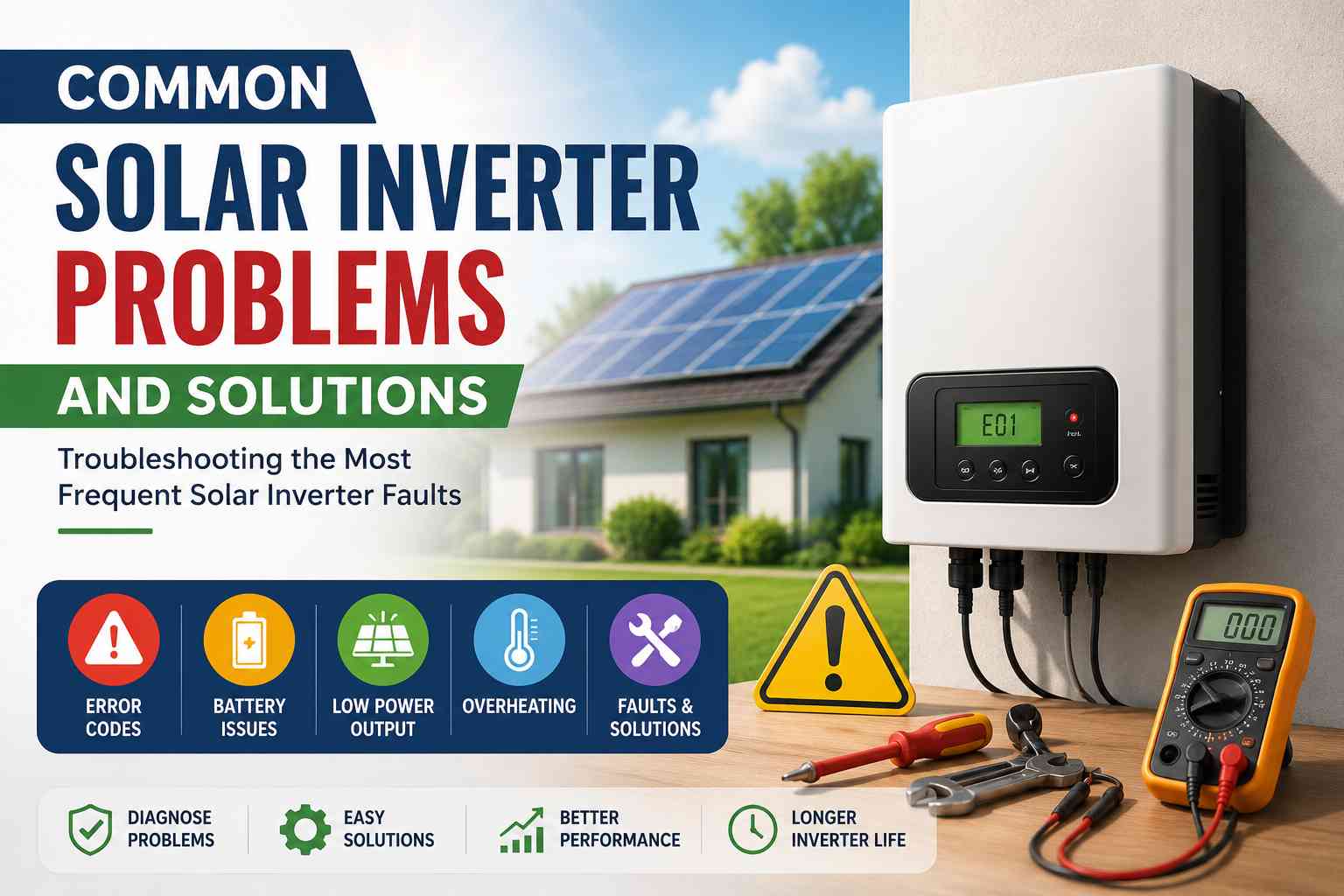
Causes, Symptoms, and Solutions for Inverter Faults
A solar inverter is often called the brain of a solar power system. While solar panels generate electricity, the inverter controls how that energy is converted, managed, stored, and delivered to household appliances.
Whether you use a standard grid-connected system or a hybrid solar inverter for home applications, inverter performance directly affects energy production, battery charging, backup capability, and electricity savings.
Most homeowners expect their solar system to operate flawlessly for years. However, like any electronic equipment, solar inverters can occasionally develop faults. Some problems are minor and easy to fix, while others require professional attention.
The good news is that many inverter issues show warning signs before they become serious failures.
This guide explains the most common solar inverter problems, their causes, and practical solutions to help homeowners keep their systems operating efficiently.
Why Solar Inverters Experience Problems
Solar power inverters operate continuously in demanding conditions.
Unlike many household appliances, they must manage:
- Variable solar generation
- Grid voltage fluctuations
- Battery charging cycles
- High ambient temperatures
- Dust and humidity exposure
- Continuous electrical switching
Over time, these factors can affect performance and trigger warnings, alarms, or shutdowns.
Understanding common faults allows homeowners to identify issues early and reduce downtime.
Problem 1: Solar Inverter Is Not Turning On
One of the most alarming situations occurs when the inverter display remains blank and the system appears completely inactive.
Imagine a homeowner who recently installed a 5kW solar inverter for home use. After months of normal operation, the display suddenly stops responding despite bright sunlight.
Possible Causes
- AC breaker is off
- DC isolator is disconnected
- Internal fuse failure
- Loose wiring
- Faulty power supply section
Recommended Solution
Before calling a technician:
- Verify AC and DC isolators
- Inspect visible wiring
- Check circuit breakers
- Look for inverter error indicators
If no obvious issue is visible, professional diagnosis may be required.
Problem 2: Solar Production Drops Unexpectedly
Many homeowners notice lower generation even during sunny weather.
Possible Causes
- Dust-covered solar panels
- New shading from nearby trees
- Faulty panel strings
- Loose MC4 connectors
- MPPT tracking issues
Example
A homeowner notices that daily energy production has fallen by nearly 30%.
After inspection, they discover that a growing tree branch is shading part of the array during peak sunlight hours.
Recommended Solution
- Clean panels regularly
- Inspect for shading
- Verify string voltages
- Check inverter monitoring data
Small generation losses can become significant over time.
Problem 3: Frequent Grid Fault Errors
Grid-related alarms are among the most common service calls.
Typical messages include:
- Grid Over Voltage
- Grid Under Voltage
- Frequency Error
- Grid Failure
Why It Happens
Both hybrid and normal solar inverters continuously monitor utility conditions.
If voltage or frequency moves outside approved limits, the inverter disconnects itself to maintain safety and regulatory compliance.
Recommended Solution
- Measure incoming utility voltage
- Review inverter event logs
- Install surge protection devices
- Contact your utility provider if fluctuations are excessive
Problem 4: Battery Not Charging Properly
This issue mainly affects homeowners using a solar power inverter for home with battery storage.
Common Causes
- Incorrect charging settings
- Battery aging
- Communication failures
- BMS configuration issues
- Insufficient solar generation
Example
A family installs a hybrid solar inverter for home backup expecting reliable nighttime operation.
After several weeks, they discover the battery never reaches full charge.
The cause turns out to be incorrect battery charging parameters.
Recommended Solution
- Verify charging voltages
- Check battery communication settings
- Review BMS alarms
- Confirm adequate solar generation
Problem 5: Backup Power Lasts Much Less Than Expected
Many homeowners install a solar inverter for home backup specifically for power outages.
Over time, they may notice backup duration decreasing.
Causes
Battery degradation
- Increased household loads
- Improper charging
- Excessive discharge cycles
Recommended Solution
- Conduct battery health testing
- Reduce unnecessary backup loads
- Upgrade battery capacity if required
Problem 6: Solar Inverter Overheating
Heat is one of the leading causes of inverter stress.
Warning Signs
- Cooling fan continuously running
- Thermal alarms
- Automatic shutdowns
- Reduced efficiency
Why It Happens
Many inverters are installed:
- In direct sunlight
- Inside poorly ventilated rooms
- Near other heat-generating equipment
Recommended Solution
- Improve airflow
- Relocate the inverter if necessary
- Clean ventilation openings
- Maintain adequate clearance around the unit
Problem 7: Communication and Monitoring Failures
Modern solar systems increasingly rely on mobile apps and cloud monitoring.
When monitoring stops working, homeowners often assume the inverter has failed.
In reality, the issue is usually communication-related.
Common Causes
- Router changes
- Wi-Fi signal issues
- Firmware problems
- Communication module failure
Recommended Solution
- Restart communication modules
- Reconnect network settings
- Update firmware
- Verify internet connectivity
Problem 8: Isolation Faults and Leakage Errors
Isolation faults are especially common during monsoon seasons.
Causes
- Damaged insulation
- Water ingress
- Moisture inside junction boxes
- Aging cables
Example
A homeowner notices that their inverter shuts down only during rainy weather.
Inspection reveals moisture entering a rooftop junction box.
Recommended Solution
- Inspect connectors
- Replace damaged cables
- Improve waterproofing
- Test insulation resistance
Problem 9: Unexpectedly High Electricity Bills
Many homeowners invest in what they believe is the best solar inverter for home use but still receive large electricity bills.
Possible Causes
- Increased consumption
- Low solar generation
- Incorrect net metering setup
- Inverter configuration issues
Recommended Solution
Review:
- Daily generation reports
- Utility bills
- Net metering records
- Inverter operating modes
Sometimes the problem is not the inverter itself but the overall system configuration.
Many inverter issues can be avoided by selecting the correct system size and technology during solar panel installation. Factors such as capacity, efficiency, and battery compatibility play a major role, making it important to understand how to choose the best solar power inverter for home use in India before investing in a solar energy system.
Hybrid vs Normal Solar Inverter: Which Requires More Maintenance?
Many homeowners researching hybrid vs normal solar inverter systems ask whether hybrid technology requires more maintenance.
The answer is generally yes—but only slightly.
Normal Solar Inverters
Advantages:
- Fewer components
- Simpler architecture
- Lower maintenance requirements
Hybrid Solar Inverters
Hybrid Solar Inverters are designed to seamlessly manage electricity generated by solar panels while integrating battery backup and grid power within a single system.
Advantages:
- Battery storage
- Backup power capability
- Advanced energy management
Because hybrid systems include batteries, communication systems, and charging circuits, they introduce additional points of maintenance.
However, modern hybrid inverters remain highly reliable when installed correctly.
Common Problems in 2BHK and 3BHK Homes
Whether you have a solar inverter for a 2BHK home or a solar inverter for a 3BHK home, the most common solar inverter problems and troubleshooting requirements are generally the same.
The difference lies mainly in:
- Number of connected appliances
- Battery capacity
- Daily energy consumption
Larger homes often place greater demand on backup systems and batteries.
Preventive Maintenance Checklist
Homeowners can prevent many inverter problems through simple maintenance practices.
✔ Keep solar panels clean
✔ Monitor daily energy generation
✔ Check batteries periodically
✔ Inspect wiring annually
✔ Maintain proper ventilation
✔ Install surge protection devices
✔ Address warning messages immediately
Final Thoughts
Solar inverters are designed to operate reliably for many years, but occasional issues are inevitable.
Whether you own a standard inverter, a hybrid solar inverter for home applications, or a solar inverter for home backup, understanding common faults can help prevent expensive repairs and unexpected downtime.
By recognizing warning signs early, performing routine maintenance, and responding quickly to alerts, homeowners can maximize the performance, reliability, and lifespan of their solar power systems.
While routine maintenance helps prevent most inverter-related issues, selecting high-quality solar energy solutions, dependable hybrid solar inverters, and advanced lithium-ion battery systems plays an equally important role in ensuring years of trouble-free operation.