

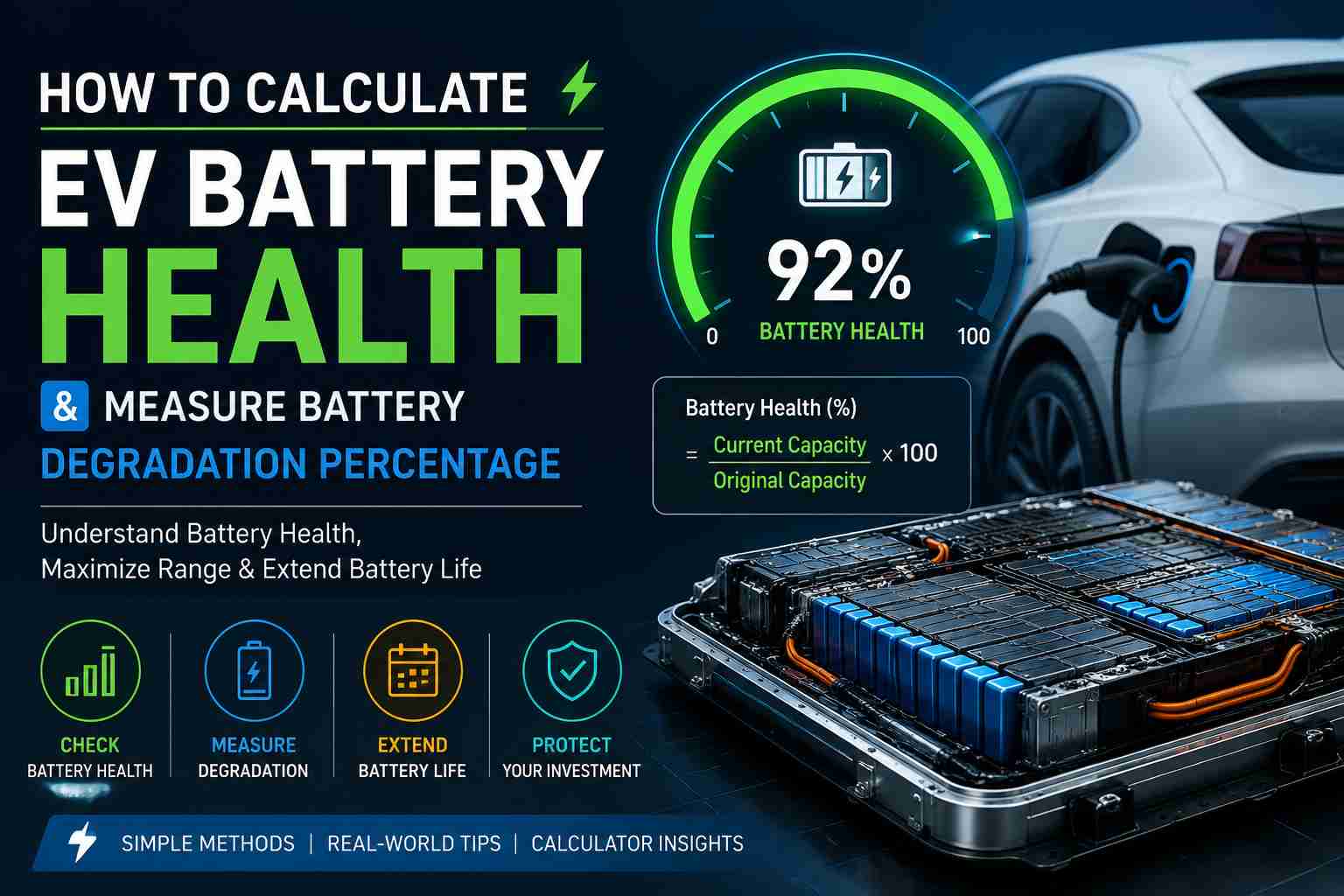
Electric vehicles are built around one critical component: the lithium ion battery. While motors, software, and charging systems play important roles, the battery ultimately determines how far an EV can travel, how efficiently it performs, and how much value it retains over time.
As electric vehicles become more common on roads around the world, battery health has become a growing concern for both new and experienced EV owners. Whether you are planning to buy a used electric vehicle, evaluating the condition of your current battery, or simply trying to understand how batteries age, knowing how to calculate EV battery health can provide valuable insights.
Many drivers assume that battery condition can only be assessed by a dealership or specialized service center. In reality, there are several ways to estimate battery health and measure battery degradation using available vehicle data and performance indicators.
If you’re looking for a quick way to evaluate your battery’s condition, you can use our Battery Health Calculator to estimate battery health based on factors such as battery age, usage patterns, charging habits, and performance indicators. It provides a convenient starting point for understanding how your battery may be aging over time.
Understanding these calculations can help you identify potential problems early, monitor battery aging, and make informed decisions about maintenance and long-term ownership.
In this guide, you will learn what EV battery health means, how battery degradation is measured, the factors that influence battery performance, and the different methods used to calculate battery health percentages.
Table of Contents
- What Is EV Battery Health?
- Why Battery Health Matters
- What Is Battery Degradation?
- How Battery Degradation Happens
- How to Calculate EV Battery Health
- How to Measure Battery Degradation Percentage
- How to Check EV Battery Health Without Specialized Equipment
- Understanding State of Health (SOH)
- What Is Considered Normal Battery Degradation?
- Signs Your EV Battery May Be Losing Capacity
- Factors That Affect EV Battery Health
- How to Reduce Battery Degradation
- Common Myths About EV Battery Health
- Frequently Asked Questions
- Final Thoughts
What Is EV Battery Health?
Battery health refers to the overall condition of an electric vehicle’s battery compared to when it was new.
Every EV battery is designed with a specific energy storage capacity. As the battery ages, its ability to store and deliver energy gradually declines. This reduction is a natural process that occurs in all lithium-ion batteries, regardless of vehicle brand or battery size.
Battery health is typically expressed as a percentage. A brand-new battery starts at 100% health. As the battery experiences charging cycles, temperature fluctuations, and normal usage, that percentage slowly decreases.
For example:
- 100% Battery Health = Original battery condition
- 95% Battery Health = Minor capacity loss
- 90% Battery Health = Moderate degradation
- 80% Battery Health = Noticeable reduction in available range
- Below 70% Battery Health = Significant performance decline
The higher the battery health percentage, the closer the battery remains to its original performance capabilities.
Why Battery Health Matters More Than Most EV Owners Realize
Many EV buyers pay close attention to a vehicle’s model year, mileage, and features, yet the condition of the battery often has a greater impact on the ownership experience than any of those factors.
Consider two electric vehicles that left the factory at the same time. One was primarily charged at home, operated in moderate weather conditions, and maintained with balanced charging habits. The other spent years in extreme heat, relied heavily on fast charging, and was frequently driven with very little charge remaining.
Although both vehicles may appear similar on paper, their batteries could be in very different conditions. The well-maintained battery may still retain most of its original capacity, while the other could show significantly higher levels of degradation.
This difference directly affects how the vehicle performs in everyday situations. A battery that has lost a noticeable portion of its original capacity may require more frequent charging and offer less flexibility for longer journeys.
A healthy battery contributes to:
- Consistent vehicle performance
- Better charging efficiency
- More predictable driving range
- Higher resale value
- Longer battery lifespan
As battery health declines, owners may begin noticing shorter driving ranges, changes in charging behavior, and reduced overall efficiency. For anyone buying, selling, or owning an electric vehicle, understanding battery health provides a much clearer picture of long-term performance than age or mileage alone.
What Is Battery Degradation?
Battery degradation refers to the gradual loss of energy storage capacity that occurs as a battery ages.
Unlike a mechanical failure, degradation happens slowly. The battery continues to function, but it can no longer hold as much energy as it did when it was new.
Imagine a water tank that originally held 100 liters. Over time, the tank develops internal limitations and can now store only 90 liters. The tank still works, but its storage capacity has decreased.
The same principle applies to EV batteries.
If a battery originally offered 60 kWh of usable capacity and now stores only 54 kWh, the battery has experienced degradation.
This reduction directly affects driving range because less stored energy means fewer miles or kilometers available between charging sessions.
How Battery Degradation Happens
Battery aging is influenced by a combination of time, usage patterns, and environmental conditions.
Several factors contribute to capacity loss, including:
Charging Habits
Repeated exposure to extreme charging conditions can accelerate battery wear. Frequently charging to maximum capacity or allowing the battery to remain at very low charge levels may increase stress on battery cells.
Temperature Exposure
Heat is one of the most significant contributors to battery aging. Batteries exposed to prolonged high temperatures often lose capacity faster than those operating within moderate temperature ranges.
Charging Cycles
Every time a battery is charged and discharged, it completes part of a charging cycle. Over thousands of cycles, gradual capacity loss becomes unavoidable.
Vehicle Age
Even when an EV is driven infrequently, battery chemistry continues to age over time. This process, known as calendar aging, contributes to long-term degradation.
To learn more, read our detailed guide on EV charging mistakes that can shorten battery life.
How to Calculate EV Battery Health
The most common method for calculating battery health involves comparing the battery’s current usable capacity with its original capacity when new.
Battery Health Formula
Battery Health (%) = (Current Battery Capacity ÷ Original Battery Capacity) × 100
Let’s look at a simple example.
Suppose an EV originally came with a 75 kWh battery.
After several years of use, diagnostic data shows that the battery can now store 68 kWh.
The calculation would be:
Battery Health = (68 ÷ 75) × 100
Battery Health = 90.67%
This means the battery has retained approximately 91% of its original capacity.
A result above 90% is generally considered excellent for most electric vehicles.
How to Measure Battery Degradation Percentage
Battery degradation percentage is essentially the opposite of battery health.
Instead of measuring how much capacity remains, degradation measures how much capacity has been lost.
Battery Degradation Formula
Battery Degradation (%) = 100 − Battery Health (%)
Using the previous example:
Battery Health = 90.67%
Battery Degradation = 100 − 90.67
Battery Degradation = 9.33%
This indicates that the battery has lost approximately 9% of its original storage capacity.
Understanding degradation percentage can help owners evaluate how quickly their battery is aging compared to expected industry averages.
How to Check EV Battery Health Without Specialized Equipment
One of the biggest misconceptions surrounding electric vehicles is that battery health can only be measured using professional diagnostic tools. While advanced testing provides the most accurate results, everyday drivers can still identify valuable clues about battery condition without visiting a service center.
In many cases, your vehicle’s behavior can reveal whether the battery is performing as expected or beginning to show signs of aging.
Compare Current Range With Original Range
A practical way to estimate battery health is by comparing your vehicle’s current driving range with the range it delivered when it was new.
For example, suppose your EV originally offered:
- 400 km of range when new
And now delivers:
- 360 km under similar driving conditions
The estimated battery health would be:
Battery Health = (360 ÷ 400) × 100
Battery Health = 90%
This approach is not perfectly accurate because driving style, weather conditions, tire pressure, and terrain also influence range. However, it provides a useful starting point for understanding battery condition.
Monitor Charging Performance
Changes in charging behavior may also indicate battery aging.
If your EV suddenly takes longer to charge than it did previously under similar conditions, it could be a sign that the battery is becoming less efficient.
Watch for:
- Noticeably slower charging speeds
- Increased charging times
- Reduced energy acceptance near higher charge levels
These changes do not automatically mean the battery is failing, but they can suggest ongoing degradation.
Observe Daily Energy Consumption
Many modern EVs display detailed energy usage statistics.
If you notice that energy consumption remains relatively stable but driving range continues to decline, battery degradation may be contributing to the reduced range.
Tracking these trends over time can help identify gradual capacity loss before it becomes significant.
Understanding State of Health (SOH)
When discussing EV battery condition, you will often encounter the term State of Health, commonly abbreviated as SOH.
State of Health represents the battery’s current condition relative to its original factory specifications.
Think of SOH as a report card for your battery.
A battery with:
- 100% SOH is essentially new
- 95% SOH has experienced minor aging
- 90% SOH remains in excellent condition
- 80% SOH shows moderate degradation
- Below 70% SOH may require closer monitoring
Many EV manufacturers use SOH as the primary metric for evaluating battery condition because it provides a clear picture of how much capacity remains.
In simple terms:
Battery Health Percentage and State of Health often refer to the same concept.
What Is Considered Normal Battery Degradation?
Many EV owners become concerned as soon as they notice any reduction in battery performance. However, some degree of degradation is completely normal.
In fact, every lithium-ion battery loses a portion of its capacity as it ages.
The important question is not whether degradation occurs, but how quickly it occurs.
Typical Battery Degradation Expectations
Although results vary depending on usage patterns and climate conditions, many electric vehicles retain:
- Around 95–98% battery health after the first year
- Approximately 90–95% after several years of moderate use
- More than 80% after many years of regular driving
Modern EV batteries are designed to remain functional long after noticeable degradation begins.
A battery with 85% health can still provide reliable daily transportation for many drivers.
Many EV owners assume that any noticeable battery degradation means a replacement is immediately necessary. However, depending on the type and extent of the issue, some battery problems can be diagnosed and repaired before a full replacement becomes the only option. Understanding the difference between normal battery aging and repairable battery faults can help reduce unnecessary costs.
Why Degradation Rates Differ
No two EV batteries age at exactly the same pace.
Battery health can be influenced by:
- Local climate
- Charging habits
- Fast charging frequency
- Annual mileage
- Storage conditions
- Battery chemistry
This explains why two identical vehicles of the same age may show different battery health percentages.
Signs Your EV Battery May Be Losing Capacity
Battery degradation usually develops gradually rather than suddenly.
As capacity declines, drivers may begin noticing subtle changes in vehicle behavior.
Reduced Driving Range
The most obvious symptom is a shorter driving range between charging sessions.
If your driving habits remain consistent but your vehicle travels noticeably fewer kilometers on a full charge, battery degradation could be a contributing factor.
More Frequent Charging
As available capacity decreases, drivers often find themselves charging more frequently to maintain their normal routines.
Slower Fast Charging Performance
Aging batteries may become less effective at accepting rapid charging, particularly during higher charge levels.
Greater Sensitivity to Temperature
Degraded batteries can sometimes show more pronounced performance fluctuations during extremely hot or cold weather.
Recognizing these signs early can help owners monitor battery health more effectively and make informed maintenance decisions.
In some cases, declining battery health may indicate that the battery is approaching the end of its useful life. If you’re noticing significant range loss, slower charging performance, or frequent charging requirements, it may be worth reviewing the common signs that a battery needs replacement before performance declines further.
Why Battery Health Is Important When Buying a Used EV
For buyers considering a pre-owned electric vehicle, battery health is often more important than mileage alone.
A vehicle with low mileage but poor battery health may ultimately provide less value than a higher-mileage vehicle with a well-maintained battery.
Before purchasing a used EV, it is wise to review:
- Battery health percentage
- State of Health reports
- Charging history
- Warranty coverage
- Vehicle age
Understanding battery condition can help buyers avoid unexpected expenses and make more confident purchasing decisions.
How an EV Battery Health Calculator Can Help
While manual calculations are useful, they do not always provide the complete picture.
Battery performance is influenced by multiple factors, including:
- Battery age
- Usage patterns
- Charging habits
- Environmental conditions
- Performance changes over time
Analyzing these variables manually can quickly become complicated.
This is where a Battery Health Calculator becomes valuable.
Instead of performing multiple calculations yourself, a calculator can provide a faster estimate of battery condition by evaluating relevant battery data and performance indicators.
Whether you want to monitor battery aging, estimate remaining battery life, or identify early signs of degradation, a battery health calculator can simplify the process and provide a clearer understanding of your battery’s overall condition.
Factors That Affect EV Battery Health
Not all EV batteries age at the same rate. Two vehicles of the same model and age can have noticeably different battery health scores depending on how they are used and maintained.
While some battery degradation is unavoidable, certain factors can either slow down or accelerate the aging process. Understanding these influences can help EV owners make smarter decisions that preserve battery performance over the long term.
Charging Habits
The way an EV is charged plays a significant role in determining how quickly the battery loses capacity.
Frequent exposure to charging extremes can place additional stress on battery cells. For example, regularly charging to maximum capacity or repeatedly allowing the battery to drop to critically low levels may contribute to faster battery wear.
Developing balanced charging habits can help reduce unnecessary strain and support healthier battery aging.
Fast Charging Frequency
Fast chargers provide convenience, especially during long-distance travel. However, relying on rapid charging for every charging session may increase thermal stress within the battery pack.
Modern EVs are designed to handle fast charging safely, but using slower charging methods whenever practical can help promote long-term battery health.
Think of fast charging as a useful convenience rather than a daily necessity.
Temperature Exposure
Environmental conditions have a direct impact on battery performance and longevity.
Excessive heat can accelerate battery aging, while extremely cold temperatures can temporarily reduce efficiency and charging performance.
Although battery management systems help regulate temperatures, vehicles that spend extended periods in harsh climates may experience different degradation rates than those operating in moderate conditions.
Annual Mileage
The more a vehicle is driven, the more charging and discharging cycles the battery experiences.
Higher mileage generally results in greater battery usage, which can contribute to gradual capacity loss over time.
However, high mileage alone does not automatically indicate poor battery health. Proper charging habits often play a much larger role than total distance traveled.
Vehicle Storage Conditions
Long periods of inactivity can also influence battery condition.
An EV that remains parked for weeks or months without proper battery management may experience additional stress, especially if the battery is left at extremely high or low charge levels.
Maintaining a balanced charge level during storage helps create more favorable conditions for long-term battery preservation.
Battery Chemistry
Not all EV batteries are built using identical technology.
Different battery chemistries can respond differently to charging patterns, temperatures, and aging.
Some battery types are optimized for energy density, while others prioritize longevity and cycle life. As a result, degradation rates may vary between vehicles even when usage patterns appear similar.
Battery quality can also influence long-term performance and degradation rates. While charging habits and environmental conditions play important roles, the battery manufacturer itself can affect reliability, cycle life, and capacity retention. Choosing a high-quality lithium battery from a trusted brand may help improve long-term performance and durability.
How to Reduce Battery Degradation and Extend Battery Life
Although battery aging cannot be stopped completely, there are several practical steps EV owners can take to slow the process and maintain stronger battery performance.
The goal is not perfection. Instead, focus on building habits that reduce unnecessary stress on the battery throughout its life.
Avoid Unnecessary Full Charges
Charging to 100% is sometimes necessary before long trips, but most daily driving routines do not require a fully charged battery.
Keeping the battery within a moderate charge range for routine use can help reduce long-term wear.
Limit Deep Discharges
Just as keeping the battery full all the time can increase stress, frequently driving until the battery is nearly empty can also contribute to degradation.
Maintaining a healthy buffer helps support more stable battery operation.
Minimize Heat Exposure
Whenever possible:
- Park in shaded areas
- Use covered parking facilities
- Charge during cooler periods of the day
- Avoid prolonged exposure to extreme temperatures
Managing heat effectively can make a meaningful difference over the life of the battery.
Use Fast Charging Strategically
Rapid charging is an excellent solution for road trips and time-sensitive situations.
For everyday charging needs, however, slower charging methods often provide a more battery-friendly approach.
Keep Software Updated
Manufacturers regularly improve battery management through software updates.
Installing updates ensures that the vehicle benefits from the latest improvements related to charging efficiency, temperature management, and battery protection.
Monitor Battery Performance Regularly
Tracking battery health periodically allows owners to identify unusual changes before they become significant problems.
Monitoring trends over time is often more valuable than focusing on a single battery health reading.
Common Myths About EV Battery Health
As electric vehicles become more popular, misinformation about battery degradation continues to circulate online.
Let’s separate fact from fiction.
Myth #1: EV Batteries Fail After a Few Years
Reality:
Most modern EV batteries are designed to last for many years and can continue operating effectively even after experiencing some capacity loss.
A moderate reduction in battery health does not mean the battery is approaching failure.
Myth #2: Fast Charging Instantly Damages Batteries
Reality:
Occasional fast charging is a normal part of EV ownership.
Problems are more likely to arise from excessive dependence on rapid charging over long periods rather than occasional use.
Myth #3: Any Battery Degradation Means Something Is Wrong
Reality:
Battery degradation is a normal part of battery aging.
The important factor is the rate of degradation rather than the simple fact that degradation exists.
Myth #4: A Battery With 80% Health Is No Longer Usable
Reality:
Many EVs continue providing reliable daily transportation even after reaching 80% battery health.
While driving range may decrease, the vehicle often remains highly practical for everyday use.
Myth #5: Mileage Is the Only Thing That Matters
Reality:
Battery condition depends on many factors, including charging behavior, climate, storage conditions, and overall battery care.
Two vehicles with identical mileage can have very different battery health scores.
What Is a Good EV Battery Health Percentage?
One of the most common questions among EV owners is whether their battery health score is considered good or bad.
While exact expectations vary by manufacturer and vehicle age, the following guidelines can provide a useful benchmark:
| Battery Health | Condition |
| 95% – 100% | Excellent |
| 90% – 94% | Very Good |
| 80% – 89% | Good |
| 70% – 79% | Moderate Degradation |
| Below 70% | Significant Capacity Loss |
It’s important to evaluate battery health in context.
For example:
- A three-year-old EV with 92% battery health is generally performing very well.
- A ten-year-old EV with 80% battery health may still offer practical daily usability.
Battery age, usage patterns, and vehicle requirements should always be considered alongside the percentage itself.
Section 4
Frequently Asked Questions About EV Battery Health
How often should I check my EV battery health?
For most EV owners, checking battery health every few months is sufficient. However, if you notice a sudden reduction in driving range, slower charging performance, or unusual battery behavior, it may be worth evaluating battery health sooner.
Regular monitoring helps identify trends over time and provides a clearer picture of how the battery is aging.
What is considered a healthy battery for an electric vehicle?
A battery health score above 90% is generally considered excellent for most electric vehicles.
Even batteries in the 80% to 90% range are often capable of delivering reliable daily performance. The significance of a battery health percentage depends on the vehicle’s age, mileage, and usage history.
Does battery degradation reduce driving range?
Yes.
As battery capacity decreases, the amount of energy the battery can store also decreases. Since driving range depends on stored energy, degradation typically results in fewer miles or kilometers available between charging sessions.
The extent of range reduction depends on the level of degradation and the vehicle’s original battery capacity.
Can battery degradation be reversed?
In most cases, battery degradation is permanent.
While certain maintenance practices can help optimize battery performance, lost battery capacity cannot usually be restored to its original level.
The best strategy is to adopt battery-friendly habits that slow degradation before significant capacity loss occurs.
Does fast charging always damage EV batteries?
Not necessarily.
Modern electric vehicles are engineered to support rapid charging safely. Occasional fast charging is a normal part of EV ownership.
However, relying heavily on fast charging over many years may contribute to faster battery aging compared to balanced charging practices.
How long do EV batteries typically last?
Most modern EV batteries are designed to remain functional for many years.
Actual lifespan depends on factors such as:
- Battery chemistry
- Charging behavior
- Climate conditions
- Annual mileage
- Vehicle maintenance
Many EV batteries continue delivering useful performance well beyond their warranty periods.
Why does my EV show less range than before?
Several factors can influence displayed range, including:
- Battery degradation
- Cold weather
- Driving habits
- Tire pressure
- Terrain
- Energy consumption patterns
A reduction in displayed range does not automatically mean the battery has developed a serious problem. Evaluating battery health can help determine whether degradation is contributing to the change.
Is battery health important when buying a used EV?
Absolutely.
Battery condition often has a greater impact on long-term ownership value than mileage alone.
Reviewing battery health can help buyers understand:
- Remaining battery capacity
- Expected driving range
- Future performance expectations
- Potential replacement risks
A battery health assessment is one of the most valuable checks when evaluating a pre-owned electric vehicle.
Why Monitoring Battery Health Is More Important Than Ever
Electric vehicles continue to evolve, but one fact remains unchanged: battery condition directly influences vehicle performance.
A healthy battery supports:
- Better driving range
- Consistent charging performance
- Improved efficiency
- Stronger resale value
- Lower long-term ownership costs
Unfortunately, battery degradation is not always obvious during everyday driving. Many owners do not notice gradual capacity loss until range reductions become significant.
This is why regular battery health monitoring has become an important part of EV ownership.
Rather than waiting for performance issues to appear, proactive monitoring allows drivers to understand how their battery is aging and make informed decisions about charging habits and vehicle maintenance.
Check Your Battery Health in Minutes
While manual calculations can provide useful estimates, evaluating battery condition becomes more challenging as multiple variables begin influencing performance.
Battery age, charging behavior, climate conditions, usage patterns, and capacity loss all contribute to overall battery health.
Instead of relying solely on assumptions, it is often more helpful to use a dedicated Battery Health Calculator to gain a clearer understanding of your battery’s condition.
Whether you want to estimate battery degradation, evaluate long-term battery performance, or understand how your charging habits may be affecting battery lifespan, a battery health assessment can provide valuable insights.
Calculate Your Battery Health Instantly
Instead of manually estimating battery capacity and degradation, use our Battery Health Calculator to get a quick assessment based on your battery’s age, usage habits, charging patterns, and performance indicators. It takes less than a minute and can help you understand the current condition of your battery.
👉 Check Your Battery Health Now
Final Thoughts
Battery degradation is a natural part of owning an electric vehicle, but understanding how it works can help you make better decisions throughout the life of your EV.
By learning how to calculate EV battery health, measure battery degradation percentage, and monitor battery performance over time, you gain valuable insight into one of the most important components of your vehicle.
Whether you are a current EV owner, a prospective buyer, or someone researching battery longevity, regularly tracking battery health can help you maximize performance, protect vehicle value, and extend the useful life of your battery.
The more you understand your battery today, the better prepared you will be to maintain reliable range, consistent performance, and a positive EV ownership experience tomorrow.
Staying informed about battery technology and maintenance practices can help EV owners make smarter decisions throughout the life of their vehicle. At PowerKart Bangalore base Solar company And lithium ion battery solutions, we regularly publish expert guides, battery insights, and EV-related resources designed to help users maximize battery performance and longevity.