
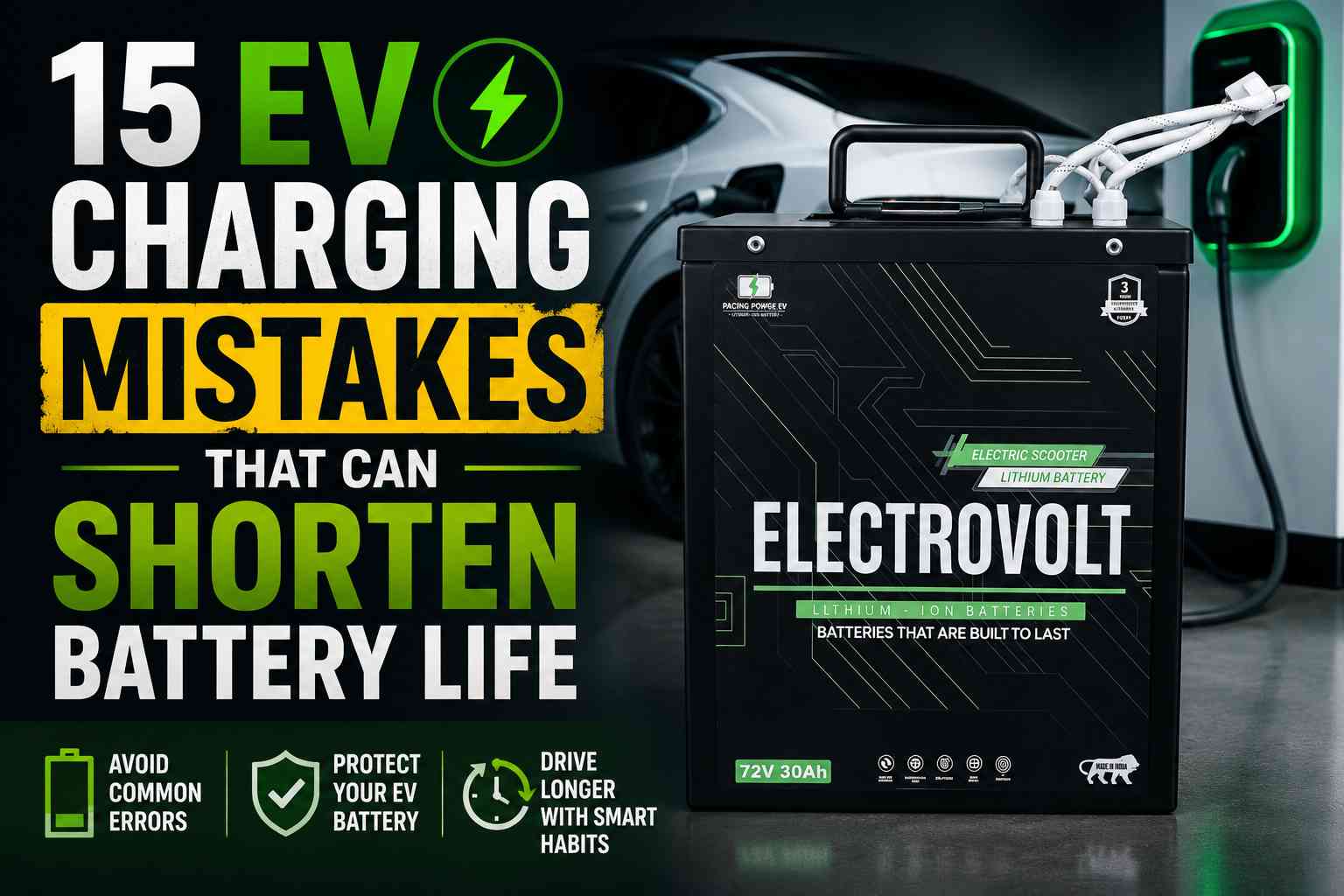
EV Charging Mistakes That Kill Your Lithium Battery Fast
Electric vehicles have changed the way people think about transportation. They are quieter, cheaper to run than conventional fuel-powered vehicles, and produce far fewer emissions. However, owning an EV comes with a responsibility that many first-time buyers underestimate: taking care of the lithium ion battery.
Unlike tires, brake pads, or windshield wipers, the lithium battery is not a component you can replace cheaply. It is the single most expensive part of an electric vehicle. Although modern EV batteries are designed to last for many years, their lifespan is heavily influenced by how they are charged and used.
Many drivers assume that plugging in an EV is no different from charging a smartphone. As a result, they develop habits that slowly reduce battery efficiency without realizing it. The damage usually happens gradually. There is no sudden warning sign, no dramatic failure, and no immediate drop in performance. Instead, the battery slowly loses its ability to store energy, reducing range and overall efficiency over time.
The encouraging news is that most battery degradation caused by charging habits can be minimized. A few changes to your charging routine can help your EV maintain better performance and preserve its driving range for years to come.
Let’s look at the charging mistakes that often shorten battery life and what you should do instead.
Mistake #1: Treating Every Charge Like a Road Trip Charge
One of the most common misconceptions among EV owners is that the battery should always be charged to its maximum level.
At first glance, this seems logical. More charge means more range, and more range means less anxiety about running out of power. However, daily driving rarely requires the full capability of the battery.
Most people travel predictable distances each day. Whether it is commuting to work, running errands, or dropping children at school, the actual energy consumption is often a fraction of the battery’s total capacity.
Keeping the battery near its upper charge limit all the time places unnecessary stress on battery cells. Over months and years, that stress can contribute to a gradual decline in battery health.
A Better Approach
Instead of aiming for a full battery every night, charge according to your actual needs.
For routine driving:
- Maintain a moderate charge level
- Reserve 100% charging for longer journeys
- Use charging schedules to finish charging shortly before departure
Think of full charging as preparation for a special occasion rather than a daily routine.
Mistake #2: Waiting Until the Battery Is Running on Its Last Few Percent
Some drivers develop the opposite habit. Rather than charging too much, they postpone charging for as long as possible.
This often happens because drivers want to maximize each charging session or because they believe completely draining the battery is somehow beneficial.
In reality, regularly operating an EV with very little charge remaining can place additional strain on the battery.
Battery systems perform best when they operate within a comfortable range. Repeatedly pushing the battery toward extremely low charge levels forces it to work under less favorable conditions.
Why This Matters
Although modern EVs include safeguards that prevent complete battery depletion, frequently approaching empty still contributes to wear over time.
A Better Approach
Instead of waiting for the battery to reach critical levels:
- Recharge before the battery becomes excessively low
- Avoid making low-battery warnings part of your normal routine
- Treat the remaining reserve as emergency capacity rather than everyday driving range
Mistake #3: Making Fast Charging Your Everyday Solution
Fast charging technology is one of the greatest advantages of modern EV ownership.
A charging session that once required hours can now take a fraction of that time. For road trips and unexpected situations, this convenience is invaluable.
The problem arises when fast charging becomes the default option for every charging session.
Rapid charging delivers large amounts of energy in a short period. While the battery is engineered to handle this process, repeated exposure to high charging rates can generate additional heat and increase stress within the battery pack.
The Long-Term Impact
Using fast charging occasionally is unlikely to create significant problems.
However, relying on it day after day can accelerate battery aging compared with slower charging methods.
A Better Approach
Whenever practical:
- Use home charging for daily needs
- Reserve rapid chargers for travel and urgent situations
- Allow slower charging methods to handle routine charging
Mistake #4: Plugging In Immediately After Heavy Driving
Imagine finishing a long highway journey on a hot afternoon.
The battery has already spent hours working hard to deliver power to the vehicle. Its temperature is elevated, and internal components are still managing the heat generated during driving.
Connecting the charger immediately adds another workload to an already warm battery.
Heat is one of the major contributors to battery aging, and combining heavy driving with immediate charging can increase thermal stress.
A Better Approach
Allow the vehicle time to stabilize after demanding driving conditions, particularly after:
- High-speed travel
- Mountain driving
- Towing
- Aggressive acceleration
Giving the battery time to cool can help reduce unnecessary stress.
Mistake #5: Charging Under Extreme Heat
Weather plays a larger role in battery health than many people realize.
When an EV is charged in intense sunlight or extreme temperatures, the battery may already be operating in a challenging environment before charging even begins.
While modern cooling systems help manage temperatures, repeated exposure to excessive heat can still contribute to long-term wear.
Why Heat Matters
Battery degradation often occurs silently.
A battery exposed to elevated temperatures may continue functioning normally for months or even years. However, the accumulated effects eventually become visible through reduced range and lower energy storage capacity.
A Better Approach
Whenever possible:
- Park in shaded locations
- Charge during cooler periods of the day
- Use covered parking areas
- Avoid prolonged exposure to direct sunlight
Small improvements in temperature management can produce meaningful long-term benefits.
Mistake #6: Ignoring Warning Messages Related to Battery Temperature
Modern EVs continuously monitor battery conditions.
When temperature-related alerts appear, they are not random notifications. They indicate that the battery is operating outside its preferred conditions.
Unfortunately, some drivers dismiss these warnings because the vehicle continues to function normally.
This is similar to ignoring a health warning simply because symptoms have not yet appeared.
A Better Approach
Pay attention to:
- Temperature alerts
- Charging warnings
- Performance limitation messages
Addressing the underlying issue early is far easier than dealing with accelerated battery degradation later.
Mistake #7: Leaving a Fully Charged EV Parked for Days
A surprisingly common scenario occurs before vacations.
A driver charges the vehicle completely in preparation for a trip. Plans change, and the car remains parked for several days or even weeks.
Although the battery is not being used, it remains under stress because it is sitting at its highest charge level.
Why This Matters
Batteries generally prefer balance. Leaving them at either extreme—completely full or nearly empty—for extended periods is not ideal.
A Better Approach
If the vehicle will remain unused:
- Store it with a moderate charge level
- Schedule charging closer to departure time
- Avoid leaving it at maximum charge unnecessarily
Mistake #8: Parking an EV for Long Periods With Very Little Charge
Just as a fully charged battery is not ideal for storage, an almost empty battery presents its own challenges.
A parked vehicle continues consuming small amounts of energy for monitoring systems and background functions.
If the battery starts with very little charge, it can fall to critically low levels during storage.
A Better Approach
Before extended parking:
- Maintain a moderate state of charge
- Check battery levels periodically
- Follow the manufacturer’s storage recommendations
A balanced charge level offers the safest environment for long-term storage.
Mistake #9: Choosing Charging Equipment Based Only on Price
Not all charging equipment delivers the same quality or reliability.
While low-cost charging solutions may appear attractive, poor-quality equipment can introduce safety concerns and inconsistent charging performance.
The battery depends on stable power delivery. Anything that compromises charging quality can potentially affect long-term reliability.
A Better Approach
Invest in:
- Certified charging equipment
- Trusted charging brands
- Approved charging accessories
Protecting an expensive battery is worth the additional investment.
Mistake #10: Skipping Software Updates
Software plays a significant role in modern EV performance.
Many updates include improvements that are invisible to the driver but highly beneficial to the battery.
Manufacturers continually refine charging strategies, temperature management systems, and battery protection algorithms.
Ignoring updates means missing these improvements.
A Better Approach
Keep vehicle software current and install updates whenever they become available.
Mistake #11: Charging a Cold Battery Without Preparation
Cold weather creates challenges that differ from those caused by heat.
When temperatures drop significantly, battery chemistry becomes less responsive. Charging under these conditions can be less efficient and may increase battery stress.
A Better Approach
If your EV offers battery preconditioning:
- Use it before charging
- Allow the battery to reach a suitable temperature
- Follow manufacturer recommendations during winter months
Mistake #12: Living in Constant Fear of Running Out of Range
Range anxiety causes many drivers to charge unnecessarily.
Even when the battery contains more than enough energy for daily driving, they continue topping it up simply for peace of mind.
Over time, this habit can keep the battery at higher charge levels than necessary.
A Better Approach
Base charging decisions on realistic driving requirements rather than worst-case scenarios.
Most daily trips consume far less energy than many drivers expect.
Mistake #13: Plugging In Every Time You Park
Some owners connect their EV to a charger whenever the opportunity arises.
Although this may seem harmless, it can increase the amount of time the battery spends at higher charge levels.
A Better Approach
Develop a consistent charging schedule based on usage patterns rather than charging out of habit.
Mistake #14: Ignoring the Guidance Provided by the Manufacturer
Every EV battery is different.
The charging recommendations for one vehicle may not be ideal for another.
Manufacturers spend years testing battery performance under various conditions before establishing charging guidelines.
A Better Approach
Review the owner’s manual and follow the recommended practices for:
- Charging limits
- Storage procedures
- Fast charging frequency
- Temperature management
Mistake #15: Assuming Technology Can Undo Poor Habits
Modern EVs contain sophisticated systems designed to protect the battery.
These systems monitor temperature, charging behavior, voltage levels, and numerous other factors.
However, they are not magic.
Protective technology can reduce risk, but it cannot completely eliminate the consequences of poor charging habits repeated over many years.
A Better Approach
View battery protection systems as assistance rather than a substitute for responsible charging practices.
Final Thoughts
An EV battery is designed for longevity, but its lifespan is not determined by technology alone. Everyday decisions influence how well that battery performs years down the road.
The good news is that battery-friendly charging habits are neither complicated nor time-consuming. Charging according to your actual driving needs, avoiding extreme battery levels, managing temperature exposure, and following manufacturer recommendations can make a meaningful difference.
Battery degradation is inevitable, but accelerated degradation is not. By adopting smarter charging practices today, you can help your EV deliver stronger performance, better range retention, and a more satisfying ownership experience for many years to come. 🚗⚡
If you notice a sudden drop in driving range, slower charging speeds, battery warning lights, or other signs of battery-related issues, don’t ignore them. Early diagnosis and professional repair can often prevent minor problems from developing into costly battery failures.
Need expert EV battery repair or battery health diagnostics? Contact our team today for a professional assessment and reliable EV battery repair services to keep your vehicle performing at its best.
PowerKart, Bangalore based lithium ion battery and Inverter solutions company, offers professional EV battery diagnostics, repair, and refurbishment services to help maximize battery life and maintain peak vehicle performance. Get in touch with our experts today.