
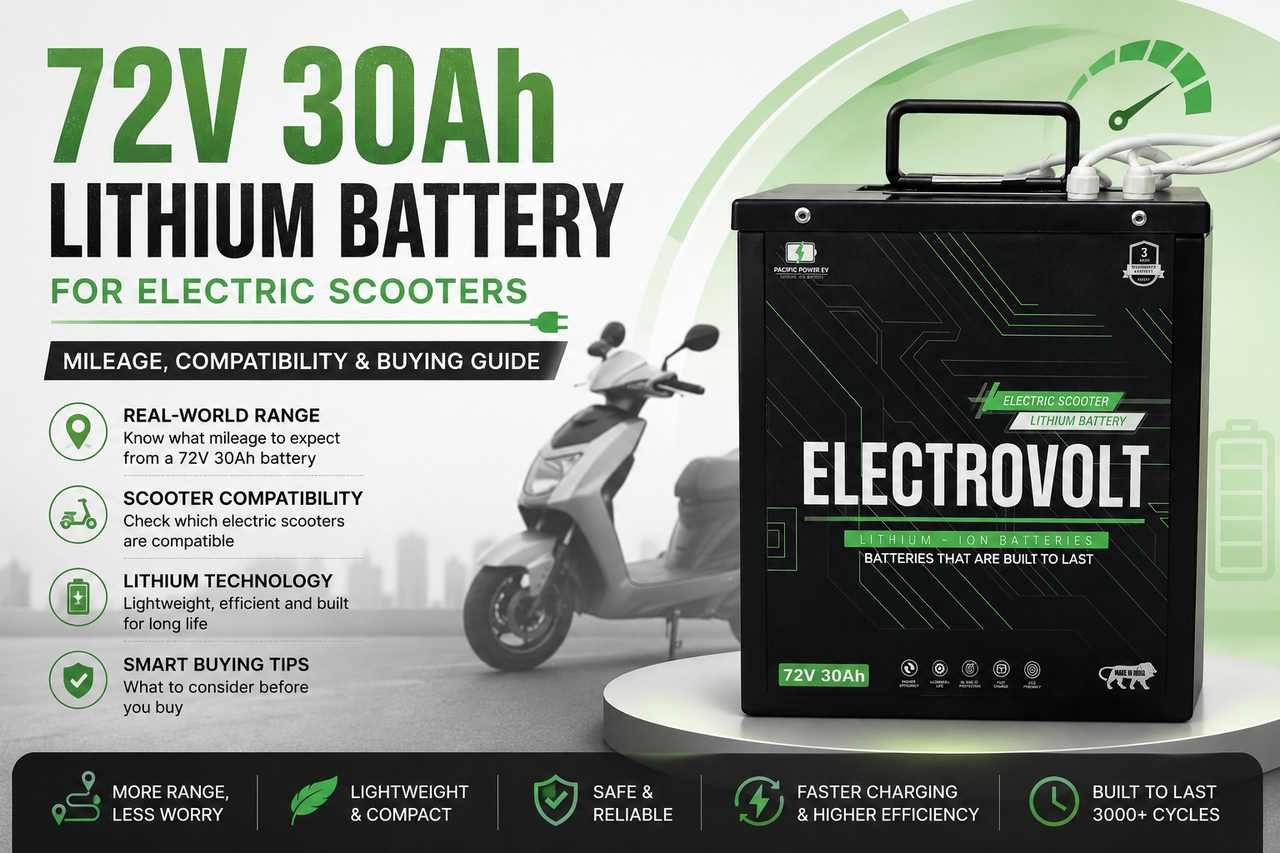
72V 30Ah Lithium Battery | Compatible Scooter Models and Key Buying Considerations
A 72V 30Ah lithium battery is a popular mid-capacity option for electric scooters that need more power than basic low-speed models but do not require a large, heavy long-range battery.
It can suit daily commuting, delivery work and replacement applications, provided the scooter’s controller, motor, charger, connectors and battery compartment are designed for the same voltage range.
However, “72V 30Ah” alone does not tell you everything about the battery. Two packs carrying the same voltage and capacity can deliver very different mileage, acceleration, safety and service life because of differences in cell chemistry, BMS quality, usable capacity, discharge rating and pack construction.
This guide explains what a 72V 30Ah battery means, how much mileage you can realistically expect, when it is worth buying and which electric scooter models use this battery size or a closely related configuration.
What Is a 72V 30Ah Lithium Battery?
The two main specifications are:
- 72V: the nominal voltage class of the battery
- 30Ah shows how much electrical charge the battery can hold and deliver.
The nominal energy can be calculated as:
Battery energy = Voltage × Capacity
Therefore:
72V × 30Ah = 2,160Wh
That equals:
2.16kWh
In simple terms, a 72V 30Ah battery stores approximately 2.16 units of electrical energy before accounting for charging losses and the reserve maintained by the Battery Management System.
This capacity places it between smaller commuter batteries and larger long-range packs.
For comparison:
| Battery | Nominal energy |
| 60V 30Ah | 1.8kWh |
| 72V 30Ah | 2.16kWh |
| 72V 40Ah | 2.88kWh |
| 72V 50Ah | 3.6kWh |
A 72V 40Ah battery stores about 33% more nominal energy than a 72V 30Ah battery. The larger battery can therefore provide more range when used in the same scooter under similar conditions.
Is It Really 72V?
Battery names can be confusing because manufacturers may use a rounded market description instead of the exact nominal voltage.
A pack advertised as 72V may actually be:
- Around 72V nominal for an NMC lithium-ion system
- Around 73V or 73.6V nominal for certain LiFePO₄ configurations
- Described by total energy, such as 2.08kWh or 2.2kWh, instead of ampere-hours
For example, Komaki currently lists its CAT 2.0 ECO commercial electric scooter with a 73V 30Ah LiFePO₄ battery, while another official Komaki page describes 72V-class scooter configurations with capacities close to 30Ah or 32Ah.
Okinawa’s PraisePro is another useful comparison. It uses a 72V, 2.08kWh detachable lithium-ion battery. Dividing 2.08kWh by 72V gives an approximate capacity of 28.9Ah, which is technically very close to a 72V 30Ah pack.
Buyers should verify the battery’s full operating-voltage range instead of judging compatibility only from the “72V” printed on its label.
Expected Mileage of a 72V 30Ah Lithium Battery
A 72V 30Ah pack has approximately 2.16kWh of nominal energy, but not all of it may be available for driving.
The BMS normally prevents the battery from reaching damaging levels of overcharge or deep discharge. Depending on the battery design, age and chemistry, the usable energy may be slightly lower than the full nominal figure.
Electric scooter energy consumption is commonly expressed in watt-hours per kilometre.
A practical scooter may consume roughly:
- 25–30Wh/km during slow, efficient riding
- 30–35Wh/km during normal city use
- Around 35–45Wh of energy may be used per kilometre when the scooter is ridden fast, climbs slopes, or carries a heavy load.
Using the full nominal 2,160Wh as a simple reference:
| Average consumption | Calculated range |
| 25Wh/km | 86km |
| 30Wh/km | 72km |
| 35Wh/km | 62km |
| 40Wh/km | 54km |
| 45Wh/km | 48km |
These are calculation-based estimates, not guaranteed mileage figures.
Practical mileage
For a typical electric scooter, a good-quality 72V 30Ah lithium battery may provide approximately:
50–75km per charge in normal city use
Under slow and favourable conditions, some vehicles may travel beyond this range. Under demanding conditions, range may fall below 50km.
The official Okinawa PraisePro provides a useful real-world reference for a similarly sized pack. Its 72V, 2.08kWh battery is advertised with an Eco-mode range of up to 81km under ideal test conditions, while the company clearly notes that actual range depends on road and riding conditions.
Komaki claims around 110–120km for its 73V 30Ah CAT 2.0 ECO, but that vehicle is a specialised commercial model whose motor programming, speed, load profile and vehicle design differ from those of a conventional passenger scooter. The figure should therefore not be applied automatically to every 72V 30Ah battery installation.
Why Mileage Can Vary So Much
Battery capacity is important, but mileage is determined by the complete vehicle.
1. Riding speed
Air resistance increases rapidly as speed rises.
A scooter travelling steadily at 25–35km/h generally consumes less energy per kilometre than one frequently operated near 55–65km/h.
The same 72V 30Ah battery might deliver:
- 70km at moderate speed
- 55km during aggressive high-speed riding
2. Rider and pillion weight
A heavier load requires more energy during:
- Acceleration
- Hill climbing
- Stop-and-go traffic
- Riding on uneven roads
A rider travelling alone may obtain noticeably better range than a scooter carrying two adults and luggage.
3. Motor power
A 1.5kW motor operated gently can be relatively efficient.
A 3kW motor may still work well with a 72V 30Ah battery, but sustained high-power riding will drain the pack more quickly.
A larger motor does not always consume maximum power. Actual energy use depends on throttle demand, controller programming and vehicle load.
4. Tyre pressure
Underinflated tyres create additional rolling resistance.
This may not feel dramatic during a short ride, but over an entire battery cycle it can reduce range.
5. Road gradient
Frequent flyovers and steep roads increase energy consumption.
Regenerative braking may recover some energy during deceleration, but it cannot fully recover the energy used for climbing.
6. Temperature
Battery performance can change in extreme heat or cold. High temperatures may also accelerate long-term degradation, particularly when the battery is repeatedly charged or stored in hot conditions.
Current electric scooter manufacturers increasingly distinguish between NMC and LFP chemistry because they behave differently in terms of energy density, heat tolerance and cycle life. Ampere, for example, states that its current lineup uses LFP batteries and highlights their thermal stability for Indian operating conditions, while explaining that NMC generally offers higher energy density.
7. Battery age
As the cells age, their available capacity gradually decreases.
A battery that initially provides 65km may eventually provide less range after repeated use, especially if it is regularly:
- Fully discharged
- Left at 100% charge in heat
- Charged using an unsuitable charger
- Operated above its recommended current
- Stored unused for long periods
NMC or LiFePO₄: Which Chemistry Is Better?
A 72V 30Ah battery may use NMC or LiFePO₄ cells.
Both belong to the lithium-ion battery family, but each chemistry offers a different mix of weight, safety, lifespan, and performance.
NMC battery
NMC stands for nickel manganese cobalt.
Advantages
- Higher energy density
- Smaller and lighter pack for the same energy
- Suitable for removable scooter batteries
- Good acceleration capability
- Common in compact electric two-wheelers
Limitations
- More sensitive to heat and overcharging
- Requires a well-designed BMS and thermal protection
- Cycle life may be lower than a comparable LFP pack
- Cell quality and pack construction are especially important
An NMC 72V 30Ah battery may be the better choice when limited battery space and lower weight are priorities.
LiFePO₄ battery
LiFePO₄ is also known as LFP or lithium iron phosphate.
Advantages
- Strong thermal stability
- Long potential cycle life
- Stable voltage characteristics
- Well suited to commercial and repeated-use applications
- Lower inherent thermal-runaway tendency than many NMC designs
Limitations
- Lower energy density
- Larger and heavier pack for the same kWh
- Its larger size may prevent it from fitting inside a battery space originally made for a smaller NMC pack.
- Requires a different cell count and charger profile
LFP can be an attractive choice for fleet vehicles, delivery applications and scooters that have enough physical space for a slightly larger pack.
Komaki currently markets several 72V-class or 73V LiFePO₄ scooter configurations, including a 73V 30Ah commercial model.
When Should You Buy a 72V 30Ah Battery?
A 72V 30Ah battery makes sense in several situations.
Your scooter was originally designed for a 72V system
This is the most important condition.
The battery should be used only when the scooter’s:
- Motor
- Controller
- Charger
- DC-DC converter
- Instrument cluster
- Main relay or contactor
- Wiring
- Connectors
are compatible with the pack’s complete voltage range.
Replacing an old 72V battery with a compatible 72V lithium pack is generally safer and simpler than converting a lower-voltage scooter.
Your daily travel is around 25–50km
A properly selected 72V 30Ah battery can be practical for a rider travelling approximately 25–50km per day.
This provides some reserve for:
- Traffic diversions
- Pillion riding
- Battery ageing
- Occasional longer trips
- Charging delays
Choose a battery that can comfortably cover more than your usual daily travel distance.
Using the battery with almost no remaining range can cause repeated deep discharges and leave you worried about running out of charge.
You want moderate range without a very heavy battery
A 72V 40Ah or 50Ah battery provides more energy, but it is also:
- More expensive
- Larger
- Heavier
- Slower to charge with the same charger
A 30Ah pack may be the better compromise when you want reasonable city range but do not need 90–120km every day.
You use the scooter for urban delivery work
A 72V 30Ah battery can work well for delivery riders who follow regular routes and have time to recharge between work shifts.
For example:
- Morning delivery route: 25–35km
- Midday charging
- Evening route: 20–30km
Commercial use requires a battery with a good continuous-current rating, strong connectors, proper vibration protection and dependable service support.
You need a replacement for an old 72V lithium battery
A replacement may restore range if the original battery has:
- Lost significant capacity
- Developed excessive voltage sag
- Started cutting off under acceleration
- Become difficult to charge
- Developed cell imbalance
- Reached the end of its practical service life
Before replacement, a technician should test whether the problem is actually in the battery. Similar symptoms can also be caused by:
- A weak charger
- Burnt connectors
- Loose terminals
- Controller faults
- Motor problems
- Brake drag
- Underinflated tyres
When Should You Not Buy It?
A 72V 30Ah battery is not suitable for every scooter.
Do not buy it for a 48V or 60V scooter without a complete evaluation
Installing a 72V battery in a lower-voltage vehicle can damage:
- Controller MOSFETs
- DC-DC converter
- Instrument cluster
- Motor insulation
- Lights and accessories
- Charger
- Relays and contactors
This is not a simple battery upgrade.
Avoid it when you regularly need more than 70km
A 72V 30Ah pack may not provide enough reserve for riders travelling 70–90km every day.
In such cases, consider:
- 72V 40Ah
- 72V 50Ah
- A larger LFP pack
- A scooter with a verified higher real-world range
The larger pack must still fit safely and remain within the vehicle’s permitted weight.
Avoid it for very high-power scooters unless the BMS supports the current
A 72V 30Ah battery can deliver strong power, but Ah capacity does not directly tell you its maximum safe current.
Suppose a scooter may demand 4kW:
Current = 4,000W ÷ 72V
Current ≈ 56A
During acceleration, temporary current may be even higher.
The pack must therefore have:
- Cells capable of supplying the required current
- A BMS with an adequate continuous rating
- A suitable peak-current rating
- Proper cable and connector size
- Adequate heat management
A cheap 30A or 40A BMS may repeatedly cut off in a scooter whose controller draws 55–70A.
Which Electric Scooter Brands Use a 72V 30Ah Battery?
Exact battery labels can vary by model year, battery supplier and market. Many manufacturers now publish capacity in kWh instead of Ah.
The following are relevant verified examples.
Komaki
Komaki currently lists the CAT 2.0 ECO with a 73V 30Ah LiFePO₄ battery, a claimed range of 110–120km and a stated top speed of 55km/h. This is technically a close 72V-class, 30Ah application rather than an exact 72.0V label.
Komaki has also advertised several 72V or 73V configurations around 30–32Ah in its SE and commercial ranges.
Okinawa
The Okinawa PraisePro uses a 72V, 2.08kWh detachable lithium-ion battery.
Its calculated Ah capacity is:
2,080Wh ÷ 72V ≈ 28.9Ah
That places it very close to the 72V 30Ah category. Okinawa lists a peak motor power of 2,700W, an Eco-mode range of 81km and a charging time of approximately two to three hours under the stated conditions.
Okinawa’s iPraise Plus also operates at 72V, although its larger 3.6kWh battery is closer to 50Ah and should not be confused with a 30Ah pack.
Other brands
Some local and regional electric scooter manufacturers have sold 72V 30Ah or similar battery configurations, but specifications can change without much public documentation.
For this reason, avoid buying a battery based only on statements such as:
- “Suitable for all 72V scooters”
- “Universal 72V replacement”
- “Works with every 2kW motor”
There is no truly universal battery unless the voltage range, connector, communication protocol, dimensions, discharge current and charger requirements all match.
Charger Requirements
The charger must match the battery chemistry and series-cell configuration.
A charger suitable for one type of 72V battery may be unsuitable for another.
Important charger specifications include:
- Output voltage
- Charging current
- Charging profile
- Connector
- Polarity
- Communication requirements
- Auto cut-off behaviour
- Temperature protection
Charging time example
A 30Ah battery charged with a 5A charger would have a basic theoretical time of:
30Ah ÷ 5A = 6 hours
Actual charging may take longer because charging current normally reduces near full charge.
With an 8A charger:
30Ah ÷ 8A = 3.75 hours
Practical charging may take approximately four to five hours.
With a 10A charger:
30Ah ÷ 10A = 3 hours
Practical charging may take around three to four hours, provided the cells and BMS allow that rate.
Never increase charger current merely to reduce charging time. The battery manufacturer’s limit must be followed.
BMS Specifications to Check
The Battery Management System is one of the most important parts of the pack.
A good BMS should provide protection against:
- Cell overvoltage
- Cell undervoltage
- Excessive charging current
- Excessive discharge current
- Short circuit
- High temperature
- Low-temperature charging where applicable
- Cell imbalance
Ask the seller for:
- Continuous discharge rating
- Peak discharge rating and permitted duration
- Maximum charging current
- Number of series cell groups
- Temperature-sensor count
- Balancing method
- Bluetooth or CAN communication support
- Low-voltage and high-voltage thresholds
Do not judge BMS quality only by the current printed on its label. Thermal design, MOSFET quality, wiring and calibration are equally important.
Battery Size and Connector Compatibility
Before ordering, measure:
- Battery length
- Width
- Height
- Handle clearance
- Cable exit direction
- Connector location
- Mounting brackets
- Available ventilation space
Also identify:
- Main positive and negative connector
- Charging connector
- Ignition or key wire
- Communication connector
- CAN, UART or RS485 requirement
- Battery-lock mechanism
Some modern scooters will not operate properly with a generic pack because the controller expects digital communication from the original battery.
Expected Battery Life
Battery life depends on chemistry, cell quality, temperature, charging habits and discharge depth.
It is better to think in terms of useful years and retained capacity rather than assuming a fixed cycle count.
To improve service life:
- Avoid leaving the battery completely discharged
- Do not charge immediately after a very hot ride
- Use the correct charger
- Keep connectors clean and tight
- Avoid water entry
- Do not store the battery at 100% for months
- Prevent physical impact
- Have repeated BMS cut-offs diagnosed promptly
- Maintain proper tyre pressure to reduce unnecessary load
Ampere’s current battery guidance also emphasises that chemistry, charging practices, temperature and real-world riding conditions significantly influence battery life and performance. (Ampere)
Questions to Ask Before Buying
Before placing an order, ask the supplier:
- Is the battery NMC or LiFePO₄?
- What is the exact nominal and fully charged voltage?
- What cells are used?
- What is the continuous BMS current?
- What is the peak BMS current?
- Is the battery approved for my motor power?
- Does it communicate with my scooter controller?
- Is a compatible charger included?
- What is the charging time?
- What is covered under warranty?
- Is local repair support available?
- Will the battery physically fit my scooter?
- Are the connector and polarity identical?
- Is the capacity measured at 30Ah or merely advertised as 30Ah?
- Is the battery designed for daily commercial use?
A reliable supplier should ask about your scooter before recommending a replacement pack.
Final Verdict
A 72V 30Ah lithium battery is a practical option for scooters that need moderate range, reasonable weight and strong 72V performance.
Its 2.16kWh nominal energy can typically support around 50–75km of real-world city riding, although the actual result depends heavily on motor power, speed, rider weight, road gradient, tyre pressure and battery quality.
It is worth buying when:
- Your scooter was designed for a 72V-class battery
- Your daily route is approximately 25–50km
- You want a lighter alternative to lead-acid
- A 40Ah or 50Ah pack is unnecessarily large
- Your existing battery has reached the end of its useful life
- The replacement pack matches your controller, charger and connectors
It may not be the correct choice when:
- Your scooter uses 48V or 60V
- Your daily requirement exceeds its practical range
- Your motor needs more current than the BMS can provide
- The pack does not support the scooter’s communication system
- The battery is physically too large or too heavy
Current verified examples include the Komaki CAT 2.0 ECO with a 73V 30Ah LiFePO₄ battery and the Okinawa PraisePro with a 72V, 2.08kWh battery, which is approximately equivalent to 29Ah. (Komaki)
The correct decision should be based on compatibility and usable energy—not voltage and Ah alone.
Battery quality, BMS specifications, warranty and service support are also worth checking when selecting a lithium battery supplier in Karnataka, particularly for a replacement battery that needs to match an existing scooter.
Before purchasing, share the following with your battery supplier:
- Scooter brand and model
- Existing battery label
- Motor rating
- Controller label
- Charger output
- Connector photographs
- Battery compartment measurements
- Daily travel distance
- Rider and pillion load
- Expected top speed
That information allows the supplier to recommend a battery that is not only powerful enough, but also safe, reliable and properly matched to the scooter.