
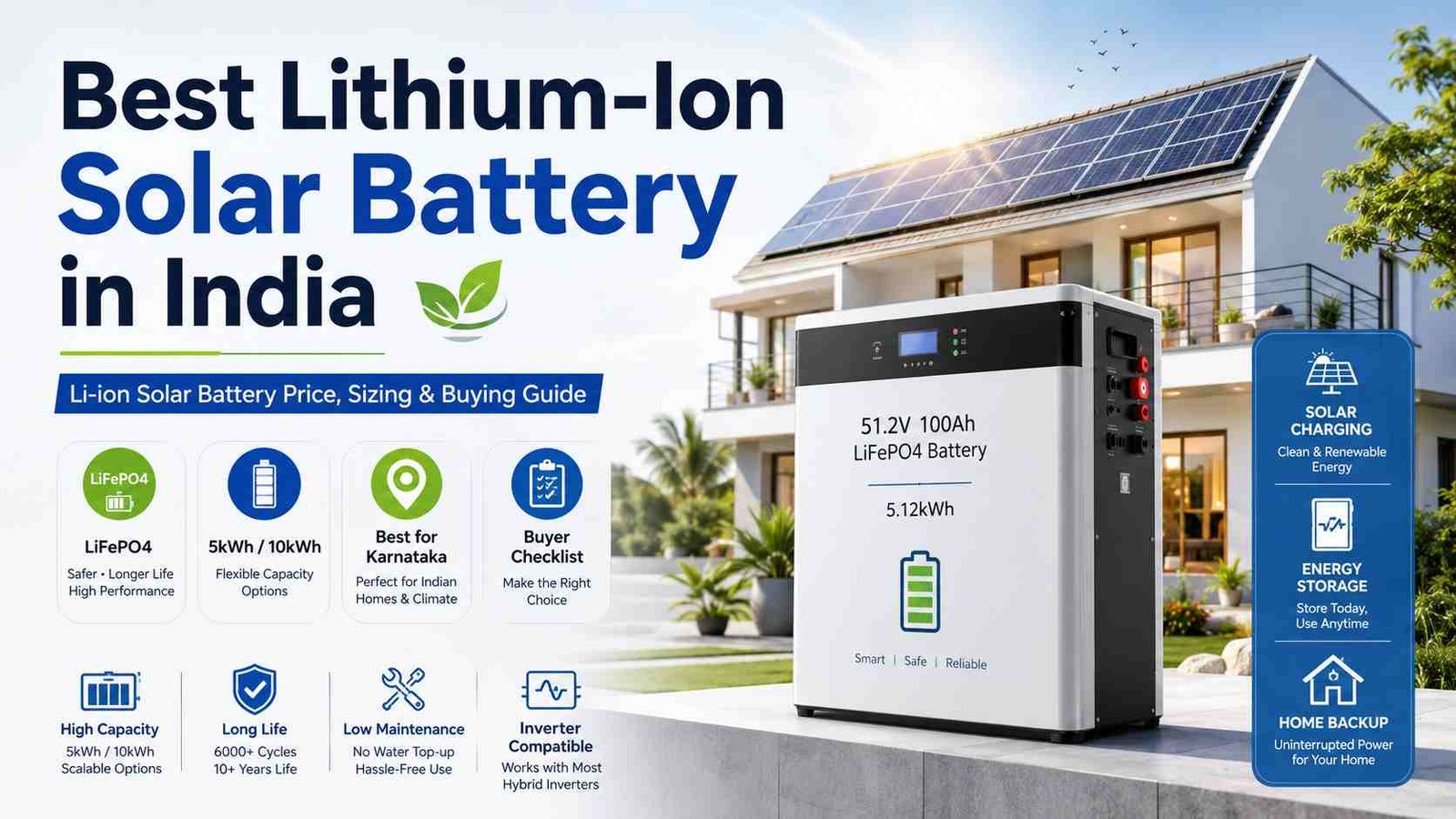
Choosing the best lithium-ion solar battery is not simply about buying the battery with the highest Ah rating.
For a home solar system, the battery must match your:
- Daily electricity consumption
- Required backup time
- Solar panel capacity
- Hybrid inverter
- Maximum load
- Available charging current
- Budget
- Installation environment
For most modern residential and commercial solar-storage systems, LiFePO4— Lithium Iron Phosphate — is one of the most practical lithium-ion chemistries to consider because it combines long cycle life, good efficiency, deep usable capacity and characteristics well suited to stationary energy storage.
Lithium-ion is actually a broad battery family. LiFePO₄, NMC and several other chemistries all fall under lithium-ion technology. For stationary solar applications, however, LiFePO₄ has become a common choice.
So, if you are searching for the best lithium-ion solar battery for home, it is worth looking beyond the words “lithium-ion” and checking the actual chemistry, cell quality, BMS, usable kWh, warranty and inverter compatibility.
Quick Answer | Which Lithium Battery Is Best for Solar?
For most home solar applications, a 48V-class or 51.2V LiFePO₄ battery with a good-quality BMS is a strong choice.
A typical system may use:
| Battery | Nominal Energy | Typical Application |
| 12.8V 100Ah | 1.28kWh | Small inverter/backup |
| 25.6V 100Ah | 2.56kWh | Small solar systems |
| 51.2V 100Ah | 5.12kWh | 3–5kW home solar |
| 51.2V 200Ah | 10.24kWh | 5kW+ solar / longer backup |
| 51.2V 300Ah | 15.36kWh | Large homes/commercial |
| 51.2V 400Ah | 20.48kWh | Large ESS applications |
The correct size depends on how much energy you actually need, not just the inverter rating.
What Is a Lithium-Ion Solar Battery?
A lithium-ion solar battery stores electricity generated by solar panels so that the energy can be used later.
During the day, solar panels may produce more electricity than the home is consuming.
Instead of wasting that available energy or relying entirely on the grid after sunset, a compatible hybrid solar inverter can use the excess solar energy to charge the battery.
The stored energy can then be used:
- At night
- During a power cut
- During cloudy periods
- When solar production is lower than household demand
- To reduce dependence on grid electricity
This type of setup is commonly called solar energy storage, home battery storage, or a solar ESS — Energy Storage System.
India’s Ministry of New and Renewable Energy has increasingly incorporated energy storage into its renewable-energy framework, including guidance around co-locating storage with solar projects.
Why Is LiFePO4 Often Preferred for Solar Batteries?
Not every lithium battery uses the same chemistry.
Two names you may commonly encounter are:
NMC — Nickel Manganese Cobalt
and
LiFePO4 — Lithium Iron Phosphate or LFP
NMC is widely used where energy density and weight are critical, particularly in electric mobility.
For stationary solar storage, weight is usually less important because the battery remains installed in one location.
That changes the priorities.
For a solar battery, buyers generally care more about:
- Cycle life
- Reliability
- Thermal behaviour
- Depth of discharge
- Maintenance
- Charging efficiency
- Cost per usable kWh over the battery’s lifetime
This is why LiFePO₄ is widely used in modern stationary lithium battery systems.
Battery operating temperature still matters. Manufacturers specify charging and discharging temperature limits, and prolonged high-temperature operation can negatively affect battery life. Proper installation and ventilation therefore remain important even with LiFePO₄.
Li-Ion Solar Battery Price in India
One of the first questions buyers ask is:
What is the Li-ion solar battery price in India?
There is no single price because lithium batteries are sold in many capacities, chemistries and configurations.
The selling price also depends heavily on:
- Cell manufacturer
- Cell grade
- Battery capacity
- BMS quality
- Continuous discharge rating
- Active or passive balancing
- CAN/RS485 communication
- Display and Bluetooth monitoring
- Cabinet construction
- Warranty
- Installation
- Brand and after-sales support
As of August 2026, current Indian listings demonstrate just how wide the price difference can be. For example, approximately 5kWh-class 48V/51.2V LiFePO₄ batteries are listed at roughly ₹58,000–₹1.15 lakh across different manufacturers and configurations. A 51.2V 200Ah/10.24kWh system can cost substantially more depending on brand and design. These are market examples rather than a fixed industry price.
Approximate Capacity Guide
| Battery Rating | Energy |
| 12.8V 100Ah | 1.28kWh |
| 25.6V 100Ah | 2.56kWh |
| 48V 100Ah | 4.8kWh |
| 51.2V 100Ah | 5.12kWh |
| 51.2V 200Ah | 10.24kWh |
Always compare batteries by kWh as well as Ah.
A 12V 200Ah battery and a 48V 200Ah battery have the same Ah rating but store completely different amounts of energy.
Why Are Many “48V” Lithium Solar Batteries Actually 51.2V?
This often confuses buyers.
A LiFePO₄ cell typically has a nominal voltage of approximately 3.2V.
A common solar battery connects 16 cells in series, producing:
16 × 3.2V = 51.2V
That is why a battery designed for a 48V-class inverter may actually be labelled:
51.2V 100Ah
Its energy capacity is:
51.2 × 100 = 5,120Wh
or:
5.12kWh
Similarly:
51.2V × 200Ah = 10.24kWh
So when comparing batteries, always check the actual nominal voltage and total kWh.
How Much Lithium Solar Battery Capacity Do You Need?
A simple starting formula is:
Battery Energy Required = Average Load × Required Backup Hours
Suppose your average nighttime load is:
700W
and you want:
8 hours of backup
Then:
0.7kW × 8 hours = 5.6kWh
However, you should not design a battery system assuming that every watt-hour stored in the battery will become usable AC electricity.
There are losses through:
- Inverter conversion
- Battery discharge
- Cables
- Connections
- BMS
- Other system components
You should therefore leave a practical reserve.
For this example, a 5.12kWh battery may be marginal, while a 10.24kWh battery provides considerably more flexibility.
51.2V 100Ah vs 51.2V 200Ah Lithium Solar Battery
This is one of the most common comparisons for home solar systems.
51.2V 100Ah
Nominal energy:
5.12kWh
Suitable for:
- Apartments
- Small and medium homes
- Essential-load backup
- Fans
- Lights
- Refrigerator
- TV
- Wi-Fi
- Computers
- Moderate nighttime consumption
51.2V 200Ah
Nominal energy:
10.24kWh
Suitable for:
- Larger homes
- Villas
- Offices
- Shops
- Longer power cuts
- Higher nighttime consumption
- Greater solar self-consumption
- Larger hybrid solar systems
A 200Ah battery does not necessarily give your inverter twice the output power.
It mainly provides twice the energy storage compared with a 100Ah battery of the same nominal voltage.
Power capability still depends on the cells, BMS and inverter.
Don’t Match Battery Capacity Only to Inverter Size
A common assumption is:
“I have a 5kW inverter, so I need a 5kWh battery.”
That is incorrect.
The two ratings describe different things.
kW = power
kWh = energy
A 5kW inverter tells you approximately how much power the inverter can deliver at one time.
A 5kWh battery tells you approximately how much energy the battery stores.
For example, a 5kWh battery supplying a 5kW load could theoretically be depleted in around one hour even before allowing for real-world losses and battery limits.
The same battery supplying only 500W could operate for many hours.
Battery sizing should therefore consider:
Maximum load + average load + required backup time.
Why the BMS Is Just as Important as Battery Capacity
The Battery Management System or BMS is one of the most important parts of a lithium solar battery.
It monitors and protects the cells.
Depending on the design, a smart BMS may monitor:
- Individual cell voltage
- Battery voltage
- Charging current
- Discharging current
- Temperature
- State of charge
- Over-current conditions
- Short circuits
- Over-voltage
- Under-voltage
- Cell balancing
Consider a 5kW inverter connected to a 51.2V battery.
Ignoring losses:
5,000W ÷ 51.2V ≈ 97.7A
Actual battery current can exceed this after inverter losses are considered.
Therefore, buying a 51.2V 100Ah battery simply because the capacity is sufficient is not enough.
You must also confirm that its continuous BMS discharge current can safely support the inverter and expected loads.
CAN and RS485 Communication: Do You Need It?
Many modern hybrid inverters communicate directly with lithium batteries.
Common communication interfaces include:
- CAN
- RS485
Communication allows the inverter and battery BMS to exchange information such as:
- State of charge
- Battery voltage
- Charge-current limits
- Discharge-current limits
- Temperature
- Alarm conditions
Before purchasing a battery, check whether your inverter requires a particular communication protocol.
A battery may have excellent cells and still be the wrong battery if it cannot communicate correctly with the inverter.
Why Lithium Solar Batteries Make Sense in Karnataka
Karnataka is already a major renewable-energy market, and the Karnataka state’s Renewable Energy Policy promotes rooftop solar PV across domestic, commercial and industrial applications. KREDL is also currently progressing battery energy-storage projects within the state, reflecting the increasing role of storage alongside renewable generation.
For a homeowner or business, the practical reason for adding a battery is simpler:
solar generation and electricity consumption do not always happen at the same time.
A home may produce significant solar energy during the afternoon but consume more electricity:
- Early in the morning
- In the evening
- At night
A battery allows some of that daytime solar energy to be shifted to later hours.
It can also provide backup where uninterrupted electricity is important.
This can be particularly useful for:
- Homes
- Villas
- Offices
- Shops
- Clinics
- Small businesses
- Remote properties
- Farm applications
- Areas with unreliable grid supply
MNRE also recognises off-grid solar applications as useful in areas where grid electricity is unavailable or unreliable.
Why Lithium Batteries Suit Homes in Bangalore
Space is often valuable in Bangalore homes, offices and commercial buildings.
A lithium solar battery can provide substantial energy storage without requiring the large multi-battery banks commonly associated with traditional lead-acid systems.
Lithium batteries also avoid routine electrolyte-water topping-up associated with flooded lead-acid batteries.
For customers searching for a lithium battery distributor in Bangalore, however, battery capacity should not be the only buying criterion.
Local technical support is particularly useful because the supplier may need to verify:
- Hybrid inverter compatibility
- Battery voltage
- BMS current
- Communication protocol
- Cable size
- DC protection
- Installation location
- Battery configuration
The correct battery is a system component, not simply a box containing cells.
Lithium vs Lead-Acid Solar Battery
Lithium batteries normally cost more initially, so the correct comparison should not be based only on purchase price.
| Factor | LiFePO4 | Lead-Acid |
| Initial Cost | Higher | Lower |
| Usable Depth of Discharge | Generally higher | Usually more restricted |
| Maintenance | Very low | Depends on type |
| Charging | Can be faster | Generally slower |
| Weight | Lower for equivalent usable storage | Higher |
| BMS Required | Yes | Usually no electronic BMS |
| Cycle Life | Typically higher | Typically lower |
| Upfront Investment | Higher | Lower |
Actual performance depends on the specific product, operating conditions and depth of discharge. Battery manufacturers also show that lithium cycle life is strongly affected by temperature, depth of discharge and operating conditions.
This is why the cheapest battery is not necessarily the battery with the lowest lifetime cost per usable kWh.
What Should You Check Before Buying a Li-Ion Solar Battery?
Use this checklist before purchasing:
- Battery chemistry
- Nominal voltage
- Ah rating
- Total kWh
- Usable kWh
- Cell manufacturer
- Cell grade
- BMS continuous current
- BMS peak current
- Charging current
- Cell balancing
- CAN/RS485 support
- Inverter compatibility
- Cycle-life specification
- Warranty
- Cabinet quality
- Cable and connector rating
- DC fuse or breaker requirement
- Installation location
- Service support
The two battery technologies also differ in usable capacity, charging behaviour, maintenance requirements and expected service life. These differences are explained in more detail in this Lithium vs Lead-Acid Solar Battery comparison.
Actual performance depends on the specific product, operating conditions and depth of discharge. Lithium battery cycle life is also influenced by factors such as temperature, charging conditions and how deeply the battery is discharged during each cycle.
Also verify that the battery remains within its specified charging and operating temperature range. A quality BMS and correct installation are fundamental parts of lithium battery safety.
Is a 5kWh Lithium Battery Enough for a Home?
For many homes, yes.
A 51.2V 100Ah battery provides approximately 5.12kWh of nominal energy.
It can be suitable where the goal is mainly to run essential loads such as:
- Fans
- Lights
- Refrigerator
- Television
- Router
- Computers
However, households expecting to run heavy loads for extended periods may require more capacity.
Is a 10kWh Lithium Battery Better?
Not automatically.
A 10.24kWh battery provides substantially more stored energy than a 5.12kWh battery, but it also costs more and requires more energy to recharge.
The larger battery makes sense when you have:
- Higher nighttime consumption
- Longer required backup
- Sufficient solar generation
- Frequent outages
- Higher daily energy use
Installing a large battery with a small solar array can result in the battery rarely receiving enough surplus solar energy to recharge fully.
Battery capacity and solar generation therefore need to be sized together.
Frequently Asked Questions
Which is the best lithium-ion battery for solar?
For many stationary solar applications, LiFePO4 is a strong option because of its combination of cycle life, efficiency and suitability for deep-cycle energy storage. The battery still needs the correct BMS, cell quality and inverter compatibility.
What is the Li-ion solar battery price in India?
The Li-ion solar battery price in India varies considerably with voltage, kWh capacity, cells, BMS, communication capability, warranty and brand. Current 5kWh-class products illustrate this clearly, with example Indian listings ranging from roughly ₹58,000 to above ₹1 lakh.
Is 48V or 51.2V better for solar?
Many LiFePO₄ batteries used with 48V-class solar inverters are actually 51.2V nominal because they contain 16 cells connected in series.
How many kWh is a 51.2V 100Ah battery?
51.2 × 100 = 5,120Wh = 5.12kWh.
How many kWh is a 51.2V 200Ah battery?
51.2 × 200 = 10,240Wh = 10.24kWh.
Can I connect a lithium battery to any solar inverter?
No. Check battery voltage, charging parameters, current capability and communication requirements before connecting the battery.
Is a lithium solar battery suitable for Bangalore and Karnataka?
Yes, lithium solar storage can be used effectively in Karnataka when correctly sized and installed. It is particularly useful where users want to store daytime solar generation for evening use or require backup power.
Final Verdict: Which Lithium Solar Battery Should You Buy?
The best lithium-ion solar battery is not necessarily the largest or most expensive model.
For many small and medium homes, a 51.2V 100Ah LiFePO₄ battery with approximately 5.12kWh capacity can provide a practical combination of storage, size and cost.
For larger homes, villas, businesses or users requiring longer backup, a 51.2V 200Ah battery with approximately 10.24kWh capacity may be more suitable.
But capacity is only one part of the decision.
The right battery should match your:
solar generation + inverter + electrical load + backup requirement.
Cell quality, BMS capacity, thermal protection, inverter communication, warranty and service support are equally important.
When comparing the Li-ion solar battery price in India, avoid selecting a battery only because its ₹/Ah figure appears lower. Compare its actual kWh, usable capacity, BMS rating, cell quality and expected service life.
And when selecting a lithium battery supplier in Karnataka choose one that can understand the complete system rather than simply recommend a battery based on Ah.
A properly designed lithium solar battery system can store daytime solar generation efficiently, provide reliable backup and reduce dependence on grid electricity for many years.