
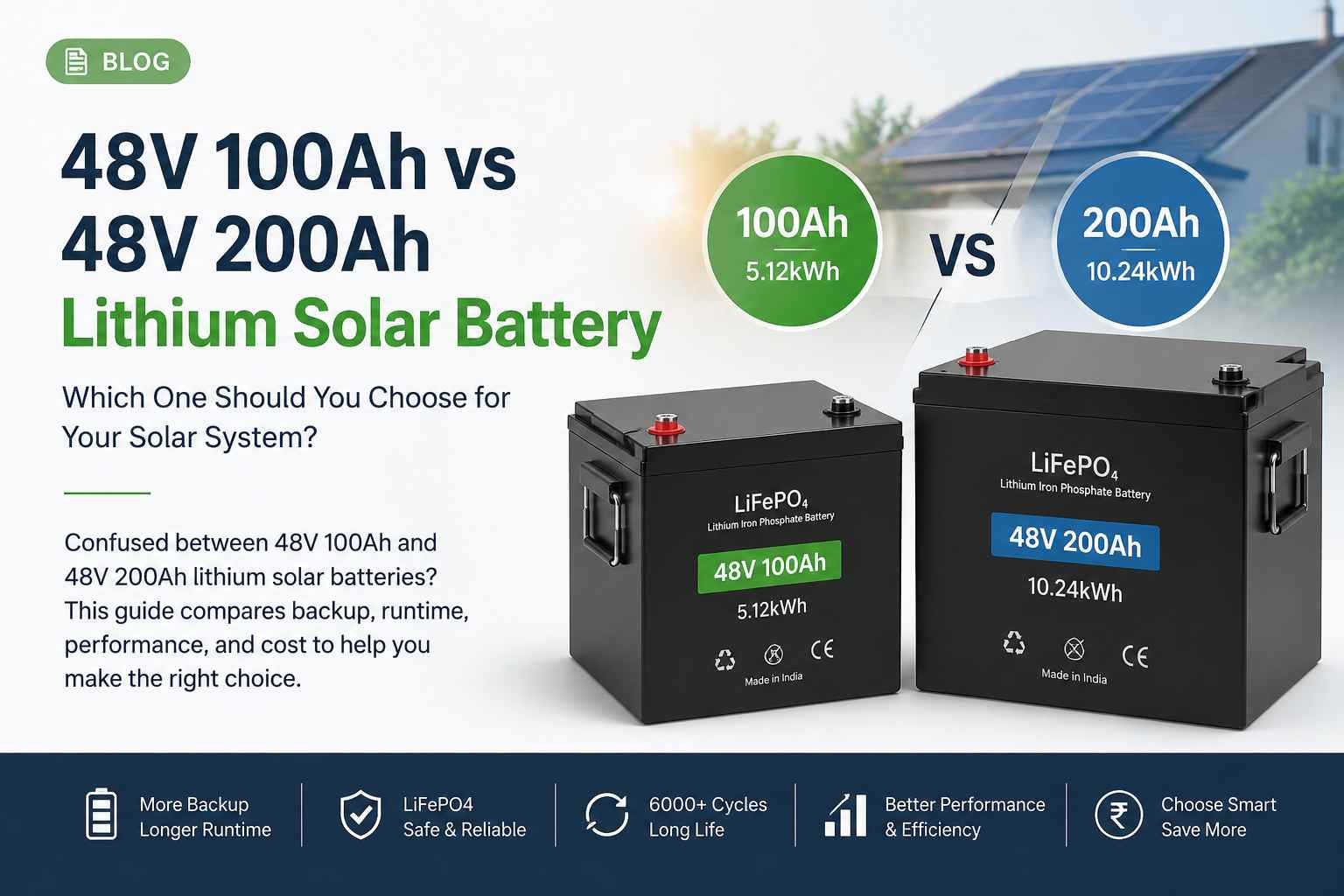
A practical comparison of capacity, backup time, solar system compatibility, charging requirements, and cost to help you choose the right lithium solar battery for your home or business.
Lithium batteries are becoming a popular choice for home solar systems because they offer longer life, faster charging, deeper usable capacity, and lower maintenance compared with traditional lead-acid batteries.
But once you decide to use a lithium battery, another question appears:
Should you buy a 48V 100Ah lithium solar battery or a 48V 200Ah lithium solar battery?
Choosing between a 48V 100Ah and a 48V 200Ah lithium solar battery is not just about buying the bigger battery. The right choice depends on how much power your home uses, how long you need backup, the size of your solar system, and how much energy you want to store for use after sunset or during power cuts.
A 48V 100Ah lithium battery typically provides around 5kWh of storage, while a 48V 200Ah battery offers around 10kWh. That difference can significantly affect backup time, charging requirements, system cost, and how efficiently you use the energy generated by your solar panels.
At first, the difference may seem simple. A 200Ah battery has twice the capacity of a 100Ah battery. But battery selection should not be based only on the Ah rating.
You also need to consider your daily electricity consumption, inverter size, backup requirement, solar panel capacity, charging time, peak load, budget, and how much energy you want to store.
In this guide, we compare 48V 100Ah vs 48V 200Ah lithium solar batteries in simple terms. You will understand their storage capacity, expected backup time, charging needs, inverter compatibility, suitable solar panel capacity, and which option makes more sense for different types of homes and businesses.
What Does 48V 100Ah Mean?
A battery rating contains two important values:
- Voltage (V) – electrical pressure
- Amp-hour (Ah) – battery capacity
A 48V 100Ah Lithium Solar battery has approximately:
48V × 100Ah = 4,800Wh
That equals:
4.8kWh of energy
However, many modern lithium solar batteries are actually built using 16 LiFePO4 cells in series, giving a nominal voltage of around 51.2V.
In such cases:
51.2V × 100Ah = 5.12kWh
So a battery sold as a “48V 100Ah lithium battery” may actually provide around 5.12kWh of nominal storage capacity.
Similarly, a 48V or 51.2V 200Ah lithium battery provides approximately:
51.2V × 200Ah = 10.24kWh
This means a 200Ah battery stores roughly twice as much energy as a 100Ah battery.
48V 100Ah vs 48V 200Ah | Quick Comparison
| Specification | 48V 100Ah Lithium Battery | 48V 200Ah Lithium Battery |
| Typical Nominal Voltage | 51.2V | 51.2V |
| Capacity | 100Ah | 200Ah |
| Nominal Energy | 5.12kWh | 10.24kWh |
| Typical Usable Energy | Around 4.5–4.9kWh | Around 9–9.7kWh |
| Suitable For | Small to medium homes | Medium to large homes |
| Backup Duration | Moderate | Longer |
| Charging Time | Faster | Longer |
| Space Required | Lower | Higher |
| Initial Cost | Lower | Higher |
| Solar Storage Capacity | Moderate | High |
| Best With | 3kW–5kW systems | 5kW–10kW systems |
These figures are general guidelines. Actual usable capacity depends on battery chemistry, BMS settings, inverter efficiency, battery discharge limits, and manufacturer specifications.
How Much Backup Can a 48V 100Ah Battery Provide?
A 51.2V 100Ah LiFePO4 battery stores approximately 5.12kWh.
You generally cannot assume that every watt-hour stored in the battery will reach your appliances. Some energy is lost in the inverter and wiring.
If we assume roughly 90% overall usable AC energy:
5.12kWh × 90% ≈ 4.6kWh
Now consider a home running the following load:
- 4 fans = 240W
- 6 LED lights = 60W
- Refrigerator average = 150W
- Television = 100W
- Wi-Fi router = 15W
- Laptop = 65W
Total approximate load:
630W
Backup time would be approximately:
4.6kWh ÷ 0.63kW = 7.3 hours
In real-world conditions, it may be slightly lower or higher depending on refrigerator cycling, inverter efficiency, battery condition, and actual appliance consumption.
For many homes, a 48V 100Ah lithium solar battery provides sufficient evening and nighttime backup for essential loads.
How Much Backup Can a 48V 200Ah Battery Provide?
A 48V 200Ah lithium solar battery stores approximately:
10.24kWh
After accounting for system losses, usable AC energy may be around:
9 to 9.5kWh
Using the same 630W household load:
9.2kWh ÷ 0.63kW ≈ 14.6 hours
So, under similar conditions, the 200Ah battery can provide roughly twice the backup duration.
This larger capacity becomes particularly useful if you want to run heavier appliances such as:
- Washing machine
- Water pump
- Microwave
- Induction cooktop
- Larger refrigerator
- Multiple computers
- Home office equipment
- Television and entertainment systems
- Air conditioner for limited periods
The Most Important Difference | Energy Storage
The main difference between the two batteries is not voltage.
Both operate in the same 48V-class system.
The major difference is how much energy they can store.
A 100Ah battery stores approximately:
5.12kWh
A 200Ah battery stores approximately:
10.24kWh
Think of the battery like a water tank.
Voltage is similar to water pressure, while Ah is similar to the size of the tank.
Both batteries may supply the same voltage, but the 200Ah battery has a much larger “tank” of stored energy.
Which Battery Is Better for a 3kW Solar System?
For many 3kW residential solar systems, a 48V 100Ah lithium battery can be a practical option.
A 3kW solar array may produce roughly 10–15kWh of energy on a good sunny day, depending on location, weather, shading, panel orientation, and system efficiency.
If your daytime loads already consume most of the solar power, you may only need to store 3–5kWh for evening use.
In that situation, a 100Ah battery may be sufficient.
A 200Ah battery can still be used with a 3kW solar system, but charging it fully may take longer, especially during cloudy weather or when daytime loads are high.
Which Battery Is Better for a 5kW Solar System?
A 5kW hybrid solar system can work with either battery.
The correct choice depends mainly on how much solar energy you want to store.
Choose 48V 100Ah if:
- Your nighttime consumption is relatively low
- You mainly need backup for fans, lights, TV and refrigerator
- Grid supply is reasonably reliable
- You want to reduce initial investment
- You are comfortable using solar directly during the day
Choose 48V 200Ah if:
- You want to store more daytime solar energy
- Your evening and nighttime consumption is high
- You experience long power cuts
- You want longer backup
- You want to reduce grid dependence further
For many households with a 5kW hybrid inverter, 200Ah provides a better storage-to-inverter balance when extended battery backup is a priority.
Battery Capacity and Inverter Power Are Different
One common misunderstanding is that a bigger battery automatically allows you to run a bigger load.
That is not always true.
Battery capacity is measured in kWh, while inverter output is measured in kW or kVA.
For example:
A 5kW inverter may be able to run a 4kW load.
But whether your battery can safely supply that load depends on its BMS current rating.
At 51.2V, supplying 5,000W theoretically requires approximately:
5,000 ÷ 51.2 = 97.7A
After accounting for inverter losses, battery current may exceed 100A.
Therefore, if you want to operate high loads, you must check:
- BMS discharge current
- Battery cable size
- Battery terminal rating
- Inverter current requirement
- Manufacturer’s recommended continuous discharge rate
A 100Ah battery with a 100A BMS may technically support a high load, but continuously operating close to its maximum current can place more stress on the battery.
A 200Ah battery can often handle the same load more comfortably, particularly if its cells and BMS are designed for higher current.
Discharge Rate Matters
Consider a 5kW load.
A 100Ah battery supplying approximately 100A is operating near:
1C discharge rate
A 200Ah battery supplying the same current is operating at:
0.5C
“C-rate” describes how quickly a battery is charged or discharged relative to its capacity.
Lower discharge rates generally create less heating and stress on the cells.
Therefore, for homes that frequently operate large loads, a 200Ah battery can have an advantage beyond just longer backup.
Charging Time: 100Ah vs 200Ah
A larger battery takes longer to charge if the charging current remains the same.
Suppose your inverter charges the battery at 50A.
For a simplified comparison:
100Ah battery
100Ah ÷ 50A ≈ 2 hours
200Ah battery
200Ah ÷ 50A ≈ 4 hours
Actual charging takes longer because charging current changes as the battery approaches full charge and because solar availability continuously changes.
If your solar array is small, installing a very large battery may result in the battery rarely reaching full charge.
The battery size should therefore be matched with available solar generation.
Solar Panel Capacity Matters
Consider a house with 3kW of solar panels.
During strong sunlight, the system may produce near 3kW, but actual generation varies throughout the day.
If your home consumes 1.5kW during daylight hours, only the remaining solar energy is available for charging the battery.
A larger 200Ah battery is useful only if sufficient excess solar energy is available to charge it.
Otherwise, you may simply end up charging the battery from the grid.
This is why battery sizing should be based on the complete solar system rather than battery capacity alone.
What About Battery Life?
Most quality LiFePO4 solar batteries are designed for thousands of charge-discharge cycles.
You can use our Battery Life Calculator to estimate how long a battery may last based on its cycle life and usage pattern.
Battery lifespan depends on several factors:
- Depth of discharge
- Charging voltage
- Charging current
- Discharge current
- Operating temperature
- Cell quality
- BMS quality
- Cell balancing
- Storage conditions
A 200Ah battery may experience a shallower discharge for the same daily electricity use.
For example, if your home uses 4kWh every night:
A 5.12kWh battery may discharge close to 80%.
A 10.24kWh battery may discharge only around 40%.
Lower daily depth of discharge can help reduce battery stress and may contribute to longer practical service life.
When Should You Buy a 48V 100Ah Lithium Solar Battery?
A 48V 100Ah battery is a good option if your primary requirement is essential-load backup.
It is particularly suitable for:
- Small homes
- Apartments
- Small offices
- Shops
- Homes with limited night consumption
- 3kW–5kW hybrid solar systems
- Users upgrading from lead-acid batteries
- Users who want lower initial investment
It is also a good starting point for modular battery systems where additional batteries can be added later.
When Should You Buy a 48V 200Ah Lithium Solar Battery?
A 48V 200Ah battery makes more sense when energy storage is a major part of the solar system.
It is suitable for:
- Larger houses
- Villas
- Small commercial establishments
- Homes with frequent power cuts
- High nighttime electricity consumption
- 5kW or larger hybrid solar systems
- Users who want greater solar self-consumption
- Users trying to reduce grid dependence
It can also be a better choice if you plan to run larger household loads during outages.
Should You Buy One 200Ah Battery or Two 100Ah Batteries?
In some systems, two 100Ah lithium batteries can be connected in parallel to create approximately 200Ah capacity.
This approach provides some advantages.
You can initially install one battery and expand later.
However, parallel battery systems must be designed properly.
Ideally, batteries connected in parallel should have:
- Same chemistry
- Same voltage
- Same capacity
- Similar age
- Similar state of charge
- Compatible BMS
- Proper communication with the inverter where required
Cable lengths and cable resistance should also be balanced to ensure both batteries share current properly.
Always follow the battery and inverter manufacturer’s recommendations before connecting batteries in parallel.
Don’t Choose Battery Size Based Only on Inverter Rating
A common mistake is assuming:
“5kW inverter means I need 5kWh battery.”
That is not necessarily correct.
Your inverter rating tells you how much power the inverter can supply at one time.
Battery capacity tells you how long that power can be supplied.
For example, theoretically:
A 5kWh battery supplying a 5kW load may last less than one hour after accounting for system losses and battery limits.
The same battery supplying a 500W load may last around 8–9 hours.
This is why choosing the best inverter for your solar system should be based on your expected load, solar capacity and battery requirement rather than battery size alone.
Therefore, battery sizing should be based on both:
Maximum load + required backup duration
Simple Formula to Calculate the Battery Capacity You Need
You can estimate your required battery capacity using:
Required Battery Energy = Average Load × Backup Hours
Suppose your average nighttime load is:
800W
And you want:
8 hours of backup
Energy required:
0.8kW × 8 = 6.4kWh
After considering inverter losses and keeping some reserve capacity, you may need approximately:
7–8kWh battery storage
In this situation, a 5.12kWh battery may be too small.
A 10.24kWh 200Ah battery would be more suitable.
Example: Typical Household Comparison
Imagine a home running an average nighttime load of 700W.
With a 48V 100Ah battery
Approximate usable AC energy: 4.6kWh
Backup:
4.6 ÷ 0.7 ≈ 6.5 hours
With a 48V 200Ah battery
Approximate usable AC energy: 9.2kWh
Backup:
9.2 ÷ 0.7 ≈ 13 hours
This simple calculation shows why understanding your actual energy consumption is more useful than comparing Ah alone.
What Should You Check Before Buying a Lithium Solar Battery?
Apart from Ah capacity, choosing the right lithium solar battery for home use also requires checking the complete battery specification.
Important parameters include:
- Battery chemistry — preferably LiFePO4 for stationary solar applications
- Nominal voltage
- Total kWh capacity
- Recommended depth of discharge
- Continuous discharge current
- Peak discharge current
- Maximum charging current
- BMS capacity
- Communication support such as CAN or RS485
- Compatibility with your hybrid inverter
- Cell quality
- Cycle life
- Warranty
- Service support
- Installation requirements
A well-designed 100Ah battery can sometimes be a better investment than a poorly designed 200Ah battery.
Battery quality matters just as much as battery capacity.
48V 100Ah vs 48V 200Ah | Which Should You Buy?
For most users, the decision can be simplified.
Choose a 48V 100Ah lithium solar battery if you need around 5kWh of storage, moderate backup, lower initial cost, and mainly want to run essential household loads.
Choose a 48V 200Ah lithium solar battery if you need around 10kWh of storage, longer backup, higher nighttime consumption, or want to store more solar energy for use after sunset.
For a small or medium home with moderate electricity consumption, 100Ah can be perfectly adequate.
For a larger household, a 5kW hybrid solar system, frequent power cuts, or higher solar self-consumption, 200Ah is usually the more comfortable option.
The best battery is not simply the biggest battery you can afford. Battery quality, BMS specifications, warranty and after-sales support are also important factors when selecting a lithium battery supplier in Karnataka.
The best battery is not simply the biggest battery you can afford.
It is the battery that matches your daily energy requirement, inverter, solar generation and expected backup duration.
When all four are matched correctly, the solar system becomes more efficient, economical and reliable.