
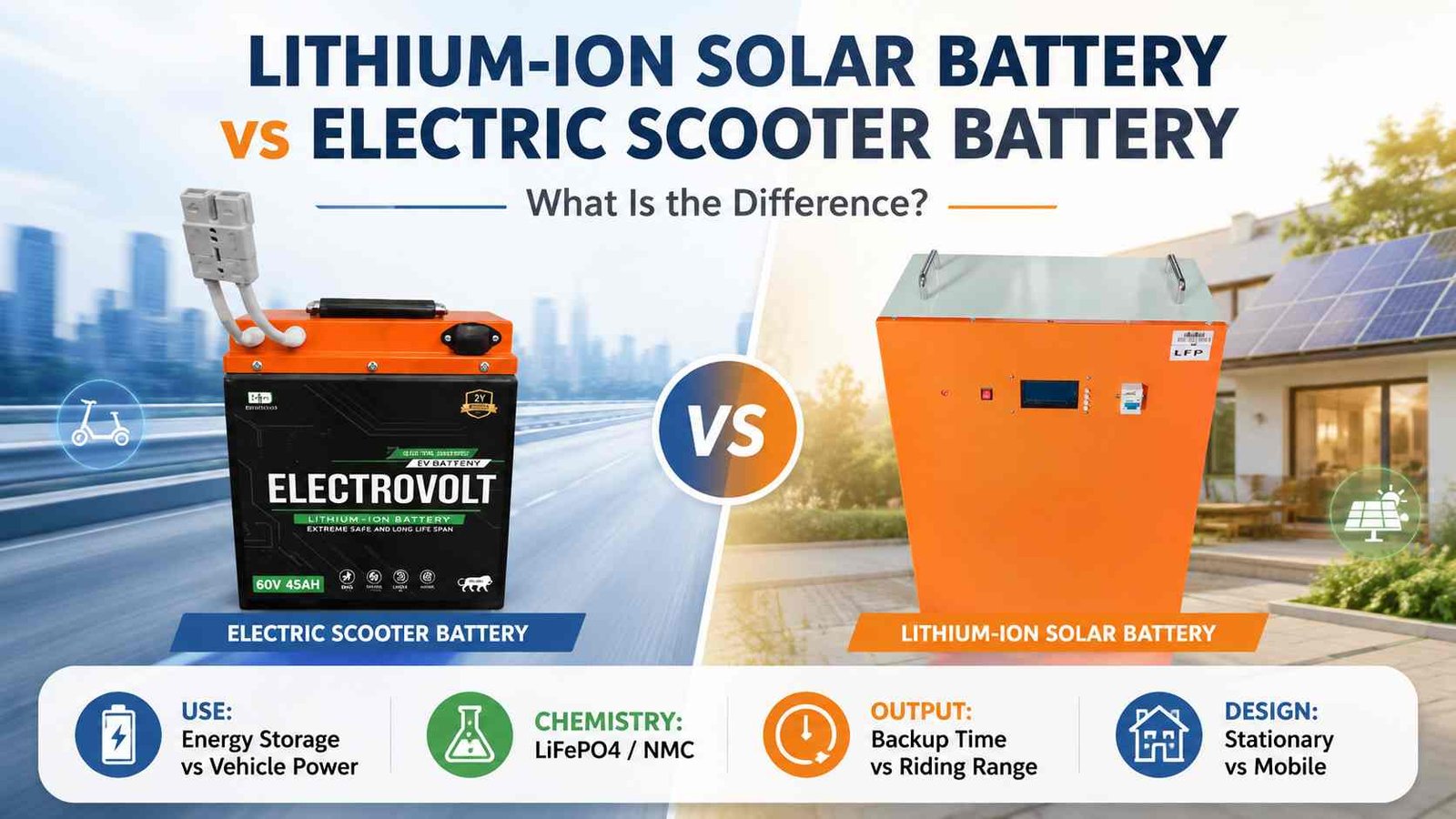
At first glance, a lithium ion solar battery and a lithium ion battery for an electric scooter may look very similar.
Both contain lithium-ion cells.
Both use a Battery Management System or BMS.
Both can be described using voltage, Ah and kWh.
And in some cases, both may even use the same battery chemistry.
But that does not mean a solar battery and an electric scooter battery are interchangeable.
They are designed for very different jobs.
A solar battery normally remains in one place and stores energy generated by solar panels for use later. An EV battery travels with the vehicle and must continuously supply the power required by the electric motor while handling acceleration, hills, braking, vibration and changing road conditions.
The U.S. Department of Energy describes stationary battery energy storage as a system that stores electrical energy for later use, while an electric vehicle uses its traction battery to directly power the electric motor.
These different applications affect almost everything inside the battery:
- Cell chemistry
- Cell format
- Voltage
- Capacity
- Discharge current
- BMS design
- Charger
- Connectors
- Communication
- Enclosure
- Cooling
- Weight
- Cycle requirements
Understanding these differences is important whether you are buying a home solar battery, replacing an electric scooter battery or comparing products from a lithium battery supplier.
Quick Answer | Solar Battery vs Electric Scooter Battery
The simplest difference is:
A solar battery is mainly designed to store energy for a long period and provide steady power.
An electric scooter battery is mainly designed to provide energy while also handling comparatively high and rapidly changing power demand from a traction motor.
Here is a quick comparison:
| Factor | Lithium Ion Solar Battery | Electric Scooter Battery |
| Main purpose | Store solar energy | Power electric motor |
| Installation | Stationary | Moves with vehicle |
| Common chemistry | LiFePO₄/LFP | NMC or LFP |
| Common voltage | 12.8V, 25.6V, 48V/51.2V | 48V, 60V, 72V and others |
| Capacity priority | Higher kWh storage | Range within limited size |
| Weight importance | Moderate | Very important |
| Energy density importance | Moderate | High |
| Discharge demand | Often relatively steady | Rapidly changing |
| BMS | Energy-storage focused | Traction/EV focused |
| Communication | Often inverter CAN/RS485 | Controller/vehicle specific |
| Environment | Fixed installation | Vibration, shocks, road conditions |
| Main buying goal | Backup time and solar storage | Range and vehicle performance |
These are general differences, not rigid rules. Both NMC and LFP can be used in transportation and stationary storage. DOE identifies NMC and LFP as two major lithium-ion chemistries, with different strengths in energy density, cycle life and thermal characteristics.
What Is a Lithium Ion Solar Battery?
A lithium ion solar battery stores electricity generated by solar panels.
During daylight hours, the solar panels may produce more energy than the house is consuming.
A hybrid inverter can use some of that excess electricity to charge the battery.
The stored energy may then be used:
- At night
- During a power cut
- During cloudy weather
- When household load exceeds solar generation
- To reduce dependence on grid electricity
This is commonly referred to as:
- Solar battery storage
- Solar energy storage
- Home battery storage
- Battery Energy Storage System or BESS
- Energy Storage System or ESS
Stationary battery systems normally work together with a power-conversion system such as an inverter to move energy between the battery and AC electrical loads.
For home solar systems, common lithium battery sizes include:
Energy:
51.2 × 100 = 5.12kWh
and:
51.2V 200Ah
Energy:
51.2 × 200 = 10.24kWh
These batteries are designed primarily around how much energy needs to be stored and how long the household needs backup.
What Is an Electric Scooter Battery?
An electric scooter battery is a traction battery.
Its primary job is to supply electrical energy to the motor that moves the scooter.
All-electric vehicles use a traction battery pack to store energy for the electric motor.
A typical lithium ion battery for an electric scooter might be rated:
For example:
60V × 30Ah = approximately 1.8kWh
while:
72V × 30Ah = approximately 2.16kWh
These calculations are useful for comparing energy capacity, although the actual nominal voltage depends on the cell chemistry and number of cells connected in series.
Unlike a solar battery, however, an EV battery must continuously respond to changing power demands.
When you accelerate from a traffic signal, climb a hill or carry a pillion rider, the controller may demand considerably more current than during steady cruising.
This makes power capability and discharge current extremely important.
Difference 1 | The Battery Has a Completely Different Job
This is the biggest difference.
Solar battery
The main goal is:
Store energy and release it efficiently over several hours.
For example, a household might use:
500W–1,000W continuously for several hours.
Electric scooter battery
The main goal is:
Provide enough energy for range while also delivering the power demanded by the motor.
The battery load changes constantly.
Current can rise when:
- Accelerating
- Climbing a slope
- Carrying additional weight
- Riding at higher speeds
- Starting from standstill
This means an EV battery needs to be designed around both:
energy + power
rather than energy storage alone.
Difference 2 | Battery Chemistry May Be Different
People sometimes assume every lithium-ion battery uses the same chemistry.
It does not.
Two common lithium-ion chemistries are:
NMC
Nickel Manganese Cobalt
LiFePO₄
Lithium Iron Phosphate, also called LFP.
Both belong to the lithium-ion battery family. DOE identifies NMC and LFP as major lithium-ion chemistries and notes the higher energy-density advantage associated with NMC and the thermal-stability advantages associated with LFP.
Why NMC is attractive for electric scooters
Space and weight are extremely important in an electric two-wheeler.
The battery must fit inside a limited battery compartment, yet store enough energy to provide useful range.
Higher energy density can therefore be valuable.
This is one reason NMC electric scooter batteries are common.
Why LiFePO₄ is attractive for solar
A home solar battery normally remains in one location.
An additional few kilograms usually matter less than they would on a scooter.
For stationary applications, priorities such as:
- Long cycle life
- Thermal stability
- Frequent charging and discharging
- Reliability
- Lifetime energy throughput
can become more important.
LFP has therefore gained considerable use in stationary energy storage.
But this does not mean:
Scooter = always NMC
or
Solar = always LiFePO₄.
LFP is also used in EV applications, while NMC has also been used in stationary storage.
Always check the actual chemistry.
Difference 3 | Voltage Configuration Is Different
Solar batteries and EV scooter batteries commonly operate at different voltages.
Many modern LFP solar systems use:
16 LiFePO₄ cells in series.
A LiFePO₄ cell has approximately 3.2V nominal voltage, so:
16 × 3.2V = 51.2V.
This is why many batteries sold for a 48V solar inverter are actually labelled:
51.2V LiFePO₄ battery.
Victron’s LiFePO₄ documentation similarly identifies a nominal cell voltage of approximately 3.2V.
Electric scooter batteries can use very different series configurations depending on:
- Chemistry
- Controller
- Motor
- Charger
- Vehicle design
You may therefore see scooters using:
48V, 60V, 72V or other pack voltages.
Never assume that a 48V scooter battery can replace a 48V-class solar battery simply because both descriptions contain “48V.”
Their:
maximum charging voltage, minimum voltage, series cell count and BMS limits may be completely different.
Difference 4 | Capacity Is Chosen Differently
Solar battery sizing normally starts with:
How much household energy needs to be stored?
Suppose a home has an average nighttime load of:
700W
and needs:
8 hours of backup.
The basic energy requirement is:
0.7kW × 8 hours = 5.6kWh
After accounting for inverter losses and reserve capacity, the user may consider a battery larger than 5.6kWh.
Electric scooter battery capacity is approached differently.
The important question is:
How much riding range is required without making the battery excessively large or heavy?
For an EV, manufacturers need to balance:
- Battery capacity
- Energy density
- Vehicle weight
- Battery-box space
- Motor power
- Range
- Cost
That is why increasing an electric scooter battery from 30Ah to 50Ah is not always as simple as installing a physically larger battery.
It must still fit the vehicle and remain within acceptable weight and electrical limits.
Difference 5 | Discharge Current Requirements
This is one of the most important technical differences.
Consider a home system using a:
51.2V battery with a 5kW inverter.
At 5,000W:
5,000 ÷ 51.2 ≈ 97.7A
The real battery current can be higher after allowing for inverter losses.
Therefore, the solar battery BMS and cells must support the required current.
Now consider an electric scooter.
A scooter may normally cruise at a moderate current but demand significantly higher current during acceleration.
The battery therefore needs to handle:
- Continuous discharge current
- Peak discharge current
- Rapid load changes
TI’s EV battery-management systems monitor cell voltage, pack current and temperature because these parameters are fundamental to safe and efficient traction-battery operation.
A battery with sufficient Ah capacity can still be unsuitable if its BMS cannot provide the required current.
Difference 6 | The BMS Is Designed Differently
Both battery types require a Battery Management System.
But the BMS requirements can be different.
Typical BMS functions include monitoring:
- Individual cell voltage
- Total battery voltage
- Battery current
- Cell temperature
- Over-voltage
- Under-voltage
- Over-current
- Short circuits
- Cell balancing
TI describes voltage, current, temperature monitoring and cell balancing as core battery-management functions.
Solar battery BMS
A solar BMS may also communicate directly with the hybrid inverter using:
- CAN
- RS485
The inverter may receive information including:
- State of charge
- Charge-current limit
- Discharge-current limit
- Battery alarms
- Temperature
EV scooter battery BMS
An EV BMS may need to work with:
- Vehicle controller
- Dashboard
- Charger
- Vehicle communication system
- Motor demand
Some scooters may also require proprietary communication.
This means you cannot assume that a generic lithium battery will work simply because its voltage and Ah match.
Difference 7 | Charging System Is Different
A solar battery is usually charged by:
- Solar inverter
- MPPT charger
- Grid through hybrid inverter
Its charging voltage and current are configured around the battery chemistry and BMS.
An electric scooter battery is normally charged using a dedicated charger designed for that specific battery configuration.
For example, NMC and LFP packs with similar nominal voltages can require different full-charge voltages.
Therefore:
Never choose a lithium battery charger based only on the advertised pack voltage.
You need to know:
- Chemistry
- Number of cells in series
- Maximum cell voltage
- BMS limits
- Charging current
Incorrect charging can result in BMS shutdown, reduced battery life or unsafe operating conditions.
Difference 8 | Physical Construction Is Different
A solar battery may use large prismatic LiFePO₄ cells.
Typical capacities might include:
- 100Ah
- 150Ah
- 200Ah
- 280Ah
- 300Ah
Because the battery remains stationary, manufacturers can use a larger cabinet.
An electric scooter battery may instead use:
- Cylindrical lithium-ion cells
- Pouch cells
- Compact prismatic cells
The pack has to fit a tightly defined battery compartment.
That makes:
shape, dimensions and weight
much more critical.
Difference 9 | Vibration and Mechanical Stress
A home solar battery normally sits on the floor, in a cabinet or on a wall.
An EV battery travels over:
- Potholes
- Speed breakers
- Rough roads
- Continuous vibration
- Sudden impacts
The battery enclosure, cell holders, busbars, welds, connectors and internal supports therefore need to be designed for a mobile environment.
An ordinary stationary solar battery cabinet is not automatically suitable for installing inside an electric scooter.
Difference 10 | Solar Backup Time vs EV Range
The customer thinks about the two batteries differently.
For solar:
How many hours of backup will I get?
For an electric scooter:
How many kilometres can I travel?
Solar battery calculation
Approximate backup:
Usable battery energy ÷ average load
EV battery calculation
Approximate range depends on:
usable battery energy ÷ vehicle energy consumption per kilometre
But EV energy consumption changes with:
- Speed
- Rider weight
- Pillion load
- Tyre pressure
- Motor efficiency
- Controller efficiency
- Road gradient
- Acceleration
- Temperature
- Traffic conditions
So two scooters using the same 60V 30Ah battery may not provide exactly the same range.
Can an Electric Scooter Battery Be Used for Solar?
Technically, lithium-ion cells originally designed for mobility can sometimes be integrated into stationary energy-storage systems.
In fact, second-life EV battery use for stationary applications is an active area of engineering research. NREL has studied procedures for assessing whether used vehicle batteries are suitable for second-life applications.
But this should not be interpreted as:
“Connect any scooter battery to a solar inverter.”
A safe conversion requires checking:
- Chemistry
- Series configuration
- Maximum battery voltage
- Minimum battery voltage
- BMS
- Continuous current
- Charger settings
- Inverter compatibility
- Communication
- Fuse
- DC breaker
- Cable size
- Enclosure
- Remaining battery health
Without these checks, the conversion may be unreliable or unsafe.
Can a Solar Battery Be Used in an Electric Scooter?
Usually, you should not assume so.
Even if the voltage appears compatible, a solar battery may:
- Be physically too large
- Be too heavy
- Have the wrong connector
- Have insufficient peak-current capability
- Use incompatible communication
- Have the wrong charger voltage
- Not be designed for vibration
- Not fit the battery compartment
A stationary 51.2V 100Ah LFP battery may be excellent for a home inverter but completely impractical for a lightweight electric scooter.
Application matters as much as chemistry.
What Should You Check Before Buying a Solar Battery?
When choosing a lithium ion solar battery, check:
- Battery chemistry
- Nominal voltage
- Total kWh
- Usable kWh
- Cell manufacturer
- Cell grade
- BMS continuous current
- Peak discharge current
- Maximum charge current
- Cycle-life specification
- Recommended depth of discharge
- CAN/RS485 communication
- Hybrid inverter compatibility
- Warranty
- Service support
- Installation requirements
Do not buy purely on Ah.
For solar storage, kWh is often the more useful comparison.
What Should You Check Before Buying an Electric Scooter Battery?
When choosing a lithium ion battery for an electric scooter, check:
- Scooter brand and model
- Existing battery chemistry
- Existing battery voltage
- Full-charge voltage
- Ah capacity
- Motor power
- Controller current
- BMS continuous current
- BMS peak current
- Charger output
- Battery dimensions
- Battery weight
- Connector type
- Communication requirements
- Expected range
- Warranty
Photographs of the existing:
battery label + controller label + charger label + connectors
can be extremely useful when discussing replacement with a lithium battery supplier.
Frequently Asked Questions
Is a solar lithium battery the same as an EV battery?
No. Both may use lithium-ion technology, but they are designed for different operating conditions. Solar batteries prioritise stationary energy storage, while EV batteries must also support traction power, compact packaging and mobile operating conditions.
Can both use LiFePO₄?
Yes. LiFePO₄ can be used for both solar storage and electric vehicles.
Can both use NMC?
Yes. NMC has been used in both transportation and stationary energy storage, although its higher energy density makes it particularly attractive where size and weight are important.
Which lithium battery is best for solar?
For many home and commercial stationary systems, LiFePO₄ is commonly preferred because its characteristics fit frequent-cycle stationary storage well. The complete battery design, BMS, cells and inverter compatibility still matter.
Which battery is best for an electric scooter?
There is no single answer. NMC can offer higher energy density, while LFP offers different benefits including thermal stability and cycle characteristics. The scooter must be designed for the battery’s chemistry, voltage, current and physical dimensions.
What does Ah mean in an EV battery?
Ah means amp-hour and describes electrical charge capacity. It should not be considered alone when comparing batteries.
What does kWh mean?
kWh measures energy.
A 51.2V 100Ah battery stores:
5.12kWh nominal energy.
A 60V 30Ah battery stores approximately:
1.8kWh nominal energy.
Final Verdict | Lithium Ion Solar Battery vs Electric Scooter Battery
A lithium ion solar battery and a lithium ion battery for an electric scooter may share similar underlying technology, but they are engineered around completely different priorities.
A solar battery is designed primarily to:
store substantial energy, cycle repeatedly and provide reliable power to an inverter for hours.
An electric scooter EV battery is designed to:
store enough energy for useful riding range while remaining compact and capable of supplying the changing power demand of a traction motor.
That is why comparing batteries only by:
voltage + Ah
can be misleading.
The correct battery must also match:
chemistry + kWh + BMS + charge voltage + discharge current + communication + application.
For solar systems, buyers should focus on usable energy, backup requirement, inverter compatibility, cycle performance and BMS capability.
For electric scooters, buyers should additionally consider motor power, controller current, battery dimensions, weight, peak-current capability, charger compatibility and expected riding range.
Most importantly, never assume that a solar battery and an EV scooter battery are interchangeable simply because their voltage appears similar.
When choosing a lithium battery supplier, providing complete information about the application allows the battery to be matched correctly instead of choosing only by Ah or price.
The best lithium battery is therefore not necessarily the battery with the largest capacity.
It is the battery whose cells, BMS, voltage, current capability, charger and physical construction are correctly designed for the job it needs to perform.