
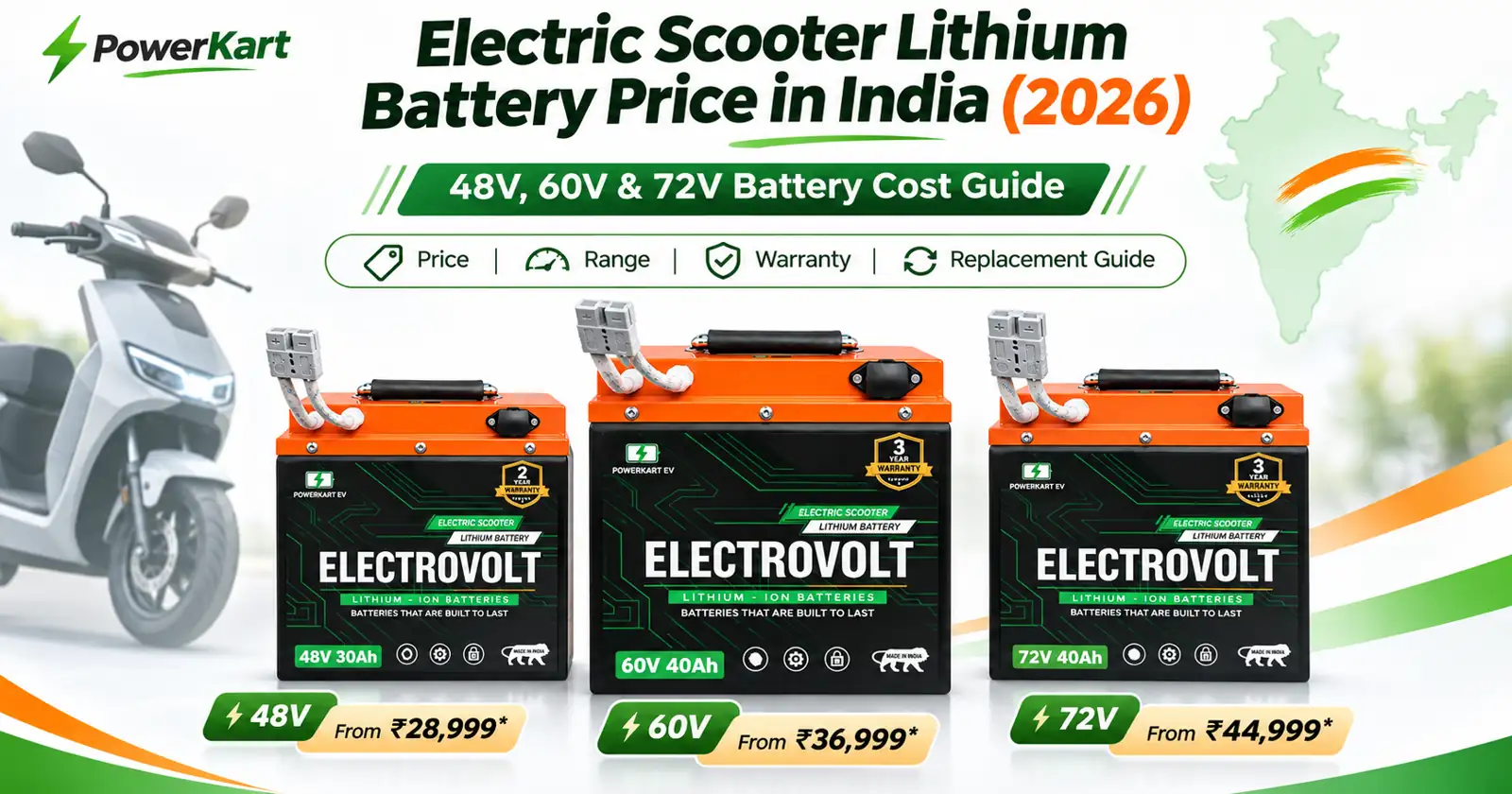
48V, 60V & 72V Battery Cost Guide
Planning to replace your electric scooter battery? Before spending ₹25,000, ₹35,000 or even more on a new lithium battery, it is important to understand what you are actually paying for.
Electric scooter lithium battery prices in India vary depending on battery voltage, Ah capacity, cell chemistry, quality of the Battery Management System (BMS), warranty and scooter compatibility.
A 60V 32Ah battery and a 72V 40Ah battery may look similar from the outside, but their energy storage capacities, electrical requirements and prices are different.
In this 2026 buying guide, we explain the electric scooter lithium-ion battery price in India, compare popular battery capacities, discuss replacement costs and help you choose a suitable battery for everyday commuting.
1. Electric Scooter Lithium Battery Price in India – 2026
The cost of an electric scooter lithium battery depends mainly on how much energy it stores and how the battery pack is constructed.
Smaller 48V battery packs generally require less stored energy than higher-capacity 60V or 72V batteries. However, a higher voltage does not automatically mean a better battery.
Here are actual examples from the PowerKart electric scooter battery range.
Electric Scooter Lithium Battery Price List – 2026
| Battery specification | Nominal energy | Listed price |
| 60V 32Ah NMC – 2-year warranty | 1.92 kWh | ₹27,044 |
| 60V 32Ah NMC – 3-year warranty | 1.92 kWh | ₹31,000 |
| 60V 40Ah NMC – 2-year warranty | 2.40 kWh | ₹33,407 |
| 60V 40Ah NMC – 3-year warranty | 2.40 kWh | ₹40,452 |
| 72V 30Ah NMC – 2-year warranty | 2.16 kWh | ₹29,249 |
| 72V 40Ah NMC – 2-year warranty | 2.88 kWh | ₹36,000 |
Prices are examples observed on PowerKart in November 2026 and may change with offers, stock availability and product updates. Confirm the latest price and specifications on the product page.
These prices demonstrate why it is important to compare more than voltage and Ah capacity.
A battery with a higher price may offer more stored energy, additional warranty coverage or different pack components. The actual value depends on the complete specification.
Explore the available options: Buy Electric Scooter Lithium Batteries at PowerKart
2. What Determines the Price of an Electric Scooter Lithium Battery?
When comparing electric scooter battery prices online, two batteries with the same voltage and capacity may have noticeably different selling prices.
There are several reasons.
Battery cell quality
Lithium cells form the main energy-storage component of the battery.
Cell manufacturing quality, consistency, capacity and discharge capability influence the reliability and performance of the assembled pack.
Ask the seller about cell chemistry, specifications and whether the pack uses new, properly matched cells.
Battery voltage and capacity
Voltage (V) describes the battery’s electrical potential, while ampere-hours (Ah) indicate its charge capacity.
Together, they help estimate the battery’s stored energy.
Battery energy (Wh) = Nominal voltage (V) × Capacity (Ah)
For example:
- 60V × 32Ah = 1,920Wh or 1.92kWh
- 60V × 40Ah = 2,400Wh or 2.40kWh
- 72V × 30Ah = 2,160Wh or 2.16kWh
- 72V × 40Ah = 2,880Wh or 2.88kWh
A battery with more usable energy can generally support greater riding distance under comparable operating conditions.
Battery Management System (BMS)
The BMS is an important safety component of a lithium-ion battery.
Depending on its design, it monitors cell voltage, charging, discharging, temperature and other operating conditions.
A properly selected BMS helps protect the battery against electrical conditions such as overcharging, deep discharge, excessive current and short circuits.
The BMS must also be rated for the current demanded by the scooter motor and controller.
Battery casing and connectors
A durable enclosure protects the battery’s internal components against ordinary handling and vibration.
Connector quality, cable sizing and mechanical fitment also matter.
A battery that fits physically but has an unsuitable connector or electrical rating is not a safe replacement.
Warranty and service support
Some batteries are offered with different warranty durations.
A 3-year warranty may be valuable for customers planning to retain their electric scooter for several years, provided the warranty terms offer meaningful coverage.
PowerKart offers selected Electrovolt NMC electric scooter batteries with 2-year or 3-year warranty options and has service support in Bangalore.
3. 48V vs 60V vs 72V Lithium Battery – Which Is Better?
One of the most important questions when buying a replacement electric scooter battery is whether to choose a 48V, 60V or 72V pack.
The answer depends on the electrical system of your scooter.
| Battery voltage | Typical consideration |
| 48V | Suitable for scooters designed for compatible 48V battery systems |
| 60V | Used in scooters with compatible 60V controllers and charging systems |
| 72V | Used in scooters designed for compatible higher-voltage battery systems |
A 72V battery is not automatically an upgrade for a scooter that originally uses 60V.
Installing a battery with an unsuitable voltage can damage the controller, charger or other electrical components.
Always match the replacement battery to your scooter’s approved voltage range.
Also remember that two packs with the same voltage can store different amounts of energy. For example, a 60V 40Ah battery stores more nominal energy than a 60V 30Ah battery.
4. How Much Range Can a 60V or 72V Lithium Scooter Battery Provide?
Battery range is one of the most searched and misunderstood topics among electric scooter owners.
The distance an electric scooter can travel depends not only on battery capacity but also on motor efficiency, road conditions and riding habits.
PowerKart provides the following indicative range estimates for selected Electrovolt batteries used with compatible Okinawa scooters.
| Battery | PowerKart’s estimated city range |
| 60V 32Ah NMC | 40–45 km |
| 60V 40Ah NMC | 50–60 km |
| 72V 30Ah NMC | 50–60 km |
| 72V 40Ah NMC | 70–80 km |
These are product-specific estimates based on steady city riding at approximately 30–40 km/h, not guaranteed or independently tested ranges. Actual results vary by scooter model and operating conditions.
Why does electric scooter battery mileage decrease?
Common reasons include:
- Frequent rapid acceleration and braking
- Higher riding speeds
- Heavy rider or luggage weight
- Low tyre pressure
- Steep roads and uneven terrain
- Battery ageing and capacity reduction
- Electrical or mechanical inefficiencies
A useful comparison method is to look at the battery’s energy capacity in kWh rather than comparing Ah alone.
For example, a 72V 30Ah battery stores approximately 2.16kWh, while a 60V 40Ah battery stores approximately 2.40kWh.
However, their actual riding ranges may differ because they can be used in different scooter systems.
5. Electric Scooter Battery Replacement Cost in India
The cost of replacing an electric scooter battery depends on whether the scooter uses a removable battery, an integrated OEM battery pack or a battery that requires a specialist replacement.
For scooters with compatible removable battery systems, replacement may involve purchasing a suitable battery with matching connectors, voltage and dimensions.
For integrated battery systems, replacement can be more complicated.
Models from manufacturers such as Ola, Ather and TVS may use proprietary enclosures, electronic communication and battery management arrangements.
An aftermarket 60V or 72V battery should not be assumed to fit these scooters merely because its voltage or energy rating appears similar.
What should you check before replacing your EV scooter battery?
- Existing battery nominal voltage and chemistry
- Current battery Ah capacity
- Charging voltage and charger specifications
- Maximum continuous and peak discharge current
- Battery dimensions and available compartment space
- Charge and discharge connector configuration
- Controller compatibility and communication requirements
- Warranty terms and installation requirements
A suitable replacement must match the electrical requirements of the vehicle, not just fit inside the battery compartment.
If your existing pack has developed a fault, ask a qualified battery technician whether it requires repair or complete replacement.
6. NMC vs LiFePO4 Battery for Electric Scooters
Two widely used lithium battery chemistries are NMC and LiFePO4 (LFP).
Both are rechargeable lithium-ion technologies, but their characteristics differ.
| Feature | NMC lithium-ion | LiFePO4 (LFP) |
| Energy density | Generally higher | Generally lower |
| Weight for similar energy | Often lower | Often higher |
| Thermal stability | Requires careful thermal and electrical management | Generally more thermally stable |
| Cycle-life potential | Depends on specific cell and operating conditions | Often favourable for repeated deep cycling |
| Voltage per cell | Typically around 3.6–3.7V nominal | Typically around 3.2V nominal |
| Scooter suitability | Common in compact EV traction batteries | Suitable where the system is designed for LFP |
The chemistry affects the battery’s voltage profile and charging requirements.
Never replace an NMC pack with an LFP pack, or vice versa, without verifying the entire electrical configuration.
PowerKart’s selected Electrovolt 60V and 72V scooter batteries use NMC cell chemistry.
7. Is a 30Ah or 40Ah Lithium Battery Better for an Electric Scooter?
Suppose your scooter supports a 60V battery.
You are comparing:
- 60V 30Ah – approximately 1.80kWh
- 60V 32Ah – approximately 1.92kWh
- 60V 40Ah – approximately 2.40kWh
At the same nominal voltage, the 40Ah battery stores approximately 25% more energy than the 32Ah battery.
This can provide a useful range advantage if the battery and scooter are otherwise comparable.
However, a higher-capacity battery may be larger, heavier or more expensive.
Before upgrading from 30Ah to 40Ah, confirm that the battery fits the scooter, provides the required discharge current and uses compatible charging and electrical connections.
Buying the highest Ah battery is not always necessary. Buying the correct battery for your scooter is more important.
8. How Long Does It Take to Charge an Electric Scooter Lithium Battery?
Charging time depends mainly on battery capacity, charger output current, the initial state of charge and the battery’s charging limits.
A simplified estimate is:
Charging time (hours) ≈ Battery capacity (Ah) ÷ Charger current (A)
For example, a 40Ah battery charged at a constant 5A would theoretically require 8 hours to receive 40Ah.
At 10A, the constant-current calculation gives 4 hours.
Actual full charging normally takes longer because the charging current decreases near full charge.
The charger must match the battery’s chemistry, series-cell configuration, full-charge voltage and maximum permitted charging current.
A charger designed for one 60V or 72V battery should not automatically be considered compatible with another battery carrying the same nominal-voltage label.
9. Is a Lithium Battery Better Than a Lead-Acid Battery for Electric Scooters?
Lithium-ion batteries offer several practical advantages over conventional lead-acid batteries when the vehicle is designed or correctly converted to use them.
Lower weight
Lithium battery packs can store comparable energy with substantially less weight than lead-acid alternatives.
This is useful for scooters where space and weight are limited.
More usable energy
Lead-acid battery performance can be affected significantly by discharge rate and depth of discharge.
A correctly designed lithium-ion battery often offers a larger usable proportion of its rated energy.
Reduced routine maintenance
Sealed lithium battery packs do not require electrolyte topping up.
However, the connectors, charging system and battery condition still require appropriate care.
Potentially longer service life
Lithium-ion batteries can offer good cycle life, depending on chemistry, cell quality and operating conditions.
Actual lifespan varies and should never be judged by chemistry alone.
Important: A lithium battery conversion requires compatible charging equipment, electrical protection and vehicle components. It should not be treated as a simple plug-and-play swap.
10. How Much Does an Electric Scooter Lithium Battery Cost Per kWh?
Comparing battery price per kWh can help buyers understand how much they are paying for nominal energy storage.
For example, consider two PowerKart battery listings:
| Battery | Price | Approx. price per nominal kWh |
| 60V 32Ah – 2Y | ₹26,990 | ₹14,057 |
| 72V 40Ah – 2Y | ₹36,000 | ₹12,500 |
The calculation is straightforward:
Battery price ÷ Nominal energy capacity (kWh)
The 72V 40Ah battery has a lower listed price per nominal kWh in this example.
But that does not automatically make it a better choice for every scooter.
Battery cell quality, usable capacity, BMS specifications, warranty and vehicle compatibility remain important.
The price-per-kWh calculation is a comparison tool, not a complete measure of battery quality.
11. Where Can You Buy an Electric Scooter Lithium Battery Online in India?
Buying an EV scooter battery online can save time, but the seller should provide clear technical information and after-sales support.
Before placing an order, look for:
- Clearly stated battery voltage and capacity
- Battery chemistry and BMS specifications
- Actual product photographs and dimensions
- Warranty period and coverage information
- Compatible charging requirements
- Transparent delivery charges
- Service or repair assistance
PowerKart offers Electrovolt NMC lithium-ion scooter batteries in selected 60V and 72V capacities, including removable hard-case designs.
Customers can compare available models, prices and warranty options before placing an order.
Explore Electric Scooter Lithium Batteries on PowerKart
12. Frequently Asked Questions
What is the price of a 60V 32Ah lithium battery in India?
PowerKart lists selected 60V 32Ah NMC electric scooter batteries at approximately ₹27,000 for the 2-year warranty version and ₹31,000 for the 3-year warranty version. Prices may vary, so check the current product listing before purchasing.
What is the price of a 72V 40Ah lithium battery for an electric scooter?
PowerKart lists its Electrovolt 72V 40Ah NMC lithium-ion scooter battery with a 2-year warranty at ₹36,000. The battery has approximately 2.88kWh of nominal stored energy and is intended for compatible 72V scooter systems.
Can a 60V lithium battery replace a 60V lead-acid battery?
It may be possible in a compatible scooter, but the controller, charger, wiring, current limits and battery mounting must be checked. A lithium battery should not be connected using an incompatible lead-acid charging system.
Does a higher Ah battery increase electric scooter range?
A higher Ah rating means more charge capacity. At the same nominal voltage, it generally means more stored energy and can increase riding range. The actual improvement depends on scooter efficiency and operating conditions.
How many years does an electric scooter lithium battery last?
There is no fixed lifespan for every electric scooter lithium battery. Battery life depends on cell chemistry, temperature, cycle count, charging habits, discharge current and storage conditions. Always compare the manufacturer’s cycle-life specification and warranty terms.
Can I install a 72V battery in a 60V electric scooter?
Not as a direct replacement unless the controller, charger and complete electrical system are specifically designed to support the higher battery voltage. An incompatible voltage can damage electrical components and create safety risks.
Which electric scooter battery is better: 30Ah or 40Ah?
A 40Ah battery stores more energy than a 30Ah battery at the same nominal voltage. However, the correct choice depends on battery dimensions, scooter compatibility, range requirement, weight and budget.
Is buying a lithium battery online safe?
Buying online can be convenient when the seller provides reliable specifications, verified compatibility, suitable shipping arrangements and warranty information. Installation and charging must still follow the battery manufacturer’s safety instructions.
Final Verdict: Which Electric Scooter Lithium Battery Should You Buy in 2026?
The best electric scooter lithium battery is not necessarily the cheapest or the one with the highest Ah rating.
For everyday city commuting, choose a battery that matches the scooter’s electrical system and provides sufficient usable energy for your riding distance.
A 60V 32Ah battery may be appropriate for a compatible scooter with moderate daily travel needs.
A 60V 40Ah battery offers additional nominal energy for riders seeking more range within a compatible 60V system.
A 72V 30Ah or 72V 40Ah battery may be suitable for vehicles specifically designed for a compatible 72V system.
Before purchasing, compare battery price, voltage, capacity, cell chemistry, BMS current rating, charging requirements, warranty and after-sales support.
At PowerKart, customers can explore a range of Electrovolt lithium-ion batteries for electric scooters, with selected models offering 2-year and 3-year warranty options and Bangalore-based service support.
Looking for a replacement electric scooter lithium battery?
Compare 60V and 72V Electric Scooter Batteries at PowerKart
Choose a battery that fits your scooter, your daily riding needs and your budget.