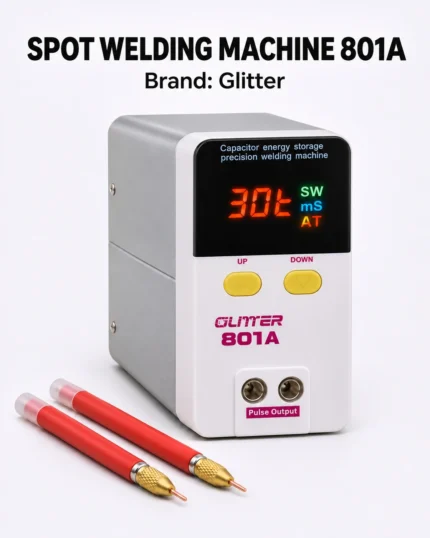
The GLITTER 801A+ capacitor battery spot welder is designed for joining nickel strips and battery tabs during lithium battery-pack manufacturing and repair.
The machine stores electrical energy in its internal capacitors and releases that stored energy as a short, high-current welding pulse.
This allows strong spot welds to be produced without requiring the AC mains supply to continuously deliver the machine’s full peak welding power.
The 801A+ also adds a useful battery voltage measurement function, allowing it to work as a spot welder and basic DC battery-voltage tester in one machine.
58J Welding Energy & 11.6kW Peak Pulse Power
The GLITTER 801A+ is specified for:
- Maximum Welding Energy: 58J
- Peak Pulse Power: 11.6kW
These values describe the short-duration welding pulse produced from stored capacitor energy.
11.6kW is peak pulse power and should not be interpreted as continuous AC mains consumption.
Capacitor Energy Storage Technology
The 801A+ uses capacitor energy-storage pulse welding technology.
The capacitors are charged first, and the stored energy is then released rapidly through the welding pen.
Benefits
- Short welding duration
- Concentrated welding energy
- Reduced continuous load on the electrical supply
- Adjustable weld strength
- Repeatable welding after correct setup
- Suitable for battery nickel-strip welding
- Reduced unnecessary heating compared with prolonged welding
Correct settings still depend on strip material, thickness, electrode condition and applied pressure.
0–99T Adjustable Welding Level
The welding output can be adjusted through a 0–99T energy setting range.
The pulse duration is specified at approximately:
0–5ms
This adjustment allows the operator to optimise the weld for different materials and thicknesses.
Welding Strength Depends On
- Nickel-strip material
- Strip thickness
- Strip width
- Electrode pressure
- Electrode spacing
- Welding-tip condition
- Battery terminal material
- Surface cleanliness
Always perform test welds before welding production battery packs.
Pure Nickel & Nickel-Plated Strip Welding
Published specifications for the 801A+ with 70A welding pen give the following practical welding range:
| Material |
Published Welding Thickness |
| Pure Nickel |
Approx. 0.05–0.15mm |
| Nickel-Plated Steel |
Approx. 0.05–0.20mm |
| Fixed-seat Butt Welding |
Up to approx. 0.30mm |
These figures are reference limits rather than guaranteed results because actual weld quality depends on material, tip pressure, welding setting and workpiece construction.
70A Separated Welding Pen
The product is supplied with a 70A separated-style welding pen.
The two independent welding probes make it easier to position weld points manually on battery strips.
Suitable For
- Battery repair
- Battery-pack manufacturing
- Custom battery layouts
- Prototype battery packs
- Hard-to-reach welding positions
- Manual positioning of individual weld points
Important: “70A” is the welding-pen model designation and should not be confused with a 70-amp output-current specification.
AT Automatic Welding Mode
The 801A+ uses AT automatic triggering.
In AT mode, the welding pulse is automatically initiated after the welding tips make proper contact with the workpiece.
This is useful for repetitive battery welding because a separate trigger does not need to be operated for every weld.
The 801A+ specifications I verified list AT mode, rather than the AT/MT dual-mode arrangement found on some higher GLITTER models.
Built-in Battery Voltage Meter
A major feature of the GLITTER 801A+ is its integrated DC voltage measurement function.
The specified measurement range is:
0–199V DC
This can be useful during battery pack assembly and servicing for checking:
- Battery-pack voltage
- Module voltage
- Cell-group voltage where appropriate
- General DC voltage during battery repair
It should be treated as a convenient integrated voltage-testing feature rather than a replacement for a full-featured professional multimeter.
Digital Display
The front digital display provides information for setting and monitoring operation.
The machine provides controls for adjusting welding energy while also supporting its voltage-measurement function.
This makes it easier to set welding parameters compared with basic spot welders without a digital interface.
Power Supply & Charging
The published electrical specifications include:
- AC Adapter Input: 100–240V AC, 50/60Hz
- Adapter Output: Approx. 15V / 1.3A
- Welding Output Voltage: Approx. 5–5.8V
- Initial Capacitor Charging Time: Approximately 30–40 minutes
Charging time can vary somewhat with operating conditions and the supplied adapter.
Suitable Battery Cells
The GLITTER 801A+ can be used during pack assembly with compatible cylindrical battery formats such as:
- 18650 cells
- 21700 cells
- 26650 cells
- 32650 / 32700-class cells
- Other compatible cylindrical lithium cells
- Custom lithium battery packs
The cell format itself does not determine the correct welding setting. Strip material and thickness must also be considered.
Suitable Applications
The GLITTER 801A+ may be used for:
- Lithium battery pack manufacturing
- Electric scooter battery repair
- EV battery assembly
- 18650 battery-pack building
- 21700 battery-pack building
- LiFePO4 battery assembly
- Solar battery manufacturing
- Home inverter lithium batteries
- UPS battery packs
- Power-tool battery repair
- Battery R&D
- Custom battery projects
- Nickel-strip spot welding
It can also weld certain compatible thin metals when the material and thickness fall within the machine’s specified capability.
Technical Specifications
| Specification |
Details |
| Brand |
GLITTER |
| Model |
801A+ |
| Product Type |
Capacitor Energy Storage Spot Welder |
| Peak Welding Energy |
58J |
| Peak Pulse Power |
11.6kW |
| Welding Level |
0–99T |
| Pulse Time |
0–5ms |
| Trigger Mode |
AT Automatic |
| Welding Pen |
70A Separated Welding Pen |
| Output Voltage |
Approx. 5–5.8V DC |
| Voltage Measurement |
0–199V DC |
| Adapter Input |
AC 100–240V, 50/60Hz |
| Adapter Output |
Approx. 15V / 1.3A |
| Pure Nickel Welding |
Approx. 0.05–0.15mm |
| Nickel-Plated Welding |
Approx. 0.05–0.20mm |
| Fixed-seat Butt Welding |
Up to approx. 0.30mm |
| Initial Charging Time |
Approx. 30–40 minutes |
| Welding Technology |
Capacitor Energy Storage Pulse |
| Application |
Battery Tab / Nickel Strip Welding |
Specifications above are supported by current GLITTER 801A+ documentation and established product listings.
Compatibility Check Before Ordering
Before purchasing, verify:
- Required welding material
- Nickel-strip thickness
- Pure nickel or nickel-plated strip
- Battery cell type
- Required welding strength
- 70A welding-pen requirement
- AC input compatibility
- Required voltage-testing range
- Expected production volume
- Exact accessories supplied with the kit
If you regularly need to weld substantially thicker pure nickel, consider a higher-energy GLITTER model instead of simply increasing the 801A+ welding setting to maximum.
Safety Instructions
- Wear suitable eye protection during welding.
- Keep flammable materials away from the welding area.
- Never weld swollen, leaking or damaged lithium cells.
- Start with a lower welding setting and increase gradually.
- Avoid repeatedly welding the same point on a battery terminal.
- Stop if a cell becomes abnormally hot.
- Keep welding tips clean and correctly tightened.
- Never intentionally short the welding electrodes.
- Disconnect power before servicing the machine.
- Keep the unit dry and away from conductive metal debris.
- Use only a compatible power adapter.
- Ensure exposed battery terminals cannot accidentally short.
- Battery welding should be performed by someone familiar with lithium battery safety.
Warranty
Warranty is subject to the applicable seller or manufacturer terms.
Damage caused by incorrect power supply, physical damage, misuse, unauthorized repair, excessive welding conditions or improper operation may not be covered.
Package Includes
Typical GLITTER 801A+ with 70A Welding Pen package may include:
- 1 × GLITTER 801A+ Capacitor Energy Storage Spot Welder
- 1 × 70A Separated Welding Pen
- Power adapter
- Welding electrodes / tips
- Voltage measuring leads
- Supporting accessories supplied with the selected kit
Exact package contents can vary between kit versions, so the supplied accessories should be confirmed before ordering.
FAQs
1. What welding setting should I use on the GLITTER 801A for nickel strip?
The correct setting depends on the nickel type and thickness. GLITTER provides adjustable 0–99T energy levels, and the manufacturer recommends starting lower and increasing gradually until the weld is strong without burning the strip or overheating the cell.
2. How do I know if the spot weld on a battery cell is good?
A good weld should hold the nickel strip firmly without excessive blackening, sparking or burning through the strip. A simple peel test can be used—the strip should resist removal and normally deform or tear around the weld points rather than lift off cleanly
3. Why is my GLITTER 801A spot weld weak?
Weak welds can result from dirty or oxidized welding pins, insufficient electrode pressure, incorrect energy settings, low capacitor voltage or using nickel that is too thick for the selected setting. Clean the tips, check contact pressure and increase the welding level gradually.
4. Does the GLITTER 801A work automatically or need a foot pedal?
The 801A uses AT automatic triggering. Once the welding probes make proper contact with the workpiece, the machine automatically triggers the welding pulse, so a foot pedal is generally not required for normal operation.
5. What is the difference between GLITTER 801A and 801A+?
Both are capacitor-energy battery spot welders, but the 801A+ adds an integrated DC battery voltage measurement function, while the standard 801A is primarily the welding model. Both are listed with approximately 40-minute initial charging time in GLITTER’s model comparison documentation.