
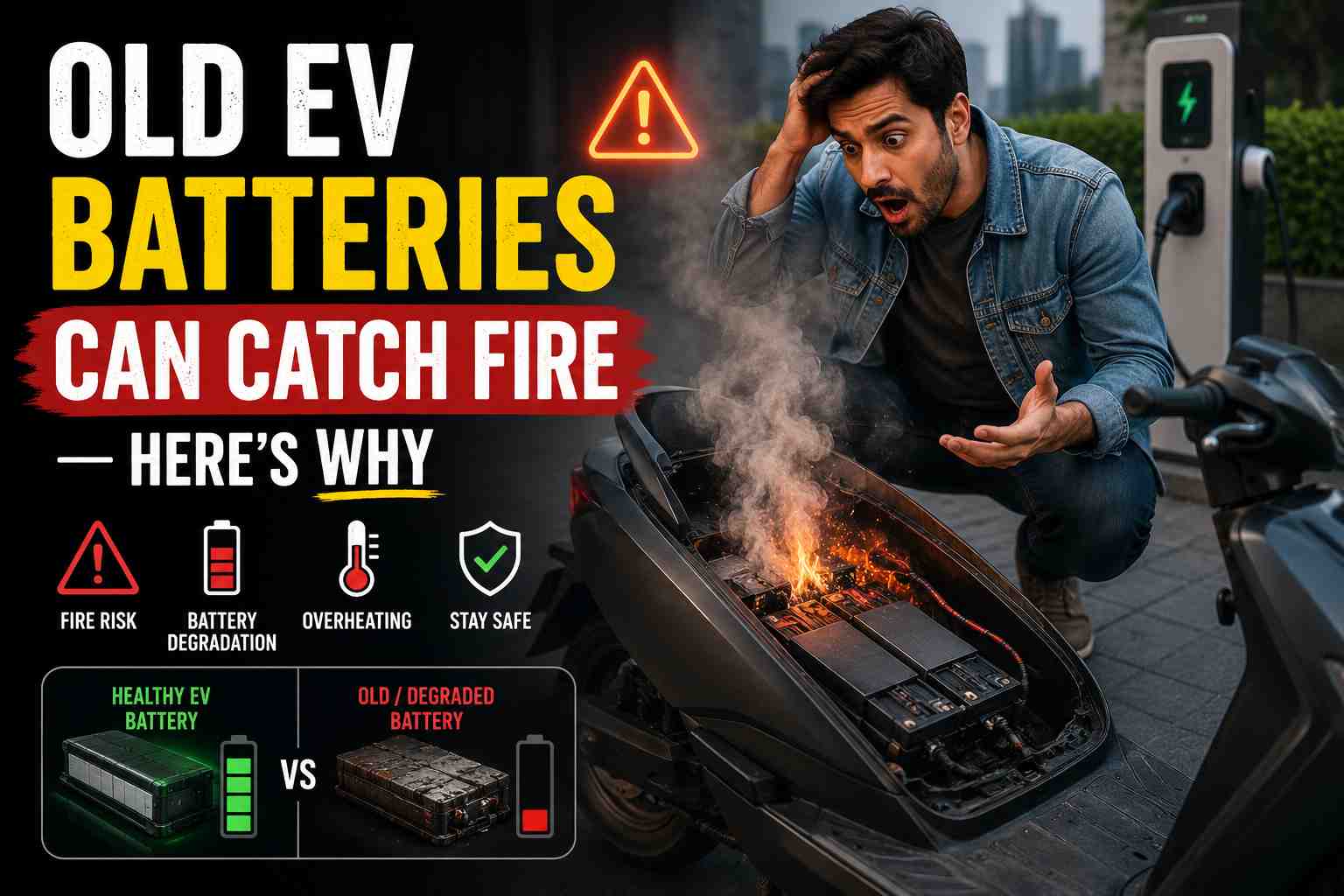
Electric vehicles are becoming a common part of everyday transportation, from personal cars to electric scooters used for daily commuting. At the heart of every electric vehicle is a battery system responsible for storing and delivering energy efficiently. Most modern EVs rely on a lithium ion battery, a technology known for its high energy density, long lifespan, and ability to support fast charging.
While lithium-ion technology has made electric mobility practical and reliable, many vehicle owners eventually begin asking an important question:
Can an old EV battery become a fire risk?
The answer is more complex than a simple yes or no.
An aging EV lithium battery does not automatically become dangerous. In fact, the vast majority of electric vehicle batteries operate safely for many years. However, as batteries age, internal wear, heat exposure, charging stress, and physical damage can increase the likelihood of certain battery-related problems.
Understanding why older batteries can become vulnerable to failure is important for every EV owner. Whether you drive an electric car or use a lithium ion battery for electric scooter transportation, knowing how batteries age can help you recognize warning signs early and make informed maintenance decisions.
In this guide, we’ll explore why old EV batteries can sometimes catch fire, how lithium battery degradation affects safety, and what steps owners can take to reduce risks and extend battery life.
How Lithium-Ion Batteries Work
To understand why battery fires sometimes occur, it helps to understand how a lithium ion battery stores energy.
Inside a battery pack are multiple battery cells. Each cell contains materials that allow lithium ions to move between positive and negative electrodes during charging and discharging.
When you charge your vehicle:
- Energy is stored inside the battery cells.
- Lithium ions move in one direction.
- The battery becomes ready to power the vehicle.
When you drive:
- The stored energy is released.
- Lithium ions move in the opposite direction.
- Electricity powers the motor.
This process occurs thousands of times throughout the battery’s life.
A modern EV lithium battery is designed with multiple safety systems to ensure these chemical reactions remain stable and controlled. However, after years of charging cycles and environmental exposure, the internal components begin to age.
This aging process is known as battery degradation.
Why Batteries Change as They Age
Every rechargeable lithium battery gradually loses capacity over time.
This happens because the chemical reactions that store and release energy slowly alter the internal structure of the battery cells.
When the battery is new:
- Cells operate efficiently.
- Heat generation remains low.
- Energy storage is close to maximum capacity.
As the battery ages:
- Internal resistance increases.
- Capacity decreases.
- Heat generation becomes more common.
- Charging efficiency may decline.
Most of the time, these changes simply result in reduced driving range and lower battery performance.
For example, an electric scooter equipped with a lithium ion battery for electric scooter applications may initially travel 80 kilometers on a full charge. After several years of use, the same battery might only provide 60 kilometers of range.
This reduction in performance is normal.
However, severe degradation can sometimes contribute to conditions that increase battery stress and create potential safety concerns.
Why Older EV Batteries Behave Differently
One of the biggest misconceptions about battery fires is that they occur suddenly without warning.
In reality, many battery-related problems develop gradually.
As an EV lithium battery ages, microscopic changes begin forming inside individual cells. Repeated charging cycles, high temperatures, and years of usage can slowly weaken internal materials.
Most aging batteries remain safe throughout their service life.
However, older batteries are more likely to experience:
- Increased internal resistance
- Cell imbalance
- Reduced cooling efficiency
- Higher operating temperatures
- Greater sensitivity to charging stress
These factors do not guarantee a fire will occur. Instead, they increase the importance of monitoring battery condition and addressing potential issues before they become serious.
This is one reason battery health assessments have become increasingly important for electric vehicle owners. Understanding the condition of a battery provides valuable insight into how well it is aging and whether further inspection may be needed. If you’re unsure about your battery’s current condition, you can use Powerkart’s EV Battery Health Calculator to estimate battery health, track degradation, and gain a better understanding of overall battery performance.
What Actually Causes an EV Battery Fire?
Many people assume that an old battery catches fire simply because it has reached a certain age.
In reality, age alone is rarely the direct cause.
Most battery fires occur when multiple factors combine to create unsafe conditions inside the battery pack.
Thermal Runaway
The most common cause of a lithium-ion battery fire is a process known as thermal runaway.
Thermal runaway occurs when a battery cell begins generating heat faster than it can safely dissipate it.
As temperature rises:
- Internal battery materials begin breaking down.
- More heat is produced.
- Neighboring cells become affected.
- The reaction spreads through the battery pack.
Once thermal runaway starts, it can rapidly escalate and become extremely difficult to control.
This is why battery manufacturers invest heavily in cooling systems, thermal protection, and advanced battery management technology.
Internal Short Circuits
A lithium-ion battery contains extremely thin internal layers that separate positive and negative components.
Over time, manufacturing defects, contamination, severe degradation, or physical damage can compromise these protective layers.
When the layers fail, an internal short circuit may occur.
This creates a direct pathway for energy release inside the cell, generating intense heat and potentially triggering thermal runaway.
Although modern batteries include multiple safeguards, severe internal damage can still create safety risks.
Excessive Heat Exposure
Heat is one of the biggest enemies of any lithium battery.
Vehicles regularly exposed to extremely high temperatures often experience faster battery aging.
Over time, excessive heat can:
- Accelerate battery degradation
- Increase internal resistance
- Reduce cooling efficiency
- Place additional stress on battery cells
While occasional heat exposure is unlikely to create immediate danger, years of operation in hot environments can contribute to long-term battery wear.
Physical Damage
A battery pack may appear normal from the outside while hiding internal damage.
Examples include:
- Road accidents
- Impact damage
- Flood exposure
- Improper battery repairs
- Incorrect battery installation
Even relatively minor damage can sometimes affect internal battery components.
In some situations, problems may not become visible until weeks or months after the initial incident.
This is why professional inspection is recommended whenever an EV battery experiences significant impact or water exposure.
Are Electric Scooter Batteries Also at Risk?
The same principles apply to a lithium ion battery for electric scooter applications.
Electric scooters often experience:
- Daily charging cycles
- Frequent stop-and-go usage
- Outdoor parking
- Exposure to rain and temperature changes
As scooter batteries age, battery cells gradually lose capacity and efficiency.
Most older scooter batteries simply provide shorter range and slower performance.
However, damaged, poorly maintained, or heavily degraded batteries can become more vulnerable to overheating.
Common warning signs include:
- Excessive heat while charging
- Battery swelling
- Reduced charging efficiency
- Rapid battery drain
- Unusual smells
Owners should never ignore these symptoms.
A battery that behaves abnormally should be inspected before further use.
Warning Signs That Should Never Be Ignored
Battery fires are uncommon, but warning signs often appear before a serious problem develops.
Unusual Heating
A battery naturally becomes warm during operation.
However, if the battery becomes excessively hot while charging or driving, it may indicate an underlying issue.
Swelling or Expansion
Battery swelling is one of the most serious warning signs.
A swollen lithium battery should never be ignored.
Expansion often indicates internal chemical breakdown that can compromise battery safety.
Strong Chemical Odors
A damaged battery may release unusual chemical smells.
Any burning odor or strong chemical scent should be treated as a potential safety concern.
Sudden Performance Changes
Unexpected battery behavior may indicate internal problems.
Examples include:
- Rapid battery drain
- Charging interruptions
- Significant range loss
- Sudden voltage fluctuations
While these symptoms do not always indicate a fire risk, they deserve professional evaluation.
Why Monitoring Battery Health Matters
Many battery-related issues develop gradually rather than suddenly.
This is why regular battery health monitoring is important.
Battery health assessments help identify:
- Unusual degradation patterns
- Capacity loss
- Cell imbalance
- Charging abnormalities
- Potential performance concerns
If you’re unsure about your battery’s condition, using an EV Battery Health Calculator can provide useful insight into how your battery is aging and whether further inspection may be beneficial.
Rather than waiting for noticeable problems to appear, monitoring battery health allows owners to take a proactive approach to battery maintenance.
How to Reduce the Risk of Battery Problems
The good news is that most battery-related issues can be minimized through proper maintenance and responsible charging habits.
Follow Smart Charging Practices
Charging behavior plays a major role in battery longevity. Many battery-related problems can be prevented by adopting proper charging habits and avoiding common charging mistakes that place unnecessary stress on battery cells. Learning which practices to avoid can help preserve battery health, improve performance, and reduce long-term degradation.
Charging behavior plays a major role in battery longevity.
To reduce battery stress:
- Avoid unnecessary exposure to extreme charge levels.
- Use manufacturer-approved chargers.
- Avoid excessive heat during charging.
- Follow recommended charging guidelines.
Good charging habits not only improve battery lifespan but can also help maintain battery safety over the long term.
Keep Software Updated
Modern EVs use sophisticated Battery Management Systems (BMS).
Manufacturers frequently release updates that improve:
- Battery monitoring
- Thermal management
- Charging efficiency
- Safety protections
Installing these updates helps ensure your vehicle benefits from the latest battery-management improvements.
Address Problems Early
Small battery issues are often easier and less expensive to resolve than major failures.
If you notice:
- Excessive battery heating
- Charging irregularities
- Swelling
- Sudden range loss
it is advisable to seek professional evaluation as soon as possible.
Understand When Repair Is Possible
Many EV owners assume battery replacement is the only solution when performance begins to decline.
However, some battery issues can be diagnosed and repaired without replacing the entire battery pack.
Understanding available repair options can help owners avoid unnecessary expenses and extend the useful life of their battery system.
What Happens to Old EV Batteries After Retirement?
When an EV lithium battery no longer provides sufficient range for vehicle use, its journey does not necessarily end.
Many retired batteries still retain a significant amount of usable energy.
These batteries are often repurposed for:
- Home energy storage systems
- Solar backup applications
- Commercial energy storage projects
- Grid-support solutions
Eventually, batteries may be recycled to recover valuable materials such as:
- Lithium
- Nickel
- Cobalt
- Copper
- Aluminum
Battery recycling helps reduce waste and supports the sustainable growth of the electric vehicle industry.
The Future of Lithium Battery Safety
Battery technology continues to evolve rapidly.
Researchers and manufacturers are developing new solutions designed to improve:
- Battery lifespan
- Charging performance
- Energy density
- Thermal stability
- Fire resistance
Future lithium-ion batteries and next-generation battery technologies are expected to deliver even higher levels of safety and reliability.
As battery management systems become more advanced, the ability to detect and prevent battery problems before they become dangerous will continue to improve.
Final Thoughts
Old EV batteries can become more vulnerable to problems as they age, but age alone does not automatically make a battery dangerous.
Most battery-related incidents occur when degradation, heat, physical damage, charging stress, and internal faults combine to create unsafe conditions.
Whether you own an electric car or use a lithium ion battery for electric scooter transportation, understanding how batteries age is one of the best ways to protect both safety and performance.
A well-maintained lithium battery can provide many years of reliable service. By following proper charging practices, monitoring battery health, responding to warning signs, and maintaining your EV lithium battery responsibly, you can significantly reduce risks while maximizing battery lifespan.
As electric mobility continues to expand, battery awareness will remain one of the most valuable tools for every EV owner.