1. Product Overview
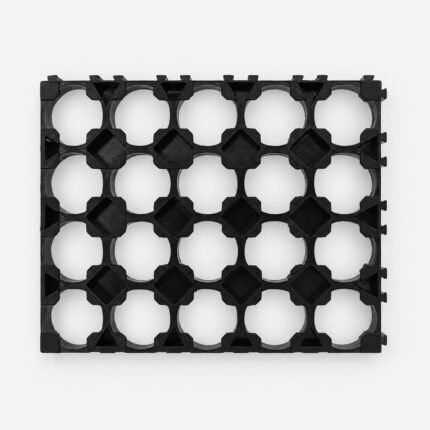
This 1×3 battery cell holder is designed to position three compatible cylindrical cells in a straight row. It helps keep the cells uniformly aligned and separated while assembling a custom battery pack.
The molded plastic structure provides mechanical support around each cell and helps reduce direct cell-to-cell contact. Its interlocking edge design may allow multiple holders to be joined together for larger series or parallel battery-pack layouts.
This product is a mechanical holder and spacer only. It does not contain electrical terminals, springs, wires or protection circuitry.
2. Technical Specifications
| Specification |
Details |
| Product type |
Cylindrical battery cell holder and spacer |
| Configuration |
1×3 |
| Cell capacity |
Three cells |
| Arrangement |
Single straight row |
| Material |
Molded plastic |
| Colour |
Black |
| Cell openings |
Three circular openings |
| Design |
Modular and interlocking |
| Electrical contacts |
Not included |
| Wiring |
Not included |
| Cell balancing |
Not applicable |
| BMS |
Not included |
| Battery cells |
Not included |
| Compatible cell diameter |
Must be verified before purchase |
| Installation type |
Battery-pack assembly component |
The cell size cannot be confirmed from the image alone. Measure the holder’s internal opening or check the seller specification before using it with 18650, 21700, 26650, 32140, 32700 or other cylindrical cells.
3. Visible Design Features
The holder includes:
- Three individual circular cell openings
- Straight 1×3 cell arrangement
- Raised outer support frame
- Reinforced dividers between adjacent cells
- Interlocking tabs along the outer edges
- Open construction around the cell body
- Compact and lightweight design
- Flat alignment suitable for structured pack assembly
The interlocking features can help connect compatible holders when constructing larger battery modules.
4. Key Benefits
This holder can help provide:
- Uniform cell spacing
- Improved cell alignment
- Reduced direct contact between adjacent cells
- More organised series and parallel layouts
- Space between cells for limited airflow
- Easier placement of nickel strips and insulation
- Better mechanical stability than loose cell assembly
- Consistent battery-pack dimensions
- Easier assembly and maintenance
The holder does not replace electrical insulation, fish paper, terminal rings, heat-resistant tape or other required battery-pack safety materials.
5. Suitable Applications
This three-cell holder may be used in compatible cylindrical-cell battery packs for:
- Electric bicycles and scooters
- Solar and energy-storage batteries
- Inverter and UPS battery packs
- Portable power systems
- Robotics projects
- Rechargeable lighting systems
- Power-tool battery projects
- DIY electronics
- Battery repair and rebuilding
- Prototype battery modules
- Custom series and parallel battery packs
Cell chemistry, voltage and pack configuration depend on the cells and electrical connections used. The holder itself does not determine the pack voltage or capacity.
6. Cell Compatibility
Before purchasing or assembling the pack:
- Confirm the exact internal diameter of each opening.
- Compare the opening diameter with the maximum diameter of the intended cell.
- Check whether the holder is designed for your specific cylindrical-cell size.
- Confirm that the upper and lower holders fit securely around the cells.
- Do not force oversized cells into the openings.
- Do not use a loose holder that cannot properly support the selected cells.
- Consider the thickness of cell wrapping and terminal insulation.
- Use matching holders on both ends of the cell group whenever required.
Cell dimensions can vary slightly between manufacturers, even when the cells share the same standard size designation.
7. Installation Guidance
- Inspect the holder for cracks, deformation or damaged locking tabs.
- Verify the cell size before beginning assembly.
- Insert each cell carefully without damaging its outer insulation sleeve.
- Maintain the correct polarity arrangement for the planned battery configuration.
- Use a matching holder on the opposite end of the cells when appropriate.
- Join additional compatible holders through the interlocking edges if required.
- Apply terminal insulation rings and fish paper where necessary.
- Complete electrical connections using correctly rated nickel, busbars or cables.
- Keep conductive materials away from exposed positive and negative terminals.
- Check the complete pack for stability before welding or final wrapping.
- Secure the completed assembly against vibration and movement.
8. Important Usage Note
This plastic component provides mechanical positioning only. It does not electrically connect the cells or protect the battery pack against overcharging, over-discharging, excessive current or short circuits.
A complete battery pack may additionally require:
- Correctly matched battery cells
- Pure nickel strips or suitable busbars
- Spot welding
- Battery management system
- Balance and sensing wires
- Terminal insulation rings
- Fish paper or other electrical insulation
- Heat-resistant tape
- Output cables and connectors
- Fuse
- Protective enclosure or heat-shrink sleeve
- Cushioning and vibration protection
Select every component according to the battery chemistry, voltage, capacity and maximum current.
9. Safety Information
- Confirm the holder size before inserting battery cells.
- Do not use cracked, melted or damaged holders.
- Never force a cell into an undersized opening.
- Avoid damaging the cell’s insulating sleeve during assembly.
- Do not allow the holder to cover or interfere with safety vents.
- Keep metal tools and loose conductive objects away from exposed terminals.
- Verify cell polarity before spot welding.
- Do not solder directly to cells unless specifically permitted by the cell manufacturer.
- Use appropriate insulation around all exposed electrical connections.
- Keep the finished battery pack away from water, excessive heat and conductive dust.
- Battery-pack assembly should be performed by someone familiar with lithium-battery construction and safety.