1. Product Overview
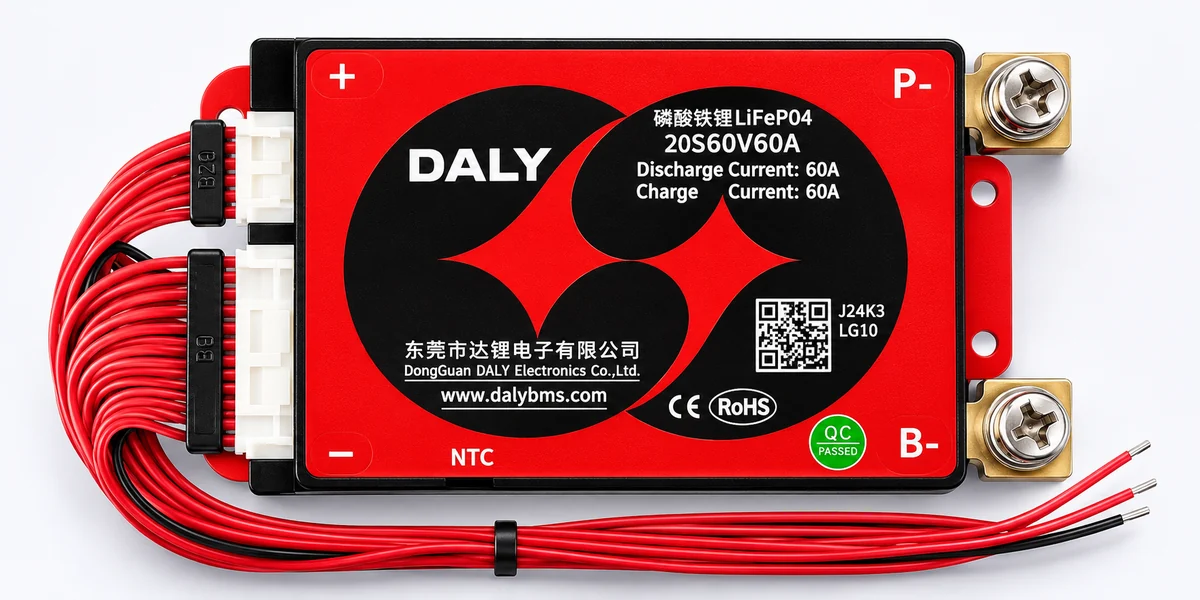
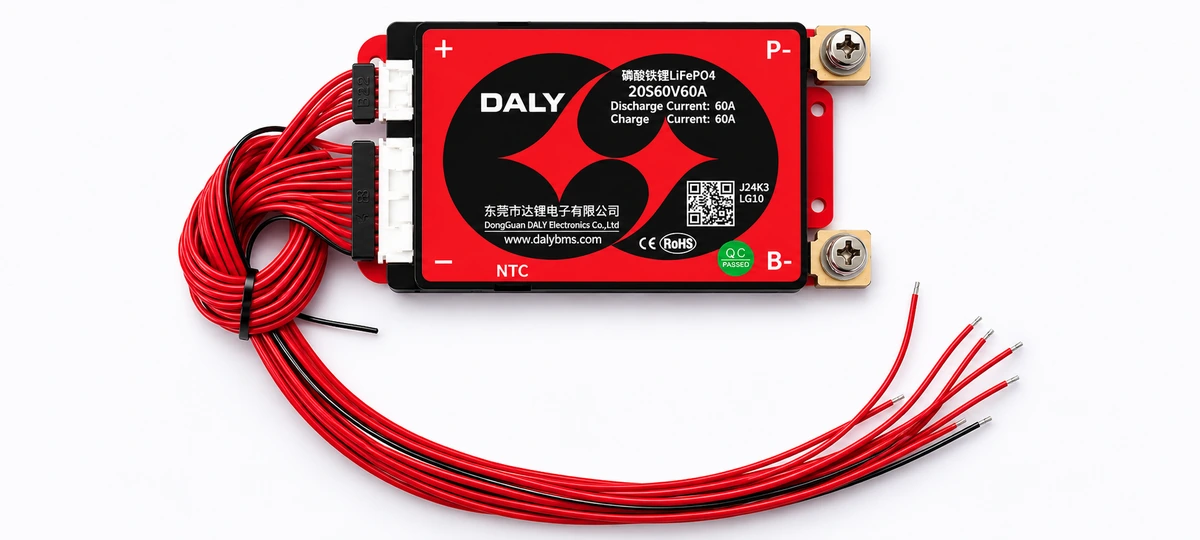
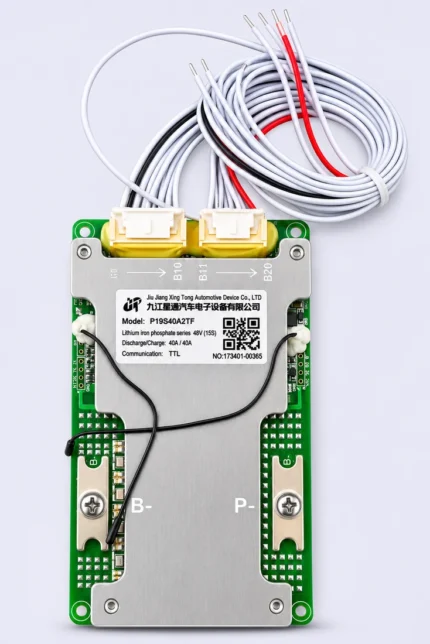
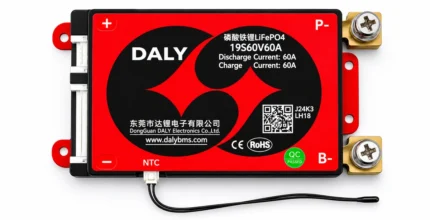
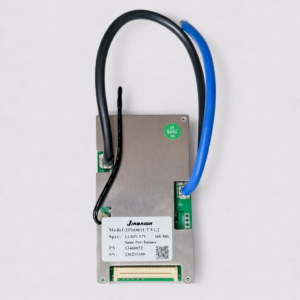
The DALY 20S 60A LiFePO₄ BMS is a Battery Management System designed for 20-series lithium iron phosphate battery packs.
The actual unit is marked:
- Brand: DALY
- Battery Chemistry: LiFePO₄
- Configuration: 20S
- Label Rating: 20S60V60A
- Discharge Current: 60A
- Charge Current: 60A
- Temperature Monitoring: NTC
- Main Connections: B- and P-
- Cell Monitoring: Multi-wire balance harness
The BMS monitors individual cell groups and controls the battery’s charge and discharge path to help protect the complete pack against abnormal electrical and temperature conditions.
2. 20S LiFePO₄ Battery Voltage
A LiFePO₄ cell has a nominal voltage of approximately 3.2V.
Nominal Pack Voltage
20 × 3.2V = 64V
Therefore, electrically this is a 64V nominal LiFePO₄ battery configuration, even though the BMS label uses the market designation 20S60V.
Typical Full-Charge Voltage
Using 3.65V per cell:
20 × 3.65V = 73V
The actual charger voltage should always follow the specifications of the LiFePO₄ cells used in the battery pack.
3. Main Specifications
- Brand: DALY
- Battery Chemistry: LiFePO₄ / LFP
- Series Configuration: 20S
- Nominal Cell Voltage: Approx. 3.2V
- Nominal Pack Voltage: Approx. 64V
- Typical Maximum Pack Voltage: Approx. 73V
- Discharge Current: 60A
- Charge Current: 60A
- BMS Configuration: Common Port
- Temperature Sensor: NTC
- Cell Monitoring: Individual series-group sensing
- Balancing: Built-in cell balancing
- High-Current Connections: B- and P-
- Construction: Enclosed DALY hardware BMS
4. 60A Charge & Discharge Rating
The product label specifies:
- Discharge Current: 60A
- Charge Current: 60A
This makes the BMS suitable for medium- to high-power LiFePO₄ battery systems.
When selecting the complete battery-pack current rating, also consider:
- Cell continuous-discharge rating
- Busbar capacity
- Battery cables
- Connectors
- Fuse
- Battery terminals
- Motor controller or inverter current
The BMS current rating alone does not determine the safe current capability of the completed battery pack.
5. Common-Port BMS Design
The BMS uses B- and P- terminals.
B-
B- connects to the total negative terminal of the battery pack.
P-
P- provides the BMS-controlled negative path for the external charger and load.
This common-port arrangement allows charging and discharging to be managed through the BMS-controlled negative path.
6. Individual Cell Monitoring
The supplied balance-wire harness allows the BMS to monitor all 20 series cell groups.
Individual cell monitoring helps detect situations where:
- One group charges higher than the others
- One cell group discharges too low
- Cell-group voltage difference becomes excessive
- One weak group limits usable battery capacity
Monitoring each series group is essential for safe operation of a high-voltage LiFePO₄ battery.
7. Built-in Cell Balancing
The DALY BMS incorporates cell-balancing functionality to help reduce voltage differences between the 20 series groups.
Balancing helps:
- Improve cell-voltage consistency
- Reduce premature charge cutoff
- Improve usable battery capacity
- Maintain better pack balance
- Support long-term battery stability
Cells should still be properly matched and balanced during initial battery-pack assembly.
8. NTC Temperature Sensor
The BMS includes an NTC temperature sensor.
The temperature sensor helps the BMS monitor battery or BMS temperature during operation.
Correct placement of the NTC sensor is important, particularly in:
- EV battery packs
- High-current applications
- Inverter batteries
- Enclosed battery systems
The sensor should be installed where it can accurately detect pack temperature without being mechanically damaged.
9. Battery Protection Functions
The DALY BMS is designed to provide important battery-protection functions such as:
- Cell over-voltage protection
- Cell under-voltage protection
- Charge over-current protection
- Discharge over-current protection
- Short-circuit protection
- Temperature protection
- Individual cell monitoring
- Cell balancing
These functions help protect the battery when abnormal operating conditions occur.
10. Suitable Applications
The DALY 20S 60A LiFePO₄ BMS is suitable for compatible battery packs used in:
- Electric scooters
- Electric motorcycles
- Electric three-wheelers
- Light electric vehicles
- Solar energy-storage systems
- Home energy-storage batteries
- Inverter batteries
- UPS backup systems
- Robotics
- AGVs
- Industrial equipment
- Custom LiFePO₄ battery packs
11. Ideal for 20S LiFePO₄ Battery Packs
A 20S LiFePO₄ battery operates at approximately:
- 64V nominal
- 73V at 3.65V per cell
This configuration is often marketed in the 60V-class battery category.
It should not be confused with a 60V NMC battery, which uses different cell counts and different voltage/protection settings.
12. Compatibility Check Before Ordering
Before purchasing, confirm:
- Battery chemistry is LiFePO₄ / LFP
- Battery configuration is exactly 20S
- Nominal battery voltage is approximately 64V
- Charger is designed for a 20S LiFePO₄ battery
- Required continuous current is within 60A
- Balance-wire configuration matches your battery pack
- B- and P- wiring matches your system
Do not select a BMS only by the advertised voltage.
Battery chemistry, number of series cells and current rating must all match the battery pack.
13. Installation Guidelines
Before installing the BMS:
- Verify all 20 cell-group voltages
- Confirm the complete balance-wire sequence
- Measure voltage progressively through the balance harness
- Connect B- correctly to battery negative
- Connect P- according to the battery wiring design
- Install the NTC temperature sensor correctly
- Use cables and terminals rated for the required current
- Insulate all exposed high-current connections
- Secure the BMS against vibration and movement
Do not connect the balance harness until the complete wiring sequence has been verified.
Incorrect balance-wire sequencing can damage the BMS.
14. Important Safety Note
Do not:
- Use this BMS with the wrong battery chemistry
- Use it with an incorrect number of series cells
- Reverse battery polarity
- Connect balance wires in the wrong sequence
- Exceed the rated current
- Short B- or P- connections
- Operate with damaged cells, cables or insulation
- Install where water or conductive debris can reach electrical connections
Professional installation is recommended for high-capacity lithium battery systems.