

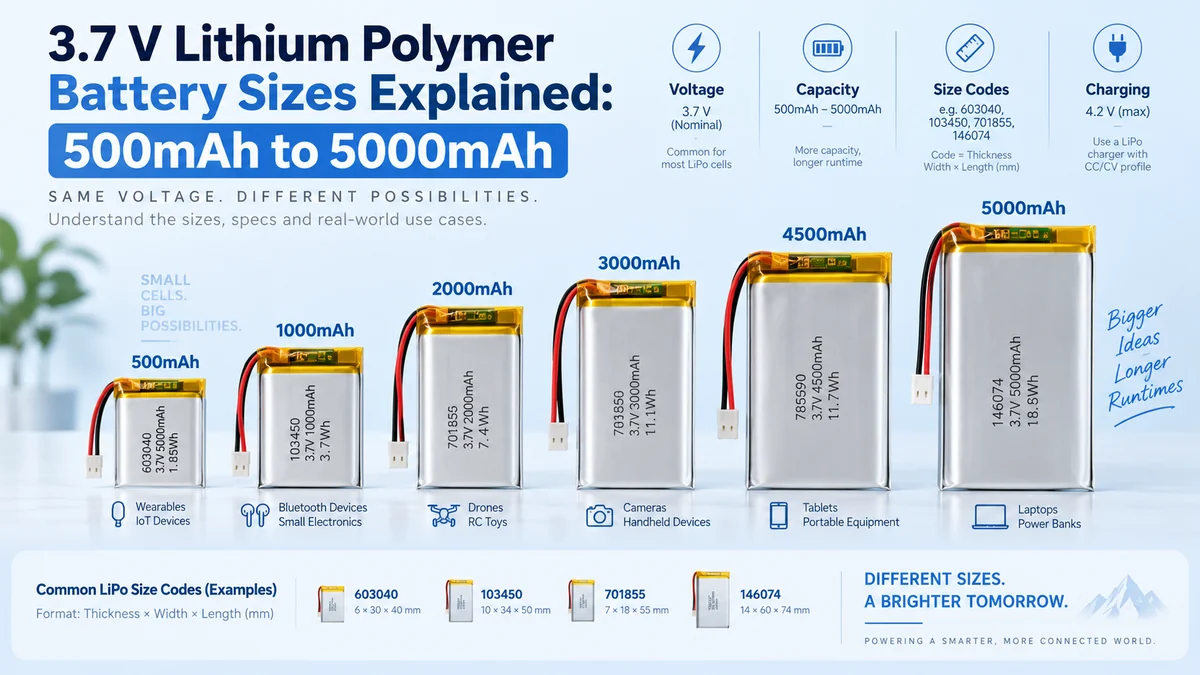
When people search for a 3.7 V lithium polymer battery, the first thing they usually notice is the capacity number.
500mAh.
1000mAh.
2000mAh.
5000mAh.
At first, the rule seems obvious:
Higher mAh = bigger battery = longer runtime.
That idea is true to an extent, but there are several other factors you also need to consider.
A 3.7V 2000mAh battery normally stores more energy than a 1000mAh battery, but capacity alone does not tell you the battery’s physical size, maximum current, connector type or whether it will actually fit inside your device.
This is especially important with lithium polymer batteries because they come in a huge range of pouch shapes and dimensions.
A thin 1000mAh cell may be wide and flat.
Another 1000mAh cell may be thicker and much narrower.
Both can have the same voltage and capacity while being completely different physically.
So if you are choosing between 500mAh, 1000mAh, 2000mAh, 3000mAh or 5000mAh LiPo batteries, it helps to understand what each capacity really means and what changes as battery size increases.
This guide explains it in practical terms.
What Is a 3.7 V Lithium Polymer Battery?
A 3.7 V lithium polymer battery, often called a LiPo battery, is a rechargeable lithium-ion pouch cell commonly used in portable electronics.
It is called a 3.7V battery because approximately 3.7V is its nominal voltage.
That does not mean the voltage stays at exactly 3.7V during use.
For many conventional single-cell LiPo batteries:
- Nominal voltage is around 3.7V
- Fully charged voltage is typically around 4.2V
- Voltage gradually falls as the battery discharges
The exact limits depend on the cell design and manufacturer.
These batteries are usually referred to as 1S LiPo batteries, meaning one lithium cell or one parallel cell group is used without increasing voltage through series connection.
Why Lithium Polymer Batteries Come in So Many Sizes
Unlike an 18650 battery, which follows a standard cylindrical format, LiPo pouch batteries can be manufactured in many shapes.
That makes them useful for devices where internal space is limited.
Manufacturers can design batteries that are:
- Thin and wide
- Thick and compact
- Long and narrow
- Square
- Rectangular
- Custom-shaped for a specific enclosure
This flexibility is one reason LiPo batteries are widely used in:
- Bluetooth speakers
- GPS trackers
- Wearable devices
- IoT products
- Rechargeable toys
- Portable medical equipment
- Handheld instruments
- Electronic accessories
- Small robotics projects
The trade-off is that replacing them can be more complicated.
You cannot simply search for “3.7V 2000mAh battery” and assume every result will fit.
What Does mAh Mean?
The capacity of small lithium batteries is usually shown in:
mAh — milliamp-hours
For example:
1000mAh = 1Ah
In simple terms, mAh tells you how much charge the battery can store.
If two batteries power the same device and operate under similar conditions, the higher-capacity battery can usually run it for longer.
For example:
A 500mAh battery stores approximately half the charge of a 1000mAh battery.
A 2000mAh battery stores approximately twice the charge of a 1000mAh battery.
A 5000mAh battery stores approximately five times the charge of a 1000mAh battery.
But the actual runtime does not always increase perfectly in the same proportion because real devices have losses and changing current consumption.
500mAh LiPo Battery
A 3.7V 500mAh lithium polymer battery is a relatively small-capacity cell.
Its nominal energy is approximately:
3.7V × 0.5Ah = 1.85Wh
This type of battery is often suitable for devices that do not need a lot of power or very long runtime.
Typical applications may include:
- Small GPS trackers
- Mini electronic toys
- Sensors
- Small wearable devices
- Compact Bluetooth products
- Low-power IoT devices
The main advantage of a 500mAh LiPo battery is size.
A device designer can keep the product compact and lightweight.
The downside is shorter runtime compared with larger capacities.
For a device drawing 100mA continuously, a simple theoretical estimate would be:
500mAh ÷ 100mA = 5 hours
Actual runtime may be lower.
800mAh LiPo Battery
An 800mAh 3.7V LiPo battery provides a useful step up from very small cells without becoming excessively large.
Nominal energy:
3.7 × 0.8 = 2.96Wh
This capacity may be found in:
- Handheld electronics
- Compact speakers
- Portable sensors
- Tracking devices
- Rechargeable accessories
- Small measurement equipment
For designers, 800mAh can be attractive when a 500mAh battery does not provide enough runtime but a 1000mAh or larger cell is difficult to fit.
1000mAh LiPo Battery
The 3.7V 1000mAh lithium polymer battery is one of the most commonly searched capacities.
1000mAh equals:
1Ah
Nominal energy is approximately:
3.7Wh
This gives a useful balance between physical size and runtime.
Common uses may include:
- Bluetooth speakers
- GPS devices
- Toys
- Portable instruments
- IoT equipment
- Small medical devices
- Rechargeable electronics
Suppose your device draws approximately 200mA.
The simple runtime calculation is:
1000 ÷ 200 = 5 hours
Again, this is only a theoretical estimate.
Real runtime depends on the device, battery age, temperature and cutoff voltage.
Can You Replace a 500mAh Battery With a 1000mAh Battery?
Possibly.
If both batteries have the same compatible voltage and chemistry, the higher-capacity battery can often provide longer runtime.
But check:
- Battery dimensions
- Connector
- Polarity
- Maximum charge voltage
- Discharge current
- Protection circuit
- Available space
The biggest practical problem is often physical size.
A 1000mAh battery will normally require more cell material than a 500mAh battery.
That usually makes it larger.
1200mAh to 1500mAh LiPo Batteries
The 1200mAh and 1500mAh range works well for devices that need noticeably more runtime but still need to remain portable.
Nominal energy:
1200mAh
3.7 × 1.2 = 4.44Wh
1500mAh
3.7 × 1.5 = 5.55Wh
These capacities are often useful for:
- Medium-size Bluetooth devices
- GPS units
- Handheld electronics
- Portable data loggers
- Rechargeable controllers
- Electronic toys
- Security devices
At this capacity level, physical dimensions start to vary considerably between manufacturers.
One 1500mAh cell may be wide and thin.
Another may be thicker and shorter.
That is why capacity should never be used as a substitute for dimensions.
2000mAh LiPo Battery
A 3.7V 2000mAh lithium polymer battery stores approximately:
3.7 × 2 = 7.4Wh
This is a popular capacity for applications requiring longer operating time.
Typical examples include:
- Larger Bluetooth speakers
- Portable monitoring equipment
- Electronics with displays
- GPS products
- Rechargeable tools with modest current
- Custom electronics
- Portable medical equipment
A 2000mAh battery can theoretically provide:
200mA for about 10 hours
or:
500mA for about 4 hours
under simplified assumptions.
Actual results will usually differ.
2000mAh vs 1000mAh: What Really Changes?
Consider two compatible cells:
Battery A: 3.7V 1000mAh
Battery B: 3.7V 2000mAh
Battery B stores roughly twice the charge.
That generally means:
- Longer runtime
- Larger physical size
- Higher weight
- Longer charging time at the same charging current
- Higher purchase cost
But it does not automatically mean:
- Twice the discharge current
- Twice the voltage
- Twice the power
That distinction is important.
Capacity and power capability are not the same thing.
2500mAh to 3000mAh LiPo Batteries
Once capacity reaches roughly 2500mAh to 3000mAh, the battery is becoming substantial for a single-cell pouch application.
A 3000mAh 3.7V battery stores approximately:
3.7 × 3 = 11.1Wh
These batteries may be used in:
- Larger handheld devices
- Portable terminals
- High-runtime IoT equipment
- Bigger Bluetooth speakers
- Rechargeable consumer electronics
- Custom embedded products
- Portable monitoring systems
A major consideration at this level is charging time.
Suppose a 3000mAh battery is charged at 1A.
A basic capacity/current calculation gives:
3000mAh ÷ 1000mA = 3 hours
Actual charging will normally take longer because lithium charging current reduces as the cell approaches full charge.
4500mAh LiPo Battery
A 3.7V 4500mAh lithium polymer battery stores about:
3.7 × 4.5 = 16.65Wh
This capacity is well suited to devices that need longer operating time but still require a compact rechargeable battery.
Possible applications include:
- Larger Bluetooth speakers
- Portable monitoring equipment
- Industrial handheld devices
- Rechargeable display systems
- Communication equipment
- Custom embedded electronics
- High-runtime portable devices
A 4500mAh battery can provide significantly longer runtime than smaller 1000mAh or 2000mAh cells, but it will usually require more physical space.
Always check the thickness, width, length, connector, polarity and discharge current before using it as a replacement. Two 4500mAh LiPo batteries can have very different dimensions even when their voltage and capacity are the same.
5000mAh LiPo Battery
A 3.7V 5000mAh LiPo battery stores approximately:
3.7 × 5 = 18.5Wh
This is five times the nominal capacity of a 1000mAh battery.
It can provide excellent runtime in devices designed to accommodate it.
Possible applications include:
- Large Bluetooth speakers
- Portable electronic equipment
- Monitoring systems
- Industrial handheld products
- Custom battery-powered devices
- High-runtime electronics
The key word is:
designed.
A 5000mAh battery is not simply a better replacement for every smaller battery.
It requires significantly more physical space.
Higher-Capacity LiPo Batteries: 6500mAh, 7200mAh and 10000mAh
For devices that need much longer runtime, 3.7V lithium polymer batteries are also available in larger capacities such as 6500mAh, 7200mAh and 10000mAh. These cells store considerably more energy than smaller 500mAh to 5000mAh batteries, but they also require more physical space and may have different charging and discharge requirements.
6500mAh LiPo Battery
A 3.7V 6500mAh lithium polymer battery stores approximately:
3.7 × 6.5 = 24.05Wh
This capacity can be useful for larger portable electronics, monitoring equipment, communication devices, industrial handheld products and custom battery-powered systems where longer runtime is important.
7200mAh LiPo Battery
A 3.7V 7200mAh LiPo battery provides approximately:
3.7 × 7.2 = 26.64Wh
It can suit applications that need extended operating time while still using a single-cell 3.7V battery system. Typical uses may include portable instruments, larger speakers, tracking systems, embedded electronics and custom rechargeable devices.
10000mAh LiPo Battery
A 3.7V 10000mAh lithium polymer battery has a nominal energy of approximately:
3.7 × 10 = 37Wh
This is a high-capacity single-cell LiPo option and can provide much longer runtime than smaller 1000mAh, 2000mAh or 5000mAh batteries. It may be suitable for larger portable electronics, industrial equipment, backup-powered devices, communication products and custom applications where long battery life is a priority.
For all three capacities, do not select the battery by mAh alone. Always confirm the physical dimensions, connector, polarity, maximum discharge current, charging current, protection circuit and available space inside the device before using it as a replacement.
500mAh to 5000mAh Comparison
Here is a simple overview.
| Battery Capacity | Approx. Nominal Energy | General Size Category |
| 500mAh | 1.85Wh | Very compact |
| 800mAh | 2.96Wh | Small |
| 1000mAh | 3.7Wh | Small/medium |
| 1200mAh | 4.44Wh | Medium |
| 1500mAh | 5.55Wh | Medium |
| 2000mAh | 7.4Wh | Medium/large |
| 3000mAh | 11.1Wh | Large |
| 4000mAh | 14.8Wh | Large |
| 5000mAh | 18.5Wh | Larger pouch |
The size descriptions are only general guidance.
Actual dimensions can vary dramatically.
Why Two 2000mAh Batteries Can Have Different Sizes
This is one of the most common questions buyers have.
Imagine:
Battery A:
3.7V 2000mAh
Battery B:
3.7V 2000mAh
Yet Battery A is thin and wide while Battery B is thick and narrow.
How can both have the same capacity?
Because cell dimensions are not determined by capacity alone.
Factors include:
- Electrode design
- Cell construction
- Energy density
- Manufacturer
- Required discharge capability
- Thickness
- Width
- Length
The manufacturer can distribute the cell volume differently.
That is why you must check the actual physical dimensions.
Understanding LiPo Battery Size Codes
Lithium polymer cells often use model numbers such as:
- 402030
- 503040
- 603450
- 704050
- 103450
- 146074
- 1260110
- 701855
- 701855
- 895073
- 704573
- 30100100
A common naming convention uses the digits to represent approximate:
Thickness × Width × Length
For example:
603040
may represent approximately:
6.0mm thick × 30mm wide × 40mm long
Similarly:
103450
may indicate approximately:
10mm × 34mm × 50mm
The larger pouch-cell codes can be interpreted in a similar way:
| LiPo Size Code | Approximate Dimensions |
|---|---|
| 146074 | 14mm × 60mm × 74mm |
| 1260110 | 12mm × 60mm × 110mm |
| 701855 | 7mm × 18mm × 55mm |
| 895073 | 8.9mm × 50mm × 73mm |
| 704573 | 7mm × 45mm × 73mm |
| 30100100 | 3mm × 100mm × 100mm |
For example, a 895073 LiPo battery is generally understood as a pouch cell measuring approximately 8.9mm thick, 50mm wide and 73mm long, while a 1260110 lithium pouch battery is considerably longer at approximately 12mm × 60mm × 110mm.
These size codes are especially helpful when looking for a replacement battery because two cells with the same 3.7V voltage and mAh capacity can still have very different shapes.
However, LiPo model-number conventions are not completely standardised between manufacturers. Protection boards, wires, tabs and manufacturing tolerances can also slightly increase the finished battery dimensions.
Always confirm the actual thickness, width and length from the lithium battery supplier or datasheet before ordering a LiPo battery for a device.
Capacity Does Not Tell You the Discharge Current
A 5000mAh battery can store a lot of energy.
But that does not automatically make it a high-power battery.
One 5000mAh LiPo battery may be designed for slow discharge in a monitoring device.
Another may be specifically designed for higher current.
The maximum current depends on:
- Cell design
- Internal resistance
- C-rating
- Tab construction
- Protection circuit
For example, if a 2000mAh battery is rated for 1C discharge:
1C × 2Ah = 2A
If another 2000mAh cell supports 2C:
2C × 2Ah = 4A
Same capacity.
Different current capability.
Does Higher Capacity Mean Longer Charging Time?
Usually, yes, if charging current stays the same.
For example, suppose the charger supplies 500mA.
500mAh battery
Basic estimate:
500 ÷ 500 = 1 hour
1000mAh battery
1000 ÷ 500 = 2 hours
2000mAh battery
2000 ÷ 500 = 4 hours
5000mAh battery
5000 ÷ 500 = 10 hours
These are simplified figures.
Real lithium charging takes longer because current gradually reduces near full charge.
You should never simply increase charging current to reduce charging time unless the cell manufacturer allows it.
Physical Fit Is Often More Important Than Capacity
Suppose your original battery is:
3.7V 1000mAh
and you find a replacement:
3.7V 2000mAh
It sounds like an excellent upgrade.
But imagine the original battery space is:
6mm × 30mm × 40mm
while the new battery is:
8mm × 35mm × 50mm
It simply will not fit.
Never:
- Bend the pouch sharply
- Compress it
- Fold the battery
- Force it into the enclosure
LiPo cells need proper mechanical clearance.
Check Connector and Polarity Too
Battery replacement is not only about size.
The replacement cell may use a different connector.
Even if the connector looks identical, polarity may be reversed.
Always check:
- Positive wire position
- Negative wire position
- Connector pitch
- Number of wires
- Protection wiring
A common colour convention is:
Red = positive
Black = negative
But do not rely on colour alone.
Verify before connecting.
Protected and Unprotected LiPo Batteries
Many consumer LiPo batteries include a small protection PCB.
The board may help protect against:
- Overcharge
- Excessive discharge
- Overcurrent
- Short circuit
Some batteries are supplied without a protection board because the device already contains battery-management electronics.
When replacing a battery, check what the original design uses.
A protected and unprotected cell may have the same voltage and capacity but behave differently in a device.
Which Capacity Should You Choose?
The best capacity is not necessarily the biggest one available.
Choose based on:
- Required runtime
- Available dimensions
- Device current
- Charging system
- Battery weight
- Budget
For example:
Choose around 500mAh if:
Your device is small, low-power and needs limited runtime.
Choose around 1000mAh if:
You need a good balance between size and runtime.
Choose around 2000mAh if:
Longer runtime matters and there is enough space.
Choose 3000–5000mAh if:
The device is physically larger and designed for extended battery operation.
Common Buying Mistakes
Choosing Only by mAh
Capacity alone is not enough.
Ignoring Dimensions
This is the most common replacement problem.
Assuming Higher Capacity Means Higher Current
It does not.
Ignoring the Connector
A correct battery with the wrong connector may still be unusable.
Ignoring Polarity
Reverse polarity can damage electronics.
Using the Wrong Charger
A conventional 3.7V LiPo requires a compatible lithium charging system.
Forcing a Larger Cell Into a Device
Never mechanically compress a pouch cell.
How to Compare 3.7V LiPo Batteries Before Buying
A useful comparison should include all of these specifications:
| Specification | Why It Matters |
| Nominal voltage | Device compatibility |
| Maximum charge voltage | Charger compatibility |
| Capacity | Runtime |
| Thickness | Physical fit |
| Width | Physical fit |
| Length | Physical fit |
| Maximum discharge current | Load capability |
| Connector | Electrical connection |
| Polarity | Prevents reverse connection |
| Protection PCB | Cell protection |
| Weight | Portable device design |
If a seller provides only:
3.7V 2000mAh
you still do not have enough information to confidently select the battery.
Final Thoughts
Understanding 3.7 V lithium polymer battery sizes becomes easier when you separate capacity from physical size.
A 500mAh battery is generally intended for small devices with modest energy requirements.
A 1000mAh battery provides more runtime while remaining compact.
2000mAh to 3000mAh cells suit devices that need longer operation.
4000mAh and 5000mAh batteries provide substantially more stored energy but also require more space.
The most important point is that mAh does not define the physical dimensions of a LiPo battery.
Two batteries can both be labelled 3.7V 2000mAh and still have completely different shapes.
Before selecting a replacement or sourcing a battery for a new product, check the complete specification:
Voltage, capacity, thickness, width, length, connector, polarity, discharge current, protection and charging requirements.
That approach is much safer than choosing a battery simply because it has the largest mAh number.
The right 3.7 V lithium polymer battery is not necessarily the highest-capacity one.
It is the battery that gives you the runtime you need while correctly fitting and electrically matching your device.
Frequently Asked Questions
Is a 5000mAh battery better than a 1000mAh battery?
It stores more energy and can provide longer runtime, but it is usually larger and heavier. It is only better when your device can accommodate it and all other electrical specifications are compatible.
Can I replace a 500mAh LiPo with a 1000mAh LiPo?
Often possible if voltage, chemistry, connector, polarity, charging requirements, discharge current and physical dimensions are compatible.
What is the size of a 1000mAh LiPo battery?
There is no universal physical size. Different manufacturers produce 1000mAh cells with different thickness, width and length.
What is the size of a 2000mAh LiPo battery?
Again, there is no fixed size. Always check the dimensions rather than assuming capacity determines shape.
Does a 5000mAh LiPo last five times longer than a 1000mAh battery?
Theoretically, under identical conditions, it has five times the capacity. Real-world runtime will depend on the device, battery condition, efficiency and cutoff voltage.
Does higher mAh mean higher voltage?
No. A 500mAh and 5000mAh battery can both have the same 3.7V nominal voltage.
Does higher mAh mean the battery can supply more amps?
Not automatically. Maximum current depends on the cell design and discharge rating.
What dimensions should I check before buying a LiPo battery?
Check thickness, width and length, plus the space needed for the protection PCB, wires and connector.
Can I use a thicker LiPo battery if it still fits?
Only if it fits without pressure or compression and all electrical specifications are compatible.
What is the best 3.7V LiPo battery capacity?
There is no single best capacity. The correct choice depends on required runtime, device current and available physical space.