
A common question among homeowners planning a solar installation is:
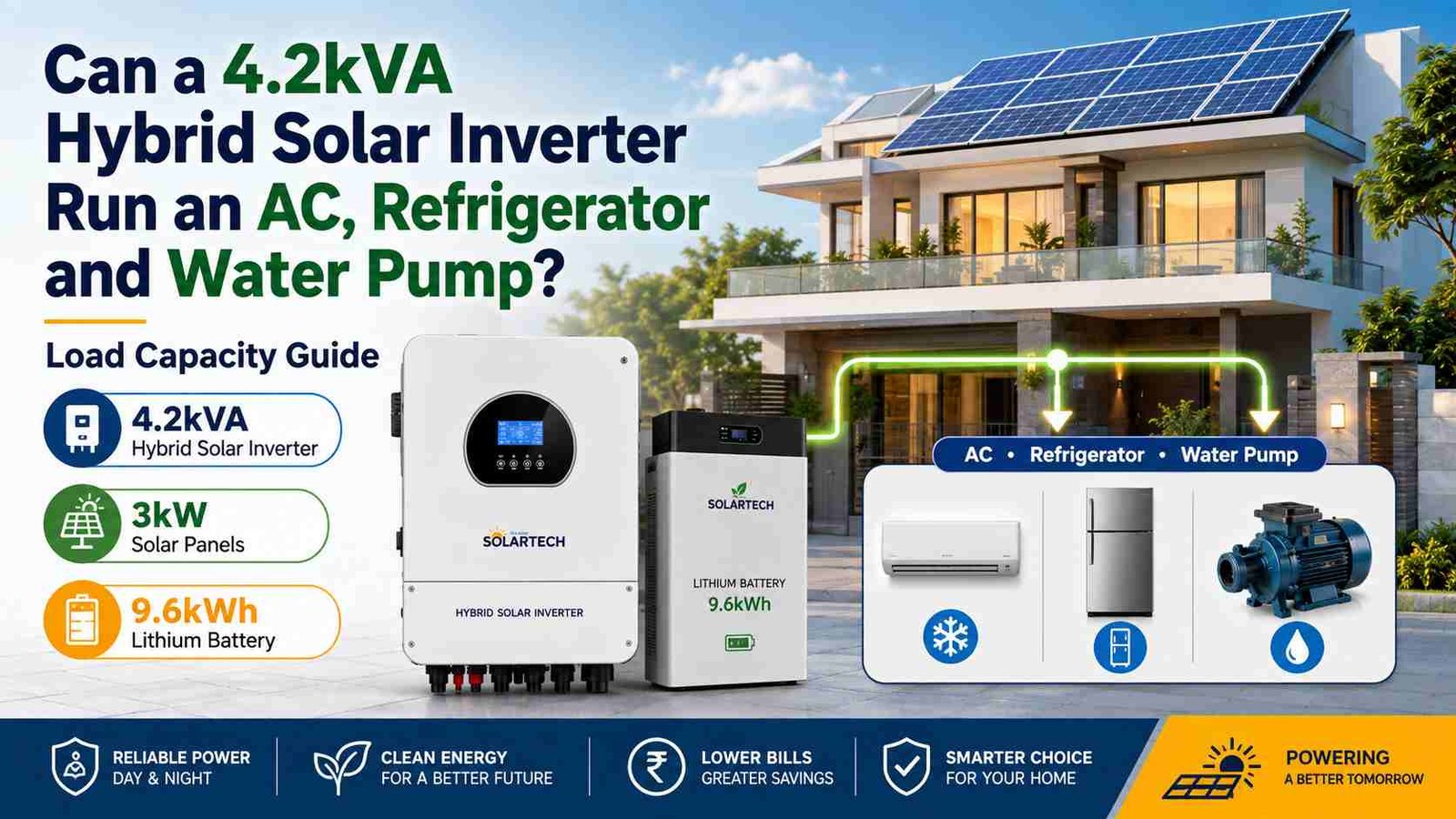
Can a 4.2kVA hybrid solar inverter run an air conditioner, refrigerator and water pump at the same time?
In many cases, the answer is yes, but only when the appliances are selected carefully and their total running load and starting surge remain within the inverter’s limits.
The answer also depends on several other factors, including:
- The rated output power of the inverter
- The size and type of air conditioner
- The horsepower of the water pump
- The starting current of motor-based appliances
- The lithium battery capacity
- Available solar generation
- Other appliances running at the same time
- Whether grid power is available through Grid Assist
This guide explains the 4.2kVA hybrid solar inverter load capacity in simple terms. It will help homeowners understand which appliances can run together and how to avoid overloading the inverter.
What Does a 4.2kVA Hybrid Solar Inverter Mean?
The term 4.2kVA refers to the apparent power capacity of the inverter.
However, kVA and kW are not always the same.
- kVA represents apparent power.
- kW represents the actual power used by appliances.
- The relationship between them depends on the inverter’s power factor.
For example, if an inverter has a power factor of 0.8:
4.2kVA × 0.8 = 3.36kW
If the power factor is close to 1, the usable watt capacity may be closer to the full 4.2kW rating.
Therefore, do not assume that every 4.2kVA inverter can continuously supply 4,200W. Always check the inverter label or technical datasheet for its:
- Rated output power in watts
- Maximum surge capacity
- Battery discharge-current limit
- Recommended continuous load
This information gives a clearer picture of the actual 4.2kVA hybrid solar inverter load capacity.
Three Ratings You Must Understand
A complete 4.2kVA hybrid solar system may include a 4.2kVA inverter, 3kW solar panels and a 9.6kWh lithium battery. These three ratings describe different parts of the system.
1. Inverter capacity determines the maximum load
The inverter decides how many appliances can operate at one time.
If the total connected load exceeds its rated output, the inverter may:
- Sound an overload alarm
- Disconnect the output
- Restart repeatedly
- Shift to grid power, depending on its settings
- Trip when a motor starts
2. Solar-panel capacity determines daytime generation
A 3kW solar array can produce up to approximately 3kW under ideal test conditions. Actual solar output changes throughout the day because of sunlight, temperature, panel direction, dust, clouds and shading.
Solar-panel capacity does not automatically increase the inverter’s maximum load capacity.
Even if the panels are producing 3kW, a 4.2kVA inverter cannot safely operate loads beyond its rated output.
3. Battery capacity determines backup duration
A 48V 200Ah lithium ion Phosphate battery stores approximately 9.6kWh of nominal energy.
The battery determines how long the appliances can operate when solar or grid power is unavailable. It does not increase the inverter’s maximum AC output.
PowerKart’s complete system combines a 4.2kVA hybrid inverter, a 48V 200Ah LiFePO₄ battery and six 500Wp solar panels, providing 3kW of solar capacity and 9.6kWh of nominal storage.
Typical Power Consumption of Home Appliances
The following values are approximate. Always check the appliance label for its actual power consumption.
| Appliance | Typical running power |
| LED light | 8–15W |
| Ceiling fan | 50–80W |
| Television | 70–150W |
| Wi-Fi router | 10–20W |
| Refrigerator | 100–300W |
| 0.5HP water pump | Around 500–750W input |
| 1HP water pump | Around 900–1,300W input |
| 1-ton inverter AC | Around 800–1,500W |
| 1.5-ton inverter AC | Around 1,200–2,200W |
| Conventional 1.5-ton AC | Can exceed 2,000W |
| Washing machine | 400–800W |
| Microwave oven | 1,000–1,500W |
| Electric geyser | 1,500–3,000W |
The blog’s broader appliance guide also lists a refrigerator at approximately 100–300W, a water pump at 500–1,500W and an air conditioner at 900–2,000W or more.
These values are useful for initial planning, but actual consumption varies by brand, age, capacity, efficiency rating and operating mode.
Can a 4.2kVA Hybrid Solar Inverter Run a Refrigerator?
Yes. A refrigerator is normally an easy load for a 4.2kVA hybrid solar inverter.
A typical household refrigerator may consume between 100W and 300W while its compressor is running. The compressor switches on and off according to the internal temperature.
This means the refrigerator does not continuously consume its maximum rated power.
However, the compressor may draw extra current for a few seconds when it starts. A refrigerator consuming 200W during normal operation may briefly need several times more power at startup.
A properly sized 4.2kVA inverter should usually handle this surge easily, provided it is not already operating close to its maximum load.
Factors that affect refrigerator consumption
- Refrigerator size
- Compressor technology
- Star rating
- Room temperature
- Door-opening frequency
- Thermostat setting
- Condition of the door seal
- Whether it is a direct-cool or frost-free model
An inverter-compressor refrigerator generally starts more smoothly and may use less energy than an older fixed-speed refrigerator.
Can It Run a Water Pump?
A 4.2kVA hybrid solar inverter can often run a small domestic water pump, but the pump’s horsepower and starting current must be checked.
Water pumps use electric motors. Motor-based appliances draw a high current for a short time when they start.
A 0.5HP water pump
A 0.5HP pump may consume approximately 500W to 750W during normal operation, depending on efficiency and water pressure.
Its starting power can be considerably higher.
A 4.2kVA inverter will usually manage a 0.5HP pump if:
- The inverter has sufficient surge capacity
- Heavy appliances are not running simultaneously
- The battery can supply the required current
- The DC cables and connections are correctly sized
A 1HP water pump
A 1HP pump may consume around 900W to 1,300W or more during normal operation.
Its starting surge can create a much higher temporary demand. A 1HP pump may still work with a 4.2kVA inverter, but the complete load must be evaluated carefully.
For example, starting a 1HP pump while an AC, refrigerator, microwave and other appliances are already running may overload the inverter.
Best time to run a water pump
Whenever possible, operate the pump during strong sunlight.
This allows solar panels to supply part of the required power and reduces energy drawn from the lithium battery.
You can also avoid running the pump at the exact moment when the air conditioner compressor starts.
Can It Run an Air Conditioner?
A 4.2kVA hybrid solar inverter may run an air conditioner, but the AC type and capacity are important.
One-ton inverter AC
A modern one-ton inverter AC may consume approximately 800W to 1,500W, depending on:
- Room temperature
- Cooling setting
- Compressor speed
- Room size
- Insulation
- Outdoor temperature
- Energy-efficiency rating
Because an inverter AC gradually adjusts compressor speed, it usually has a lower starting surge than a conventional fixed-speed AC.
A one-ton inverter AC is generally more suitable for a 4.2kVA hybrid system.
1.5-ton inverter AC
A 1.5-ton inverter AC may use approximately 1,200W to 2,200W depending on operating conditions.
It may run successfully, but less inverter capacity will remain for other appliances.
For example, if the AC is drawing 1,800W and a 1HP pump starts, the combined demand may move close to or beyond the safe operating limit.
Conventional non-inverter AC
A conventional fixed-speed AC switches its compressor fully on and off. This can create a large starting surge.
Such an AC is more likely to overload the inverter when another motor-based appliance starts at the same time.
For solar and battery operation, an energy-efficient inverter AC is usually a better choice.
Can the AC, Refrigerator and Water Pump Run Together?
They may run together, but the answer depends on their actual ratings.
Consider this practical example:
| Appliance | Estimated running load |
| One-ton inverter AC | 1,200W |
| Refrigerator | 200W |
| 0.5HP water pump | 600W |
| Four ceiling fans | 280W |
| Six LED lights | 60W |
| Television | 100W |
| Wi-Fi router | 15W |
| Total estimated running load | 2,455W |
A suitable 4.2kVA hybrid solar inverter may operate this combination because the continuous load is below the likely rated output.
However, there is an important risk:
The AC, refrigerator and water pump all contain motors or compressors.
If two or three of them start at the same moment, the temporary surge can be much higher than 2,455W.
The inverter may trip even though the normal running load appears safe.
Example Load Combinations
Combination 1: Generally comfortable
- One-ton inverter AC
- Refrigerator
- Four fans
- Six LED lights
- Television
- Wi-Fi router
Estimated running load: approximately 1,800W to 2,200W
This combination is usually manageable for a correctly rated 4.2kVA hybrid inverter.
Combination 2: Possible with careful management
- One-ton inverter AC
- Refrigerator
- 0.5HP water pump
- Fans and lights
Estimated running load: approximately 2,300W to 2,800W
This may work, but avoid starting the pump while the AC compressor is ramping up.
Combination 3: High-risk load
- 1.5-ton AC
- Refrigerator
- 1HP water pump
- Microwave oven
- Fans and lights
The normal load itself may approach or exceed the inverter’s limit. Motor-starting surge can easily cause an overload.
The microwave or pump should be operated separately.
Combination 4: Not recommended
- Air conditioner
- Electric geyser
- Induction cooktop
- Water pump
- Refrigerator
Heating appliances draw high continuous power. Running these appliances together may exceed the inverter’s capacity even without considering startup surge.
Why Starting Surge Matters
Many people calculate inverter size by simply adding the wattage printed on appliance labels.
That approach is incomplete.
Appliances such as refrigerators, air conditioners and pumps may briefly draw much more power when starting. This temporary demand is called:
- Starting surge
- Inrush current
- Startup current
- Motor-starting load
A pump consuming 1,000W during normal operation may momentarily demand several times more power while starting.
The inverter must supply this surge without shutting down.
This is why an installer should check both:
- Continuous running load
- Maximum starting load
The inverter’s surge rating and surge duration are equally important. An inverter may support a high surge for only a few seconds.
How Grid Assist Changes the Answer
Grid Assist can make a hybrid system more flexible.
Suppose the household load is 2,500W, but the solar panels are producing only 1,500W.
A Grid Assist inverter may use:
- 1,500W from solar
- Approximately 1,000W from the grid
This lowers grid usage while the grid covers only the power that solar cannot supply.
When solar generation is lower than the load, a Grid Assist system can use available solar energy and obtain the remaining requirement from the grid, depending on inverter settings.
However, Grid Assist should not be misunderstood.
It does not necessarily mean that you can connect unlimited load. The inverter output, bypass capacity, wiring, breakers and system configuration still have limits.
During a power cut
When the grid fails, Grid Assist is no longer available.
The inverter must support the load using:
- Solar power
- Lithium battery power
- A combination of solar and battery power
During this period, managing heavy appliances becomes more important.
How the Lithium Battery Affects AC and Pump Operation
The inverter converts DC power from the lithium battery into AC power for household appliances.
A 48V battery supplying a 3,000W load may need to deliver more than 60A after allowing for inverter losses.
At higher loads, the required battery current increases quickly.
The battery system must have:
- A suitable continuous-discharge rating
- A BMS with sufficient current capacity
- Correctly sized battery cables
- Secure terminals
- Suitable DC protection
- Proper ventilation and installation
A battery may have enough energy capacity but still be unable to provide the high current required by an AC or water pump.
This is why both kWh capacity and current rating matter.
Expected Backup with a 9.6kWh Lithium Battery
A 9.6kWh battery does not provide the full rated energy to AC appliances. Some capacity may be reserved to protect the battery, and some energy is lost during conversion.
The following are practical planning estimates:
| Average load | Approximate backup time |
| 500W | 15–16 hours |
| 1,000W | 7.5–8 hours |
| 1,500W | 5–5.5 hours |
| 2,000W | 3.7–4 hours |
| 3,000W | 2.5–2.7 hours |
These estimates assume approximately 7.5kWh to 8.2kWh of usable AC energy after battery reserve and inverter losses.
Example with an AC
Suppose the average household load with an AC is 1,800W.
The estimated battery backup may be around four hours, depending on:
- AC compressor cycling
- Temperature setting
- Battery discharge limit
- Inverter efficiency
- Battery condition
- Available solar power
If solar panels are producing 1,000W during a daytime power cut, the battery may need to supply only the remaining load. This can extend backup significantly.
Solar Generation Also Matters
A 3kW solar array does not continuously provide 3,000W.
Its output changes according to:
- Time of day
- Cloud cover
- Season
- Panel direction
- Roof angle
- Shading
- Dust
- Temperature
- Installation quality
During strong midday sunlight, solar power may support the AC, refrigerator and other loads directly.
During cloudy conditions, the battery or grid may need to provide more power.
For this reason, the system should not be designed by assuming full solar production throughout the day.
How to Calculate Your Home Load
Before buying a hybrid solar system, create a simple load list.
Step 1: List essential appliances
Write down everything that must run during a power cut.
For example:
- Air conditioner
- Refrigerator
- Water pump
- Lights
- Fans
- Television
- Wi-Fi router
- Computers
- Medical equipment
Step 2: Note running wattage
Check the appliance label or manufacturer specifications.
Do not rely only on internet estimates.
Step 3: Identify motor loads
Mark appliances with compressors or motors:
- Refrigerator
- Air conditioner
- Water pump
- Washing machine
- Mixer grinder
These appliances may have a starting surge.
Step 4: Add simultaneous loads
Calculate the wattage of appliances that may run at the same time.
Do not add appliances that are rarely used together unless you want the system to support them simultaneously.
Step 5: Keep a safety margin
Avoid designing the system so that the inverter operates at its maximum rating continuously.
A reasonable safety margin helps with:
- Starting surge
- Future appliance additions
- Temporary load variations
- Inverter heating
- Unexpected usage
Common Mistakes to Avoid
Choosing an inverter only by kVA
Always check the rated output in watts and the surge capacity.
Ignoring the pump’s startup current
The pump may trip the inverter even when its normal wattage appears low.
Assuming solar panels always produce rated power
A 3kW array will not generate 3kW from morning to evening.
Running heavy heating appliances during backup
Geysers, heaters, electric kettles and induction cooktops can quickly use battery energy.
Using undersized battery cables
Thin cables may cause voltage drop, heating and inverter shutdown.
Connecting every home circuit to backup
Separating essential and non-essential loads can improve reliability and extend battery backup.
Buying without a load study
A proper load assessment is more valuable than simply selecting a larger inverter.
Choosing a Solar and Lithium Battery Supplier
The system’s performance depends on more than the inverter rating.
Cell quality, BMS selection, wiring, protection devices, installation and programming all affect reliability.
When looking for a Lithium battery supplier in Bangalore, ask about:
- Battery chemistry
- Cell manufacturer and grade
- BMS current rating
- Warranty terms
- Battery communication
- Installation support
- Service availability
- Expansion options
- Recommended discharge limits
Customers searching for the Best lithium battery supplier in Karnataka should compare technical quality and after-sales support rather than focusing only on the lowest price.
Similarly, when selecting a Solar system supplier in Bangalore, check whether the supplier performs:
- Appliance-load analysis
- Roof survey
- Shadow assessment
- Cable-size calculation
- Earthing planning
- Protection-device selection
- Inverter programming
- Post-installation testing
A correctly designed off-grid solar system in Karnataka should account for local sunlight conditions, roof layout, power-cut frequency and the customer’s actual backup needs.
Frequently Asked Questions
Can a 4.2kVA hybrid inverter run a one-ton AC?
Yes, a modern one-ton inverter AC can often run on a 4.2kVA inverter, provided the total load and starting surge remain within the inverter’s limits.
Can it run a 1.5-ton AC?
It may run a 1.5-ton inverter AC, but the remaining capacity for pumps, kitchen appliances and other heavy loads will be lower.
Can a refrigerator and water pump run together?
Usually yes, especially with a small pump. Their combined starting surge must still be considered.
Can the AC and water pump start together?
It is better to avoid simultaneous starting. Starting the pump after the AC has stabilised can reduce the risk of inverter overload.
Will a 3kW solar array run a 4.2kVA load?
Not by itself under most conditions. If the load exceeds available solar output, the battery or grid must supply the remaining power.
Does a bigger battery increase inverter load capacity?
No. A larger battery increases backup duration. The inverter’s rated output still determines the maximum supported AC load.
Can Grid Assist prevent overload?
Grid Assist can supply a power shortfall in supported operating modes, but the inverter, bypass circuit and wiring still have defined limits.
How long can the battery run an AC?
Backup depends on AC consumption and other connected loads. A higher AC load reduces battery backup quickly, while daytime solar generation can extend it.
Final Answer
A 4.2kVA hybrid solar inverter can often run an air conditioner, refrigerator and water pump, especially when:
- The AC is an efficient inverter model
- The pump is 0.5HP or another manageable size
- Heavy appliances are not started simultaneously
- The combined appliance load remains within the inverter’s safe power limit.
- The inverter has adequate surge capability
- The lithium battery can supply sufficient current
- Solar or Grid Assist is available
A one-ton inverter AC, refrigerator, small water pump, fans, lights and basic electronics may operate together under suitable conditions.
However, a 1.5-ton AC, 1HP pump and other heavy appliances should be managed carefully. Microwave ovens, geysers, induction cooktops and room heaters may need to be operated separately.
The safest approach is to perform a complete load study before installation.
For homeowners who need daytime solar savings and dependable battery backup, explore PowerKart’s 4.2kVA off-grid hybrid solar system with Grid Assist, 9.6kWh LFP battery and 3kW solar panels.
The system is designed for apartments, villas and independent houses that need solar self-consumption, lithium battery backup and zero-export operation without net metering.