
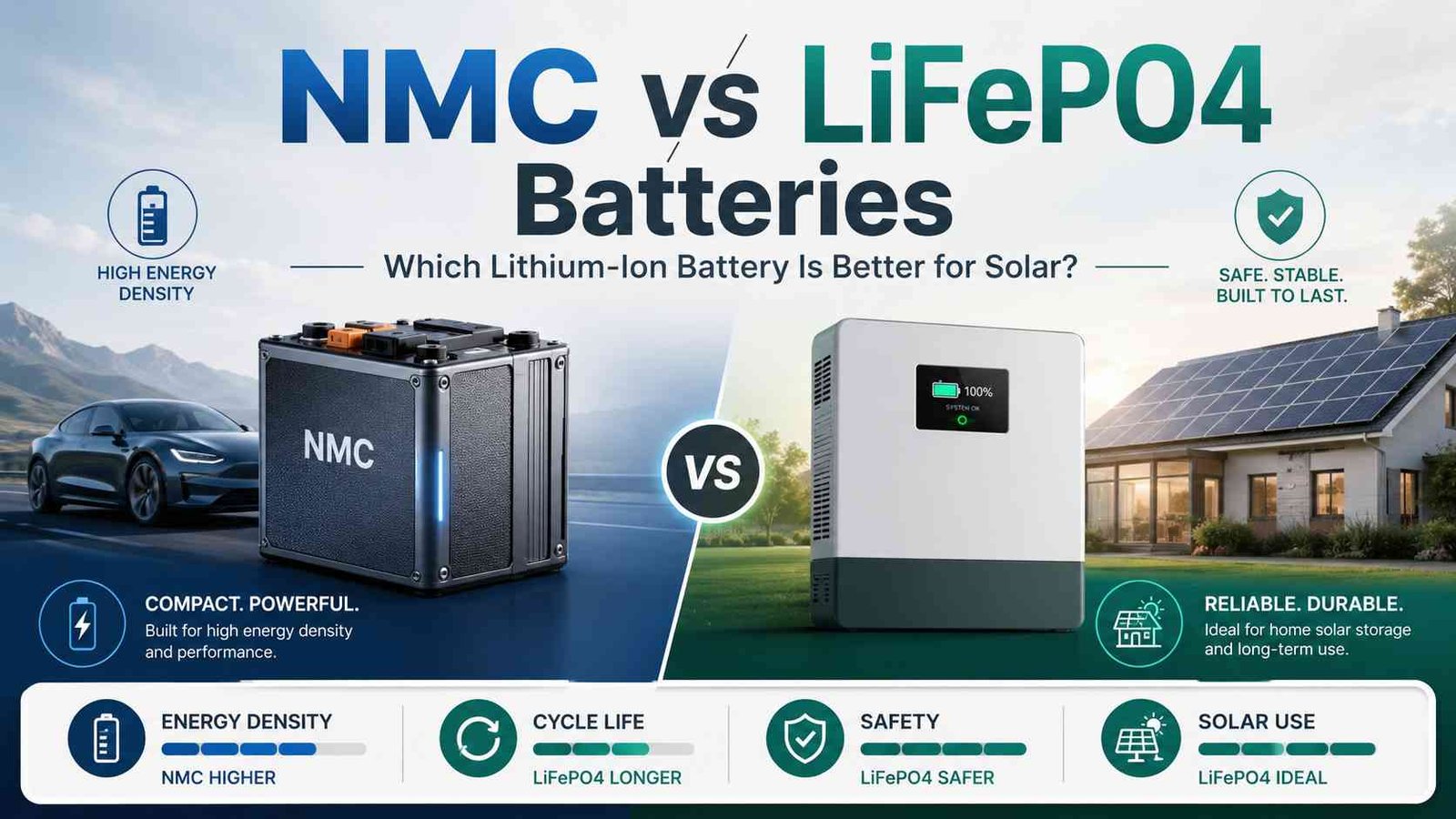
When buying a lithium ion solar battery, you will often come across two battery chemistries: NMC and LiFePO4 (lithium iron phosphate )
Both are lithium-ion batteries, but they are designed with different priorities.
NMC batteries are known for packing more energy into a smaller and lighter battery. LiFePO₄ batteries, also called LFP batteries or lithium iron phosphate batteries, generally offer better thermal stability and are widely used where long cycle life and stationary energy storage are important. The U.S. Department of Energy identifies NMC and LFP as two major lithium-ion chemistries, highlighting NMC’s energy-density advantage and LFP’s safety characteristics.
This creates an important question for anyone planning a solar installation:
NMC vs LiFePO4 battery — which one is better for solar energy storage?
For most stationary home and commercial solar applications, LiFePO4 is usually the more practical chemistry, while NMC can make sense where battery size and weight are major constraints.
However, chemistry alone should never decide which battery you buy.
Cell quality, BMS design, inverter compatibility, usable capacity, charging current, warranty and installation quality can be just as important.
This guide explains the differences in simple terms.
First | Is LiFePO4 Different From Lithium-Ion?
LiFePO₄ is actually one type of lithium-ion battery chemistry. However, its characteristics differ from other lithium-ion chemistries in areas such as safety, cycle life, thermal stability and typical applications, which is why lithium battery vs LiFePO4 battery is an important distinction when choosing a battery for solar storage.
This is one of the most common areas of confusion.
You may see searches such as:
NMC vs lithium-ion battery
or
NMC vs lithium ion phosphate battery
Technically, neither comparison is quite correct because NMC and LiFePO₄ are both types of lithium-ion battery.
Lithium-ion is the larger family.
Two members of that family are:
NMC — Nickel Manganese Cobalt
and
LiFePO₄ — Lithium Iron Phosphate, commonly shortened to LFP.
So the correct technical comparison is:
NMC vs LiFePO₄
or:
NMC vs LFP battery
Think of “lithium-ion” as the category and NMC or LFP as the specific chemistry used inside the battery.
What Is an NMC Battery?
NMC stands for:
Nickel Manganese Cobalt
These three materials form an important part of the battery’s cathode.
Different NMC batteries may use different ratios of nickel, manganese and cobalt, so not every NMC cell has exactly the same characteristics.
One major strength of NMC chemistry is high energy density.
This means an NMC battery can store a relatively large amount of energy while remaining compact and lightweight.
That is especially useful in applications where space and weight matter.
Examples include:
- Electric scooters Batteries
- Electric motorcycles
- Electric cars
- Portable equipment
- Mobile energy-storage applications
- Compact battery systems
The Department of Energy notes that many earlier grid-scale battery systems used NMC and that some behind-the-meter home-storage products continue to use it.
So NMC solar batteries do exist.
NMC is not an “EV-only” chemistry.
The real question is whether its advantages are important for your particular solar application.
What Is a LiFePO4 Battery?
LiFePO₄ stands for:
Lithium Iron Phosphate
It is also commonly called:
- LFP battery
- Lithium phosphate battery
- Lithium iron phosphate solar battery
- LiFePO4 solar battery
- LFP solar battery
A single LFP cell commonly has a nominal voltage of approximately 3.2V.
That is why many modern “48V” lithium solar batteries actually use 16 LiFePO₄ cells connected in series:
3.2V × 16 = 51.2V
So a battery advertised as a 48V lithium battery for solar may actually be rated:
51.2V 100Ah
or:
51.2V 200Ah
The corresponding nominal energy is:
51.2V × 100Ah = 5.12kWh
and:
51.2V × 200Ah = 10.24kWh
This 51.2V lithium ion phosphates solar batteries architecture has become common in home battery storage and hybrid solar systems.
NMC vs LiFePO4 Battery | Quick Comparison
| Factor | NMC Battery | LiFePO₄ / LFP Battery |
| Battery family | Lithium-ion | Lithium-ion |
| Main cathode materials | Nickel, manganese, cobalt | Lithium, iron, phosphate |
| Energy density | Higher | Lower |
| Size for equal energy | Usually smaller | Usually larger |
| Weight for equal energy | Usually lower | Usually higher |
| Thermal stability | Lower than LFP | Higher |
| Cycle-life potential | Good | Generally better for frequent cycling |
| Stationary solar use | Possible | Very common |
| EV use | Very common | Also increasingly used |
| Cobalt requirement | Yes, depending on NMC formulation | No cobalt |
| Nickel requirement | Yes | No nickel |
| Best advantage | Compact energy storage | Longevity and thermal stability |
| Typical solar priority | Where space/weight matter | Daily home/commercial energy storage |
The Department of Energy notes that recent grid-scale installations have increasingly used LFP because of factors including lower cost, better cycle life and increased thermal stability. It also points out that LFP has lower energy density than NMC.
NMC vs LiFePO4 Energy Density
Energy density tells you how much energy can be stored relative to battery weight or volume.
This is where NMC has an important advantage.
Suppose two battery packs both store approximately:
5kWh
An NMC battery can generally be designed smaller and lighter than an equivalent LFP battery.
That is very important in an electric scooter.
Every additional kilogram has to travel with the vehicle.
The available battery compartment is also limited.
But consider a home solar battery.
Once installed beside a hybrid inverter or inside an equipment room, the battery normally stays there for years.
A slightly heavier battery may therefore not be a serious disadvantage.
For stationary storage, priorities often shift toward:
cycle life, thermal behaviour, usable energy, reliability and lifetime value.
This is one of the main reasons LFP has become so important in battery energy storage systems.
NMC vs LiFePO4 Safety
Battery safety should never be reduced to a statement such as:
“LFP cannot catch fire.”
That is incorrect.
All lithium-ion battery systems store significant energy and need proper protection.
Lithium-ion batteries can develop dangerous conditions if they are subjected to problems such as:
- Internal short circuits
- Excessive charging
- Excessive temperature
- Physical damage
- Manufacturing defects
- Incorrect charger settings
- Poor connections
One important failure mechanism is thermal runaway, where heat generation becomes self-sustaining.
UL describes thermal runaway as a potential failure mode in lithium-ion systems when batteries are compromised or improperly operated.
However, chemistry does affect thermal behaviour.
DOE reports that LFP is increasingly used in stationary storage partly because of its greater thermal stability, while high-nickel NMC formulations can present greater structural and thermal-stability challenges.
That makes LFP particularly attractive for stationary systems installed around:
- Homes
- Offices
- Shops
- Solar installations
- Telecom sites
- Commercial buildings
- Energy-storage rooms
But LFP still needs:
a correctly designed BMS, suitable enclosure, correct charger, appropriate protection and professional installation.
DOE specifically cautions that LFP is not completely free from thermal-runaway risk.
NMC vs LiFePO4 Cycle Life
Solar batteries may charge and discharge almost every day.
That makes battery cycle life particularly important.
Imagine a solar battery being charged by panels during daylight and discharged every evening.
That can mean hundreds of partial or full battery cycles each year.
LFP performs particularly well in this type of repeated cycling application.
As one real product example, Victron specifies its LiFePO₄ battery range at:
2,500 cycles at 80% depth of discharge, 3,000 cycles at 70% DoD and 5,000 cycles at 50% DoD, measured to at least 80% remaining nominal capacity. These figures apply to that specific battery product and should not be treated as a guarantee for every LFP battery.
Actual lithium battery life depends heavily on:
- Cell quality
- Temperature
- Depth of discharge
- Charging voltage
- Charging current
- Discharge current
- State of charge
- Cell balancing
- BMS settings
This is why two batteries labelled LiFePO4 100Ah can deliver very different long-term performance.
Chemistry matters.
Battery construction matters too.
Why LiFePO4 Is Often Better for a Solar Battery
A solar battery has a very different job from an electric-scooter battery.
A scooter battery must move with the vehicle.
A home solar energy storage system normally remains stationary.
That makes LFP’s main disadvantages — larger size and higher weight for equal energy compared with NMC — less important.
At the same time, several LFP strengths become highly valuable:
1. Frequent cycling
Solar batteries may cycle every day.
2. Thermal stability
Stationary batteries can store several kWh or even tens of kWh inside or near buildings.
3. Long-term energy storage
The system is expected to remain operational for years rather than prioritising maximum energy in minimum space.
4. Deep-cycle operation
Solar applications regularly charge and discharge significant portions of battery capacity.
5. High efficiency
Lithium batteries can return a high percentage of stored energy. As one manufacturer example, Victron specifies 92% round-trip efficiency for its LFP Smart batteries.
These factors make the LiFePO₄ solar battery a logical choice for many hybrid and off-grid systems.
Are NMC Solar Batteries Bad?
No.
This is an important distinction.
NMC solar batteries are not automatically bad batteries.
A properly engineered NMC energy-storage system can work very well.
NMC becomes particularly attractive if:
- Installation space is extremely limited
- Battery weight needs to remain low
- High energy density is important
- The battery system was specifically designed and certified around NMC chemistry
- The manufacturer provides a well-engineered thermal-management and BMS system
Some home storage systems have used NMC successfully, and DOE notes that some behind-the-meter systems continue to use the chemistry.
Therefore, buyers should avoid the simplistic conclusion:
NMC = bad
LFP = good
A more useful conclusion is:
NMC prioritises energy density.
LFP is often better aligned with the priorities of stationary solar storage.
NMC vs LFP for Electric Scooters
The decision changes when the battery has to move.
Suppose you need a:
60V 40Ah electric scooter battery
The available battery box may be small.
The scooter may also need:
- Good acceleration
- Low battery weight
- High discharge current
- Maximum practical range
In such cases, the greater energy density of NMC can be valuable.
This is why NMC chemistry has traditionally been attractive for electric mobility.
LFP can also be used in electric vehicles, but a battery with equivalent energy may require more space or weight.
So the best chemistry depends on the application.
For electric scooters, packaging and energy density can make NMC attractive.
For a lithium ion solar battery, weight usually matters far less.
48V NMC vs 51.2V LiFePO4 Solar Battery
Do not assume two “48V lithium batteries” are interchangeable.
The voltage behaviour of NMC and LFP cells is different.
A common LFP solar battery uses:
16 cells × 3.2V = 51.2V nominal
But NMC packs can use different series configurations.
The charger’s maximum voltage, inverter settings and BMS thresholds must therefore match the battery chemistry and pack design.
Never replace an NMC battery with LFP — or LFP with NMC — simply because both are advertised as approximately 48V.
Before connecting a lithium battery to a solar inverter, confirm:
- Nominal battery voltage
- Maximum charging voltage
- Minimum discharge voltage
- Continuous discharge current
- Maximum charge current
- BMS limits
- CAN or RS485 communication requirements
- Inverter compatibility
A wrong charging profile can damage cells or cause the BMS to disconnect the battery.
The BMS Matters as Much as Battery Chemistry
A high-quality cell still needs proper management.
The Battery Management System or BMS monitors the battery and protects it from operating outside safe limits.
A suitable BMS can monitor:
- Individual cell voltage
- Total battery voltage
- Charge current
- Discharge current
- Temperature
- Over-voltage
- Under-voltage
- Over-current
- Short circuit
- Cell imbalance
Some modern smart lithium batteries can also communicate with hybrid inverters using protocols such as:
CAN
or
RS485
DOE notes that battery-management systems need to restrict charge currents to safe levels to help prevent potentially damaging conditions such as lithium plating.
Therefore, don’t choose a battery simply because the advertisement says:
100Ah lithium battery
Check the complete battery specification.
NMC vs LiFePO4 for a 5kW Solar System
Suppose you have a:
5kW hybrid solar inverter
and need around:
5kWh of battery storage.
A common LFP option is:
51.2V 100Ah = 5.12kWh
If you require approximately twice that storage:
51.2V 200Ah = 10.24kWh
For a fixed residential installation, the extra size and weight of LFP may be relatively unimportant.
This means the benefits of LFP — particularly cycle performance and thermal stability — often become more relevant than NMC’s compactness.
For this reason, LiFePO4 is generally the chemistry I would compare first for a home solar battery.
NMC should still be considered when a reputable manufacturer has specifically engineered the complete storage system around that chemistry.
Which Battery Is Better in Hot Conditions?
Temperature affects every lithium-ion battery.
High battery temperature can accelerate degradation, while incorrect low-temperature charging can also create problems.
A battery installed in a solar system should therefore never be treated as something that can simply be placed anywhere.
Avoid locations exposed to:
- Direct afternoon sunlight
- Excessive roof heat
- Poor ventilation
- Water
- High humidity beyond product specifications
- Nearby heat-producing equipment
The battery manufacturer’s operating and charging-temperature specifications should always be followed.
For example, Victron publishes separate charge and discharge temperature limits for its LFP products, showing why installation environment needs to be considered as part of battery design rather than after installation.
NMC vs LFP: Which Has Better Lifetime Value?
The cheapest battery on the purchase date is not necessarily the cheapest battery to own.
A better comparison is:
Cost per usable kWh over the battery’s useful life.
Imagine one battery costs less initially but:
- Degrades faster
- Has lower usable capacity
- Requires earlier replacement
- Has poor service support
Another battery may cost more initially but operate reliably for substantially longer.
The second battery could ultimately provide better value.
When comparing NMC battery price vs LiFePO4 battery price, look beyond the purchase invoice.
Consider:
purchase cost + usable energy + expected cycle life + warranty + replacement cost + service support.
How to Choose Between NMC and LiFePO4
For most buyers, the decision can be simplified.
Choose NMC when:
Energy density is one of your highest priorities.
This may apply where:
- Battery space is very limited
- Weight matters significantly
- The battery is used in an electric vehicle
- A compact battery is essential
- The complete system was professionally engineered around NMC
Choose LiFePO₄ when:
Your priority is stationary storage, frequent cycling and long-term use.
It is particularly suitable for:
- Home solar systems
- Hybrid solar inverters
- Off-grid solar
- Solar ESS
- Commercial battery backup
- Villas
- Shops
- Offices
- Telecom applications
- Renewable-energy storage
DOE’s recent energy-storage safety work similarly notes the movement toward LFP in grid-scale installations because of its lower cost, better cycle life and thermal stability relative to NMC, while recognising NMC’s energy-density advantage.
What Should You Check Before Buying a Lithium Ion Solar Battery?
Whether you choose NMC or LFP, check the complete specification rather than chemistry alone.
Important factors include:
- Actual cell chemistry
- Cell manufacturer
- Cell grade
- Nominal battery voltage
- Ah capacity
- Total kWh
- Usable kWh
- Recommended depth of discharge
- BMS continuous current
- Peak discharge current
- Maximum charging current
- Cell balancing
- Temperature sensors
- CAN/RS485 communication
- Hybrid-inverter compatibility
- Warranty
- Cycle-life conditions
- Enclosure quality
- DC cables and connectors
- Fuse or breaker protection
- Installation environment
- Local technical support
A well-engineered NMC battery can be better than a poorly built LFP battery.
Similarly, simply seeing LiFePO₄ on a label does not guarantee quality.
Frequently Asked Questions
Is NMC a lithium-ion battery?
Yes. NMC is one type of lithium-ion chemistry. LiFePO4 or LFP is another.
Is lithium iron phosphate the same as lithium-ion?
LiFePO4 is a type of lithium-ion battery. “Lithium-ion” is the broader battery family.
Which is better, NMC or LiFePO4?
It depends on the application. NMC offers higher energy density, while LFP generally provides better thermal stability and is particularly attractive for frequent-cycle stationary storage.
Which battery is better for solar panels?
For most home and commercial stationary solar-storage applications, LiFePO₄ is usually the first chemistry worth considering because weight and compactness are less important than longevity, thermal behaviour and repeated cycling.
Can an NMC battery be used for solar?
Yes. NMC batteries can and have been used in stationary and home-storage applications. The system must have a compatible inverter, charger, BMS and protection design.
Is LiFePO4 safer than NMC?
LFP has greater thermal stability than NMC, which is an important safety advantage, but it is not risk-free. Every lithium battery requires proper BMS protection, installation and operating conditions.
Why are LiFePO4 solar batteries often 51.2V?
A LiFePO₄ cell has a nominal voltage of approximately 3.2V. Sixteen cells connected in series provide:
16 × 3.2V = 51.2V.
Is a 51.2V 100Ah battery 5kWh?
Yes.
51.2V × 100Ah = 5.12kWh nominal energy.
Which chemistry lasts longer for solar use?
LFP generally has an advantage for frequent cycling, but actual battery life depends strongly on product design, depth of discharge, temperature, current, BMS settings and cell quality. DOE identifies better cycle life as one of the reasons LFP has gained ground in stationary storage.
Final Verdict: NMC or LiFePO4 for Solar?
Both NMC and LiFePO₄ are proven lithium-ion battery chemistries, but they solve somewhat different problems.
NMC is particularly strong when you need maximum energy from minimum size and weight.
That makes it useful for applications such as electric scooters, electric vehicles and compact battery systems.
LiFePO4 is particularly strong when cycle life, thermal stability and repeated daily energy storage are more important than minimum battery weight.
That makes LFP especially suitable for:
home solar batteries, hybrid inverter batteries, off-grid solar systems and commercial energy storage.
For most homeowners comparing an NMC solar battery with a LiFePO4 solar battery, I would generally start with LFP unless there is a specific reason to prioritise NMC’s higher energy density.
But don’t buy on chemistry alone.
The best lithium ion solar battery is the battery whose:
cells + BMS + usable capacity + inverter compatibility + current rating + warranty + installation
all match the application correctly.
A high-quality LFP battery with a poor BMS can still become unreliable.
A well-designed NMC battery installed in the correct application can perform very well.
So instead of asking only:
“Which battery chemistry is better?”
ask the more useful question:
“Which complete battery system is better suited to the way I will actually use it?”
That means considering not only NMC vs LiFePO₄ chemistry, but also cell quality, BMS design, inverter compatibility, warranty and technical support when choosing a lithium ion battery supplier.
That is the decision that ultimately determines battery performance, safety, reliability and long-term value.