

Buying a 12V lithium battery sounds simple until you start looking at the specifications.
One battery says 30Ah. Another says 60Ah. A larger one may be 100Ah. Then you see specifications such as 30A BMS, 60A BMS or 100A BMS.
It is easy to assume that a larger battery automatically needs a larger BMS.
That is not always true.
Battery capacity and BMS current rating describe two completely different things.
A 60Ah battery tells you how much energy the battery can store. A 60A BMS tells you approximately how much electrical current the battery management system is designed to handle continuously, subject to the manufacturer’s specification.
Understanding this difference is important when choosing a 12V lithium ion battery BMS for an inverter, UPS, solar backup system or other high-current application.
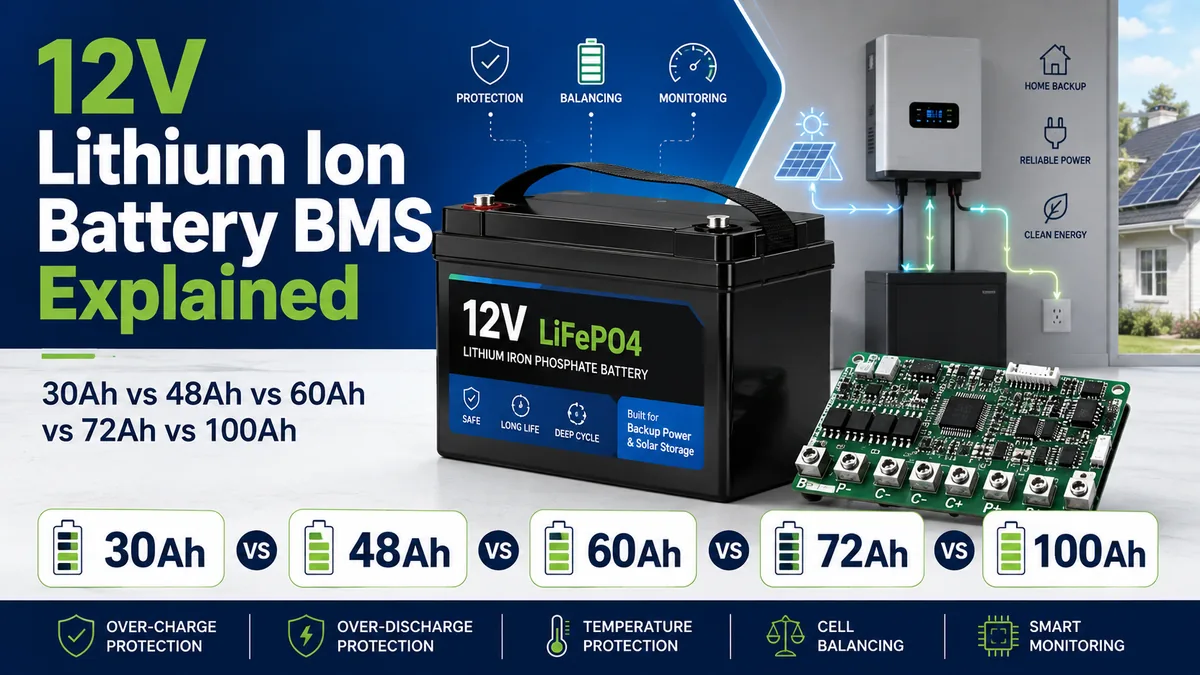
In this guide, we will compare 30Ah, 48Ah, 60Ah, 72Ah and 100Ah 12V batteries and explain how to select a suitable BMS for each one.
First Understand What the BMS Actually Does
A lithium battery is not simply a group of cells connected to two terminals.
Inside a properly designed lithium battery pack, there is normally a Battery Management System, commonly called the BMS.
Think of it as the protection system sitting between the lithium cells and the outside equipment.
Depending on its design, the BMS can monitor and protect against conditions such as:
- Cell overvoltage
- Cell undervoltage
- Excessive discharge current
- Excessive charging current
- Short circuit
- High temperature
- Low charging temperature
- Cell imbalance
Some smart BMS models may also provide Bluetooth monitoring, state-of-charge information, configurable protection limits and communication with compatible equipment.
But there is another important job performed by the BMS:
It must carry the battery current.
If your inverter requires 80A but the battery has a BMS designed for only 40A continuous discharge, having a large battery capacity will not solve the problem.
The BMS may disconnect the battery even though plenty of energy is still stored inside it.
Ah and A Are Not the Same Thing
This is one of the most useful ideas to understand before going further is this distinction.Consider a battery marked:
Consider a battery marked:
12.8V 100Ah, 100A BMS
There are two different numbers here.
100Ah
This is the battery’s capacity.
Roughly speaking, it tells us how much electrical charge the battery stores.
For a 12.8V 100Ah LiFePO4 battery:
12.8V × 100Ah = 1,280Wh
So the battery stores approximately:
1.28kWh of nominal energy
100A BMS
This tells us about current capability rather than stored energy.
A BMS rated for 100A continuous discharge is designed to allow approximately 100A of continuous battery current, assuming the cells, busbars, cables, terminals and other components are also suitable.
Therefore:
Ah mainly affects backup time.
BMS amperage mainly affects how much power the battery can deliver.
They should never be treated as the same specification.
Why 12V Lithium Batteries Usually Mean 12.8V LiFePO4
For inverter and backup applications, many batteries sold as “12V lithium batteries” are actually 12.8V LiFePO4 batteries.
LiFePO4 stands for lithium iron phosphate.
A LiFePO4 cell has a nominal voltage of approximately:
3.2V
Four cells connected in series give:
3.2V × 4 = 12.8V
This arrangement is normally called:
4S LiFePO4
The “4S” means four cell groups connected in series.
Therefore, if you are building a 12V LiFePO4 inverter battery, you would normally use a:
4S LiFePO4 BMS
Do not accidentally use a BMS designed for a different lithium chemistry.
For example, a 3S NMC battery and a 4S LiFePO4 battery have different voltage characteristics even though both may be loosely described as “12V lithium batteries.”
The BMS Size Depends More on Load Than Battery Ah
Suppose two people own identical 100Ah batteries.
The first person runs:
- Two fans
- Three lights
- Wi-Fi router
The second person runs:
- Television
- Fans
- Refrigerator
- Other appliances
Both batteries may have exactly the same 100Ah capacity.
But the second system can demand much more current.
This means the required BMS current rating is determined primarily by maximum expected battery current, not simply by battery Ah.
A useful approximation is:
Battery Current = Inverter Load ÷ (Battery Voltage × Inverter Efficiency)
For illustration, assume:
- Battery voltage = 12.8V
- Inverter efficiency = 90%
Now look at what happens as the load increases.
| AC Load | Approx. Battery Current |
| 250W | 22A |
| 300W | 26A |
| 500W | 43A |
| 600W | 52A |
| 800W | 69A |
| 1,000W | 87A |
| 1,200W | 104A |
| 1,500W | 130A |
This table explains why BMS selection matters so much on a 12V system.
A 1,000W load can require nearly 90A from the battery.
Do Not Size the BMS Exactly at the Expected Current
Imagine your maximum calculated battery current is 58A.
Installing a BMS rated for exactly 60A leaves almost no operating margin.
That is not an ideal design.
Real systems experience:
- Temporary overload
- Motor startup current
- Inverter surge
- Variations in battery voltage
- Higher current at low state of charge
- Heating
- Component tolerance
For this reason, the BMS should normally have a reasonable margin above the expected continuous operating current.
But simply installing an enormous BMS is not the answer either.
A 200A BMS does not magically turn cells rated for 50A into 200A cells.
Every current-carrying component must support the intended current.
That includes:
- Cells
- Nickel or copper connections
- Busbars
- BMS
- Internal wires
- Battery terminals
- External cables
- Fuse
- Connectors
The battery is only as capable as its weakest part.
30Ah 12V Lithium Battery | What BMS Should You Use?
A 30Ah battery is relatively compact and may be suitable where the load is small and long backup is not required.
Nominal energy is approximately:
12.8V × 30Ah = 384Wh
That does not mean the battery should automatically use a 30A BMS.
Suppose the cells are capable of safely delivering 60A.
A 40A or 50A BMS might be possible.
But if the cells are designed for only 15A or 20A discharge, installing a 50A BMS would provide inadequate protection.
For a small inverter application, a 30A to 50A BMS may be encountered, but the final selection must be based on the cell’s permitted discharge current.
Example
With a 30A continuous BMS, approximate inverter load capability at 12.8V and 90% efficiency is:
12.8 × 30 × 0.90 ≈ 346W
So a 30A BMS is more suited to relatively modest loads.
Typical applications might include:
- Lights
- Wi-Fi router
- Laptop
- Small fan
- Small electronics
The actual allowable appliances depend on the inverter and battery specifications.
48Ah 12V Lithium Battery | What BMS Should You Use?
A 48Ah battery provides approximately:
12.8V × 48Ah = 614Wh
This capacity is useful where a compact battery is required but 30Ah does not provide enough backup time.
For inverter applications, you may see batteries in this range paired with approximately 40A, 50A or 60A BMS designs.
But once again, battery capacity alone does not determine the correct number.
For example, a 50A BMS could theoretically support approximately:
12.8 × 50 × 0.90 ≈ 576W
of AC load under our simplified assumptions.
That may suit moderate backup systems operating appliances such as fans, lights, television and networking equipment.
60Ah 12V Lithium Battery: What BMS Should You Use?
A 12V 60Ah LiFePO4 battery stores approximately:
12.8 × 60 = 768Wh
At this capacity, users may expect the battery to handle a reasonably powerful inverter.
But this is where many purchasing mistakes happen.
A 60Ah battery could theoretically be built using:
- 30A BMS
- 50A BMS
- 60A BMS
- 80A BMS
- 100A BMS
depending on its cells and intended application.
The Ah rating does not tell us which one is correct.
For a moderately powerful inverter system, you might commonly consider the 50A–80A region, provided the cells and construction support that current.
For example:
A 60A BMS corresponds to approximately:
12.8 × 60 × 0.90 ≈ 691W
A nominal 80A BMS corresponds to approximately:
12.8 × 80 × 0.90 ≈ 922W
These are approximate continuous-load calculations, not guaranteed inverter ratings.
72Ah 12V Lithium Battery: What BMS Should You Use?
A 12V 72Ah battery stores approximately:
12.8 × 72 = 922Wh
So it is approaching 1kWh of nominal stored energy.
This makes 72Ah interesting for users who want useful backup capacity without moving all the way to a 100Ah battery.
Depending on cell current capability, a battery like this might be paired with a BMS somewhere around the 60A to 100A range for inverter-oriented applications.
A 100A BMS theoretically corresponds to:
12.8 × 100 × 0.90 ≈ 1,152W
of AC power under the simplified assumptions used here.
However, do not conclude that every 72Ah battery can run a 1,000W continuous load.
Check the cell manufacturer’s discharge rating first.
100Ah 12V Lithium Battery: What BMS Should You Use?
The 100Ah category is extremely common for inverter and solar backup applications.
Nominal stored energy:
12.8 × 100 = 1,280Wh
or:
1.28kWh
A 100Ah battery can provide useful backup for normal household loads.
But there is a big difference between:
100Ah battery + 50A BMS
and
100Ah battery + 100A BMS
Both batteries store approximately the same energy.
The difference is their ability to deliver that energy quickly.
50A BMS
Approximate AC load:
576W
80A BMS
Approximate AC load:
922W
100A BMS
Approximate AC load:
1,152W
120A BMS
Approximate AC load:
1,382W
These figures assume 12.8V and 90% conversion efficiency.
This is why buyers should never purchase a 100Ah battery simply because the seller says:
“It is suitable for inverter.”
Ask for the continuous BMS discharge rating.
30Ah vs 48Ah vs 60Ah vs 72Ah vs 100Ah
Here is the comparison in one place.
| Battery Capacity | Nominal Energy | Typical Use |
| 30Ah | 384Wh | Small backup loads |
| 48Ah | 614Wh | Light to moderate backup |
| 60Ah | 768Wh | Medium backup |
| 72Ah | 922Wh | Medium/longer backup |
| 100Ah | 1,280Wh | Home inverter and larger backup |
Notice something important.
As battery capacity increases, energy storage increases.
But nothing in this table tells us the maximum inverter wattage.
For that, we need to know the:
BMS current rating and cell discharge capability.
A Better Way to Select Your BMS
Instead of saying:
“I have a 100Ah battery, therefore I need a 100A BMS.”
use this method.
Step 1: Find the Maximum Inverter Load
Suppose the maximum load you expect to operate is:
700W
Step 2: Calculate Battery Current
Using 12.8V and approximately 90% inverter efficiency:
700 ÷ (12.8 × 0.9)
≈ 61A
Step 3: Add Operating Margin
Using a BMS rated exactly 60A would be too close to your expected load.
A higher continuous-current BMS may be appropriate.
Step 4: Check the Cells
This is essential.
If the battery cells can only safely deliver 50A, you should not simply install a larger BMS and draw 80A.
The BMS must protect the battery rather than allow unsafe current.
BMS Current vs Inverter Wattage
A convenient reference table can help during initial selection.
Assuming approximately 12.8V battery voltage and 90% inverter efficiency:
| BMS Continuous Current | Approx. AC Load |
| 20A | 230W |
| 30A | 346W |
| 40A | 461W |
| 50A | 576W |
| 60A | 691W |
| 80A | 922W |
| 100A | 1,152W |
| 120A | 1,382W |
| 150A | 1,728W |
These numbers should be used as planning estimates, not as absolute design limits.
Actual performance depends on battery voltage, BMS design, inverter efficiency, temperature and load behaviour.
Why a 1,500W Inverter Can Be Difficult on 12V
A large number printed on an inverter can hide what is happening on the battery side.
Consider a 1,500W load.
At 12.8V and 90% efficiency:
1,500 ÷ (12.8 × 0.9)
≈ 130A
That is a very high DC current.
At this level you need to pay close attention to:
- BMS
- Cell discharge rating
- Cable thickness
- Cable length
- Terminals
- Fuse
- Busbars
- Connectors
- Heat generation
For higher-power systems, moving to a 24V or 48V architecture can significantly reduce battery current.
Continuous BMS Current and Peak Current Are Different
A BMS specification may say:
100A continuous / 200A peak
That does not necessarily mean the battery can supply 200A whenever required.
Peak ratings normally apply for limited durations.
For example, an appliance motor may require higher current for only a short period during startup.
Common surge loads include:
- Refrigerators
- Water pumps
- Compressors
- Power tools
- Motors
Therefore, when choosing a BMS, check both:
Continuous discharge current
and
Peak discharge current + permitted duration
Do not treat peak current as continuous current.
Why Refrigerators Can Trip a BMS
A refrigerator might consume only 150W while running.
A buyer may therefore assume that a small BMS is sufficient.
But when the compressor starts, current may rise sharply for a brief period.
If this causes battery current to cross the BMS overcurrent threshold, the BMS can disconnect the pack.
The result is confusing:
The battery appears charged.
The inverter works with lights.
But it shuts off when the refrigerator starts.
The problem may not be capacity.
It may be peak current capability.
What About BMS Charging Current?
Discharge current gets most of the attention, but charging current matters too.
A BMS may be capable of:
100A discharge
but only:
50A charge
That is perfectly possible.
Your charger must remain within:
- Cell charging limits
- BMS charging limits
- Battery manufacturer’s limits
A simple charger-sizing reference for LiFePO4 might use moderate charging rates such as roughly 0.2C to 0.5C only where the cell manufacturer permits them.
For illustration:
| Battery | 0.2C | 0.5C |
| 30Ah | 6A | 15A |
| 48Ah | 9.6A | 24A |
| 60Ah | 12A | 30A |
| 72Ah | 14.4A | 36A |
| 100Ah | 20A | 50A |
This is not a universal charging specification.
The cell or battery manufacturer’s recommended charge current always takes priority.
What Protections Should a Good 12V BMS Have?
Current rating should not be the only specification you compare.
A good BMS for an inverter battery should normally provide protection against important abnormal conditions.
Look for:
Overcharge Protection
Stops charging when an individual cell reaches an unsafe high voltage.
Over-Discharge Protection
Disconnects the load before cells are driven too low.
Overcurrent Protection
Protects the battery when discharge current becomes excessive.
Short-Circuit Protection
Provides rapid protection during severe fault conditions.
Temperature Protection
Temperature sensors can protect against excessive battery or BMS temperature.
Cell Balancing
Balancing helps reduce differences in cell state of charge, especially near the top of charge.
Passive Balancing vs Active Balancing
Not every BMS balances cells in the same way.
Passive balancing
A small amount of energy from higher-voltage cells is dissipated, usually as heat.
It is simple and widely used.
Active balancing
Energy is transferred between cells or cell groups rather than simply being dissipated.
Active balancing may be useful for larger packs or applications where maintaining cell balance is more challenging.
However, having active balancing does not automatically make one BMS better than another.
The basic protection functions, current capability and reliability remain more important.
Smart BMS or Normal BMS?
A basic BMS may work perfectly well when you only need protection.
A smart BMS can add useful monitoring features.
Depending on the model, you may be able to see:
- Individual cell voltages
- Battery current
- Battery voltage
- Temperature
- State of charge
- Number of cycles
- Protection events
Some models allow protection values to be configured.
For battery repair, diagnostics or more sophisticated inverter systems, this information can be extremely useful.
For a simple low-cost battery, a basic quality BMS may be sufficient.
Never Choose a BMS Without Knowing the Cell Specification
Suppose you have a 100Ah battery.
Someone suggests:
“Use a 150A BMS because bigger is better.”
That advice is incomplete.
Imagine your cells are rated for only 1C continuous discharge.
For a 100Ah cell:
1C = 100A
Allowing a 150A continuous load could exceed the intended cell specification.
The BMS should protect the cells, not merely provide the largest possible current rating.
Always check:
- Cell capacity
- Maximum continuous discharge current
- Maximum pulse discharge
- Maximum charge current
- Operating voltage
- Temperature limits
before choosing the BMS.
The Busbars and Wiring Must Also Match the BMS
Installing a 150A BMS does not create a 150A battery.
Imagine the BMS can carry 150A but the battery uses undersized internal wires.
Those wires become the weak point.
High resistance causes:
heat
and
voltage drop
The same applies to:
- Nickel strips
- Copper busbars
- Cable lugs
- Connectors
- Battery terminals
High-current battery packs must be designed as a complete system.
A Fuse Is Still Important Even When You Have a BMS
A common question is:
“My battery already has a BMS. Do I still need a fuse?”
A properly designed battery installation should normally include suitable overcurrent protection.
The BMS protects the battery electronically.
A fuse provides another layer of protection for the battery cables and system during abnormal current or faults.
Fuse sizing depends on:
- Maximum normal current
- Cable current capacity
- Inverter surge
- Battery capability
Do not simply fit the largest fuse available.
The fuse must actually protect the circuit.
Should a 100Ah Battery Always Have a 100A BMS?
No.
A 100Ah battery could legitimately have:
- 30A BMS
- 50A BMS
- 80A BMS
- 100A BMS
- 150A BMS
depending on the cells and application.
A 12V 100Ah solar storage battery designed for moderate discharge may use a lower-current BMS.
A 100Ah battery intended for a high-power inverter may need a considerably higher discharge capability.
Therefore, asking:
“What BMS is used?”
is just as important as asking:
“What Ah is the battery?”
Is a 100A BMS Enough for a 1,000W Inverter?
Usually, a 1,000W load on a 12.8V battery can draw roughly:
87A
assuming approximately 90% inverter efficiency.
So a genuine 100A continuous BMS may appear suitable.
However, you should still consider:
- Inverter surge
- Low battery voltage
- Cell current capability
- BMS temperature
- Continuous operating margin
- Motor loads
Operating permanently very close to the BMS maximum is generally not desirable.
A larger margin may therefore be appropriate, provided the rest of the battery supports it.
Why Battery Current Increases as Voltage Falls
There is another detail that many first-time battery builders miss.
The battery does not remain at exactly 12.8V throughout discharge.
If the inverter is supplying roughly constant power and battery voltage falls, the required current can increase.
For example, delivering 1,000W from a lower battery voltage requires more current than delivering the same power from a higher voltage.
Therefore, BMS sizing should not be based only on nominal voltage under ideal conditions.
Leave adequate current margin.
Which Capacity Should You Choose?
The BMS determines current capability.
Battery Ah determines how long the system can run.
So choose the battery capacity mainly from the energy you need.
30Ah
Useful for small, portable or short-duration backup applications.
48Ah
Offers more backup while remaining relatively compact.
60Ah
Good middle ground for moderate household loads.
72Ah
Provides close to 1kWh nominal energy and can offer longer backup without moving to a full 100Ah pack.
100Ah
A popular option for home inverter and solar applications because it provides approximately 1.28kWh nominal energy.
But remember:
A larger Ah rating does not automatically mean a more powerful battery.
Battery Capacity Controls Runtime
Suppose two batteries both use a suitable 60A BMS.
Battery A:
30Ah
Battery B:
100Ah
Both may be capable of delivering a similar instantaneous current if their cells and construction permit it.
But Battery B stores much more energy.
At 12.8V:
30Ah:
384Wh
100Ah:
1,280Wh
Therefore, Battery B can potentially run the same load for considerably longer.
This is the difference between:
power capability
and
energy capacity.
Understanding this single concept makes battery selection much easier.
Simple BMS Selection Checklist
Before purchasing or building a 12V lithium inverter battery, check these points:
- Confirm chemistry — LiFePO4 or another lithium chemistry.
- Check series count — for a 12.8V LiFePO4 pack, this is normally 4S.
- Find maximum expected inverter load.
- Calculate battery-side current.
- Allow adequate continuous-current margin.
- Check inverter startup/surge current.
- Check cell continuous discharge rating.
- Check maximum cell charging current.
- Confirm BMS charging-current rating.
- Size wires, busbars and terminals correctly.
- Install appropriate overcurrent protection.
- Check temperature protection.
Do these before ordering the BMS rather than trying to solve compatibility problems after assembling the battery.
Common BMS Buying Mistakes
Mistake 1: Matching BMS Amps to Battery Ah
A 60Ah battery does not automatically need a 60A BMS.
They measure different things.
Mistake 2: Buying the Biggest BMS Available
A larger BMS does not increase the current capability of the battery cells.
Mistake 3: Ignoring Peak Current
A battery that works with lights may trip when a refrigerator or pump starts.
Mistake 4: Checking Discharge Rating but Ignoring Charge Rating
Charging current can also exceed BMS or cell limits.
Mistake 5: Ignoring Temperature Protection
Lithium cells and power MOSFETs should not be operated outside their specified temperature limits.
Mistake 6: Using the Wrong Chemistry BMS
A LiFePO4 BMS and an NMC BMS may use different voltage protection thresholds.
Mistake 7: Using Thin Cables
A powerful BMS cannot compensate for undersized wiring.
30Ah vs 48Ah vs 60Ah vs 72Ah vs 100Ah: Which Is Best?
There is no single best battery capacity.
The right one depends on two separate questions.
How long do you want your backup to last?
This determines the required Ah/Wh capacity.
What is the highest load the inverter must run?
This determines the required current capability and BMS rating.
For example, someone running a 250W load for many hours may need a large-capacity battery but only moderate discharge current.
Another customer running a 1,000W load for only 30 minutes may need less stored energy but considerably higher current capability.
That is why capacity and BMS selection must be calculated separately.
Final Thoughts
Choosing a 12V lithium ion battery BMS becomes much easier once you stop treating battery Ah and BMS amperage as the same specification.
A 30Ah, 48Ah, 60Ah, 72Ah or 100Ah rating tells you about battery capacity.
A 30A, 50A, 80A or 100A BMS rating tells you about current capability.
For inverter applications, always begin with the appliances you intend to run.
Calculate the expected DC battery current, allow for inverter losses and startup surge, and then select a BMS with suitable continuous and peak-current capability.
After that, verify that the cells, wires, terminals and other battery components are capable of carrying the same current safely.
A 100Ah battery with an undersized BMS can shut down under a heavy load.
A smaller battery with high-current cells and the correct BMS may handle much greater power, although for a shorter period.
The best lithium battery is therefore not simply the one with the highest Ah rating or the largest BMS.
If you are buying a ready-made pack or sourcing components locally, choosing a reliable lithium ion battery supplier in Bangalore can also make it easier to confirm the correct cell chemistry, BMS rating, charging limits and inverter compatibility before purchase.
It is the battery where capacity, cell capability, BMS, charging system and inverter load are properly matched.
Frequently Asked Questions
What BMS should I use for a 30Ah lithium battery?
There is no fixed BMS rating based only on 30Ah capacity. Determine the maximum load current and verify the cell’s discharge specification. For relatively small inverter applications, BMS ratings around 30A–50A may be encountered, but the cells must support the selected current.
What BMS should I use for a 60Ah LiFePO4 battery?
First calculate the maximum inverter current. A 60Ah battery could use anything from a relatively low-current BMS to a much higher-current design depending on its cells and intended use. Do not automatically choose a 60A BMS simply because the battery is 60Ah.
What BMS is suitable for a 100Ah battery?
100Ah batteries are commonly built with a wide variety of BMS ratings. A moderate-load battery may use approximately 50A, while an inverter-oriented design may use 100A or more. Cell capability and the required inverter load determine the correct choice.
Is a 100A BMS the same as a 100Ah battery?
No. A 100Ah rating describes battery capacity. A 100A BMS rating describes current capability. The units represent different electrical quantities.
Can I install a 150A BMS on a 100Ah battery?
Only when the cells, busbars, wiring, terminals and other components safely support that current. Installing a larger BMS alone does not increase battery discharge capability.
How many watts can a 50A BMS handle on a 12V battery?
At approximately 12.8V and 90% inverter efficiency, 50A corresponds to roughly 575W of AC load. Leave margin and check surge current rather than designing directly at the BMS limit.
What BMS do I need for a 1,000W 12V inverter?
A 1,000W AC load can draw around 85–90A from a 12.8V battery after inverter losses. Therefore, the battery needs a continuous current capability above this level plus sufficient surge capability. The cells and wiring must also support the selected current.
Do I need a 4S BMS for a 12V LiFePO4 battery?
A conventional 12.8V LiFePO4 battery normally consists of four 3.2V cell groups in series, so it typically uses a 4S LiFePO4 BMS.
Does a larger BMS give more battery backup?
No. Backup duration primarily depends on battery energy capacity in Wh or Ah. A larger BMS primarily increases allowable current when the rest of the battery is designed to support it.
Which is better: 60Ah with a 100A BMS or 100Ah with a 50A BMS?
Neither is universally better. The 60Ah/100A battery may support a higher-power load but for a shorter time. The 100Ah/50A battery stores more energy but may be limited to a smaller load. Choose according to both required power and required backup duration.