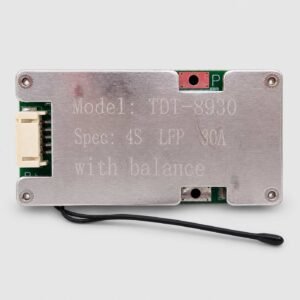
1. Product Overview
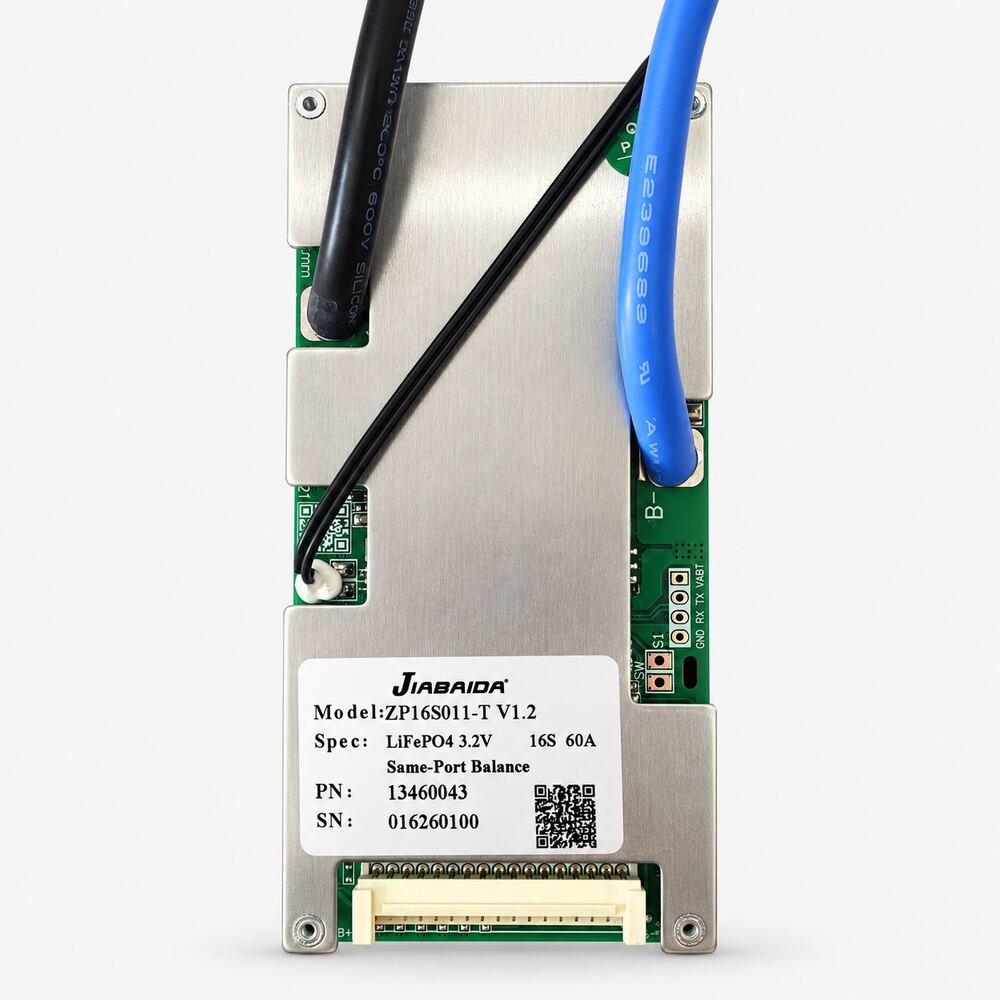
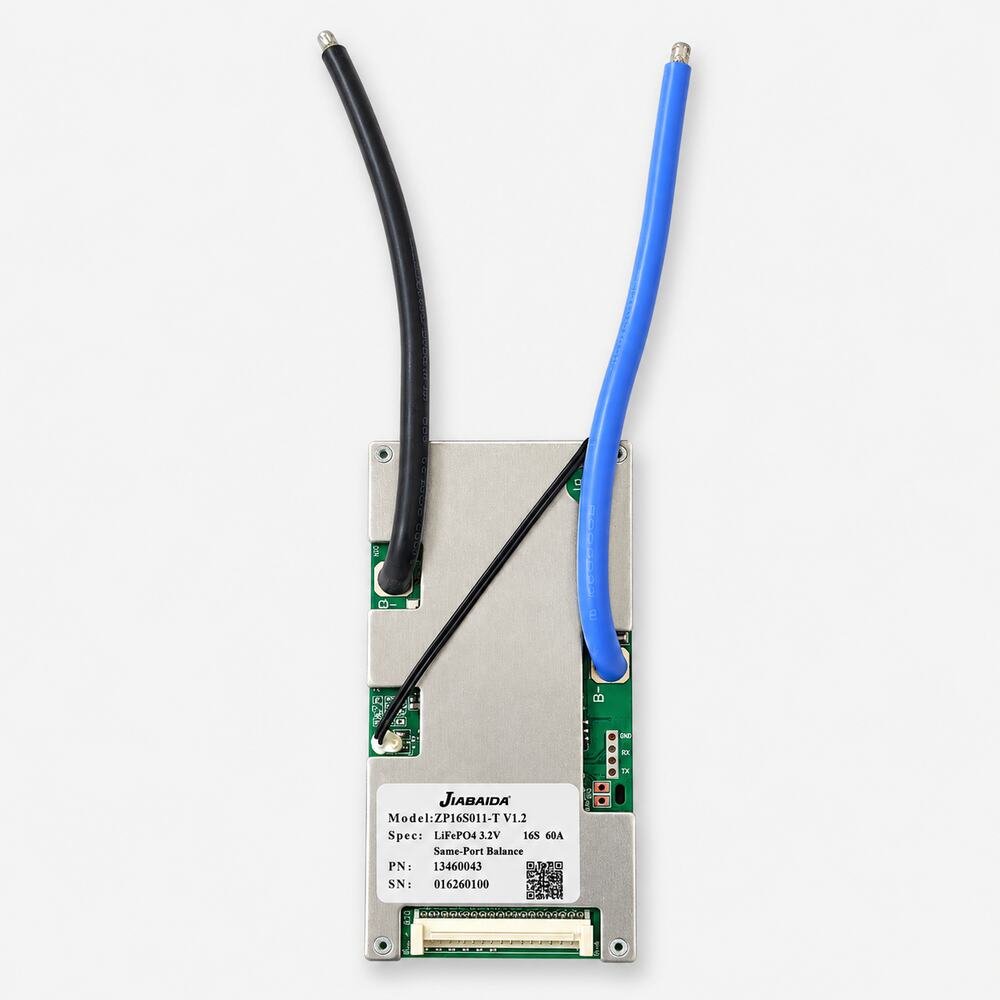
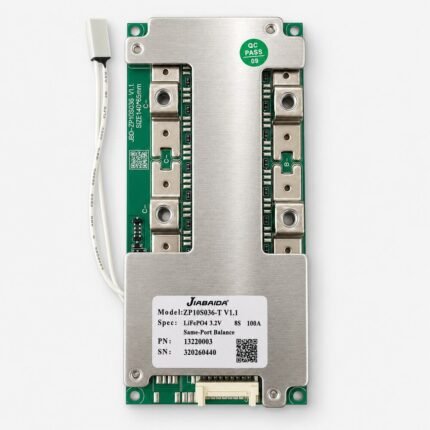
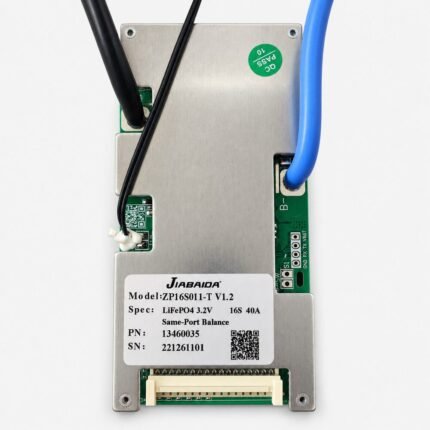
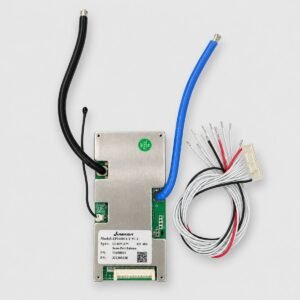
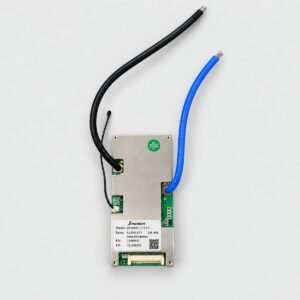
The JIABAIDA ZP16S011-T V1.2 is a 16S 60A battery management system designed for LiFePO₄ battery packs containing sixteen cells or parallel cell groups connected in series.
A completed 16S LiFePO₄ battery has a nominal voltage of approximately 51.2V and reaches 58.4V when fully charged. These batteries are commonly marketed as 48V or 51.2V LiFePO₄ packs.
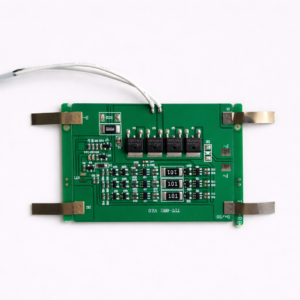
The BMS monitors the voltage of each series-connected cell group and provides protection against unsafe charging, excessive discharge, overcurrent and short-circuit conditions. Its same-port configuration allows charging and discharging through a common controlled negative connection.
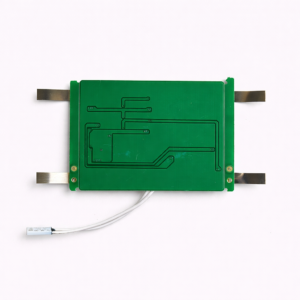
The product label specifies a 60A rating and confirms that cell balancing is supported. A temperature-sensor lead is also fitted for thermal monitoring.
2. Technical Specifications
| Specification |
Details |
| Brand |
JIABAIDA |
| Model |
ZP16S011-T V1.2 |
| Product type |
LiFePO₄ battery management system |
| Battery configuration |
16S |
| Battery chemistry |
LiFePO₄ |
| Compatible cell voltage |
3.2V nominal |
| Nominal pack voltage |
51.2V |
| Battery class |
48V/51.2V LiFePO₄ |
| Maximum charging voltage |
58.4V |
| Advertised current rating |
60A |
| Port configuration |
Same-port |
| Cell-voltage monitoring |
16 series-connected cell groups |
| Cell balancing |
Yes |
| Temperature monitoring |
Yes, sensor lead fitted |
| Balance connector |
Multi-pin connector fitted |
| Communication connection |
UART pads visible; compatibility must be verified |
| Bluetooth module |
Not included or confirmed |
| Protection functions |
Overcharge, over-discharge, overcurrent and short circuit |
| Part number |
13460043 |
| Serial number shown |
016260100 |
| Charger requirement |
16S LiFePO₄ charger with maximum output of 58.4V |
Protection thresholds, balance current, charging-current limit, recovery delays and communication protocols should be confirmed from the manufacturer’s documentation for this exact model.
3. Typical Connection Points
| Connection |
Typical function |
| B− |
Connects to the battery-pack negative terminal |
| B1–B15 |
Connect to the intermediate junctions between the 16 cell groups |
| B+ |
Connects to the positive terminal of the final cell group |
| C−/P− |
Common controlled negative connection for charging and discharging |
| Pack positive |
Charger and load positive normally connect directly to battery positive |
| Balance connector |
Connects the individual cell-group sensing wires to the BMS |
| Temperature sensor |
Monitors battery or BMS temperature |
| UART pads |
Potential data or service connection; pinout and protocol must be verified |
Always follow the wiring diagram supplied for the exact BMS. Do not identify connections only by cable colour, physical position or assumptions based on another JIABAIDA model.
4. Protection and Management Functions
The JIABAIDA 16S BMS is intended to provide essential battery-management functions, including:
- Monitoring of sixteen individual cell groups
- Cell overcharge protection
- Cell over-discharge protection
- Discharge-overcurrent protection
- Short-circuit protection
- Charge and discharge switching through internal MOSFETs
- Cell balancing
- Temperature monitoring
- Same-port charging and discharging
- Recovery after supported protection events
The BMS protects a correctly assembled battery pack, but it cannot compensate for damaged, mismatched, deeply discharged or incorrectly connected cells.
5. Suitable Applications
This BMS may be suitable for compatible 16S LiFePO₄ battery packs used in:
- Solar-energy storage systems
- Inverter batteries
- UPS and backup-power systems
- Electric scooters
- E-rickshaws and mobility equipment
- Golf carts
- Robotics and automated equipment
- Portable power systems
- Marine and recreational battery systems
- DIY 48V or 51.2V LiFePO₄ battery packs
- Battery repair and replacement projects
The equipment’s continuous current, startup current and peak current must remain within the verified limits of the BMS, battery cells, cables and connectors.
6. Battery and Charger Compatibility
Use this BMS only when:
- The battery contains exactly sixteen series-connected LiFePO₄ cell groups.
- Each cell group has a nominal voltage of approximately 3.2V.
- The battery has a nominal pack voltage of approximately 51.2V.
- The charger is specifically designed for a 16S LiFePO₄ battery.
- The charger’s maximum output voltage does not exceed 58.4V.
- All sixteen cell groups are at closely matched voltages before connection.
- The battery cells can safely provide the required continuous and peak current.
- The cables, connectors, fuse and busbars are correctly rated for the application.
Do not use this BMS with 16S lithium-ion or lithium-polymer cells rated at 3.6V or 3.7V nominal. These chemistries require different charging and protection voltages.
7. Installation Guidance
- Measure the voltage of all sixteen cell groups before installation.
- Confirm the complete balance-wire sequence using the correct wiring diagram.
- Connect B− to the battery-pack negative terminal.
- Connect each balance wire sequentially to the appropriate cell-group junction.
- Connect the final sensing wire or B+ connection as specified by the manufacturer.
- Connect the common charge/discharge negative cable to the designated external terminal.
- Connect the charger and load positive directly to battery positive unless the manufacturer specifies otherwise.
- Verify the voltage between every pair of consecutive balance wires before inserting the connector.
- Confirm that the connector polarity and pin order match the BMS.
- Position the temperature sensor where it can reliably monitor pack temperature.
- Use appropriately sized cables, terminals and connectors.
- Install a correctly rated fuse close to the battery’s positive terminal.
- Insulate all exposed electrical connections.
- Mount the BMS where it receives adequate ventilation and cannot contact conductive parts.
Incorrect balance-wire order can permanently damage the BMS immediately after the connector is inserted.
8. Important Current-Rating Note
The advertised 60A BMS rating does not increase the current capability of the battery cells.
The safe current of the complete battery system is limited by the lowest-rated component, including:
- Battery cells
- BMS
- Busbars or nickel strips
- Power cables
- Connectors
- Fuse
- Charger
- Connected load
Motors and inverters may draw a startup or surge current considerably higher than their normal operating current. Confirm the continuous, peak and surge-current requirements before selecting this BMS.
The exact continuous charge-current rating and short-duration peak-current capability should be verified before installation.
9. Safety Information
- Use only with a 16S LiFePO₄ battery pack.
- Use a compatible 58.4V LiFePO₄ charger.
- Never reverse the battery polarity.
- Never short the BMS or battery terminals.
- Do not connect the balance wires in the wrong sequence.
- Do not insert the balance connector until every sensing voltage has been verified.
- Do not exceed the verified charge or discharge-current limits.
- Use an appropriately rated fuse and correctly sized cables.
- Keep the BMS away from water, conductive dust and loose metal objects.
- Do not use a damaged, burnt, corroded or unusually hot BMS.
- Stop using the battery if any cell becomes swollen, overheated or abnormally unbalanced.
- Installation should be performed by someone experienced with high-current LiFePO₄ battery systems.